-
Stats on the Rally
Posted by Eddy Elfenbein on March 5th, 2013 at 1:19 pmI noticed that the S&P 500’s recent drop lasted from February 19th to February 26th. From top to bottom, the total loss came to 3.0001%.
I hate to go to the edge of any fair use laws, but this Bloomberg article has so many good bits, it’s hard not to quote it at length.
Almost $10 trillion has been restored to U.S. equities as retailers, banks and manufacturers led the recovery from the worst bear market since the 1930s. It took the Dow less than 65 months to rise above its previous high set on Oct. 9, 2007, more than a year faster than the recovery from the Internet bubble.
While the Dow has more than doubled in the four years since its bear-market low, its valuation remains 20 percent less than the price-earnings ratio at the previous peak and 15 percent below its 20-year average.
(…)
The gauge plunged 34 percent in 2008 for the worst performance in 77 years as the housing bubble burst and the U.S. financial system required a government bailout.
(…)
American Express Co., Caterpillar Inc. and Home Depot Inc. have led the Dow’s rally since its 2009 low, climbing more than 275 percent as the economy recovered from the worst recession in seven decades. Hewlett-Packard Co., the largest personal computer maker, is the only stock still in the 30-company gauge to fall since March 9, 2009. The shares tumbled 22 percent as mobile devices such as Apple Inc.’s iPad and iPhone began to compete with PCs. Exxon Mobil Corp., which has rallied 38 percent, is the second-worst performer since the gauge bottomed.
Bankruptcies and government bailouts helped make the Dow a different gauge than it was in 2007. Citigroup Inc., American International Group Inc. and General Motors Corp. were removed from the price-weighted average, while Cisco Systems Inc. and Travelers Cos. joined. Kraft Foods Inc., which took over AIG’s spot, was replaced by UnitedHealth Group Inc. last year after the food-maker split in two.
(…)
A rebound in corporate profits coupled with more than $2.3 trillion in Fed stimulus have pushed investors back into equities, sending the Dow up more than 116 percent from its March 2009 low of 6,547.05. The Standard & Poor’s 500 (SPX) Index is less than 3 percent below its record, reached the same day as the Dow.
The Dow surpassed its dot-com-era record on Oct. 3, 2006, 81 months after it peaked in January 2000. The measure had tumbled 38 percent from the 2000 high of 11,722.98 to its bottom on Oct. 9, 2002, as the Internet boom collapsed.
The gauge on average has taken about 6 1/2 years to return to previous record levels, according to data compiled by Bloomberg. Should the measure have followed that path, the Dow wouldn’t have posted a new record until the middle of 2014.
(…)
Dow profits are projected by analysts to increase 9.2 percent this year and 9 percent next year. Profit from companies in the S&P 500 will exceed $120 a share by next year, double the level in 2008, according to Wall Street estimates. That’s the biggest increase since the 142 percent gain amid the rally in technology stocks from 1993 to 1999.
The expansion in the Dow’s valuation since March 2009 has been slower than the S&P 500’s, while both are cheaper than 2007. The Dow’s trading at 13.8 times earnings in the last year, compared with a multiple of 17.1 at its 2007 peak and 25.9 when it reached a record in January 2000. The S&P 500’s multiple is about 15 times profit, compared with 17.5 on Oct. 9, 2007.
The operating margin, a measure of profitability, for S&P 500 companies is 19.9 percent after reaching 20.7 percent in August, the highest level in Bloomberg data going back to 1998.
-
Dilbert on Market Manipulation
Posted by Eddy Elfenbein on March 5th, 2013 at 12:00 pmScott Adams of Dilbert fame recently said he thought the stock market was due for a 20% slide. Our friends at Business Insider followed up to see why. Here’s Scott’s response:
Rob Wile at Businessinsider.com asked me to clarify my prediction of a 20% stock market correction in 2013. (See my post below.) So I tapped out the following message on my smartphone:
—- Start —-
“I’m glad you had the wisdom to get a cartoonist’s opinion on global financial markets.
The 20% estimate is based on the fact that 20 is a big round number and more likely to happen than 30%. I don’t like to over-think these things.
My reasoning is that the people at the highest levels of finance are brilliant people who chose a profession with the credibility of astrology. And they know it. Then they sell their advice to people who don’t know it. So that’s your cast of characters.
Now consider that the characters – who are literally geniuses in many cases – have an immense financial motive, opportunity, and a near-zero risk of getting caught. How do you think that plays out?
We can only give a guess of the odds that the market is being manipulated. So I ask myself: How often does the fox leave the hen house because he feels that taking an egg would be wrong?
If you have a different answer from mine, I applaud your faith in human nature.”
—– End —–
Personally, I think it’s funny if a bit overly cynical. Remember, of course, that the super geniuses are also battling each other which brings a certain level of accountability to any attempts at manipulation.
-
The Dow Blasts to All-Time High
Posted by Eddy Elfenbein on March 5th, 2013 at 9:54 amThe Dow just blasted through to an all-time high.
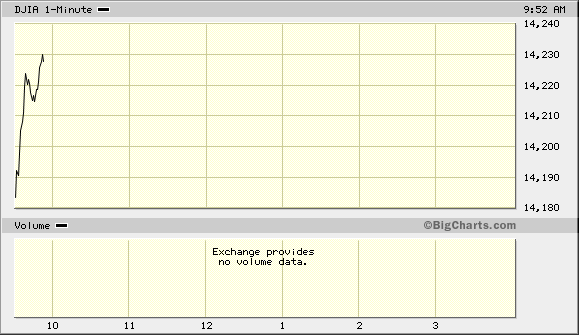
On October 9th, 2007, the Dow closed at 14,164.53. The intra-day high came two days later on October 11th when the Dow touched 14,198.10. This morning, we’ve been as high as 14,233.07. Four years ago today, the Dow had closed at 6,594.44.
The S&P 500, meanwhile, has been as high as 1,537.27 this morning which is a five-year high. The index made its all-time high close on October 9th, 2007 at 1,565, and like the Dow, the intra-day high came two days later at 1,576.09.
-
Morning News: March 5, 2013
Posted by Eddy Elfenbein on March 5th, 2013 at 6:01 amBOJ Nominee Iwata Adds to Calls for Buying Longer-Term Bonds
Chinese Stocks Plunge on Plan to Tax Home Sales
China Vanke To Issue Its First Dollar Bond
EU Opens Way for Easier Budgets After Austerity Backlash
U.K. Services Unexpectedly Strengthen as Confidence Increases
Yellen Says Fed Should Press on With QE Amid Limited Risk
A Stealth Tax Subsidy for Business Faces New Scrutiny
F.C.C. Backs Consumers in Unlocking of Cellphones
S&P Credibility Seen Eroded by Complicity in Soured Deals
Glencore Sees Sharp Fall In 2012 Earnings
Standard Chartered Posts Full-Year Profit Increase
Hess to Sell Gas Stations as Part of a Shift in Strategy
Buffett Finds His Bear: Doug Kass To Join Berkshire Annual Meeting
Credit Writedowns: The Product is the Promise: Finance and Social Values
Joshua Brown: Winston Churchill for Traders and Analysts
Be sure to follow me on Twitter.
-
OMG! Fiscal Cliff! OMG! Debt Ceiling! OMG! Sequester!
Posted by Eddy Elfenbein on March 4th, 2013 at 3:55 pmOh…and second-highest Dow close ever.
-
Recent March Turning Points
Posted by Eddy Elfenbein on March 4th, 2013 at 2:03 pmIn the last few years, the month of March has seen more than its fair share of market turning points. The big closing low from four years ago came on March 9th, 2009. The intra-day low, when the S&P 500 got to 666, came on the previous Friday, March 6th.
Nine years before that, the S&P 500’s closing high came on March 24, 2000 at 1,527.46. The intra-day high was the same day at 1,552.87. The Nasdaq, however, which greatly defined the bull market, hit its peak two weeks earlier, on March 10, 2000 when it closed at 5,048.62. So our lost decade was actually one day shy of nine years.
March 2003 also got into the act. The market technically hit its low in October 2002, but the rally off the low lost its steam and fell again until the second bottom in March 2003. The S&P 500’s closing low was 800.73 on March 11th, and the intra-day low was 788.90 on March 12th.
-
The Plunge at Coach
Posted by Eddy Elfenbein on March 4th, 2013 at 1:06 pmIn the last year, shares of Coach ($COH) have plunged from a high of $79.70 to a low of $45.87. The stock is currently at $48.43. The dropoff appears to be due to a rather modest decline in the company’s earnings acceleration.
Here’s a chart of Coach stock price in black (left scale) along with its earnings-per-share in gold (right scale) and Wall Street’s estimate in red. The two lines are scaled at a ratio of 16-to-1 so whenever the lines cross, the P/E Ratio is exactly 16.
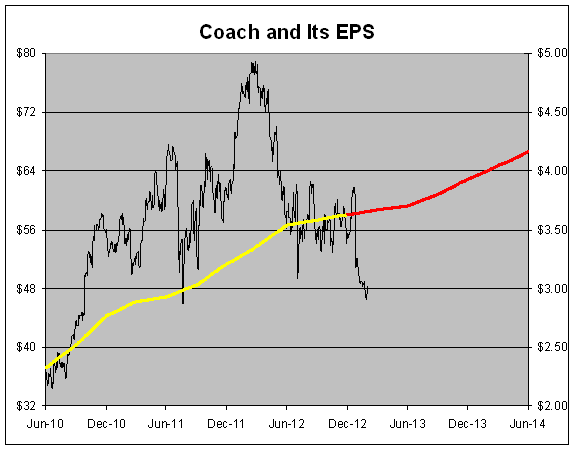
The stock had a brief rally last week on rumors that Coach was putting itself up for sale. This turned out to be untrue. Coach recently reported weak holiday sales. I can’t say how serious Coach’s problems are but the company is working hard on new strategies. The problem with retail is that Coach is no longer seen as a premium brand especially compared with Michael Kors ($KORS).
If the Street’s outlook is correct, then the stock is pretty cheap. Going by my World’s Simplest Stock Valuation metric, Coach is about 25% undervalued.
-
Berkshire’s Stock Positions
Posted by Eddy Elfenbein on March 4th, 2013 at 10:53 amFrom page 15 on this year’s Buffett Shareholder Letter, here’s a look at the common stocks held by Berkshire Hathaway.
 Eddy Elfenbein is a Washington, DC-based speaker, portfolio manager and editor of the blog Crossing Wall Street. His