In the last few years, the month of March has seen more than its fair share of market turning points. The big closing low from four years ago came on March 9th, 2009. The intra-day low, when the S&P 500 got to 666, came on the previous Friday, March 6th.
Nine years before that, the S&P 500’s closing high came on March 24, 2000 at 1,527.46. The intra-day high was the same day at 1,552.87. The Nasdaq, however, which greatly defined the bull market, hit its peak two weeks earlier, on March 10, 2000 when it closed at 5,048.62. So our lost decade was actually one day shy of nine years.
March 2003 also got into the act. The market technically hit its low in October 2002, but the rally off the low lost its steam and fell again until the second bottom in March 2003. The S&P 500’s closing low was 800.73 on March 11th, and the intra-day low was 788.90 on March 12th.
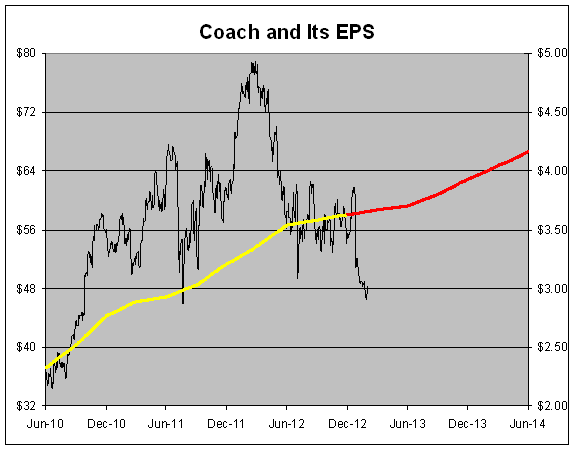
In the last year, shares of Coach ($COH) have plunged from a high of $79.70 to a low of $45.87. The stock is currently at $48.43. The dropoff appears to be due to a rather modest decline in the company’s earnings acceleration.
Here’s a chart of Coach stock price in black (left scale) along with its earnings-per-share in gold (right scale) and Wall Street’s estimate in red. The two lines are scaled at a ratio of 16-to-1 so whenever the lines cross, the P/E Ratio is exactly 16.
The stock had a brief rally last week on rumors that Coach was putting itself up for sale. This turned out to be untrue. Coach recently reported weak holiday sales. I can’t say how serious Coach’s problems are but the company is working hard on new strategies. The problem with retail is that Coach is no longer seen as a premium brand especially compared with Michael Kors ($KORS).
If the Street’s outlook is correct, then the stock is pretty cheap. Going by my World’s Simplest Stock Valuation metric, Coach is about 25% undervalued.
The stock market is looking for its first positive Monday of the year. The indexes are down slightly so far this morning, but the Dow isn’t far away from a new all-time high. Just a little push and we can finally break the high from nearly five-and-a-half years ago.
Warren Buffett was on CNBC this morning and said that stocks are not “as cheap as they were four years ago” but “you get more for your money” compared to other investments. Interestingly, Buffett said, “The dumbest investment, in my view, is a long-term government bond.”
This week, the market is in a bit of a no-man’s land. There are no earnings or big economic reports except for the big jobs report on Friday. I think volatility will probably continue to cool off. The Volatility Index ($VIX) jumped from 12 to 19 in less than a week, and now it’s back to 15.
Teresa Rivas at Barron’s make the case for AFLAC ($AFL):
The Aflac duck endures many misfortunes in the insurance company’s goofy advertisements, from scorched feet to a broken bill. Now the stock is taking a beating as well, following a drop in Japan’s currency, and this has created an opportunity for investors.
(…)
“This is one of the cheapest stocks in the S&P 500 right now, especially among companies that are going to report earnings, not losses,” says Bill Smead, portfolio manager of the Smead Value Fund. “This is a premier financial services and insurance company—a storm doesn’t come in and turn a company upside down. If you look at the 2011 tsunami, even though 75% of Aflac’s revenue comes from Japan, [the disaster] didn’t really have any impact.”
(…)
“It has low price-to-earnings and price-to-book [ratios], and yet the company is going to be turning in a fairly healthy return on equity in 2013, so there’s a disconnect between the price today and the returns the company is providing.”
(…)
Still, the stock price doesn’t reflect Aflac’s long-term potential. Its premium brand name is an asset in Japan, where it has long enjoyed a stellar reputation, and, thanks to the duck, it is well known in the U.S.
“If you put 100 people in a room and give them the generic category of supplemental health insurance, I don’t think anyone would be able to say any name other than Aflac,” says Smead. “If savvy people can’t tell you who a company’s No. 2 competitor is, they’ve won the game before it starts.”
Eddy Elfenbein is a Washington, DC-based speaker, portfolio manager and editor of the blog Crossing Wall Street. His Buy List has beaten the S&P 500 over the last 20 years. (more)
 Eddy Elfenbein is a Washington, DC-based speaker, portfolio manager and editor of the blog Crossing Wall Street. His