-
Morning News: February 13, 2013
Posted by Eddy Elfenbein on February 13th, 2013 at 7:20 amBoE Will Tolerate Inflation To Aid Growth
G-7 Roils Currency Markets With Split on Yen Views
Wheat Falls to Seven-Month Low as Rain in Plains May Boost Crop
Obama Paints Wider Role for Government in Middle Class Revival
Raising Minimum Wage Would Ease Income Gap but Carries Political Risks
Silicon Valley and Immigrant Groups Find Common Cause
Small-Business Optimism in U.S. Improves for Second Month
Comcast Buys Rest of NBC’s Parent
ING Cutting 2,400 Jobs as Quarterly Profit Misses Estimates
Peugeot Citroën Reports Record Loss
Big Investors Stiffen Their Resistance to Dell’s Offer
Apple Said to Have Team Developing Wristwatch Computer
Pragmatic Capitalism: Market Volatility and Returns
Joshua Brown: begging your pardon…
Be sure to follow me on Twitter.
-
The Yen Drag
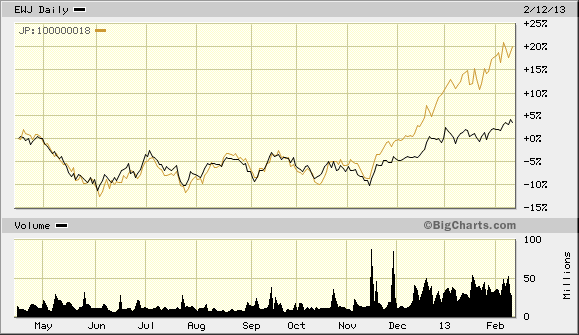
Posted by Eddy Elfenbein on February 12th, 2013 at 7:07 pmI thought this chart was interesting. It shows how much better the Nikkei Index has done than the iShares MSCI Japan Index ($EWJ) which is, of course, denominated in dollars. Japanese stocks are indeed doing well but devaluation explains some of it, though not all of it.
-
How Overpriced Were Stocks in 1929?
Posted by Eddy Elfenbein on February 12th, 2013 at 10:46 amScott Sumner recently wrote, “studies have shown that stocks were not overpriced in 1929.” This observation surprises many people. They’ve been led to assume to stocks were wildly overvalued in 1929, but carefully looking at the evidence shows that that really isn’t the case.
While stocks did soar during the 1920s, so did earnings and dividends. Stocks exploded higher in 1929, especially after April. The Federal Reserve also stepped in by raising rates a few times.
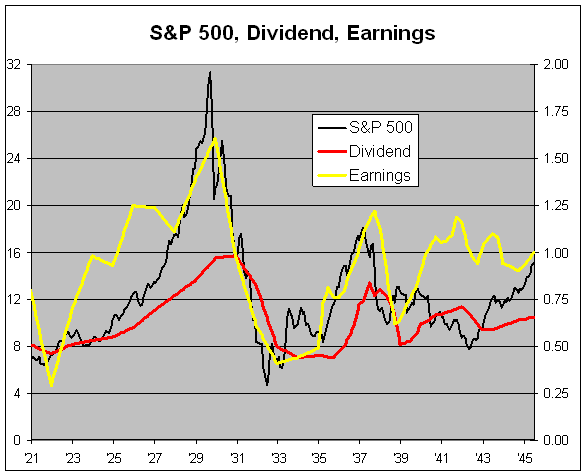
The chart above is from data from Robert Shiller’s website. The S&P 500 is the black line and it follows the left scale. The one-year trailing earnings and dividends follow the right scale. The lines are scaled at a ratio of 16-to-1, so whenever the lines cross, the earnings multiple is exactly 16 or the dividend yield is 6.25%.
I think a good way to view bear markets is to divide them into two categories. One is when prices far overshoot fundamentals. The other is when fundamentals crumble beneath prices; 1987 and 2000 are examples of the former, 1990 and 2007 are examples of the latter. I would say that 1929 is another good example of fundamentals falling apart beneath prices. So were stock prices overvalued in 1929? I think it’s fair to say that stock prices became “elevated,” but I don’t believe it was anything truly excessive.
According to the monthly Shiller data, the peak P/E Ratio, based on one-year trailing earnings, was 20.2 in September 1929. That’s high but hardly out of orbit. The dividend yield for September was 3%.
Bear in mind that I’m speaking from the standpoint of an investor at the time. Of course, investors then wouldn’t have known that the Federal Reserve engaged in an historic blunder by tightening as things got worse which, in turn, made things even worse. But for a person in 1929, there was little reason to believe that stock prices had reached the moon. In early 2000, by contrast, it was quite obvious that tech stocks bore little relation to their long-term value. They were going up simply because they were going up. As Herb Stein said about unsustainable trends, they eventually come to an end.
Let me add that any look at the market’s value is inherently subjective. There’s no one perfect measure of something’s worth. After all, if there were one, we wouldn’t need markets. In the end, something is worth how much someone else is willing to pay for it. So I’m not saying stocks were perfectly valued or undervalued in late 1929. I’m saying that there was no obvious signal at the time that stocks were overvalued.
That brings me to Robert Shiller’s CAPE, which is the Cyclically Adjusted Price/Earnings Ratio. That’s the P/E Ratio but based on the average of the last 10 years’ worth of earnings. As I’ve written before, I’m not a fan of CAPE. The issue for me is that stock valuations are inherently cyclical so there’s no need to adjust them for a cycle. With the 1929 example, we can really see the weakness of CAPE.
The problem is that 10 years prior to 1929, the earnings denominator included the earnings plunge of the early 1920s. That really weighs down the data and thereby elevates CAPE. On the chart, notice how earnings dropped below dividends which is a good sign that the data is a bit messy. If the CAPE were five years instead of 10, the picture would look much different. I used one-year data in my chart which I think gives us a better picture of what was truly happening.
Historically, CAPE doesn’t have a great track record. It showed that stocks were rather high in 1995 at the start of the bull market, and it showed that prices were fairly valued only weeks after the March 2009 low.
Recently I wrote about the little-appreciated bull market of 1949-55. I think it’s ignored because it didn’t come to a crashing end. The 1929 market gets the opposite effect. Because it came to a crashing end, people assume stocks were outrageously priced. The ultimate judge of a market shouldn’t be what comes after.
-
Morning News: February 12, 2013
Posted by Eddy Elfenbein on February 12th, 2013 at 7:00 amWorld Bank Chief Economist Calls On G20 To Coordinate Policies
G-7 Won’t Target Exchange Rates Amid Currency War Concern
ECB Ready to Offset Banks’ Accelerated LTRO Payback
U.K. Inflation Stays at 2.7% as Price Pressures Mount
Buyout-Boom Shakeout Seen Leaving One in Four to Starve
Corn Heads for Longest Losing Run Since 2010 as Output May Climb
Yellen Says Higher Rates Not Assured After Thresholds Hit
Karen Mills to step down as head of Small Business Administration
Barclays Posts $1.3 Billion Loss and Plans to Cut 3,700 Jobs
Shell Vessels Sidelined, Imperiling Arctic Plans
Hostess Gets Approval to Auction Twinkies, Drake’s Brands
UK Fines UBS $15 Million For Failings In AIG Fund Sale
Samsung Girds for Life After Apple in Disruption Devotion
Howard Lindzon: Momentum Monday…The Magic Behind LinkedIn and Tesla Motors
John Hempton: Another Day – Another Strange Gulfport Energy Related Party Transaction
Be sure to follow me on Twitter.
-
About That Earnings Acceleration….
Posted by Eddy Elfenbein on February 11th, 2013 at 2:28 pmOne aspect of this market that I’m starting to strongly doubt is the belief that earnings growth is about to ramp up. In other words, the rate of growth will itself increase.
The chart below shows the S&P 500 (blue line, left scale) along with its earnings (yellow line, right scale). The red line is Wall Street’s forecast (please note: it’s not my forecast, it’s Wall Street’s consensus). The lines are scaled at a ratio of 15-to-1 so whenever the lines cross, the P/E Ratio is exactly 15.
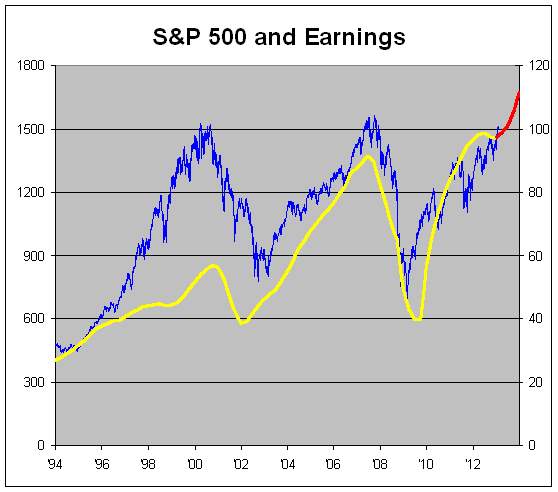
It’s that red line that has me concerned. Wall Street seems to believe it’s about to hook upward. Me? I’m not so sure. For one, profit margins have been pushed about as far as they can go. I can believe that nominal GDP growth will pick up, but nothing close to what would sustain a major bounce in corporate earnings.
The Street currently sees full-year earnings for the S&P 500 coming in at $111. That’s down from $117 ten months ago. Earnings growth was actually negative for Q3 and Q4 of 2012. Unless we see evidence of an earnings pickup for Q1 2013, I’m inclined to believe the market will earn $100 for all of 2013.
Is the yellow line going through a minor bump like it did in 1998, or is it hitting a major peak like 2000 and 2007? I should add that if the earnings projections are correct, the S&P 500 is very undervalued here.
-
Stocks Go for Seven Straight Up Weeks
Posted by Eddy Elfenbein on February 11th, 2013 at 1:04 pmThe stock market has now risen for six weeks in a row, and today we’re trying to make it seven. Right now, stocks are mostly unchanged. The S&P 500 is down a bit, but it’s nothing too serious. Just listening to the chatter, it seems like everyone is expecting a pullback to happen at some point. Just when and how much are the only missing pieces.
There’s a big euro meeting today to discuss what to do over Cyprus and Greece. Then on Friday, the G-20 finance chiefs gather for a meeting in Moscow. The big political item this week will be tomorrow’s State of the Union by address by President Obama. It’s expected that he’ll offer specific proposals about gun control and immigration.
The next earnings report from one of the stocks on the Buy List will be DirecTV ($DTV) which is due to report on Thursday. Wall Street expects earnings of $1.13 per share. Also on our Buy List, Medtronic ($MDT) made a fresh 52-week high.
-
Morning News: February 11, 2013
Posted by Eddy Elfenbein on February 11th, 2013 at 6:59 amEurope Threatened With The Slap Of Harsh Reality
Kuroda Says Additional BOJ Easing Can Be Justified for 2013
Putin Turns Black Gold to Bullion as Russia Outbuys World
G-7 Said to Discuss Statement to Calm Currency War Concern
U.S. Soy Supply at 48-Year Low as Brazil Ships Held
Investor Aims High With Price For Dell
American and US Airways May Announce a Merger This Week
Hakon Agrees to Buy ICA Stake From Ahold for $3.1 Billion
Samsung Emerges as a Potent Rival to Apple’s Cool
Novo Nordisk Hit Hard As U.S. Rebuffs Insulin Drug
Disruptions: Where Apple and Dick Tracy May Converge
Rating Victims Didn’t Know S&P’s Toxic AAA Born of Greed
Complex Investments Prove Risky as Savers Chase Bigger Payoff
Credit Writedowns: Inflationary Pressure In Brazil Is Building
Epicurean Dealmaker: Skin in Which Game?
Be sure to follow me on Twitter.
-
Stock Market At Inflation-Adjusted All-Time High
Posted by Eddy Elfenbein on February 8th, 2013 at 4:53 pmI can’t be absolutely certain of this but I’m reasonably confident in reporting that the total real return of the U.S. stock finally reached an all-time high today. By this, I mean adjusting for dividends and inflation, we took out the old peak from 13 years ago.
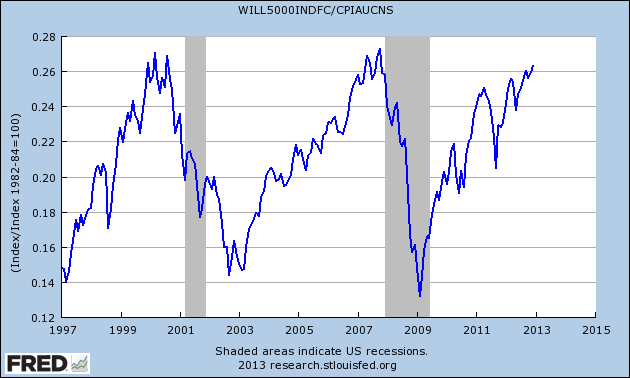
Note: The above chart goes to the end of 2012.
Here are some numbers: The Wilshire 5000 Total Return Index has increased by 35.41% from March 24, 2000 to today. Meanwhile, the CPI has increased by 34.1% from March 2000 through December 2012. The numbers for January won’t come out until later this month. Despite this, it would be a noticeable break from the recent trend for the January CPI to knock out the small lead that stocks appear to enjoy.So raise a glass to stocks. It only took 13 years to make a real profit. A very, very, very, very small (but real) profit.
-
CWS Market Review – February 8, 2013
Posted by Eddy Elfenbein on February 8th, 2013 at 8:12 amThat money talks I’ll not deny,
I heard it once: It said, “Goodbye.”
-Richard ArmourLast Friday, the Dow pierced 14,000 for the first time in five years. But as I suspected, investors got a case of the jitters, and the Dow hasn’t been able to hold 14,000. We even had a small uptick in volatility as the S&P 500 had three straight moves of greater than 1%. One money manager said, “We’ve moved so far so fast that the market’s just looking for any kind of sign to take something off the table.” I think that’s exactly right.
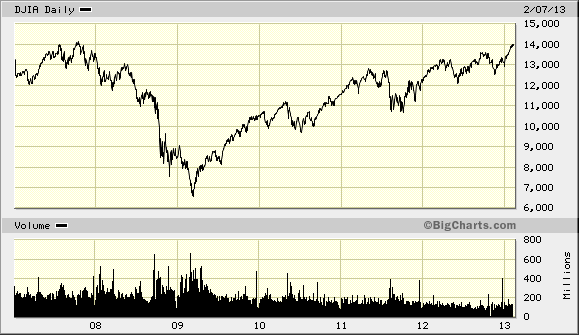
Wall Street is still focused on earnings. While fourth-quarter earnings season has been good (not great), I’m starting to have concerns that Wall Street’s earnings outlook is too optimistic. According to the Street, earnings growth will accelerate, meaning the pace of growth itself will increase, throughout 2013. That’s certainly possible, but I see that as a best-case scenario. More likely, earnings growth will flat-line or grow rather modestly.
That’s not necessarily awful news. Corporate America has been raking it in lately. The companies in the S&P 500 will probably net a cool $1 trillion this year. But we have to face the fact that the easy money in this bull market has already been made. Stocks have more than doubled in less than four years. The next four years won’t be so fortunate.
That’s why I urge all investors to focus on high-quality stocks for the long term like the stocks on our Buy List. We had more good news this week, including a 21% dividend increase from Ross Stores ($ROST), and JPMorgan ($JPM) reached yet another 52-week high. Now let’s look at some of our earnings reports this week.
AFLAC Is a Buy up to $54 per Share
After the close on Tuesday, AFLAC ($AFL) reported fourth-quarter earnings of $1.48 per share. Make no mistake: this was a solid quarter for the duck stock, and it was squarely in line with what they told us to expect. Three months ago, AFLAC said Q4 EPS should range between $1.46 and $1.51.
But here’s the issue for us: Since most of AFLAC’s business comes from Japan, their bottom line can be adversely impacted (or helped) by fluctuations in the yen/dollar exchange rate. Lately, the government in Japan has aggressively stated its intention of pursuing a pro-inflation policy. That’s caused the yen to tank against the dollar. In response, the Nikkei Index has soared.
As I said, AFLAC as a business is fine and dandy and as strong as it’s ever been. I want to make it clear that I’m not overly worried about the exchange rate, but I have to say that it’s an issue for investors. AFLAC said the falling yen cost dinged their Q4 by four cents per share. Not fun, but not a disaster either. Bear in mind that AFLAC’s full-year earnings for 2012 were actually helped by one penny per share, thanks to the exchange rate. So it works in both directions.
For all of 2012, AFLAC made $6.60 per share in operating earnings. The company said it sees operating earnings growth of 4% to 7% for this year. On a currency-neutral basis, that means operating earnings of $6.86 to $7.06 per share.
Now here’s the tricky part (warning: math ahead). Each move in the exchange rate of one yen from 78.5 will cost AFLAC 4.3 cents per share for the year. So if the exchange rate averages 90 for the entire year, that will cost AFLAC 49.45 cents per share (11.5 times 4.3). That stings, but it’s roughly 50 cents per share out of $7 of earnings. It’s not enough for me to change my opinion that AFLAC is a very solid stock to own. And of course, I have no idea what the exchange rate will do this year. However, I suspect that most of the damage to the yen has already been done.
Shares of AFL pulled back after the earnings report, but the stock is basically where it was three months ago. AFLAC remains an excellent company. Due to the recent pullback, I’m going to lower my Buy Below to $54 per share.
Good News from FISV and CTSH, Bad News from WXS
Also on Tuesday, Fiserv ($FISV) reported Q4 earnings of $1.39 per share, which exactly matched Wall Street’s forecast. The company already told us that this was going to be a good quarter. Remarkably, this is Fiserv’s 27th-straight year of double-digit earnings growth. There aren’t many companies that can boost a record like that.
For 2012, Fiserv earned $5.13 per share, which is a very nice increase over the $4.58 per share they made in 2011. Fiserv said that they expect growth of 15% to 18% for this year, and they specified an earnings range of $5.88 to $6.07 per share. If that’s correct, FISV is going for less than 14 times this year’s earnings. This is a solid stock. Fiserv is a buy up to $88 per share.
We had a great earnings report from Cognizant Technology Solutions ($CTSH) on Thursday. The company reported Q4 earnings of 99 cents per share, which is up from 84 cents for Q4 of 2011. That’s eight cents more than the Street had been expecting. Quarterly revenue rose 17.1% to $1.95 billion. For all of 2012, revenue rose 20% to $7.35 billion, and earnings-per-share increased from $3.07 in 2011 to $3.70 for 2012. This is clearly a rapidly-growing outfit.
Cognizant also offered very impressive guidance for Q1 and all of 2013. The company sees Q1 revenue rising by 20% to “at least” $2 billion and expects earnings-per-share to hit $1.01. Wall Street had been expecting 93 cents per share. For the whole year, CTSH sees revenue climbing to “at least” $8.6 billion. That’s an increase of 17%. Cognizant also sees earnings-per-share of at least $4.31. That’s a big increase over Wall Street’s expectation of $4.00 per share. CTSH is an excellent buy anytime you see it below $81.
Our dud this week came from WEX Inc. ($WXS). The company reported fourth-quarter earnings of $1.07 per share, which was a penny below consensus. Quarterly revenue rose 20.9% to $169 million.
But the earnings weren’t the bad part; it was the guidance. For Q1, WXS expects earnings to range between 89 cents and 96 cents per share. The Street had been expecting $1.08 per share. For all of 2013, WXS sees earnings between $4.30 and $4.50 per share. The Street was expecting $4.88 per share. For all of 2012, WXS made $4.06 per share which was a nice increase from $3.64 per share on 2011.
Frankly, this guidance is very disappointing news. I’m not ready to toss in the towel with WXS; the stock has been a huge winner for us over the last eight months. But for now, I’m going to lower the Buy Below price to $72.
Ross Stores Is a Buy up to $62
Ross Stores ($ROST) gave us great news this week. The retailer reported blowout sales for January, and thanks to the rush of business, Ross sees Q4 earnings coming in at $1.06 to $1.07 per share, and $3.52 to $3.53 per share for the entire year. (Note that like a lot of retailers, Ross ends their fiscal year at the end of January.) The earnings report should be out in mid-March.
But the best news is that Ross raised their quarterly dividend from 14 cents to 17 cents per share. That’s a 21% hike. Ross pays out a very small amount of their profits as dividends to shareholders (about 20%). Based on Thursday’s closing price, Ross yields 1.13%. That’s obviously not a very high yield, but the dividend increase and strong sales news are a good omen for Ross Stores. ROST remains a very good buy up to $62.
Before I go, I want to highlight two Buy List stocks that look especially attractive. Again, Microsoft ($MSFT) looks very good here. The pullback in Harris ($HRS) seems about done. Shares of HRS got hit hard for a modest decrease in guidance.
That’s all for now. Next week, we get important reports on retail sales and industrial production. Our final earnings report of this cycle will be from DirecTV ($DTV) on Wednesday, February 13th. Wall Street expects $1.13 per share. Be sure to keep checking the blog for daily updates. I’ll have more market analysis for you in the next issue of CWS Market Review!
– Eddy
-
Morning News: February 8, 2013
Posted by Eddy Elfenbein on February 8th, 2013 at 7:10 amChina Trade Growth Hints At Strong 2013
European Leaders Struggle to Bridge Budget Gaps
Aso Says Pace of Yen Decline Too Fast With G-20 Set to Meet
Draghi’s Powerful Weapon Is Words as Euro Heeds His Voice
German Exports Rose in December to Cap Trillion-Euro Year
4 Years After Crisis, Ireland Strikes Deal to Ease a Huge Debt Load
Gold Sideways in Asia as Outlook Unclear; Precious Metals Lower
Worker Productivity in U.S. Declines, Pushing Up Labor Costs
Business and Labor Unite to Try to Alter Immigration Laws
Apple With $137 Billion in Cash Considers Preferred Stock
Hewlett Directs Its Suppliers in China to Limit Student Labor
BMW Posts Record Group Sales In January, Up 9.9 Percent
Google Suit Against IRS Planned Over Domestic Tax Dispute
Roger Nusbaum: Position Management
Be sure to follow me on Twitter.
-
Archives
- September 2026
- August 2026
- July 2026
- June 2026
- May 2026
- April 2026
- March 2026
- February 2026
- January 2026
- December 2025
- November 2025
- October 2025
- September 2025
- August 2025
- July 2025
- June 2025
- May 2025
- April 2025
- March 2025
- February 2025
- January 2025
- December 2024
- November 2024
- October 2024
- September 2024
- August 2024
- July 2024
- June 2024
- May 2024
- April 2024
- March 2024
- February 2024
- January 2024
- December 2023
- November 2023
- October 2023
- September 2023
- August 2023
- July 2023
- June 2023
- May 2023
- April 2023
- March 2023
- February 2023
- January 2023
- December 2022
- November 2022
- October 2022
- September 2022
- August 2022
- July 2022
- June 2022
- May 2022
- April 2022
- March 2022
- February 2022
- January 2022
- December 2021
- November 2021
- October 2021
- September 2021
- August 2021
- July 2021
- June 2021
- May 2021
- April 2021
- March 2021
- February 2021
- January 2021
- December 2020
- November 2020
- October 2020
- September 2020
- August 2020
- July 2020
- June 2020
- May 2020
- April 2020
- March 2020
- February 2020
- January 2020
- December 2019
- November 2019
- October 2019
- September 2019
- August 2019
- July 2019
- June 2019
- May 2019
- April 2019
- March 2019
- February 2019
- January 2019
- December 2018
- November 2018
- October 2018
- September 2018
- August 2018
- July 2018
- June 2018
- May 2018
- April 2018
- March 2018
- February 2018
- January 2018
- December 2017
- November 2017
- October 2017
- September 2017
- August 2017
- July 2017
- June 2017
- May 2017
- April 2017
- March 2017
- February 2017
- January 2017
- December 2016
- November 2016
- October 2016
- September 2016
- August 2016
- July 2016
- June 2016
- May 2016
- April 2016
- March 2016
- February 2016
- January 2016
- December 2015
- November 2015
- October 2015
- September 2015
- August 2015
- July 2015
- June 2015
- May 2015
- April 2015
- March 2015
- February 2015
- January 2015
- December 2014
- November 2014
- October 2014
- September 2014
- August 2014
- July 2014
- June 2014
- May 2014
- April 2014
- March 2014
- February 2014
- January 2014
- December 2013
- November 2013
- October 2013
- September 2013
- August 2013
- July 2013
- June 2013
- May 2013
- April 2013
- March 2013
- February 2013
- January 2013
- December 2012
- November 2012
- October 2012
- September 2012
- August 2012
- July 2012
- June 2012
- May 2012
- April 2012
- March 2012
- February 2012
- January 2012
- December 2011
- November 2011
- October 2011
- September 2011
- August 2011
- July 2011
- June 2011
- May 2011
- April 2011
- March 2011
- February 2011
- January 2011
- December 2010
- November 2010
- October 2010
- September 2010
- August 2010
- July 2010
- June 2010
- May 2010
- April 2010
- March 2010
- February 2010
- January 2010
- December 2009
- November 2009
- October 2009
- September 2009
- August 2009
- July 2009
- June 2009
- May 2009
- April 2009
- March 2009
- February 2009
- January 2009
- December 2008
- November 2008
- October 2008
- September 2008
- August 2008
- July 2008
- June 2008
- May 2008
- April 2008
- March 2008
- February 2008
- January 2008
- December 2007
- November 2007
- October 2007
- September 2007
- August 2007
- July 2007
- June 2007
- May 2007
- April 2007
- March 2007
- February 2007
- January 2007
- December 2006
- November 2006
- October 2006
- September 2006
- August 2006
- July 2006
- June 2006
- May 2006
- April 2006
- March 2006
- February 2006
- January 2006
- December 2005
- November 2005
- October 2005
- September 2005
- August 2005
- July 2005
 Eddy Elfenbein is a Washington, DC-based speaker, portfolio manager and editor of the blog Crossing Wall Street. His