-
“Are You Guys Just Incompetent Or What?”
Posted by Eddy Elfenbein on December 24th, 2012 at 2:32 pm -
Last Year’s Deletions are up 31.7%
Posted by Eddy Elfenbein on December 24th, 2012 at 12:50 pmA reader emailed to say he’d crunched the numbers:
This is just a crude analysis-
Your deletions last year averaged 31.7% in 2012, and your new adds averaged 25.06%. Both outpacing the SPX and the 2012 buy list by a good amount.
I’m thinking to mimic your 2013 adds + 2013 deletions.
Congrats on being so consistent!
Perhaps someone could make an ETF out of my Buy List deletions.
But seriously, most of that 31.7% gain is due to Gilead Sciences which had an amazing year. I should add that I’m breaking a rule I often advise investors to follow — don’t worry about what stocks do after you sell them. It doesn’t do you any good. So I’ll just pretend that I’m ignoring Gilead.
In other news, last year Eric Jackson at Forbes collected some market picks for 2012. Mine have held up fairly well.
Top Long: Hudson City Bancorp, HCBK
Top Short: Starbucks, SBUX
YE S&P Target: 1,450The S&P 500 is currently at 1,426 so I wasn’t too far off. Hudson City is up 29% for the year and that doesn’t include a generous dividend. Starbucks, however, is up about 17% for the year which is pretty good.
-
Morning News: December 24, 2012
Posted by Eddy Elfenbein on December 24th, 2012 at 7:50 amEuropean Markets Steady Despite Fiscal Cliff Fears
Greece Not Doing Enough Against Rich Tax Dodgers, Say EU/IMF
Buying Back Greek Debt Rewarded Hedge Funds
China To Crack Down On “Malicious” Trademark Registrations
India to Buy More Russian Fighter Jets, Helicopters
Americans Miss $200 Billion Abandoning Stocks
Dealers Tighten Treasuries Grip as New Fed QE3 Suppresses
Bullish Wagers Drop to Six-Month Low on U.S. Budget
White House Reverses Itself, Lifts Political Block on FDA Approval of GM Salmon
Pinnacle to Buy Ameristar Casinos for $869 Million
All the World’s a Game, and Business Is a Player
Economy Weighs on Shoppers in Final Holiday Weekend Dash to Mall
A 2013 Guide to Better Behavior in Business
Pragmatic Capitalism: The Unemployment Rate Increased in Zero States in November
Be sure to follow me on Twitter.
-
Johnny Carson & Benny Goodman
Posted by Eddy Elfenbein on December 22nd, 2012 at 9:10 pm -
The 2013 Buy List
Posted by Eddy Elfenbein on December 21st, 2012 at 1:39 pmThe wait is over. Ladies and gentlemen, here’s the 2013 Crossing Wall Street Buy List:
AFLAC ($AFL)
Bed Bath & Beyond ($BBBY)
CA Technologies ($CA)
Cognizant Technology Solutions ($CTSH)
CR Bard ($BCR)
DirecTV ($DTV)
FactSet Research Systems ($FDS)
Fiserv ($FISV)
Ford ($F)
Harris Corporation ($HRS)
JPMorgan Chase ($JPM)
Medtronic ($MDT)
Microsoft ($MSFT)
Moog ($MOG-A)
Nicholas Financial ($NICK)
Oracle ($ORCL)
Ross Stores ($ROST)
Stryker ($SYK)
Wells Fargo ($WFC)
WEX Inc. ($WXS)
There are five new stocks and five stocks that I’m removing. The five new stocks are Cognizant Technology Solutions ($CTSH), FactSet Research Systems ($FDS), Microsoft ($MSFT), Ross Stores ($ROST) and Wells Fargo ($WFC). Cognizant and FactSet are both returning members of the Buy List.
The five stocks I’m removing are Hudson City Bancorp ($HCBK), Johnson & Johnson ($JNJ), JoS. A Bank Clothiers ($JOSB), Reynolds American ($RAI) and Sysco ($SYY). I don’t necessarily consider the stocks I’m removing to be Sells.
Note that we’re turning over just one-fourth of our Buy List. You don’t have to go madly in and out of stocks to beat the market.
For tracking purposes, I assume the Buy List is a $1 million portfolio that’s equally divided into 20 positions of $50,000 each. The “initial price” will be the closing price on December 31, 2012. The market will be closed on New Year’s Day, and the new list will take effect once trading starts on Wednesday, January 2nd.
As usual, this list is locked and sealed, and I can’t make any changes for the next 12 months. I may have to make adjustments along the way for any buyouts or mergers that may occur. If I do, I’ll be sure to explain exactly what’s happening.
I’ll also periodically adjust my Buy Below prices. Please note that these aren’t “price targets.” They’re guidance for optimal entry prices. The reason we do this is so no one chases after one of our stocks and gets a lousy price.
-
Nike Gets Ready to Split
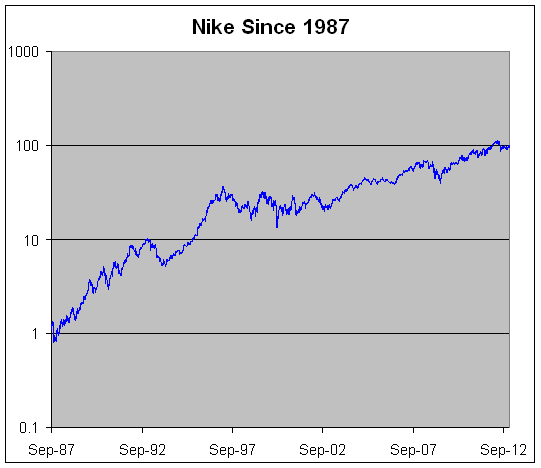
Posted by Eddy Elfenbein on December 21st, 2012 at 1:18 pmNext week, Nike ($NKE) will split 2-for-1 for the fifth time since 1990. This stock has been an amazing performer. Shortly after the 1987 Crash, shares of NKE got as low as 80 cents. Today the stock is at $104.
Still, I have to say that I think Nike is very overpriced. Nike should be going for about $70.
-
Fiscal Cliff Talks Dampen Market
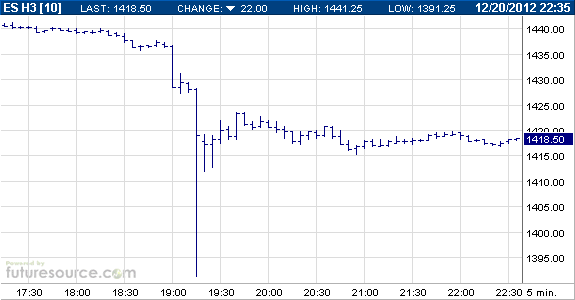
Posted by Eddy Elfenbein on December 21st, 2012 at 11:40 amThe stock market is down so far this morning, although the futures action signaled that it could have been much worse. After the dissolution of John Boehner’s attempt to bridge the Fiscal Cliff, the futures dropped down to 1,391. Fortunately, the S&P 500 is currently around 1,426 which is a loss of about 1.3%. That’s still higher than where we were when the market closed last Friday.
The government reported that consumer spending rose by the most in three years:
The Commerce Department said on Friday inflation-adjusted consumer spending rose 0.6 percent, and after-tax income climbed 0.8 percent when adjusting for inflation.
The department gave no indication super storm Sandy, which slammed the East Coast in late October and kept many people out of work for weeks, had impacted the data or its collection in November.
Spending before taking into account changes in prices rose 0.4 percent. Economists polled by Reuters had expected nominal consumer spending would rise 0.3 percent last month.
The rise in real spending was the largest increase since August 2009 and suggested purchases by consumers were not taking the hit many expected due to growing fears the economy could slip into recession next year.
The bad news this morning is the consumer sentiment dropped to a five-month low.
The Thomson Reuters/University of Michigan consumer sentiment index decreased to 72.9, the weakest since July, from 82.7 in November. Economists projected a final reading of 75 for December, according to the median of 66 estimates in a Bloomberg survey. Today’s figure was lower than a preliminary report earlier this month.
-
CWS Market Review – December 21, 2012
Posted by Eddy Elfenbein on December 21st, 2012 at 9:48 amLet’s jump right into the main event of this week’s issue. Here are the 20 stocks for my 2013 Buy List:
AFLAC ($AFL)
Bed Bath & Beyond ($BBBY)
CA Technologies ($CA)
Cognizant Technology Solutions ($CTSH)
CR Bard ($BCR)
DirecTV ($DTV)
FactSet Research Systems ($FDS)
Fiserv ($FISV)
Ford ($F)
Harris Corporation ($HRS)
JPMorgan Chase ($JPM)
Medtronic ($MDT)
Microsoft ($MSFT)
Moog ($MOG-A)
Nicholas Financial ($NICK)
Oracle ($ORCL)
Ross Stores ($ROST)
Stryker ($SYK)
Wells Fargo ($WFC)
WEX Inc. ($WXS)
There are five new stocks, and five stocks I’m removing. The five new stocks are Cognizant Technology Solutions ($CTSH), FactSet Research Systems ($FDS), Microsoft ($MSFT), Ross Stores ($ROST) and Wells Fargo ($WFC). I’ll have more to say about the new buys in upcoming blog posts.
The five stocks I’m removing are Hudson City Bancorp ($HCBK), Johnson & Johnson ($JNJ), JoS. A Bank Clothiers ($JOSB), Reynolds American ($RAI) and Sysco ($SYY). I don’t necessarily consider the stocks I’m removing to be Sells.
Note that we’re turning over just one-fourth of our Buy List. You don’t have to go madly in and out of stocks to beat the market.
For tracking purposes, I assume the Buy List is a $1 million portfolio that’s equally divided into 20 positions of $50,000 each. The “initial price” will be the closing price on December 31, 2012. The market will be closed on New Year’s Day, and the new list will take effect once trading starts on Wednesday, January 2nd.
As usual, this list is locked and sealed, and I can’t make any changes for the next 12 months. I may have to make adjustments along the way for any buyouts or mergers that may occur. If I do, I’ll be sure to explain exactly what’s happening.
I’ll also periodically adjust my Buy Below prices. Please note that these aren’t “price targets.” They’re guidance for optimal entry prices. The reason we do this is so no one chases after one of our stocks and gets a lousy price.
Earnings from Oracle and Bed, Bath & Beyond
The new Buy List is the big news this week, but I also wanted to touch on the earnings reports from Oracle ($ORCL) and Bed, Bath & Beyond ($BBBY). As I told you last week to expect, Oracle easily topped its earnings expectations. For its fiscal Q2, Oracle earned 64 cents per share, which was three cents better than Wall Street’s consensus.
This was a solid report for Oracle. New software license and subscription sales rose by 17%. That’s usually a good indicator of future revenue. Hardware is still very weak, but the company has indicated that that’s ready to turn a corner. Here’s a good video of Mark Hurd discussing the earnings report.
The market was very pleased with Oracle’s results: the stock broke out to a new 52-week high and is now a 32.32% winner on the year for us. For fiscal Q3 (which is December, January and February), Oracle said it expects earnings between 64 and 68 cents per share. The Street had been expecting 62 cents per share, so that’s good news. Oracle remains a very good buy any time it’s below $35 per share.
After the close on Wednesday, Bed Bath & Beyond reported fiscal Q3 earnings of $1.03 per share. The Street had been expecting $1.02 per share. These results were pretty good: sales rose 15.3% to $2.702 billion. The key metric to watch for with retailers is comparable-store sales. For Q3, that rose by 1.7%. The company estimates that Hurricane Sandy knocked 0.9% off comparable-store sales growth. Overall, Q3 was a nice comeback from the poor results for Q2. Bed Bath & Beyond also announced a $2.5 billion share repurchase program. Personally, I’d much rather they had a dividend.
Now let’s look at guidance. For a retailer like BBBY, Q4 is extremely important. For Q4, the company sees earnings ranging between $1.60 and $1.67 per share. Wall Street had been expecting $1.75, so this was a disappointment, and the stock got cracked for 6.5% on Thursday. The shares are now about where they were at November’s low.
The problem is that the company faces some higher operational costs, plus they’ve become overly reliant on coupons in order to get people in the door. That was understandable during the housing bust, but they need to wean themselves off that strategy. I’d much prefer to see BBBY hit comparable-store sales growth of 4%, and I think they can do that. Despite the soggy guidance, BBBY is still putting up some impressive numbers, and that’s why I’m sticking with them for 2013. This is a very well-run company, and I’m not going to be rattled by short-term jitters. For now, I’m adjusting my Buy Below price to $60.
What Happened With Nicholas Financial
I want to make sure everyone is clear on what happened this week with Nicholas Financial ($NICK). Tuesday was the last day you could buy shares in order to quality for the big dividend. That’s why the stock fell on Wednesday. Of course, shareholders didn’t lose any value, since they’re getting the $2-per-share dividend.
On Wednesday’s trading, NICK lost $2.29 per share, so that was $2 due to the dividend and 29 cents as a part of regular trading. Understand that we’re still way ahead. When the big dividend was first announced, NICK was at $13.35, so the stock has only lost 89 cents per share. In effect, the stock gained $1.11 per share before we adjust for the $2 dividend.
Before I go, I want to raise my Buy Below price on AFLAC ($AFL) to $57. I’m also raising WEX Inc.’s ($WXS) to $77 per share.
That’s all for now. The market closes at 1 p.m. on Monday and will be closed all day Tuesday. Be sure to keep checking the blog for daily updates. I’ll have more market analysis for you in the next issue of CWS Market Review!
– Eddy
-
Morning News: December 21, 2012
Posted by Eddy Elfenbein on December 21st, 2012 at 5:30 amIf You Bought Greek Bonds in January You Earned 80%
UK Told To Add Break-Up Threat To Bank Reform
Japan’s Abe Offers Olive Branch To Seoul
Boehner’s “Fiscal Cliff” Plan Fails
Swaps ‘Armageddon’ Lingers as New Rules Concentrate Risk
Exchange Sale Reflects New Realities of Trading
Third-Quarter U.S. Growth Revised Higher
Sales of Existing U.S. Homes Climb to Three-Year High
GE to Buy Avio’s Aviation Parts Business for $4.3 Billion
Arcelor Takes $4.3 Billion Write Down on Europe
Lilly to Pay $29.4 Million to Settle SEC Allegations
Crossing Wall Street Stock Picks (2012)
Howard Lindzon: Howie’s Life Lessons
Jeff Miller: Fiscal Cliff Notes – Plan B Edition
Be sure to follow me on Twitter.
-
S&P 500 Futures
Posted by Eddy Elfenbein on December 20th, 2012 at 11:50 pmIt’s the “down” part of the graph that has people worried.
-
Archives
- September 2026
- August 2026
- July 2026
- June 2026
- May 2026
- April 2026
- March 2026
- February 2026
- January 2026
- December 2025
- November 2025
- October 2025
- September 2025
- August 2025
- July 2025
- June 2025
- May 2025
- April 2025
- March 2025
- February 2025
- January 2025
- December 2024
- November 2024
- October 2024
- September 2024
- August 2024
- July 2024
- June 2024
- May 2024
- April 2024
- March 2024
- February 2024
- January 2024
- December 2023
- November 2023
- October 2023
- September 2023
- August 2023
- July 2023
- June 2023
- May 2023
- April 2023
- March 2023
- February 2023
- January 2023
- December 2022
- November 2022
- October 2022
- September 2022
- August 2022
- July 2022
- June 2022
- May 2022
- April 2022
- March 2022
- February 2022
- January 2022
- December 2021
- November 2021
- October 2021
- September 2021
- August 2021
- July 2021
- June 2021
- May 2021
- April 2021
- March 2021
- February 2021
- January 2021
- December 2020
- November 2020
- October 2020
- September 2020
- August 2020
- July 2020
- June 2020
- May 2020
- April 2020
- March 2020
- February 2020
- January 2020
- December 2019
- November 2019
- October 2019
- September 2019
- August 2019
- July 2019
- June 2019
- May 2019
- April 2019
- March 2019
- February 2019
- January 2019
- December 2018
- November 2018
- October 2018
- September 2018
- August 2018
- July 2018
- June 2018
- May 2018
- April 2018
- March 2018
- February 2018
- January 2018
- December 2017
- November 2017
- October 2017
- September 2017
- August 2017
- July 2017
- June 2017
- May 2017
- April 2017
- March 2017
- February 2017
- January 2017
- December 2016
- November 2016
- October 2016
- September 2016
- August 2016
- July 2016
- June 2016
- May 2016
- April 2016
- March 2016
- February 2016
- January 2016
- December 2015
- November 2015
- October 2015
- September 2015
- August 2015
- July 2015
- June 2015
- May 2015
- April 2015
- March 2015
- February 2015
- January 2015
- December 2014
- November 2014
- October 2014
- September 2014
- August 2014
- July 2014
- June 2014
- May 2014
- April 2014
- March 2014
- February 2014
- January 2014
- December 2013
- November 2013
- October 2013
- September 2013
- August 2013
- July 2013
- June 2013
- May 2013
- April 2013
- March 2013
- February 2013
- January 2013
- December 2012
- November 2012
- October 2012
- September 2012
- August 2012
- July 2012
- June 2012
- May 2012
- April 2012
- March 2012
- February 2012
- January 2012
- December 2011
- November 2011
- October 2011
- September 2011
- August 2011
- July 2011
- June 2011
- May 2011
- April 2011
- March 2011
- February 2011
- January 2011
- December 2010
- November 2010
- October 2010
- September 2010
- August 2010
- July 2010
- June 2010
- May 2010
- April 2010
- March 2010
- February 2010
- January 2010
- December 2009
- November 2009
- October 2009
- September 2009
- August 2009
- July 2009
- June 2009
- May 2009
- April 2009
- March 2009
- February 2009
- January 2009
- December 2008
- November 2008
- October 2008
- September 2008
- August 2008
- July 2008
- June 2008
- May 2008
- April 2008
- March 2008
- February 2008
- January 2008
- December 2007
- November 2007
- October 2007
- September 2007
- August 2007
- July 2007
- June 2007
- May 2007
- April 2007
- March 2007
- February 2007
- January 2007
- December 2006
- November 2006
- October 2006
- September 2006
- August 2006
- July 2006
- June 2006
- May 2006
- April 2006
- March 2006
- February 2006
- January 2006
- December 2005
- November 2005
- October 2005
- September 2005
- August 2005
- July 2005
 Eddy Elfenbein is a Washington, DC-based speaker, portfolio manager and editor of the blog Crossing Wall Street. His