-
CWS Market Review – January 11, 2013
Posted by Eddy Elfenbein on January 11th, 2013 at 7:42 am“The key to making money in stocks is not to get scared out of them.” – Peter Lynch
I’ll sum up this market up in four words: Fear is melting away. Wall Street continues to rally as the fear that gripped the market so intensely slowly fades away. This has been great news for the broader market—and especially for our new Buy List.
On Thursday, the S&P 500 closed at its highest level in more than five years. What’s even more impressive is that the Volatility Index ($VIX), also known as the Fear Index, recently dropped to its lowest level in five-and-a-half years. After seven days of trading, our Buy List is already up 4.34% for the year, which is 1.12% ahead of the S&P 500.
Earnings season is about to start, and we’ve had a flurry of good news this week. Both Stryker ($SYK) and Medtronic ($MDT) raised the low end of their full-year guidance. DirecTV ($DTV) rallied after the company said it had added 100,000 new subscribers in Q4.
How about Nicholas Financial ($NICK)? The little powerhouse came close to breaking through $14 per share. On Thursday, Oracle ($ORCL), Fiserv ($FISV) and Stryker ($SYK) all made fresh 52-week highs. (Is it me, or didn’t Oracle just break $30 a few weeks ago—and it’s already closing on $35?)
Perhaps the best news of all came from Ford ($F). The automaker said it’s doubling its dividend. In the CWS Market Review from a month ago, I said it is possible Ford could sweeten its dividend, but honestly, I was expecting something minor. Not doubling! This is an excellent sign of confidence from Ford. The stock got as high as $13.94 on Thursday, which is an 18-month high.
The End of the Fear Trade
Before we get too carried away, I want to warn you that this is a tricky market. Last week, I mentioned that we’re witnessing a “high-beta rally,” which means that a lot of bad stuff is getting pulled along with the good stuff. Fortunately, we have the good stuff.
What’s interesting is that the most-hated stocks on Wall Street, meaning those that are “shorted” the most, have been doing the best. The folks who have been short this market have been getting squeezed. This means they have to cover their shorts, and that’s propelling those hated stocks even higher.
I’ll explain what’s going on with a simple example. Let’s say you have two stocks that are perfectly equal in every way. Same industry, same finances, same logos, you name it, they’re exactly alike. Both are expected to earn $1 per share this year. However, there’s one difference. Stock A is expected to earn $1 per share, plus or minus two cents per share, while Stock B is expect to earn $1 per share, plus or minus 30 cents per share.
So which stock is going to be worth more? The answer is that in most cases Stock A will be worth more. It’s not entirely logical, but investors are more scared of the downside than they are optimistic for the upside.
But here’s the important part investors need to understand: While Stock A will usually be worth more than Stock B, that gap will fluctuate a lot. Sometimes, the crowd turns fearful and the A/B gap will open wide. But other times, when folks are more confident, that gap will narrow. The A/B gap will move according to the crowd’s fear level.
Now let’s bring our thought exercise back to the real world. What happened over the past few years is that the whole world got terrified. The A/B gap opened to ridiculous levels. Any investment that wasn’t a surefire guarantee got dumped. It wasn’t just stocks: we saw it in bonds as well. High-grade corporates lagged Treasuries, and junk bonds lagged high-grades.
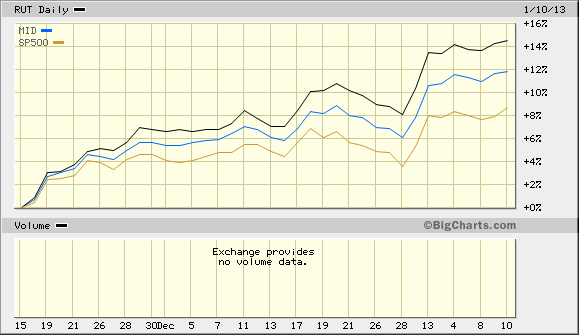
As the fear is slinking away, the fear gap is closing up. As a result, the Stock Bs of the world are outperforming the Stock As. Meaning that anything that’s seen as carrying higher risk has been doing well. In the real world, we can see that in the fact that small-cap indexes like the Russell 2000 ($RUT) and S&P Small-Cap 600 (^SML) have recently hit all-time highs, even though the S&P 500 still has a way to go to match its all-time high. Even the Mid-Cap 400 (^MID) is at a new high. Last week, I showed you how well the High-Beta ETF ($SPHB) has performed.
This chart shows you that since mid-November, small-caps have done the best, followed by the mids, followed by large. Performance has been perfectly ordered by size (or risk, B to A).
Let me caution investors not to be too impressed by some of the stocks that they’ll see rally. Facebook ($FB), for example, is back over $30. FB is horribly overpriced, and there are lots of stocks rallying that are even worse. Don’t chase them. Instead, investors should stick with high-quality stocks like the names you’ll find on our Buy List. Now let’s look at some of the recent good news from our stocks.
Stryker and Medtronic Raise Guidance
Even though earnings season hasn’t begun yet for our Buy List, two of our stocks got ahead of the game by raising their full-year guidance forecasts. I should add that I like stocks that provide full-year forecasts. Companies aren’t required to do this, so it’s nice to see firms give more information to the public.
On Monday, Medtronic ($MDT) raised its full-year forecast to a range of $3.66 to $3.70 per share. That’s an increase of four cents per share to the low end. Medtronic has stuck by its original forecast since May, which is commendable. The increase is due to a research tax credit.
Note that Medtronic’s fiscal year ends in April, so Q3 earnings are due in about six weeks. For the first six months of this fiscal year, Medtronic earned $1.73 per share. That means we can expect $1.93 to $1.97 for the back end. Medtronic earned $3.46 per share last year. Medtronic remains a good buy up to $44 per share.
On Wednesday, Stryker ($SYK) raised the low end of their full-year guidance by one penny per share. The company now sees full-year earnings ranging between $4.05 and $4.07 per share. Stryker also said that sales for Q4 rose by 5.5%, while the Street had been expecting an increase of 2%. For 2013, Stryker reiterated its full-year forecast for earnings of $4.25 to $4.40 per share. Wall Street is expecting $4.30 per share. Earnings are due out on January 22nd. The shares closed Thursday at $58.84, which is a new 52-week high. I’m raising my Buy-Below on Stryker to $62.
Ford Doubles Dividend
After the South Sea Bubble went ka-blamo in the early 18th century, Sir Isaac Newton famously said, “I can predict the movement of heavenly bodies, but not the madness of crowds.” Ike, my man, I feel you.
Long-term readers of CWS Market Review know how much I like Ford ($F). When the stock dropped below $9 last summer, I thought either Wall Street or I had lost our marbles. Possibly both.
The numbers said Ford was cheap, and we stuck to our guns. Today, suddenly Ford is one of the hottest stocks on Wall Street. The stock got another big boost this week when the automaker said that it’s doubling its quarterly dividend from five cents to ten cents per share. The dividend hasn’t been this high in seven years. Going by Thursday’s close, Ford yields 2.89%. The stock jumped to an 18-month high. I rate Ford an excellent buy up to $15.
New Buy Below Prices
Thanks to our Buy List’s strong performance, I want to adjust several of our Buy Below prices. Remember, these aren’t price targets; they’re guidance for what’s a good entry point. This week, I’m raising Oracle’s ($ORCL) Buy Below by $2 to $37 per share. As I mentioned earlier, I’m raising Stryker ($SYK) to $62. I’m also raising Fiserv ($FISV) to $88 and WEX ($WXS) to $82. Quiet, unassuming Moog ($MOG-A) is our third-best performer this year, with a 7.24% YTD gain. Moog’s new Buy Below is $46. I’m raising CR Bard ($BCR) to $108.
JPMorgan Chase ($JPM) is due to report earnings next Wednesday, January 16th. The Street currently expects earnings of $1.20 per share. My numbers say that’s too low. For now, I’ll raise my Buy Below to $47 per share, which is just above the current price. Let’s see how the earnings shake out before we make a larger move.
That’s all for now. Earnings season starts to heat up next week. Remember JPM reports on Wednesday. We’ll also get important reports on inflation and industrial production. Be sure to keep checking the blog for daily updates. I’ll have more market analysis for you in the next issue of CWS Market Review!
– Eddy
-
Morning News: January 11, 2013
Posted by Eddy Elfenbein on January 11th, 2013 at 6:37 amJapan’s Abe Unveils 10.3 Trillion Yen Fiscal Stimulus
China’s Inflation Accelerates as Chill Boosts Food Prices
Bats Blaming Market Rules as Calls of Overhaul Grow
China Car Sales Set to Surge in 2013
UK Industrial Production Growth Weaker Than Forecast
Why Natural Gas Will Stay Cheap in 2013
Trade Gap in U.S. Probably Narrowed as Fuel Costs Declined
Geithner’s Tenure Defined by Financial Crisis
Bank Deal Ends Flawed Reviews of Foreclosures
Ford Plans 2,200 Salaried Hires in Biggest Increase Since 2001
FAA to Launch Review of Boeing’s 787 Dreamliner
Chevron Strikes Optimistic Note for Quarterly Earnings
Nokia Has Some Good News After Two Years of Gloom
Edward Harrison: Review: How My Ten Surprises for 2012 Fared
Jeff Carter: Are You Connected?
Be sure to follow me on Twitter.
-
Ford Doubles Dividend
Posted by Eddy Elfenbein on January 10th, 2013 at 11:28 amExcellent news from Ford ($F) today. The company is doubling its quarterly dividend from five cents to 10 cents per share. The dividend is now at a seven-year high.
Ford last paid a 10-cent dividend in June 2006. Shortly after that, the company reduced and later suspended its dividend as it struggled to avoid bankruptcy. It restored dividends in March 2012.
“We had thought that a dividend increase was likely but this announcement is larger than we expected,” RBC Capital Markets analyst Joseph Spak said.
“Today’s announcement shows strong confidence in their outlook, balance sheet and liquidity.”
Everything is moving in the right direction for Ford. Going by yesterday’s close, Ford yields 2.97%. The stock has been as high as $13.94 today which is an 18-month high. Look for a good earnings report soon.
-
Morning News: January 10, 2013
Posted by Eddy Elfenbein on January 10th, 2013 at 6:58 amDraghi Spared as Confidence Swing Quells Rate-Cut Talk
Spain Kicks Off Tough 2013 With Strong Bond Sale
China Exports Rebound But 2013 Outlook Remains Murky
Obama Picking Lew for Treasury Fuels Fight on Budget
A Trillion-Dollar Coin Brings a Jackpot of Jests
Arcelormittal Fundraising Upped To $4 Billion
Deep Cuts Raise Questions About Morgan Stanley
Chinese Firm Buys U.S. Solar Start-Up
CEO Akerson Sets Goals for a Revitalized GM
Housing Rebound May Drive Year of the Truck for Detroit
Public Goals, Private Interests in Debt Campaign
NYC Firm Hit Hard on 9/11 Gives $10 Million in Sandy Aid
Phil Pearlman: Its Official: Jeff Bezos Won the Internet
Howard Lindzon: Herbalife or Herbadeath?….and Social Markets are Here to Stay!
Be sure to follow me on Twitter.
-
Good Day for Our Buy List
Posted by Eddy Elfenbein on January 9th, 2013 at 6:11 pmToday was an outstanding day for our Buy List. The portfolio gained 1.12% compared with 0.27% for the S&P 500. Thirteen of our 20 stocks outperformed the broader market.
As I mentioned earlier, Stryker ($SYK) had a good day. The stock gained 2.47% in today’s session. Nicholas Financial ($NICK) was very strong. The shares jumped 6.44% and came close to breaking $14 per share. DirecTV ($DTV) rallied 2.77% on news of subscriber growth.
After just six trading days this year, our Buy List is up 3.70% to the S&P’s 2.44%.
-
Nicholas Financial Spikes Higher
Posted by Eddy Elfenbein on January 9th, 2013 at 11:20 amShares of Nicholas Financial ($NICK) have spiked higher today. I don’t know why. The stock has been as high as $13.89 today. Remember that’s equivalent to $15.89 pre-dividend.

-
Stryker Raises Guidance
Posted by Eddy Elfenbein on January 9th, 2013 at 11:07 amEven though none of our Buy List stocks has reported earnings yet, a second stock of ours raised its guidance today. Well, it was only by a penny, but still, we’ll take it. This morning, Stryker ($SYK) said that it expects to earn $4.05 to $4.07 per share for all of 2012. That’s an increase of one penny to the low end.
Stryker also said full-year sales rose 4.2% to $8.7 billion, compared with its October forecast for 4% to 5.5% sales growth.
Sales for the fourth quarter climbed 5.5% to $2.3 billion, while analysts surveyed by Thomson Reuters were expecting a 2% increase to $2.27 billion.
Stryker also said it will book an estimated fourth-quarter charge of $133 million, or 35 cents a share, for its previously disclosed voluntary recall of Rejuvenate and ABG II modular-neck hip stems.
For 2013, Stryker expects current foreign currency exchange rates to reduce sales by as much as 1% in both the first quarter and full year. On a constant currency basis, the company predicts 3% to 5.5% sales growth.
For 2013, Stryker reiterated its full-year forecast for earnings of $4.25 to $4.40 per share. Wall Street had been expecting $4.30 per share. The stock is up 2.3% this morning.
-
Morning News: January 9, 2013
Posted by Eddy Elfenbein on January 9th, 2013 at 6:50 amEuribor Rates Unchanged As ECB Seen On Hold
German Industrial Output Misses Expectations
Merkel Economy Shows Neglect as Sick Man Concern Returns
Global Shares Buoyed By Alcoa Earnings, Dollar Gains On Yen
Bank Hacks Were Work of Iranians, Officials Say
Gold Gains a 2nd Day in London on Signs of China Demand
No More Paper Social Security Checks Come March
IRS Delays Tax Season, Will Start Accepting Returns On January 30
A Bold Dissenter at the Fed, Hoping His Doubts Are Wrong
What The $8.5 Billion Foreclosure Deal Means For Borrowers
Barge Owners Say Drought May Wipe Out Mississippi Gains
Blackstone Steps Up Home Buying as Prices Jump
UBS Says Focused On Restoring “Honor” After Scandals
Epicurean Dealmaker: Wherein Your Droll, Semi-Victorian Bloggist Jumps the Shark
Be sure to follow me on Twitter.
-
Be Wary of Top-Down Investing
Posted by Eddy Elfenbein on January 8th, 2013 at 12:28 pmInvestors often ask me a question that follows this pattern: “I think X industry is going to be very big in the future, so I want to invest in Y stock. What do you think?”
The X industry is usually something like biotech or green energy or perhaps biotech using green energy. In any event, this thought process towards investing is a mistake. First, X industry may in fact turn out to be a big winner in the future, but that doesn’t mean Y will follow. .
Embryonic industries are notoriously difficult sectors to invest in. There’s a great deal of innovation, prices are plunging and anyone not in first is quickly left behind.
A century ago, if you thought automobiles were the wave of the future, you would have been correct. But, as Wikipedia notes, “there were over 1,800 automobile manufacturers in the United States from 1896 to 1930. Very few survived and only a few new ones were started after that period.” Think on that.
The problem with top-down investing is that it misses that point that profits can be found anywhere. Profits are made wherever a good or service intersects with a need. It’s just that simple; there’s no magic formula. The trick isn’t finding that special industry. Rather, it’s finding that special stock.
Consider the stock of Donaldson ($DCI). What does Donaldson do? I’ll let Hoovers explain:
Grime fighter Donaldson is cleaning up the industrial world. The company makes filtration systems designed to remove contaminants from air and liquids. Donaldson’s engine products business makes air intake and exhaust systems, liquid-filtration systems, and replacement parts; products are sold to manufacturers of construction, mining, and transportation equipment, as well as parts distributors and fleet operators. The company’s industrial products include dust, fume, and mist collectors and air filtration systems used in industrial gas turbines, computer disk drives, and manufacturers’ clean rooms. Founded in 1915, Donaldson now operates in 43 countries worldwide and has 39 manufacturing plants.
My apologies to anyone in the filtration biz but I have to confess that it sounds rather dull. Now imagine that it’s 1989 and you’re trying to think of companies that would be the “wave of the future.” I doubt filtration systems would have been at the top of your list. Yet, Donaldson’s stock is up 50-fold since then and that doesn’t include a dividend that’s risen every year since 1996.
The reason Donaldson has done well is that it’s a very good company. But you only could have known that through analysis that’s bottom-up. For the most part, don’t worry so much about the industry. First, find a very good company.
-
Wall Street Prepares to Celebrate Blah Earnings
Posted by Eddy Elfenbein on January 8th, 2013 at 10:33 amThe stock market is down again today but nothing too severe. What’s really interesting is how far the VIX has fallen. It’s been below 14 recently. It seems that once the Fiscal Cliff episode ended, that trade simply collapsed.
Earnings season begins today when Alcoa reports its fourth-quarter earnings. For the broader market, earnings growth is expected to increase by 2.8% from a year ago. That’s not great, but it’s the best growth rate in three quarters.
What’s disturbing is how far expectations for Q4 have fallen. Paul Vigna at the WSJ notes that at the end of September, the Street was expecting Q4 earnings growth of 9.2%. That’s been cut by two-thirds.
Estimates for the first half’s numbers are already coming down as well. Profit growth for the first quarter is now estimated to be about 2.5%, down from a 5.3% estimate at the end of September, and the second-quarter’s forecast has come down to 6.7% from 9.1%.
One curious thought to ponder is the trend in earnings multiples. In October 2011, the P/E Ratio for the market reached a multi-year low. Since then, it’s started to creep higher.
As an investor, it’s unwise to assume earnings multiples will rise. However, historically P/Es have to tended to move in large, multi-year trends. Meaning, if they’re rising, they’ve tended to rise for a long time. When they’ve fallen, they’ve continued to fall for many years. Was a major low reached 15 months ago? I just don’t know.
-
Archives
- November 2026
- October 2026
- September 2026
- August 2026
- July 2026
- June 2026
- May 2026
- April 2026
- March 2026
- February 2026
- January 2026
- December 2025
- November 2025
- October 2025
- September 2025
- August 2025
- July 2025
- June 2025
- May 2025
- April 2025
- March 2025
- February 2025
- January 2025
- December 2024
- November 2024
- October 2024
- September 2024
- August 2024
- July 2024
- June 2024
- May 2024
- April 2024
- March 2024
- February 2024
- January 2024
- December 2023
- November 2023
- October 2023
- September 2023
- August 2023
- July 2023
- June 2023
- May 2023
- April 2023
- March 2023
- February 2023
- January 2023
- December 2022
- November 2022
- October 2022
- September 2022
- August 2022
- July 2022
- June 2022
- May 2022
- April 2022
- March 2022
- February 2022
- January 2022
- December 2021
- November 2021
- October 2021
- September 2021
- August 2021
- July 2021
- June 2021
- May 2021
- April 2021
- March 2021
- February 2021
- January 2021
- December 2020
- November 2020
- October 2020
- September 2020
- August 2020
- July 2020
- June 2020
- May 2020
- April 2020
- March 2020
- February 2020
- January 2020
- December 2019
- November 2019
- October 2019
- September 2019
- August 2019
- July 2019
- June 2019
- May 2019
- April 2019
- March 2019
- February 2019
- January 2019
- December 2018
- November 2018
- October 2018
- September 2018
- August 2018
- July 2018
- June 2018
- May 2018
- April 2018
- March 2018
- February 2018
- January 2018
- December 2017
- November 2017
- October 2017
- September 2017
- August 2017
- July 2017
- June 2017
- May 2017
- April 2017
- March 2017
- February 2017
- January 2017
- December 2016
- November 2016
- October 2016
- September 2016
- August 2016
- July 2016
- June 2016
- May 2016
- April 2016
- March 2016
- February 2016
- January 2016
- December 2015
- November 2015
- October 2015
- September 2015
- August 2015
- July 2015
- June 2015
- May 2015
- April 2015
- March 2015
- February 2015
- January 2015
- December 2014
- November 2014
- October 2014
- September 2014
- August 2014
- July 2014
- June 2014
- May 2014
- April 2014
- March 2014
- February 2014
- January 2014
- December 2013
- November 2013
- October 2013
- September 2013
- August 2013
- July 2013
- June 2013
- May 2013
- April 2013
- March 2013
- February 2013
- January 2013
- December 2012
- November 2012
- October 2012
- September 2012
- August 2012
- July 2012
- June 2012
- May 2012
- April 2012
- March 2012
- February 2012
- January 2012
- December 2011
- November 2011
- October 2011
- September 2011
- August 2011
- July 2011
- June 2011
- May 2011
- April 2011
- March 2011
- February 2011
- January 2011
- December 2010
- November 2010
- October 2010
- September 2010
- August 2010
- July 2010
- June 2010
- May 2010
- April 2010
- March 2010
- February 2010
- January 2010
- December 2009
- November 2009
- October 2009
- September 2009
- August 2009
- July 2009
- June 2009
- May 2009
- April 2009
- March 2009
- February 2009
- January 2009
- December 2008
- November 2008
- October 2008
- September 2008
- August 2008
- July 2008
- June 2008
- May 2008
- April 2008
- March 2008
- February 2008
- January 2008
- December 2007
- November 2007
- October 2007
- September 2007
- August 2007
- July 2007
- June 2007
- May 2007
- April 2007
- March 2007
- February 2007
- January 2007
- December 2006
- November 2006
- October 2006
- September 2006
- August 2006
- July 2006
- June 2006
- May 2006
- April 2006
- March 2006
- February 2006
- January 2006
- December 2005
- November 2005
- October 2005
- September 2005
- August 2005
- July 2005
 Eddy Elfenbein is a Washington, DC-based speaker, portfolio manager and editor of the blog Crossing Wall Street. His