-
Anniversary Time
Posted by Eddy Elfenbein on October 10th, 2012 at 3:18 pmGary Alexander notes that the media is highlighting that yesterday was the fifth anniversary of the top. But that’s not all. There was a major low on October 9, 2002. There were also lows on October 11, 1990 and October 8, 1998.
It’s interesting but what’s the reason behind this? Nothing. It’s just finding patterns in noise.
-
The Big Picture Investment Conference
Posted by Eddy Elfenbein on October 10th, 2012 at 12:07 pmI’m at Barry Ritholtz’s Big Picture Investment Conference. I got here a little late so I missed the first speakers. I was able to hear James P. O’Shaughnessy, the author of “What Works on Wall Street.” James takes a very long approach to investing and he’s currently very bullish on stocks, especially compared with bonds. It’s hard for me to disagree. He pointed out that TIPs buyers are locking in 91 cents on the dollar by 2022. That doesn’t sound like a good plan.
Next up is Barry Ritholtz. He’s riffing on behavioral finance which is basically the area of science that looks at the many ways our brains actively work to trick us. They make us think we’re smarter than we truly are. We have to rationalize certain ideas.
The media is very savvy at giving us people who sound like they know what they’re talking about. Audiences rally around confidence. Speakers who convey nuance aren’t liked by audiences. Furthermore, the greater self-confidence of the expert, the worse track records are. I always find these facts disquieting because we expect our brain to be our guard against irrational beliefs. But the truth is, our brain doesn’t do a terribly good job of this. We prefer nice neat stories.
Lunch!
David Rosenberg is up. He defends himself against the perma-Bear charge. I like how he describes himself as the firm’s chief worrywart.
Rosenberg called the Fed minutes as being from La-La Land. The lists of worries aren’t from a recovery, especially considering the stimulus. He’s going through the numbers and says they’re dismal. He says that going by previous cycles, real growth in this cycle should be closer to 8% instead of the 1.5% we’re getting.
Rosenberg says that we’re still going through a deleveraging cycle and it’s not nearly done. We have to go back to long-term ratios of debt to equity and debt to income. Rosie says that we’ll eventually get to the Holy Grail of sustainable growth without massive government aid. He said we’re probably about halfway there.
Now is the HFT panel. Josh asks the panelists how they came to be HFT critics. They said that around 2007, they noticed unusual behavior. They claim that there are unfair predatory practices and the rise of private exchanges. The glue that holds them all together is HFT.
The other panelist said that he wanted to write about HFT and his editors were stunned to learn that HFT controls 70% of the trading volume. At first, he thought HFT was ok in that they provided liquidity. In 2010, he went to an HFT firm. Soon after was the Flash Crash. He called some HFT firms and they said they had pulled out of the market. He then realized that this was a major structural problem for the markets. The panelists also point out that spreads have not narrowed. Since 2007, they’ve actually expanded.
I think the best anti-HFT point is about the integrity of the capital markets. No one cares about a fraction of a penny. But the key about HFT is that it has squeezed out smaller firms. There are no more second- or third-tier firms, and that has hindered new IPOs. HFT is now going into other markets like currencies.
-
The Wrong 73 Years
Posted by Eddy Elfenbein on October 10th, 2012 at 11:13 amI’m often called a buy-and-hold investor. That’s true but I’m not in favor of locking in on an index and forgetting about it.
Here’s an interesting fact. Between September 20, 1929 and October 9, 2002, the Dow Utility average grew by 16% not including dividends. That’s 16% over 73 years. Ten years ago yesterday, the Utes reached the trough of an awful bear market.
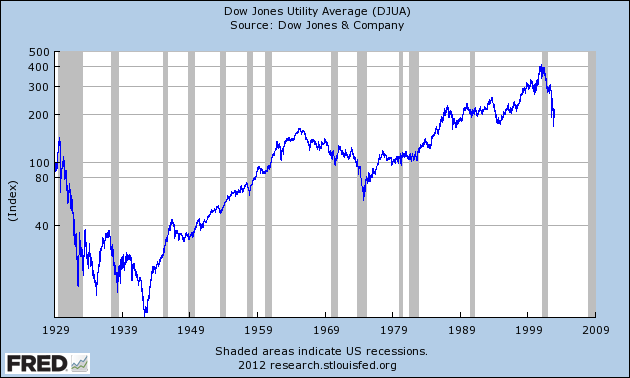
I’m buy-and-hold but it depends a lot on what you buy and what you hold.
-
Morning News: October 10, 2012
Posted by Eddy Elfenbein on October 10th, 2012 at 7:23 amEurope Still at Odds Over the Workings of Its Bailout Fund
Greek Reform Pledge On Trial As State Sales Resume
Japan Calls China PBOC Chief Skipping IMF Meeting ‘Regrettable’
China Slams Congressional Charges Against Its Telecom Firms Huawei And ZTE
India’s Embrace of Foreign Retailers
U.S. Stocks Drop Before Alcoa Report as IMF Cuts Growth Forecast
Fiscal Cliff May Be Felt Gradually, Analysts Say
Government Sues Wells Fargo For Reckless Lending Practices
Wal-Mart and AmEx in Prepaid Card Deal
Bain Capital Buys Maker of Craftsman Tools in $1.6 Billion Deal
GOLDMAN: A Significant Tax Hike Is Coming, And Neither Party Is Even Talking About Stopping It
EADS, BAE In Last-Ditch Struggle To Save Merger
Facebook Fought SEC to Keep Mobile Risks Hidden Before IPO Crash
Joshua Brown: Fast Money: The Apple Dip Debate!
Cullen Roche: Is The Volatility Index Really That Low?
Be sure to follow me on Twitter.
-
The Market Top Five Years On
Posted by Eddy Elfenbein on October 9th, 2012 at 12:21 pmFive years ago today, the S&P 500 had its all-time high close of 1,565.15. The index closed yesterday 6.98% below its all-time high close.
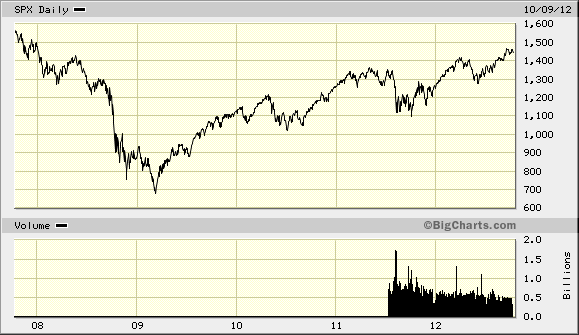
Here’s a look at how sector ETFs have done since the market top. These returns include dividends.
Staples ($XLP) +47.1%
Discretionaries ($XLY) 34.6%
Healthcare ($XLV) 24.0%
Technology ($XLK) 18.0%
Utility ($XLU) 6.9%
Energy ($XLE) 4.6%
S&P 500 ($SPY) 3.2%
Industrials ($XLI) -2.2%
Materials ($XLB) -4.5%
Financials ($XLF) -49.9% -
4% of Trading Activity Last Week Was Due to a Mysterious Algorithm
Posted by Eddy Elfenbein on October 9th, 2012 at 11:50 amA single mysterious computer program that placed orders — and then subsequently canceled them — made up 4 percent of all quote traffic in the U.S. stock market last week, according to the top tracker of high-frequency trading activity. The motive of the algorithm is still unclear.
The program placed orders in 25-millisecond bursts involving about 500 stocks, according to Nanex, a market data firm. The algorithm never executed a single trade, and it abruptly ended at about 10:30 a.m. ET Friday.
“Just goes to show you how just one person can have such an outsized impact on the market,” said Eric Hunsader, head of Nanex and the No. 1 detector of trading anomalies watching Wall Street today. “Exchanges are just not monitoring it.”
Hunsader’s sonar picked up that this was a single high-frequency trader after seeing the program’s pattern (200 fake quotes, then 400, then 1,000) repeated over and over. Also, it was being routed from the same place, the Nasdaq.
“My guess is that the algo was testing the market, as high-frequency frequently does,” says Jon Najarian, co-founder of TradeMonster.com. “As soon as they add bandwidth, the HFT crowd sees how quickly they can top out to create latency.” (Read More: Unclear What Caused Kraft Spike: Nanex Founder.)
Translation: The ultimate goal of many of these programs is to gum up the system so it slows down the quote feed to others and allows the computer traders (with their co-located servers at the exchanges) to gain a money-making arbitrage opportunity.
The scariest part of this single program was that its millions of quotes accounted for 10 percent of the bandwidth that is allowed for trading on any given day, according to Nanex. (The size of the bandwidth pipe is determined by a group made up of the exchanges called the Consolidated Quote System.) (Read More: Cuban, Cooperman: Curb High-Frequency Trading.)
“This is pretty out there to see this affect this many stocks at the same time,” said Hunsader, adding that high-frequency traders are doing anything to “tip the odds in their favor.”
-
Morning News: October 9, 2012
Posted by Eddy Elfenbein on October 9th, 2012 at 5:54 amIMF Says Global Recession Risk Grows
EADS, BAE Said to Plan Extra-Time Request to Salvage Deal
Spain Foreclosures Spread to Once Wealthy
Toyota to Nissan Sales Plunge as Chinese Shun Japanese Cars
Recent India Reforms to Boost Foreign InvestmentMegaFon Files for IPO in Biggest Russian Sale Since 2007
Oil Declines a Second Day as Europe Ministers Meet Amid Slowdown
One In Eight Of World Population Going Hungry
Investors’ Billion-Dollar Fraud Fighter
Netflix Rises to Highest Since July After Stock Upgraded
Barclays to Buy Online Assets of ING Groep
American Airlines Is Losing Important Customers
Wal-Mart, Amex Take On Banks With Low-Priced Debit Card
Roger Nusbaum: Fixed Income Allocations
Jeff Carter: Crowdfunding Summit
Be sure to follow me on Twitter.
-
Is Dell a Bargain?
Posted by Eddy Elfenbein on October 8th, 2012 at 12:51 pmHere’s a quick podcast I did with Jeff Reeves of InvestorPlace.
-
Dividends Soar 19.5% in Q3
Posted by Eddy Elfenbein on October 8th, 2012 at 11:42 amAccording to the latest numbers from Standard & Poor’s, dividends are hot. For the third quarter, the S&P 500 paid out an index-adjusted 7.771 in dividends which is an all-time record. That’s an increase of 19.5% over the third quarter of 2011. For the first and second quarters, dividends rose by 15.1% and 14.9% respectively.
For the trailing four quarters, the S&P 500 paid out an index adjusted 29.59 in dividends which is also an all-time record. It just narrowly takes out the previous four-quarter peaked which came in the third quarter of 2008. At the latest prices, that comes to a yield of 2% (note that this is going by trailing payouts, not project). For the year, I think it’s very possible for the S&P 500 to pay out 30.60 in dividends.
Here’s the S&P 500 (in blue, left scale) along with dividends (in black, right scale). The two lines are scaled at a ratio of 50-to-1.
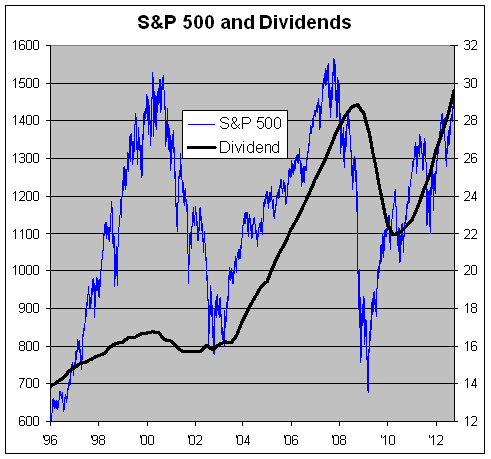
I like to follow dividends because they tend to be stable. During the market plunge of 2008-09, however, dividends took a beating especially in the financial sector. The government wasn’t about to allow bailed out banks to pay funds to their shareholders. As a result, many banks slashed their dividends to the bone.
Only recently have dividends in the financial sector started to some signs of life. Two weeks ago, the Financial Sector ETF ($XLF) paid out a quarterly dividend of 6.6 cents per share. That’s a 32% increase over one year ago, but it wasn’t that long ago that the XLF was paying out more than 20 cents per share.
-
Morning News: October 8, 2012
Posted by Eddy Elfenbein on October 8th, 2012 at 5:55 amShift in Global Growth Engines Signals Gain After Pain
Europe Finance Ministers Meet Amid Spanish Woes
German Trade Surplus Boosted by Strong Exports
East Asia Growth Seen at 11-Year Low on China Slowdown
Japan Carmakers To Cut China Production By Half
US Follows Australia In Naming Huawei As A Possible Security Threat
Bank Profit Leading S&P 500 as U.S. Earnings Growth Sputters
Oil Declines a Second Day as Europe Ministers Meet Amid Slowdown
BAE’s Largest Investor Voices Concerns Over EADS Merger
UN Says Europe Wastes 50% Of Fruit And Vegetables — And America Isn’t Much Better
Business Hiring Calms Concerns About U.S. Fiscal Cliff
Chevy Sonic-to-Fiat 500 Surge in Big Year for Small Cars
Jeff Miller: Weighing the Week Ahead: Entering a Season of Fear?
John Hempton: Carlyle’s China Problem: Some Questions For David Rubenstein
Be sure to follow me on Twitter.
-
Archives
- October 2026
- September 2026
- August 2026
- July 2026
- June 2026
- May 2026
- April 2026
- March 2026
- February 2026
- January 2026
- December 2025
- November 2025
- October 2025
- September 2025
- August 2025
- July 2025
- June 2025
- May 2025
- April 2025
- March 2025
- February 2025
- January 2025
- December 2024
- November 2024
- October 2024
- September 2024
- August 2024
- July 2024
- June 2024
- May 2024
- April 2024
- March 2024
- February 2024
- January 2024
- December 2023
- November 2023
- October 2023
- September 2023
- August 2023
- July 2023
- June 2023
- May 2023
- April 2023
- March 2023
- February 2023
- January 2023
- December 2022
- November 2022
- October 2022
- September 2022
- August 2022
- July 2022
- June 2022
- May 2022
- April 2022
- March 2022
- February 2022
- January 2022
- December 2021
- November 2021
- October 2021
- September 2021
- August 2021
- July 2021
- June 2021
- May 2021
- April 2021
- March 2021
- February 2021
- January 2021
- December 2020
- November 2020
- October 2020
- September 2020
- August 2020
- July 2020
- June 2020
- May 2020
- April 2020
- March 2020
- February 2020
- January 2020
- December 2019
- November 2019
- October 2019
- September 2019
- August 2019
- July 2019
- June 2019
- May 2019
- April 2019
- March 2019
- February 2019
- January 2019
- December 2018
- November 2018
- October 2018
- September 2018
- August 2018
- July 2018
- June 2018
- May 2018
- April 2018
- March 2018
- February 2018
- January 2018
- December 2017
- November 2017
- October 2017
- September 2017
- August 2017
- July 2017
- June 2017
- May 2017
- April 2017
- March 2017
- February 2017
- January 2017
- December 2016
- November 2016
- October 2016
- September 2016
- August 2016
- July 2016
- June 2016
- May 2016
- April 2016
- March 2016
- February 2016
- January 2016
- December 2015
- November 2015
- October 2015
- September 2015
- August 2015
- July 2015
- June 2015
- May 2015
- April 2015
- March 2015
- February 2015
- January 2015
- December 2014
- November 2014
- October 2014
- September 2014
- August 2014
- July 2014
- June 2014
- May 2014
- April 2014
- March 2014
- February 2014
- January 2014
- December 2013
- November 2013
- October 2013
- September 2013
- August 2013
- July 2013
- June 2013
- May 2013
- April 2013
- March 2013
- February 2013
- January 2013
- December 2012
- November 2012
- October 2012
- September 2012
- August 2012
- July 2012
- June 2012
- May 2012
- April 2012
- March 2012
- February 2012
- January 2012
- December 2011
- November 2011
- October 2011
- September 2011
- August 2011
- July 2011
- June 2011
- May 2011
- April 2011
- March 2011
- February 2011
- January 2011
- December 2010
- November 2010
- October 2010
- September 2010
- August 2010
- July 2010
- June 2010
- May 2010
- April 2010
- March 2010
- February 2010
- January 2010
- December 2009
- November 2009
- October 2009
- September 2009
- August 2009
- July 2009
- June 2009
- May 2009
- April 2009
- March 2009
- February 2009
- January 2009
- December 2008
- November 2008
- October 2008
- September 2008
- August 2008
- July 2008
- June 2008
- May 2008
- April 2008
- March 2008
- February 2008
- January 2008
- December 2007
- November 2007
- October 2007
- September 2007
- August 2007
- July 2007
- June 2007
- May 2007
- April 2007
- March 2007
- February 2007
- January 2007
- December 2006
- November 2006
- October 2006
- September 2006
- August 2006
- July 2006
- June 2006
- May 2006
- April 2006
- March 2006
- February 2006
- January 2006
- December 2005
- November 2005
- October 2005
- September 2005
- August 2005
- July 2005
 Eddy Elfenbein is a Washington, DC-based speaker, portfolio manager and editor of the blog Crossing Wall Street. His