-
Morning News: October 10, 2012
Posted by Eddy Elfenbein on October 10th, 2012 at 7:23 amEurope Still at Odds Over the Workings of Its Bailout Fund
Greek Reform Pledge On Trial As State Sales Resume
Japan Calls China PBOC Chief Skipping IMF Meeting ‘Regrettable’
China Slams Congressional Charges Against Its Telecom Firms Huawei And ZTE
India’s Embrace of Foreign Retailers
U.S. Stocks Drop Before Alcoa Report as IMF Cuts Growth Forecast
Fiscal Cliff May Be Felt Gradually, Analysts Say
Government Sues Wells Fargo For Reckless Lending Practices
Wal-Mart and AmEx in Prepaid Card Deal
Bain Capital Buys Maker of Craftsman Tools in $1.6 Billion Deal
GOLDMAN: A Significant Tax Hike Is Coming, And Neither Party Is Even Talking About Stopping It
EADS, BAE In Last-Ditch Struggle To Save Merger
Facebook Fought SEC to Keep Mobile Risks Hidden Before IPO Crash
Joshua Brown: Fast Money: The Apple Dip Debate!
Cullen Roche: Is The Volatility Index Really That Low?
Be sure to follow me on Twitter.
-
The Market Top Five Years On
Posted by Eddy Elfenbein on October 9th, 2012 at 12:21 pmFive years ago today, the S&P 500 had its all-time high close of 1,565.15. The index closed yesterday 6.98% below its all-time high close.
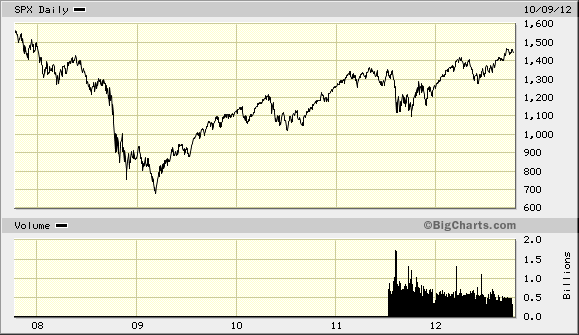
Here’s a look at how sector ETFs have done since the market top. These returns include dividends.
Staples ($XLP) +47.1%
Discretionaries ($XLY) 34.6%
Healthcare ($XLV) 24.0%
Technology ($XLK) 18.0%
Utility ($XLU) 6.9%
Energy ($XLE) 4.6%
S&P 500 ($SPY) 3.2%
Industrials ($XLI) -2.2%
Materials ($XLB) -4.5%
Financials ($XLF) -49.9% -
4% of Trading Activity Last Week Was Due to a Mysterious Algorithm
Posted by Eddy Elfenbein on October 9th, 2012 at 11:50 amA single mysterious computer program that placed orders — and then subsequently canceled them — made up 4 percent of all quote traffic in the U.S. stock market last week, according to the top tracker of high-frequency trading activity. The motive of the algorithm is still unclear.
The program placed orders in 25-millisecond bursts involving about 500 stocks, according to Nanex, a market data firm. The algorithm never executed a single trade, and it abruptly ended at about 10:30 a.m. ET Friday.
“Just goes to show you how just one person can have such an outsized impact on the market,” said Eric Hunsader, head of Nanex and the No. 1 detector of trading anomalies watching Wall Street today. “Exchanges are just not monitoring it.”
Hunsader’s sonar picked up that this was a single high-frequency trader after seeing the program’s pattern (200 fake quotes, then 400, then 1,000) repeated over and over. Also, it was being routed from the same place, the Nasdaq.
“My guess is that the algo was testing the market, as high-frequency frequently does,” says Jon Najarian, co-founder of TradeMonster.com. “As soon as they add bandwidth, the HFT crowd sees how quickly they can top out to create latency.” (Read More: Unclear What Caused Kraft Spike: Nanex Founder.)
Translation: The ultimate goal of many of these programs is to gum up the system so it slows down the quote feed to others and allows the computer traders (with their co-located servers at the exchanges) to gain a money-making arbitrage opportunity.
The scariest part of this single program was that its millions of quotes accounted for 10 percent of the bandwidth that is allowed for trading on any given day, according to Nanex. (The size of the bandwidth pipe is determined by a group made up of the exchanges called the Consolidated Quote System.) (Read More: Cuban, Cooperman: Curb High-Frequency Trading.)
“This is pretty out there to see this affect this many stocks at the same time,” said Hunsader, adding that high-frequency traders are doing anything to “tip the odds in their favor.”
-
Morning News: October 9, 2012
Posted by Eddy Elfenbein on October 9th, 2012 at 5:54 amIMF Says Global Recession Risk Grows
EADS, BAE Said to Plan Extra-Time Request to Salvage Deal
Spain Foreclosures Spread to Once Wealthy
Toyota to Nissan Sales Plunge as Chinese Shun Japanese Cars
Recent India Reforms to Boost Foreign InvestmentMegaFon Files for IPO in Biggest Russian Sale Since 2007
Oil Declines a Second Day as Europe Ministers Meet Amid Slowdown
One In Eight Of World Population Going Hungry
Investors’ Billion-Dollar Fraud Fighter
Netflix Rises to Highest Since July After Stock Upgraded
Barclays to Buy Online Assets of ING Groep
American Airlines Is Losing Important Customers
Wal-Mart, Amex Take On Banks With Low-Priced Debit Card
Roger Nusbaum: Fixed Income Allocations
Jeff Carter: Crowdfunding Summit
Be sure to follow me on Twitter.
-
Is Dell a Bargain?
Posted by Eddy Elfenbein on October 8th, 2012 at 12:51 pmHere’s a quick podcast I did with Jeff Reeves of InvestorPlace.
-
Dividends Soar 19.5% in Q3
Posted by Eddy Elfenbein on October 8th, 2012 at 11:42 amAccording to the latest numbers from Standard & Poor’s, dividends are hot. For the third quarter, the S&P 500 paid out an index-adjusted 7.771 in dividends which is an all-time record. That’s an increase of 19.5% over the third quarter of 2011. For the first and second quarters, dividends rose by 15.1% and 14.9% respectively.
For the trailing four quarters, the S&P 500 paid out an index adjusted 29.59 in dividends which is also an all-time record. It just narrowly takes out the previous four-quarter peaked which came in the third quarter of 2008. At the latest prices, that comes to a yield of 2% (note that this is going by trailing payouts, not project). For the year, I think it’s very possible for the S&P 500 to pay out 30.60 in dividends.
Here’s the S&P 500 (in blue, left scale) along with dividends (in black, right scale). The two lines are scaled at a ratio of 50-to-1.
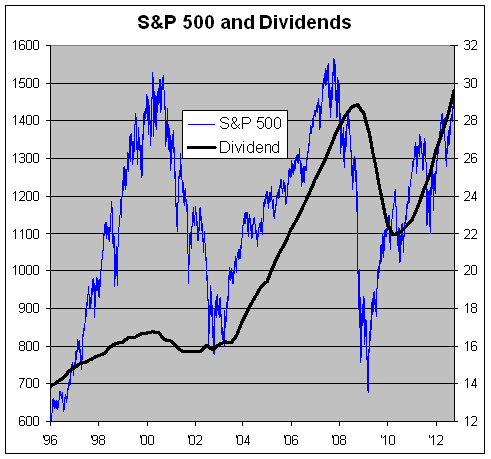
I like to follow dividends because they tend to be stable. During the market plunge of 2008-09, however, dividends took a beating especially in the financial sector. The government wasn’t about to allow bailed out banks to pay funds to their shareholders. As a result, many banks slashed their dividends to the bone.
Only recently have dividends in the financial sector started to some signs of life. Two weeks ago, the Financial Sector ETF ($XLF) paid out a quarterly dividend of 6.6 cents per share. That’s a 32% increase over one year ago, but it wasn’t that long ago that the XLF was paying out more than 20 cents per share.
-
Morning News: October 8, 2012
Posted by Eddy Elfenbein on October 8th, 2012 at 5:55 amShift in Global Growth Engines Signals Gain After Pain
Europe Finance Ministers Meet Amid Spanish Woes
German Trade Surplus Boosted by Strong Exports
East Asia Growth Seen at 11-Year Low on China Slowdown
Japan Carmakers To Cut China Production By Half
US Follows Australia In Naming Huawei As A Possible Security Threat
Bank Profit Leading S&P 500 as U.S. Earnings Growth Sputters
Oil Declines a Second Day as Europe Ministers Meet Amid Slowdown
BAE’s Largest Investor Voices Concerns Over EADS Merger
UN Says Europe Wastes 50% Of Fruit And Vegetables — And America Isn’t Much Better
Business Hiring Calms Concerns About U.S. Fiscal Cliff
Chevy Sonic-to-Fiat 500 Surge in Big Year for Small Cars
Jeff Miller: Weighing the Week Ahead: Entering a Season of Fear?
John Hempton: Carlyle’s China Problem: Some Questions For David Rubenstein
Be sure to follow me on Twitter.
-
Highest Close Since 2007
Posted by Eddy Elfenbein on October 5th, 2012 at 10:24 amThe market is up on today’s jobs report. If the S&P 500 holds up, this will be our highest close since December 28, 2007.
Here are some more facts about the jobs market.
For the jobs-to-population ratio to be what it was 12 years ago, we’d need 13.5 million more jobs, or 21 million fewer people.
Since March 2001, the economy has created 999,000 net new jobs.
Since June 2005, the U.S. economy has created a grand total of -107,000 net jobs.
In 25 months, the U.S. economy lost 8.779 million jobs. Over the next 31 months, we gained back 4.256 million, or 48.5% of what we lost.
The number of Americans in the civilian non-institutional population over the age of 16 without a job now stands at 100.798 million.
-
September Unemployment = 7.8%
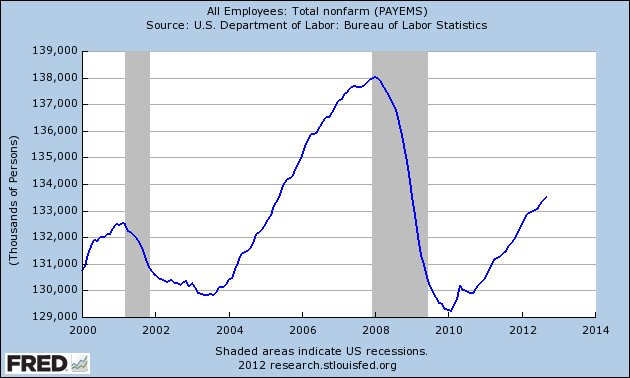
Posted by Eddy Elfenbein on October 5th, 2012 at 8:30 amThe jobs numbers are out! The U.S. economy created 114,000 jobs last month. The revisions for July and August were 86,000.
Most surprisingly, the unemployment rate dropped down to 7.8%.
-
CWS Market Review – October 5, 2012
Posted by Eddy Elfenbein on October 5th, 2012 at 8:12 am“The best stock to buy may be the one you already own.” – Peter Lynch
I’m writing today’s CWS Market Review early on Friday morning so I don’t have the results of September’s jobs report (be sure to check the blog for complete coverage). The jobs report will probably be out by the time you’re reading this. But I can say that Wall Street has very modest expectations. The consensus is for a gain of 115,000 jobs. While that’s better than nothing (or a loss), it’s not very robust growth. The rule of thumb is that you need at least 150,000 new jobs each month to bring down the unemployment rate. The ADP report on Wednesday was better-than-expected so that may be a positive omen for today’s report.
The stock market seems, for the time being, to have regained its footing. The S&P 500 has rallied all four days this week, and on Thursday, the index closed at its highest level since September 14th. The stock market is a mere 0.3% away from closing at a 57-month high. A good jobs report could carry us across the line.
Unfortunately, I can’t sound the “all clear” siren just yet. We still have an election to get through, plus more drama in Europe, and most importantly, third-quarter earnings season is only a few days away. I still believe that we’re in for a few bumpy weeks, and I urge investors to be especially cautious right now. But there is some good news to report: Analysts on Wall Street had spent much of this year paring back their earnings forecasts, which the market has mostly ignored, but estimates have stopped trending downward recently. That’s good to see.
In this issue of CWS Market Review, I want to say a few words about politics and its impact on the stock market. I don’t like to write about politics but I will discuss mistakes investors make, and a biggie is letting your political views interfere with a sound investment strategy. I’ll also let you know which stocks on our Buy List look especially attractive right now. (Here’s a preview: Expect to see a very impressive earnings beat from JPMorgan next week.) But first, let’s look at why elections aren’t so important in the eyes of your stock portfolio.
Don’t Let Politics Interfere With Your Investing
You wouldn’t know it from reading much of the financial commentary but the stock market has had an amazing run. In one year and one day from the 2011 low, the S&P 500 has gained nearly 32% while the Dow has added a cool 2,920 points. That’s more than the whole thing was worth 25 years ago.
I’m also happy to report that our Buy List has continued to thrive. Over the last nine weeks, our Buy List has gained 10.65% compared with just 7.06%. And on Thursday, Buy List standouts Fiserv ($FISV), Medtronic ($MDT) and Hudson City ($HCBK) all hit fresh 52-week highs. Plus, Sysco ($SYY) and Harris ($HRS) made news highs earlier this week. If you recall from last week’s newsletter, I urge you to focus on high-yielding Buy List stocks.
I was amused this week when I heard market pundits attribute Thursday’s rally to Mitt Romney’s debate performance. Sure, that could be the reason, but honestly, I doubt it. For one, this theory conveniently skips over the fact that the market opened slightly on Thursday. The rally continued throughout the day, well after the market had the opportunity to digest the outcome of the debate.
This argument beings me to a mistake that too many investors make—they let their political opinions seep into their investing strategy. I like to call this the “Larry Kudlow Fallacy,” after the CNBC pundit and former Reagan official who can always find his political views confirmed by whatever happened on Wall Street that day.
Don’t mistake me as saying that the market doesn’t care about policy. Public policy can have a major impact on the financial markets. But the market is surprisingly indifferent to the standard back-and-forth bickering of partisan politics. Stock prices are chiefly concerned with earnings and interest rates, and very little else.
The stock market has performed well under Republicans and Democrats. The market has performed poorly under both as well. And of course, just because one party controls the executive mansion doesn’t mean that they have absolute power. Presidents routinely find their agendas frustrated by Congress or the courts or even public opinion. Any investor who bailed out when President Obama took office missed one of the greatest rallies in history.
I’ll give you an example of a small story that’s probably far more important to stocks and bonds than anything discussed at the debates. The minutes from the FOMC’s September meeting indicate that several members believe the Fed ought to tie their interest rate policy to some economic metric. The minutes didn’t specify which metrics were discussed. If they mean employment, that probably means that short-term rates will stay low for quite some time. This would be a huge benefit for dividend-paying stocks, and companies like Nicholas Financial ($NICK) that rely on short-term funding.
In fact, a bigger event for U.S. stock prices may not even be happening in this country. Over the past few days, the Iranian currency has completely fallen apart. The Iranian rial plunged 59% in one week. I won’t even try to guess what the fallout will be.
Let’s remember the important lesson: The key for being a successful investor is being disciplined. You need to be disciplined in the stocks you select. Disciplined in when you sell. And most importantly, you must be disciplined in holding on during lousy markets. All of these involve holding your emotions at bay, and people can be very passionate about politics. Don’t let the elections rattle you or change your strategy of investing in high-quality stocks. Once the election passes, I see a strong year-end rally forming especially for our stocks on the Buy List.
Expect an Earnings Beat from JPM
Here are a few notes on some of our Buy List stocks. I continue to like Ford ($F) a lot. If you can get it below $10 per share, then you’ve gotten a very good deal. Truck sales at Ford are pace for their best year since 2007. Ford is a buy up to $12.
The fraud suit brought against JPMorgan Chase ($JPM) made a lot of news this week, but there’s less there than meets the eye. I think this was a bit of political grandstanding before the election. Plus, all this happened with Bears Stearns which the government pleaded with JPM to buy.
Look for another good earnings report from JPM next Thursday, October 11. Wall Street currently expects earnings of $1.21 per share. My numbers say that JPM will easily beat that. JPMorgan is a good buy up to $43 per share.
One of the best values on our Buy List is Moog ($MOG-A). At $38, the stock is a very strong buy. I rate Moog a strong buy up to $45.
Before I go I want to say that I was impressed by this week’s ISM report which finally ticked back over 50. The report came in at 51.5. Any number above 50 means that the manufacturing sector is expanding. This was the best report since May.
That’s all for now. We’ll get some early earnings reports next week. The first Buy List stock to report will be JPMorgan which reports on Thursday. Look for a big earnings beat. I’ll also be curious to see the Fed’s Beige Book which comes out on Wednesday. Be sure to keep checking the blog for daily updates. I’ll have more market analysis for you in the next issue of CWS Market Review!
– Eddy
-
Archives
- October 2026
- September 2026
- August 2026
- July 2026
- June 2026
- May 2026
- April 2026
- March 2026
- February 2026
- January 2026
- December 2025
- November 2025
- October 2025
- September 2025
- August 2025
- July 2025
- June 2025
- May 2025
- April 2025
- March 2025
- February 2025
- January 2025
- December 2024
- November 2024
- October 2024
- September 2024
- August 2024
- July 2024
- June 2024
- May 2024
- April 2024
- March 2024
- February 2024
- January 2024
- December 2023
- November 2023
- October 2023
- September 2023
- August 2023
- July 2023
- June 2023
- May 2023
- April 2023
- March 2023
- February 2023
- January 2023
- December 2022
- November 2022
- October 2022
- September 2022
- August 2022
- July 2022
- June 2022
- May 2022
- April 2022
- March 2022
- February 2022
- January 2022
- December 2021
- November 2021
- October 2021
- September 2021
- August 2021
- July 2021
- June 2021
- May 2021
- April 2021
- March 2021
- February 2021
- January 2021
- December 2020
- November 2020
- October 2020
- September 2020
- August 2020
- July 2020
- June 2020
- May 2020
- April 2020
- March 2020
- February 2020
- January 2020
- December 2019
- November 2019
- October 2019
- September 2019
- August 2019
- July 2019
- June 2019
- May 2019
- April 2019
- March 2019
- February 2019
- January 2019
- December 2018
- November 2018
- October 2018
- September 2018
- August 2018
- July 2018
- June 2018
- May 2018
- April 2018
- March 2018
- February 2018
- January 2018
- December 2017
- November 2017
- October 2017
- September 2017
- August 2017
- July 2017
- June 2017
- May 2017
- April 2017
- March 2017
- February 2017
- January 2017
- December 2016
- November 2016
- October 2016
- September 2016
- August 2016
- July 2016
- June 2016
- May 2016
- April 2016
- March 2016
- February 2016
- January 2016
- December 2015
- November 2015
- October 2015
- September 2015
- August 2015
- July 2015
- June 2015
- May 2015
- April 2015
- March 2015
- February 2015
- January 2015
- December 2014
- November 2014
- October 2014
- September 2014
- August 2014
- July 2014
- June 2014
- May 2014
- April 2014
- March 2014
- February 2014
- January 2014
- December 2013
- November 2013
- October 2013
- September 2013
- August 2013
- July 2013
- June 2013
- May 2013
- April 2013
- March 2013
- February 2013
- January 2013
- December 2012
- November 2012
- October 2012
- September 2012
- August 2012
- July 2012
- June 2012
- May 2012
- April 2012
- March 2012
- February 2012
- January 2012
- December 2011
- November 2011
- October 2011
- September 2011
- August 2011
- July 2011
- June 2011
- May 2011
- April 2011
- March 2011
- February 2011
- January 2011
- December 2010
- November 2010
- October 2010
- September 2010
- August 2010
- July 2010
- June 2010
- May 2010
- April 2010
- March 2010
- February 2010
- January 2010
- December 2009
- November 2009
- October 2009
- September 2009
- August 2009
- July 2009
- June 2009
- May 2009
- April 2009
- March 2009
- February 2009
- January 2009
- December 2008
- November 2008
- October 2008
- September 2008
- August 2008
- July 2008
- June 2008
- May 2008
- April 2008
- March 2008
- February 2008
- January 2008
- December 2007
- November 2007
- October 2007
- September 2007
- August 2007
- July 2007
- June 2007
- May 2007
- April 2007
- March 2007
- February 2007
- January 2007
- December 2006
- November 2006
- October 2006
- September 2006
- August 2006
- July 2006
- June 2006
- May 2006
- April 2006
- March 2006
- February 2006
- January 2006
- December 2005
- November 2005
- October 2005
- September 2005
- August 2005
- July 2005
 Eddy Elfenbein is a Washington, DC-based speaker, portfolio manager and editor of the blog Crossing Wall Street. His