-
Morning News: September 27, 2012
Posted by Eddy Elfenbein on September 27th, 2012 at 6:32 amMarkets Falter in Europe Amid Protests on Austerity
Focus Turns to Spanish Budget Plan
Hollande Struggles to Match Sarkozy Budget-Gap Wins
China Stocks Jump Most in Three Weeks on Market Support Prospect
Yuan Snaps Two-Day Gain as PBOC Cuts Fixing Amid Growth Concern
Oil Recovers From Eight-Week Low After U.S. Inventories Dropped
Fracking Makes U.S. Surprise Energy Power
Gold Prices Crawl Back From Two-Week Lows
Banks Fail to Repel Cyber Threat
Beyond Wall St., Curbs on High-Speed Trades Proceed
Toyota Moves to Revamp Its Lexus Luxury Line
VW Says Some Carmakers May Go Bankrupt Without Assistance
H&M Profit Misses Analyst Estimates as Gap to Inditex Widens
Howard Lindzon: Google will be the First Trillion Dollar Company
Phil Pearlman: High Reactivity: Neurotic Market Continues
Be sure to follow me on Twitter.
-
The Importance of Extreme Events
Posted by Eddy Elfenbein on September 26th, 2012 at 11:05 pmOver the 116 years of its existence, the Dow Jones Industrial Average has risen by 4% or more in a single day 138 times, which works out to about once every ten months.
Now if we take the combined gain of these 138 days, it comes to more than six times the entire gain of the Dow over its entire 116 years.
In other words, most of the stock market’s gain has come on just 0.5% of the trading days. The other 99.5% of the time, the market is a net loser (this is just capital gain, not dividends).
Now let me stop for a second. While these stats are accurate, they’re slightly misleading. The problem happens with extreme events — at the far tails of the distribution. For example, the 138 days aren’t evenly spread out. Seventy of those days, a slim majority, came during the 1930s. There were only two 4% or more days between Pearl Harbor and JFK’s assassination.
The lesson is that finance tends to move in two speeds. The vast majority is slow and boring. Then, very suddenly, things get very, very dramatic.
-
Dividend Guy’s Stock Screen
Posted by Eddy Elfenbein on September 26th, 2012 at 4:03 pmI’m not usually a fan of stock screens. I think they’re fine when looking for good prospects but I caution investors not to blindly follow them.
I do like the five criteria list at The Dividend Guy.
1. Yield above 3%. I would say “above market,” but 3% is a good rule of thumb.
2. Five-year dividend growth rate over 1%. Basically, a rising dividend even if it’s small.
3. ROE over 10%. Yep, that’s always good. That means a company is probably healthy.
4. Five-year income growth over 1%. This one I’m not so sure about. The problem, of couse, is that the last five years have been very atypical. Many well-run companies have seen their profits plunge.
5. Dividend payout under 75%. Meaning less than three-fourths of their profits should be paid out. That’s good because it would eliminate companies that don’t have confident plans for future growth.
The longer I invest, the more impressed I am with dividends. There are several reasons why. They’re easy to follow. Unlike accounting earnings, you know exactly what you’re getting. Dividends also tend to be “sticky,” meaning most companies have an implicit promise to maintain their dividend at the same level, or possibly increase it.
-
The Presidential Election Cycle
Posted by Eddy Elfenbein on September 26th, 2012 at 9:58 amI don’t put too much faith in seasonal trading patterns but I do find them interesting from an historical perspective.
A few years ago, I took the entire Dow from its inception and worked out what the average four-year presidential election cycle looks like.
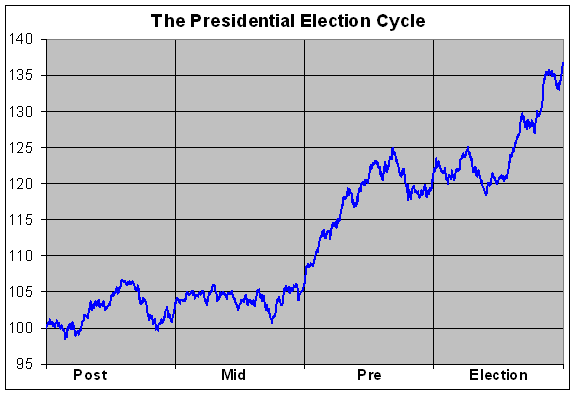
The second half of the election year has been one of the best times for the market. The Dow has gained an average of 14.5% during those six months. The good mood lasts until September of the year following the election. After that, the market enters a lousy patch that doesn’t end until the mid-term election.
-
The S&P 500’s First 1% Drop in Two Months
Posted by Eddy Elfenbein on September 26th, 2012 at 9:27 amFor the first time in two months, the S&P 500 lost more than 1% yesterday. The market didn’t start out so poor yesterday but traders got nervous after Charles Plosser, the head of the Philadelphia Fed, said that QE3 won’t work. Specifically, Plosser said that by pinning so much on the policy, the Fed is risking its credibility. My initial reaction is that I’m afraid that happened a long time ago.
The market slowly moved down towards yesterday’s closing bell. Financial stocks were particularly hard hit. Members of our Buy List like AFLAC ($AFL), JPMorgan Chase ($JPM) and Nicholas Financial ($NICK) were surprising losers.
The market is still nervous about events in Europe. The austerity policies have led to more riots in Greece. There are also protests in Spain and bond yields there are back over 6%. The government there is prepared to ask for a bailout. In China, the Shanghai Composite has fallen to a 3.5-year low.
The key metric that’s on everyone’s mind is the bond market in Europe. The authorities there have made it clear that they intend to defend the euro. That would lead me to believe that yield spreads would tighten. That had been happening but now the yields are moving in the other direction.
-
Morning News: September 26, 2012
Posted by Eddy Elfenbein on September 26th, 2012 at 6:28 amRajoy Bets Italian Woes May Ease Spain Rescue Terms
Greece Hit By 24-Hour General Strike Ahead of New Budget Cuts
Germany Clears Last Hurdle To ESM Bailout Fund Ratification
RBS Instant Messages Show Libor Rates Skewed for Traders
Toyota Joins Nissan in Saying Deeper China Output Cuts Loom
AngloGold Mines Halted in South Africa as Strikes Spread
Housing Market Displays New Vigor as Prices Rise
Consumer Confidence in U.S. Rises to a Seven-Month High
Tesla Cuts Revenue Outlook, Unveils Plan to Sell More Shares
U.S. Regulators Order Discover to Pay $214 Million to End Probe
EU Rejects US Claim To Have Weaned Boeing Off Subsidies
ICAP Sees First-Half Revenue Down 14% on ‘Subdued’ Markets
Barnes & Noble Tablets Aim for Niche Below iPad
Jeff Carter: Meaningful Tidbits of Information-Job Creation and Bain Capital
Cullen Roche: When the Egos of Capitalists Ruin a Good Thing…
Be sure to follow me on Twitter.
-
DirecTV Hits 52-Week High
Posted by Eddy Elfenbein on September 25th, 2012 at 1:29 pmFrom Bloomberg:
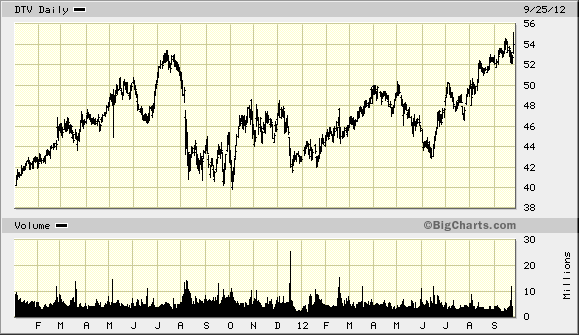
DirecTV (DTV), the largest U.S. satellite-television provider, rose to a record high after Hudson Square Research upgraded the stock to buy from hold.
The shares climbed 3.2 percent to $54.39 at 12:09 p.m. in New York. DirecTV, already up 23 percent this year, rose as much as 4.7 percent to $55.17 earlier in the session, reaching the highest level since the stock began trading in 1985.
-
Drunken Profits
Posted by Eddy Elfenbein on September 25th, 2012 at 11:15 amJosh Brown highlights this amusing tale from the London Telegraph:
It’s probably not uncommon for City traders to wonder how they burnt so much cash during a drunken night on the town.
But Steve Perkins was left with a bigger black hole in his memory than most when his employer rang one morning to ask what he’d done with $520m of the oil trading firm’s money.
It was 7.45am on June 30 last year when the senior, longstanding broker for PVM Oil Futures was contacted by an admin clerk querying why he’d bought 7m barrels of crude in the middle of the night.
The 34-year old broker at first claimed he had spent the night trading alongside a client. But the story began to fall apart when he refused to put the customer in touch with his desk for official approval of the trades.
By 10am it emerged that Mr Perkins had single-handedly moved the global price of oil to an eight-month high during a “drunken blackout”. Prices leapt by more than $1.50 a barrel in under half an hour at around 2am – the kind of sharp swing caused by events of geo-political significance. Ten times the usual volume of futures contracts changed hands in just one hour.
Oopsie.
-
Scattered Thoughts
Posted by Eddy Elfenbein on September 25th, 2012 at 10:55 amThe stock market is up again this morning but only by a modest amount. The market was helped by a strong Case-Shiller report and news that consumer confidence rose to a seven-month high.
I want to pass on a few scattered unrelated thoughts about some stocks.
FactSet Research Systems ($FDS) is down today even though they beat earnings and guided inline. I like this company a lot and it used to be a Buy List member. Unfortunately, I think the price is way too high. I wish it would come down a lot.
I often tell investors to ignore what happens to stocks after you sell them. Of course, I ignore this advice all the time only to my detriment. Of last year’s sells, I see that Gilead ($GILD) is up over 65% this year, Deluxe ($DLX) is up by 38% and Abbott Labs ($ABT) is up by 25%. Deep sigh.
I’ve been watching Global Payments ($GPN) lately. The stock was crushed earlier this year due to an embarrassing security breach. You’ll notice that many good bargains often have dents and scratches in them, but the question is how damaging are they. GPN still looks like a strong business. They report earnings tomorrow. The stock should probably be about $10 higher but I understand the market’s reticence. I’m not saying it’s a clear buy but it’s one to watch.
Seneca Foods ($SENEA) is one of those odd stocks I love. No one follows them but they continue to prosper. The stock is at a new 52-week high.
Cummins ($CMI) seems to be a very attractive stock. I’m surprised the stock is so low. The same could be said for Crane ($CR).
-
Morning News: September 25, 2012
Posted by Eddy Elfenbein on September 25th, 2012 at 6:30 amMerkel Says Markets Worried About Euro States Repaying Debt
The Trade-Off That Created Germany’s Job Miracle
Draghi Rally Lets Skeptics Dump Spain for Bunds
Spain Presses ECB to Quantify Bond Purchases as Bill Yields Rise
IMF No ‘Yes-Man’ For Euro Zone, Lagarde Says
I.M.F.’s Call for More Cuts Irks Greece
South Africa Warms To Shale Gas
Riot at Foxconn Factory Underscores Rift in China
Williams Says Fed to Pursue QE3 Until Job Market Rebounds
After U.S. Inquiries, Discover Agrees to Refund Some Credit Protection Fees
Jump in Home Deliveries Boosts Lennar’s Profit
Verizon to Pay More Than $510 Million to TiVo, ActiveVideo
Roger Nusbaum: Something No One Needs
Be sure to follow me on Twitter.
-
Archives
- October 2026
- September 2026
- August 2026
- July 2026
- June 2026
- May 2026
- April 2026
- March 2026
- February 2026
- January 2026
- December 2025
- November 2025
- October 2025
- September 2025
- August 2025
- July 2025
- June 2025
- May 2025
- April 2025
- March 2025
- February 2025
- January 2025
- December 2024
- November 2024
- October 2024
- September 2024
- August 2024
- July 2024
- June 2024
- May 2024
- April 2024
- March 2024
- February 2024
- January 2024
- December 2023
- November 2023
- October 2023
- September 2023
- August 2023
- July 2023
- June 2023
- May 2023
- April 2023
- March 2023
- February 2023
- January 2023
- December 2022
- November 2022
- October 2022
- September 2022
- August 2022
- July 2022
- June 2022
- May 2022
- April 2022
- March 2022
- February 2022
- January 2022
- December 2021
- November 2021
- October 2021
- September 2021
- August 2021
- July 2021
- June 2021
- May 2021
- April 2021
- March 2021
- February 2021
- January 2021
- December 2020
- November 2020
- October 2020
- September 2020
- August 2020
- July 2020
- June 2020
- May 2020
- April 2020
- March 2020
- February 2020
- January 2020
- December 2019
- November 2019
- October 2019
- September 2019
- August 2019
- July 2019
- June 2019
- May 2019
- April 2019
- March 2019
- February 2019
- January 2019
- December 2018
- November 2018
- October 2018
- September 2018
- August 2018
- July 2018
- June 2018
- May 2018
- April 2018
- March 2018
- February 2018
- January 2018
- December 2017
- November 2017
- October 2017
- September 2017
- August 2017
- July 2017
- June 2017
- May 2017
- April 2017
- March 2017
- February 2017
- January 2017
- December 2016
- November 2016
- October 2016
- September 2016
- August 2016
- July 2016
- June 2016
- May 2016
- April 2016
- March 2016
- February 2016
- January 2016
- December 2015
- November 2015
- October 2015
- September 2015
- August 2015
- July 2015
- June 2015
- May 2015
- April 2015
- March 2015
- February 2015
- January 2015
- December 2014
- November 2014
- October 2014
- September 2014
- August 2014
- July 2014
- June 2014
- May 2014
- April 2014
- March 2014
- February 2014
- January 2014
- December 2013
- November 2013
- October 2013
- September 2013
- August 2013
- July 2013
- June 2013
- May 2013
- April 2013
- March 2013
- February 2013
- January 2013
- December 2012
- November 2012
- October 2012
- September 2012
- August 2012
- July 2012
- June 2012
- May 2012
- April 2012
- March 2012
- February 2012
- January 2012
- December 2011
- November 2011
- October 2011
- September 2011
- August 2011
- July 2011
- June 2011
- May 2011
- April 2011
- March 2011
- February 2011
- January 2011
- December 2010
- November 2010
- October 2010
- September 2010
- August 2010
- July 2010
- June 2010
- May 2010
- April 2010
- March 2010
- February 2010
- January 2010
- December 2009
- November 2009
- October 2009
- September 2009
- August 2009
- July 2009
- June 2009
- May 2009
- April 2009
- March 2009
- February 2009
- January 2009
- December 2008
- November 2008
- October 2008
- September 2008
- August 2008
- July 2008
- June 2008
- May 2008
- April 2008
- March 2008
- February 2008
- January 2008
- December 2007
- November 2007
- October 2007
- September 2007
- August 2007
- July 2007
- June 2007
- May 2007
- April 2007
- March 2007
- February 2007
- January 2007
- December 2006
- November 2006
- October 2006
- September 2006
- August 2006
- July 2006
- June 2006
- May 2006
- April 2006
- March 2006
- February 2006
- January 2006
- December 2005
- November 2005
- October 2005
- September 2005
- August 2005
- July 2005
 Eddy Elfenbein is a Washington, DC-based speaker, portfolio manager and editor of the blog Crossing Wall Street. His