-
So the Vietnamese Are Now Better At Enforcing the Rules of Capitalism than We Are
Posted by Eddy Elfenbein on August 23rd, 2012 at 10:39 amWhenever I’m at a dinner party and the subject of the public-education system in the U.S. comes up, inevitably the conversation turns to America’s consistently dismal performance on international standardized tests in math, reading and the rest. When asked what I think would be a challenging yet still doable goal for our nation’s schools to shoot for, I smile and say, “Well, some day, I’d like for us to be in the same league with Estonia.”
I don’t think I’m asking for the moon. I mean, hey, I’m not hoping to compete with, say, Lithuania. Let alone a colossus like Singapore. After all, America’s educational system is still developing.
As it turns out, in the area of market capitalism, too, the U.S. could stand to learn a good deal from other countries—specifically, from one of the last four Communist nations left on earth.
Vietnam is a small country. Market-wise, it has a way to go. Yet to all appearances, the Vietnamese have arrived at some innovative new approaches for dealing with corruption and monetary malfeasance. In Vietnam, if someone does something bad, especially something bad that involves other people’s money, they arrest the offender. Afterwards they proceed to investigate and prosecute that person, regardless of his or her business clout, political ties or potential ability to undermine other financial firms by means of the tentacles they’ve insinuated into crevices in the system.
Exhibit A: On Sunday, the Vietnamese Ministry of Police arrested Ngyuen Duc Kien, the 48-year-old business mogul who founded Vietnam’s Asia Commercial Bank (ACB), one of the country’s top lending institutions. The charges are as yet unspecified; the tight-lipped arresting officers have stated only that Kien was involved in “illegal business” with three private firms.
Kien, though, would appear to have fingers in many different pies in the banquet that, up until very recently, was his country’s developing economy. In addition to being a major shareholder in several Vietnamese banks, he is also the chairman of both the Hanoi Football Club and the V-League, a professional soccer association. He also has close ties to Vietnam’s prime minister, Nguyen Tan Dung, who himself is under suspicion of financial Lehmanism. In 2010, Kien resigned from ACB’s board of directors; the bank’s current vice-president issued a statement online two days ago distancing himself from the disgraced tycoon’s misbehavior, calling the indiscretions a “personal matter” that would not affect his company’s operations.
Kien’s fall comes in the wake of a long financial ride, for both himself and Vietnam. The country boasted one of the fastest-growing Asian economies in the first years of the new millennium, with annual GDP growth cruising along at 7% until the 2008 financial crisis. At this point, the government, hoping to avoid going down with the ship of unbridled Western capitalism, overstimulated the economy, causing inflation to skyrocket to 23% one year ago. The Viet Fed then took away the punchbowl. Construction sites around Hanoi fell silent as scores of major projects failed. At present, the central bank is easing up on the credit bit, hoping to restore a modicum of tranquility to an overheated system.
Needless to say, Kien’s arrest has hit Hanoi’s stock exchange hard; the HNX was down more than 5% on Tuesday, the biggest drop in over four years. ACB’s share price fell first 7% on Monday, then 6.6% on Tuesday. (The maximum daily drop allowed by the regulation-rife Vietnamese government is 7%.) All this is on top of the knot of problems in which Vietnam is already entangled: the country has more bad debt than any other Southeast Asian nation, largely because its bank officers customarily make loans not on the basis of the financial soundness of the projects under consideration, but as a result of cronyism and connections.
The pattern here is eerily familiar. Relaxation of traditional economic restraints. A runaway stock market. Shenanigans at the top by the entitled rich. A sharp crash. But the Vietnamese seem to have maintained their moral clarity about one thing: if predators jeopardize the system through their misdeeds, they have to pay the price.
It wouldn’t the first time Hanoi has understood something Washington hasn’t.
America fell into recession in 2008. Four years and no high-level arrests later, many of us are still wondering about what has happened to our country’s ethical foundation. What has happened to America that the Communists are getting capitalism right, but we’re not?
As police carted Kien away from his Hanoi mansion, a neighbor, Tran Trung Thanh, 33, expressed concern:
“People around here felt very surprised,” he said. “We thought that he’s working in the banking system, so he must be doing clean business.”
-
Big Profits in Little-Followed Companies: Tootsie Roll Industries
Posted by Eddy Elfenbein on August 23rd, 2012 at 9:53 amOne of the mistakes a lot of new investors make is that they assume they need to invest in some revolutionary technology. They think they need to find some outfit that’s inventing the 18th dimension or planning to set up colonies on Pluto.
That’s not the case at all.
Those opportunities do exist like Apple and Google, but they’re very rare. Even Apple was dead money for years, and Google hasn’t done much over the past few years. Instead, investors ought to focus on companies that consistently churn out the profits. If you look around you realize that there’s money to be made everywhere. In fact, it is being made everywhere.
Just because a company seems dull doesn’t mean it’s not worth investors’ attention. Many times, the dull ones are the best. The key to business success is actually quite simple; keep your costs down, be wary of debt, take care of your customers. All the numbers and ratios I refer to are merely reflections of how well a company is keeping faithful to these basic concepts.
I was reminded of this as I read Ben Kesling’s profile of Tootsie Roll Industries ($TR) in the Wall Street Journal. Who would think that the little candy-maker has been enormously profitable? The company has raised its dividend every year since 1966, and the stock is up 100-fold since 1980.
But Tootsie Roll is in a rather unusual position right now. The firm is run by an elderly couple, Melvin and Ellen Gordon, and they’ve become incredibly secretive. Kelsing writes:
The 116-year-old company, run by one of America’s oldest CEOs, has become increasingly secretive over the years, severing nearly all of its connections to the outside world. Tootsie Roll shuns journalists, refuses to hold quarterly earnings calls, and issues crookedly-scanned PDFs for its earnings releases. The last securities industry analyst to maintain coverage of the company stopped last year because it was too hard to get information.
“I think the only way you can get a tour is by jumping over the fence and sneaking in,” said the last analyst to attempt the task, Elliott Schlang of Cleveland firm Great Lakes Review.
Tootsie’s profit margins have come under pressure over the past few years, and the company desperately needs a shake-up. Unfortunately, there’s no clear succession plan. In recent years, large confectioners have snapped up smaller ones, but Tootsie has insisted on remaining by itself.
There’s clearly a lot of untapped potential in Tootsie. My concern is that I have no idea if anyone can try to unleash that anytime soon.
-
Morning News: August 23, 2012
Posted by Eddy Elfenbein on August 23rd, 2012 at 8:05 amFed Signals Readiness to Ease Without U.S. Growth Pickup
German Finance Minister Says Giving Greece More Time Will Not Solve Its Problems
Euro-Zone Business Activity Points to Recession
Marubeni’s $5.6 Billion Gavilon Deal Hits Delay
Manufacturing in China Slows Further
Gold Rises For Seventh Day After Fed Stimulus Surprise
Facebook Wins Antitrust Approval for Instagram Purchase
Facebook Director’s Quick $1 Billion Share Sale Lacks Precedent
Weak Sales and a Large Write-Down Give H.P. a Loss
Hormel Foods 3rd-Quarter Net Rises 13% on Strong Spam, Turkey Sales
Qantas Cancels 787 Order After Posting Annual Net Loss
Steep Profits Drop Adds To ZTE Woes
Diageo Still in Hunt for Jose Cuervo
Credit Writedowns: The Fed, The Interest Income Channel And Net Interest Margins
Howard Lindzon: Peter Thiel is a Genius…You are Just a Taxpayer!
Be sure to follow me on Twitter.
-
Still Staying Away from Dell
Posted by Eddy Elfenbein on August 22nd, 2012 at 12:37 pmI wish I could like Dell ($DELL) more than I do. The cheap price is tempting and I wouldn’t be surprised to see the shares rally from here. The problem for me is that by buying Dell here, I’m taking on more risk than I need to. One of my fundamental rules of investing is to never take risks that I don’t need to. Last month, I said I was staying away from Dell and that’s how I feel today.
Warren Buffett said, “I don’t look to jump over 7-foot bars: I look around for 1-foot bars that I can step over.” That’s my thought about Dell. The company just beat earnings by five cents per share. This is a good example of the quarterly earnings report not meaning much. The big news was that Dell said it expects earnings for the year of $1.70 per share which is down from the previous forecast of $2.13 per share they gave in February.
Earnings downgrades are like cockroaches: there are usually a few more for every one you see. Companies aren’t like athletes who may go into a slump or have an “off day.” If a company lowers its guidance by a lot, there’s probably a major reason why, and that reason isn’t easily fixed.
Dell, once the world’s top personal computer maker and a pioneer in computer supply chain management, is struggling to defend its market share against Asian rivals like Acer and Lenovo and consumers’ fast-growing adoption of tablets like Apple’s iPad in place of PCs.
Dell forecast that its revenue would slide 2 percent to 5 percent in its fiscal third quarter from the second, to $13.8 billion to $14.2 billion. Wall Street had been expecting third-quarter revenue of $14.85 billion.
It is predicting earnings of “at least” $1.70 a share for fiscal 2013, compared with a previous forecast for more than $2.13 a share.
“People had already expected them to take down numbers, but I think the level to which they are taking down numbers is pretty severe compared to expectations,” said Shannon Cross, an analyst at Cross Research.
Dell’s chief financial officer, Brian Gladden, said in an interview that the company had tempered its outlook for the fiscal third quarter partly because it expected distributors to hold off on buying new computers before the late October release of the latest version of Microsoft’s Windows operating system.
Using $1.70 or earnings compared to the new stock price of $11.50 makes Dell appears attractive. But I’m not convinced. I just don’t see much coming out of Dell in the way of growth. Until I’m convinced that Dell can increase its earnings at a stable rate, I don’t see much value in the shares.
-
The Beatles 50 Years Ago Today
Posted by Eddy Elfenbein on August 22nd, 2012 at 10:56 amThis is the first real video of the Beatles from 50 years ago today. Ringo Starr had just replaced Peter Best as drummer. You can even hear someone shout at the very end, “We want Pete!”
-
Morning News: August 22, 2012
Posted by Eddy Elfenbein on August 22nd, 2012 at 8:03 amAsian Stocks Decline on Japan’s Trade Deficit, Greek Bailout
Spain Deficit Goals at Risk as Cuts Consensus Fades
China To Spend $372 Billion On Cutting Energy Use, Pollution
China Raises Rare-Earth Export Quota
RBS Probed Over Possible Iran Sanctions Violations
U.S. Companies Worry About Effect of Russia Joining W.T.O.
Dell Outlook Gloomy as PCs Slump
Nokia’s $39 Phone Rebound Wins More Time for Comeback Bid
Apple Breaks A Record, Facebook Breaks Its Fall
Best Buy Net Sinks as Turmoil Builds
Strong Revenue Boosts Toll Brothers’ Net Profit
Jeff Carter: When Insiders Sell An IPO is it “Bad”?
Pragmatic Capitalism: No Recession Now, But When?
Be sure to follow me on Twitter.
-
Medtronic’s CEO on CNBC
Posted by Eddy Elfenbein on August 21st, 2012 at 2:43 pmHere’s Omar Ishrak, CEO of Medtronic, on CNBC earlier today.
-
Medtronic Earns 85 Cents Per Share
Posted by Eddy Elfenbein on August 21st, 2012 at 11:36 amNot much of a surprise from Medtronic ($MDT) this morning. The company reported fiscal Q1 earnings of 85 cents per share which matched Wall Street’s forecast. I was expecting a little more but I’m not at all disappointed by these results. Revenues were up 1.6% to $4.01 billion..
The world’s biggest medical device maker said sales of coronary and vascular devices and structural heart products all improved. Medtronic said revenue from implantable devices like pacemakers and defibrillators decreased, although it said U.S. sales of implantable defibrillators are holding steady.
Bone graft revenue decreased in the wake of safety concerns and a shareholder lawsuit, and revenue from diabetes and surgical technology and other devices increased.
The earnings-per-share figure got a boost thanks to 3% fewer shares outstanding.
Medtronic said revenue from coronary products increased 11 percent to $433 million. Sales of structural heart devices like artificial valves rose 2 percent to $280 million and endovascular revenue, which includes stents, increased 12 percent to $209 million.
Revenue from the company’s restorative therapy business, which makes surgical devices and products used to treat diabetes, nerve disorders, and other conditions rose 3 percent to $1.89 billion. Medtronic said most of its businesses reported better sales than a year ago, but sales of its Infuse bone graft shrank 19 percent to $141 million during the quarter.
In 2011, a medical journal said Medtronic understated the risks of Infuse and did not disclose payments to the authors of studies on the product. In March 2012, Medtronic agreed to pay $85 million to resolve a federal lawsuit brought by shareholders. The U.S. government closed an investigation into Infuse in May. The product contains a genetically engineered protein that can stimulate bone growth. It is approved for use in spinal, oral and dental graft procedures, and it was frequently used in neck surgeries and other procedures.
The most important news is that Medtronic is reaffirming its full-year earnings forecast of $3.62 to $3.70 per share. Earlier today, the shares got to a new 52-week high.
-
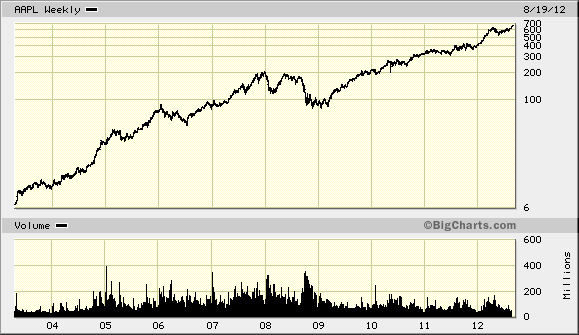
Apple’s Gained 1% a Week, On Average, for 10 Years
Posted by Eddy Elfenbein on August 21st, 2012 at 10:57 amShares of Apple ($AAPL) are up again today making the company not only the most valuable company in the world, but also the company valuable company that’s ever been.
A few days ago, I tweeted that Apple has gained an average of 1% a week for the last ten years. The key word here is on “average.”
Let’s check the math. On April 17, 2003, Apple closed at $13.12. Adjusted for splits, that comes to $6.56. Tomorrow will mark 488 weeks which is roughly nine years and four months.
Going by today’s high of $674.88, Apple is up over 102-fold since April 17, 2003. Compounded per week, that works out to 0.954%. That also doesn’t include the dividend which Apple recently instituted.
-
Is Your Credit-Card Company Secretly Screwing You Over?
Posted by Eddy Elfenbein on August 21st, 2012 at 9:23 amMost credit-card holders don’t realize this, but there’s an easy way to lower your card’s interest rate:
Just ask your provider to do it.
No joke. Just call them up and say in your nicest voice that you’d like your APR lowered. Don’t be rash and threaten to leave or exhibit any histrionics like that. Just say that you’ve been a cardholder for such-and-such period and you’d like to have a lower rate. If you’ve been a good customer, they won’t want you to go.
Surprising? Well, if you’re like most American consumers, and even many financial professionals, there’s a lot about credit cards you don’t know. And it’s exactly this lack of knowledge that has allowed the banks who are in the card business to siphon money out of your pockets for the purpose of lining their own.
Of the approximately 120 million households in the U.S. today, some 47% carry a monthly card balance. On average, that balance totals $14,517—which is actually a significant drop from the five-year high of nearly $18,000 back in 2008. So let’s do the math. Assuming an APR of 20% (which for many cardholders is generously low), after one year that balance is up to $17,420. After another year, it’s at $20,904. Twelve months later, it’s at a whopping $25,084.
If only the S&P index funds performed like that.
So what can you do to avoid getting gutted by the purveyors of plastic? The list is quite simple:
- The best advice is the most obvious: Don’t carry a balance in the first place. The credit-card companies have a name for customers like this: bums. These people are basically getting a service—the convenience of not having to carry cash—for free. Plus your credit score goes up if you consistently pay off your cards in full. Put the cards to work for you.
- Be very, very suspicious of rewards programs. Those bonus points and free air miles that look so appealing in the card company’s brochures frequently don’t add up to much; many of them have hidden fees and blackout dates, and often the range of merchandise you can redeem them for is very limited. If the bargain-hunter in you is too strong and you just can’t resist enrolling, be sure to check the program’s online reviews beforehand, as well as the websites of the airlines you plan on using.
- If you don’t like something, say so. If you’re a customer in good standing and one of your payments arrives a few days late, or your interest rate is too high, most likely you can get the bank to work with you. The intensity of the competition means the banks are eager to keep valued clients. Frequently they will forgive late charges, remove late-payment records from your credit history, drop annual fees, or lower your APR if you’ve shown them you’re a solid customer. Of course, normal rules of courtesy apply. Be polite, but firm.
- Do not, repeat, do not, exceed your credit limit. Oftentimes, when banks lower your limit, they set it at just a few dollars above the balance you’re currently carrying. Sneaky. If you then go over that magic number, not only will you have to pay a hefty over-the-limit fee, but your credit score will drop. Remember, your credit score depends in part on the percentage of your available credit that you use. Use it all, and you’ll be seen as a potential credit hazard by the good people at TRW, Experian, and the like.
- Avoid consumer-protection plans like the plague. These plans offer no benefits whatsoever to customers; if you find yourself out of a job, they freeze your account and charge you an interest rate on your outstanding balance, typically 1%. That’s on top of the ludicrous fees they charge you for this “service” in the first place.
- Be on the lookout for “overseas” charges. When the federal government tightened its credit-card regulations after the 2008 financial debacle, many banks raised their foreign-transaction fees to make up for lost revenue. Many of these rates now hover around 3%, and frequently they apply even when you, the customer, are not overseas. That is, they can be assessed even if you order from a foreign company from within the States, so check your statements carefully.
- Call out the banks on bogus charges. A friend of mine once was car shopping and noticed the abbreviation “ADM” on the list of features for a particular vehicle. When he asked the salesman about it, the latter smugly said it stood for “additional dealer markup.” Incredible, but most people would have been content to pay it, and banks are not above pulling the same scam. Many have teaser rates that suddenly go up at a mystery date that is buried in the cardholder agreement’s fine print, while others charge fees if your card doesn’t show a certain amount of activity per year. (The latter is a way of reinstating inactivity fees, which were technically outlawed by the CARD Act of 2009. Which is to say, the banks want you to pay something for nothing.) Also to be avoided are so-called “upfront processing fees,” which are frequently applied to low-credit-limit cards to get you closer to (and hopefully, over) that credit limit. Thereby incurring more fees, and…well, you get the idea.
Like so many financial organizations, the banks count on you to be ignorant, obedient, and passive. But at the end of the day, remember: they’re there for you, not you for them. There’s no reason for you to pay money you don’t have for services you don’t need to please people you’ve never met.
To paraphrase Gordon Gekko, getting back on track, credit-card-wise, will cure what ails not just your individual bank balance, but the balance sheet of that great malfunctioning financial-services provider that is the U.S.A.
-
Archives
- November 2026
- October 2026
- September 2026
- August 2026
- July 2026
- June 2026
- May 2026
- April 2026
- March 2026
- February 2026
- January 2026
- December 2025
- November 2025
- October 2025
- September 2025
- August 2025
- July 2025
- June 2025
- May 2025
- April 2025
- March 2025
- February 2025
- January 2025
- December 2024
- November 2024
- October 2024
- September 2024
- August 2024
- July 2024
- June 2024
- May 2024
- April 2024
- March 2024
- February 2024
- January 2024
- December 2023
- November 2023
- October 2023
- September 2023
- August 2023
- July 2023
- June 2023
- May 2023
- April 2023
- March 2023
- February 2023
- January 2023
- December 2022
- November 2022
- October 2022
- September 2022
- August 2022
- July 2022
- June 2022
- May 2022
- April 2022
- March 2022
- February 2022
- January 2022
- December 2021
- November 2021
- October 2021
- September 2021
- August 2021
- July 2021
- June 2021
- May 2021
- April 2021
- March 2021
- February 2021
- January 2021
- December 2020
- November 2020
- October 2020
- September 2020
- August 2020
- July 2020
- June 2020
- May 2020
- April 2020
- March 2020
- February 2020
- January 2020
- December 2019
- November 2019
- October 2019
- September 2019
- August 2019
- July 2019
- June 2019
- May 2019
- April 2019
- March 2019
- February 2019
- January 2019
- December 2018
- November 2018
- October 2018
- September 2018
- August 2018
- July 2018
- June 2018
- May 2018
- April 2018
- March 2018
- February 2018
- January 2018
- December 2017
- November 2017
- October 2017
- September 2017
- August 2017
- July 2017
- June 2017
- May 2017
- April 2017
- March 2017
- February 2017
- January 2017
- December 2016
- November 2016
- October 2016
- September 2016
- August 2016
- July 2016
- June 2016
- May 2016
- April 2016
- March 2016
- February 2016
- January 2016
- December 2015
- November 2015
- October 2015
- September 2015
- August 2015
- July 2015
- June 2015
- May 2015
- April 2015
- March 2015
- February 2015
- January 2015
- December 2014
- November 2014
- October 2014
- September 2014
- August 2014
- July 2014
- June 2014
- May 2014
- April 2014
- March 2014
- February 2014
- January 2014
- December 2013
- November 2013
- October 2013
- September 2013
- August 2013
- July 2013
- June 2013
- May 2013
- April 2013
- March 2013
- February 2013
- January 2013
- December 2012
- November 2012
- October 2012
- September 2012
- August 2012
- July 2012
- June 2012
- May 2012
- April 2012
- March 2012
- February 2012
- January 2012
- December 2011
- November 2011
- October 2011
- September 2011
- August 2011
- July 2011
- June 2011
- May 2011
- April 2011
- March 2011
- February 2011
- January 2011
- December 2010
- November 2010
- October 2010
- September 2010
- August 2010
- July 2010
- June 2010
- May 2010
- April 2010
- March 2010
- February 2010
- January 2010
- December 2009
- November 2009
- October 2009
- September 2009
- August 2009
- July 2009
- June 2009
- May 2009
- April 2009
- March 2009
- February 2009
- January 2009
- December 2008
- November 2008
- October 2008
- September 2008
- August 2008
- July 2008
- June 2008
- May 2008
- April 2008
- March 2008
- February 2008
- January 2008
- December 2007
- November 2007
- October 2007
- September 2007
- August 2007
- July 2007
- June 2007
- May 2007
- April 2007
- March 2007
- February 2007
- January 2007
- December 2006
- November 2006
- October 2006
- September 2006
- August 2006
- July 2006
- June 2006
- May 2006
- April 2006
- March 2006
- February 2006
- January 2006
- December 2005
- November 2005
- October 2005
- September 2005
- August 2005
- July 2005
 Eddy Elfenbein is a Washington, DC-based speaker, portfolio manager and editor of the blog Crossing Wall Street. His