-
Morning News: June 25, 2012
Posted by Eddy Elfenbein on June 25th, 2012 at 6:54 amCentral Banks Commit to Ease as Threat of Lost Decades Rises
Banking Union Is an Idea in Search of the Good
Spain Asks For Aid To Recapitalise Banks
Spain: Liar, Liar, Pants on Fire
Germany to Confront United Euro Bloc at Summit
Fitch Cuts Cyprus to Junk as Greek Exposure Hits
Monte dei Paschi Eyes Tremonti Bond
India Boosts Foreign Debt Cap by $5 Billion to Defend Rupee
Thomson Reuters Buys Business Information Service Zawya
Abu Dhabi Wealth Fund Long-Term Returns Drop on Global Decline
Gas Price Dips, but Confidence Stalls
Anheuser Said to Be Near a Deal for Grupo Modelo
Sales of New Homes Probably Rose in U.S. as Mortgage Rates Fell
Hedge Fund Manager to Pay $405 Million in Madoff Settlement
London Olympics to Be Most Over-Budget Games Since Atlanta 1996
Jeff Miller: Weighing the Week Ahead: Time for Some Surprises?
Epicurean Dealmaker: Breakfast in Fur
Be sure to follow me on Twitter.
-
Global Investing
Posted by Eddy Elfenbein on June 23rd, 2012 at 9:47 am -
Dark Side of the Moon
Posted by Eddy Elfenbein on June 22nd, 2012 at 9:16 amThe SEC busted a guy who was running a Ponzi Scheme. The investments decisions were based on lunar cycles. Also, they lost money.
32. However, Persaud did not tell investors that in making at least 90% of his trading decisions, he relied on directional market forecasts based on lunar cycles and gravitational pull provided by an internet service.
33. The primary principle underlying Persaud’s trading strategy was that the gravitational pull between the moon and Earth affects mass human behavior, which in tum affects the stock markets. For example, Persaud believed that when the moon is positioned so there is a greater gravitational pull on humans, they feel down and are therefore more inclined to sell securities in the markets.
34. Persaud failed to disclose he would trade investors’ contributions based on lunar cycles and the gravitational pull between Earth and the moon.
-
Why Short-Term Market Moves Aren’t Important
Posted by Eddy Elfenbein on June 22nd, 2012 at 6:14 am -
Medtronic Raises Dividend for 35th Year in a Row
Posted by Eddy Elfenbein on June 22nd, 2012 at 6:11 amI recently said that I expected Medtronic ($MDT) to raise its dividend for the 35th year in a row. Sure enough, the company announced today that it’s raising its dividend from 24.25 cents per share to 26 cents per share. Going by yesterday’s close, Medtronic yields 2.75%.
-
CWS Market Review – June 22, 2012
Posted by Eddy Elfenbein on June 22nd, 2012 at 5:33 amWith investing, sometimes you’re wrong even when you’re right. In last week’s CWS Market Review, I made a bold prediction. I said that Bed Bath & Beyond ($BBBY) could earn as much as 88 cents per share which was well above both Wall Street’s consensus of 84 cents per share and the company’s own guidance of 79 cents to 83 cents per share.
Well, my bold forecast was right. In fact, it wasn’t optimistic enough! Bed Bath & Beyond reported fiscal Q1 earnings of 89 cents per share. The problem is that they gave Q2 guidance of 97 cents to $1.03 per share which was below the Street’s consensus of $1.08 per share.
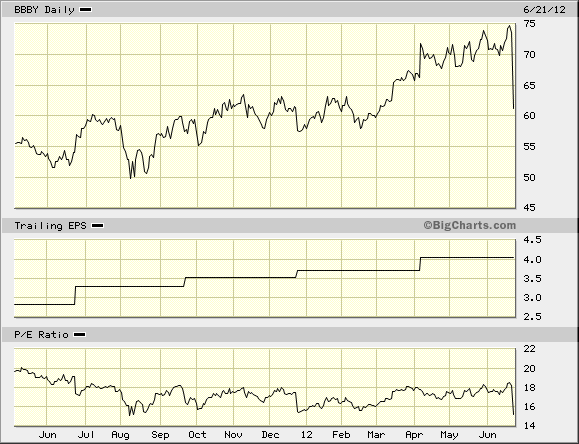
That’s all it took to unleash the bears. On Thursday, traders gave the stock a super-atomic wedgie. When the closing bell sounded, BBBY had lost $12.50, or 17% of its value. Ouch!
In this week’s issue of CWS Market Review, I’ll talk more about the outlook for BBBY. (Here’s a preview: Thursday’s selling was way, way, WAY overdone.) We’ll also look at the positive earnings report from Oracle ($ORCL). Put it this way: Things are going so well for Larry Ellison that he just bought his own Hawaiian island. (I’m serious.) But first, let’s try to deconstruct the damage at Bed Bath & Beyond.
Bloodbath & Beyond: 17% Loss in One Day
Let’s start with the good news. Bed Bath & Beyond reported solid earnings for the first quarter of their fiscal year (March, April and May). The company earned 89 cents per share which is a 24% increase over the 72 cents per share from last year’s Q1. That’s very good growth in this economy. Sales rose 5.1%, and the key metric for retailers, same-store sales, rose by 3%. That’s a good number although it’s down from 7% last year. The company was also helped by a tax benefit.
Bed Bath & Beyond has been buying back its stock at a furious pace. They spent $306 million during the first quarter to buy back 4.6 million shares. That’s roughly 2% of the outstanding shares. As I’ve said before, I’m not a fan of share repurchases. I’d rather see companies pass those profits on to shareholders in the form of dividends. Still, these numbers give you an idea of how profitable BBBY has been. In fact, they still have another $600 million left in the current share repurchase program. (Hey guys, how about a dividend?)
The company experienced a small drop in gross margins (40.6% to 40.0%) during Q1 which was due to the use of coupons. Still, BBBY has done a very good job of growing its margins over the past few years so I’m not concerned by a minor downtick. What’s far more important is that BBBY has a rock-solid balance sheet which includes $1.8 billion in cash, cash equivalents and investment securities.
As I mentioned last week, BBBY has made some impressive strategic acquisitions lately. They recently picked up Linen Holdings, and a few weeks ago they bought Cost Plus. Combined, these deals cost $650 million. In my opinion, these were very good moves. On an accounting note, BBBY said that once the Cost Plus deal is done, it will subtract several cents off their Q2 earnings but would be slightly accretive to second-half earnings.
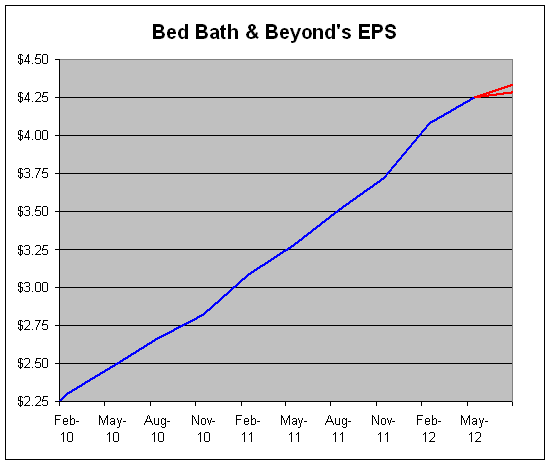
Now let’s look at the bad news. On the earnings call, BBBY said they expect fiscal Q2 earnings to range between 97 cents and $1.03 per share. Wall Street has been expecting $1.08 per share. The company also said it expects earnings for the fiscal year, which is 53 weeks long, to rise by a “high single-digit to a low double-digit” rate. This isn’t news—it’s an exact repeat of what they said in April. Let’s say this means growth of 8% to 12%. Last year, BBBY earned $4.06 per share so the guidance works out to a range of $4.38 to $4.55 per share. The Street had been expecting $4.63 per share which represents growth of 14%.
The guidance is disappointing, but please, it’s hardly that dramatic. In percentage terms, we’re only talking about a few points. On top of that, we know that BBBY has been beating its estimates pretty handily for the past several quarters. Consider these stats: Last quarter, they beat their own guidance by ten cents on the low end and six cents on the high end. For Q4, BBBY topped their guidance by 20 cents on the low end and 15 cents on the high end!
Doesn’t this suggest that this company likes to lowball Wall Street? Nothing in the past few months has greatly altered BBBY’s business. Remember, these are the folks who remained profitable during an historic housing bust; not all home furnishings stores can say that.
Going by Thursday’s closing price, BBBY is trading at roughly 13.5 to 14.0 times this year’s estimate. That’s a good deal. I apologize for the dramatic price swing, but the stock market isn’t always so cooperative. Due to Thursday’s big fall, I’ve decided to lower my buy price. I now rate Bed Bath & Beyond an excellent buy anytime the shares are below $70.
Reynolds American Hits New All-Time High
Before I get to Oracle’s earnings report, here’s a reminder of why we prefer high-quality stocks—and this is why I’m not worried about Bed Bath & Beyond. Two months ago Reynolds American ($RAI) posted disappointing earnings. They missed estimates by a grand total of two pennies per share. However, as I noted at the time, they kept their full-year forecast the same (just like BBBY). Sure enough, traders ignored the important stuff and latched on to the negative news. The market knocked 5% off the stock. I said that this made no sense and we shouldn’t be rattled by these short-term reactions.
So what’s happened since then? In the last two months, Reynolds American has raised its quarterly dividend and the stock has made up all the ground it lost and then some. On Wednesday, shares of RAI hit a new all-time high. Once again, patience and careful stock selection won in the end.
Oracle Can Reasonably Be a $40 Stock
On Monday, Oracle ($ORCL) surprised us by releasing their earnings report earlier than expected. The company earned 82 cents per share for the fourth quarter of their fiscal year. Oracle had told us to expect earnings to range between 76 cents and 81 cents per share. Wall Street’s consensus was for 78 cents per share. Revenue rose 1.3% to $10.9 billion which was inline with the Street. For the entire fiscal year, Oracle earned $2.46 per share. Oracle’s board also approved adding $10 billion to the company’s share repurchase program.
Oracle’s stock responded by jumping as high as $28.75 on Tuesday. After Thursday’s market downdraft, the shares closed at $27.81 which is still a very good bargain.
On the earnings call, Oracle said it sees fiscal Q1 earnings ranging between 51 and 55 cents per share. I think that’s probably a bit too low. Right now, Wall Street thinks Oracle can earn $2.66 per share for the entire fiscal year. That means the stock is going for a little over 10 times earnings. I honestly think Oracle can be a $40 stock. I’m raising my buy price to $32 per share.
That’s all for now. Next week is the final week of the second quarter. Can you believe the year is already half over? Historically, this has been a good time for stocks. Be sure to keep checking the blog for daily updates. I’ll have more market analysis for you in the next issue of CWS Market Review!
– Eddy
P.S. I recently sat down for an interview with Brian Richards of The Motley Fool. It was nice to have time to give detailed answers to questions on investing. You can see clips of our talk here, here, here, here and here.
-
Morning News: June 22, 2012
Posted by Eddy Elfenbein on June 22nd, 2012 at 4:52 amEuro Chiefs Spar On Greek, Spanish Aid
Spain’s Banks Need Up To $78 Billion, Report Shows
Manufacturing Shrinks In China & Eurozone, Slows In US
U.S. and Switzerland Reach Deal on Sharing of Financial Account Data
IMF Sees Euro Crisis At Critical Stage, Sees Bank Stress
Bank Investors Dismiss Moody’s Cuts As Years Too Late
Home Resales Decline While Fewer File Claims for Jobless Benefits
US Factory, Jobs Data Highlight Struggling Recovery
Bed Bath & Beyond: Slowed Growth, But Avoid Cleaning House Entirely
Rosneft In Talks To Join Exxon In Iraq
What To Expect From A Sinopec-Chesapeake Deal
As Facebook Seeks Answers, S.E.C. Investigates Exchanges
Joshua Brown: Involuntary Bankslaughter
Stone Street: How I Legally Caused BAC To Lose $4,000 On My Mortgage
Be sure to follow me on Twitter.
-
Higgs Boson on Intrade
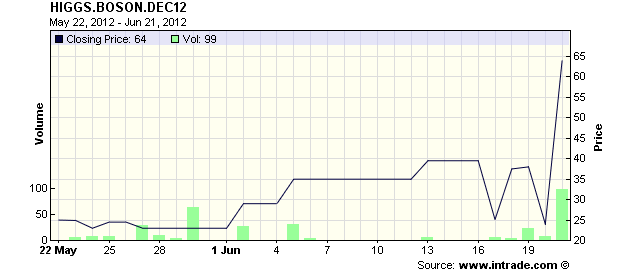
Posted by Eddy Elfenbein on June 21st, 2012 at 2:17 pmIntrade, the futures market for real world events, has a contract on whether a Higgs Boson Particle will be observed before the end of the year. The trade in this contract spiked up dramatically recently. (See Physics Community Afire With Rumors of Higgs Boson Discovery at Wired.)
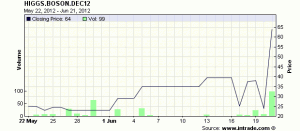
Ironically, even though the contract is gapping up on heavy volume, it still has no mass. (BWAHAHAHA!)
-
Good Time in the Election Cycle
Posted by Eddy Elfenbein on June 21st, 2012 at 1:01 pmThe market adage “sell in May and go away,” worked well this year for about one month. However, the end of May during an election year has often been a good time to buy stocks.
A few years ago, I took all the data and calculated the average market during a Presidential Election Cycle. Historically, a low point has come on May 29th of the election year.
From there until August 3rd of the post-election year, the Dow has gained an average of 23.2%. That’s very impressive for just 14 months.
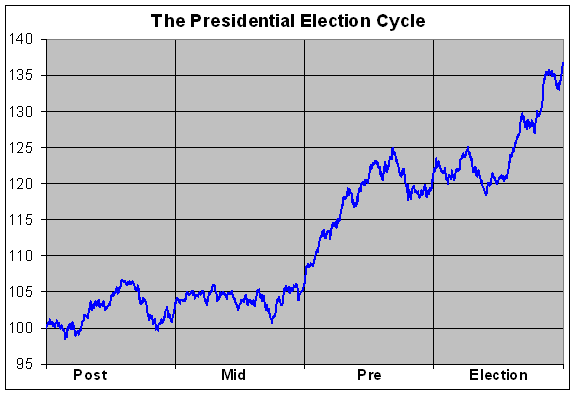
Let me add that I don’t make investment decisions based on these calendar effects. After all, this is an average of 115 years’ worth of data. I just think it’s fascinating how the market has behaved historically.
-
Bloodbath & Beyond
Posted by Eddy Elfenbein on June 21st, 2012 at 10:04 amShares of Bed Bath & Beyond ($BBBY) are getting crushed today. The stock has been as low as $62.23 this morning.
I think this is an absurd overreaction. Combined with yesterday’s drop, the shares are down 16.72% since Tuesday’s close.
Just to be clear, the midpoint of BBBY’s guidance was eight cents below Wall Street’s consensus. The market is translating that into a loss of over $12.
-
Archives
- October 2026
- September 2026
- August 2026
- July 2026
- June 2026
- May 2026
- April 2026
- March 2026
- February 2026
- January 2026
- December 2025
- November 2025
- October 2025
- September 2025
- August 2025
- July 2025
- June 2025
- May 2025
- April 2025
- March 2025
- February 2025
- January 2025
- December 2024
- November 2024
- October 2024
- September 2024
- August 2024
- July 2024
- June 2024
- May 2024
- April 2024
- March 2024
- February 2024
- January 2024
- December 2023
- November 2023
- October 2023
- September 2023
- August 2023
- July 2023
- June 2023
- May 2023
- April 2023
- March 2023
- February 2023
- January 2023
- December 2022
- November 2022
- October 2022
- September 2022
- August 2022
- July 2022
- June 2022
- May 2022
- April 2022
- March 2022
- February 2022
- January 2022
- December 2021
- November 2021
- October 2021
- September 2021
- August 2021
- July 2021
- June 2021
- May 2021
- April 2021
- March 2021
- February 2021
- January 2021
- December 2020
- November 2020
- October 2020
- September 2020
- August 2020
- July 2020
- June 2020
- May 2020
- April 2020
- March 2020
- February 2020
- January 2020
- December 2019
- November 2019
- October 2019
- September 2019
- August 2019
- July 2019
- June 2019
- May 2019
- April 2019
- March 2019
- February 2019
- January 2019
- December 2018
- November 2018
- October 2018
- September 2018
- August 2018
- July 2018
- June 2018
- May 2018
- April 2018
- March 2018
- February 2018
- January 2018
- December 2017
- November 2017
- October 2017
- September 2017
- August 2017
- July 2017
- June 2017
- May 2017
- April 2017
- March 2017
- February 2017
- January 2017
- December 2016
- November 2016
- October 2016
- September 2016
- August 2016
- July 2016
- June 2016
- May 2016
- April 2016
- March 2016
- February 2016
- January 2016
- December 2015
- November 2015
- October 2015
- September 2015
- August 2015
- July 2015
- June 2015
- May 2015
- April 2015
- March 2015
- February 2015
- January 2015
- December 2014
- November 2014
- October 2014
- September 2014
- August 2014
- July 2014
- June 2014
- May 2014
- April 2014
- March 2014
- February 2014
- January 2014
- December 2013
- November 2013
- October 2013
- September 2013
- August 2013
- July 2013
- June 2013
- May 2013
- April 2013
- March 2013
- February 2013
- January 2013
- December 2012
- November 2012
- October 2012
- September 2012
- August 2012
- July 2012
- June 2012
- May 2012
- April 2012
- March 2012
- February 2012
- January 2012
- December 2011
- November 2011
- October 2011
- September 2011
- August 2011
- July 2011
- June 2011
- May 2011
- April 2011
- March 2011
- February 2011
- January 2011
- December 2010
- November 2010
- October 2010
- September 2010
- August 2010
- July 2010
- June 2010
- May 2010
- April 2010
- March 2010
- February 2010
- January 2010
- December 2009
- November 2009
- October 2009
- September 2009
- August 2009
- July 2009
- June 2009
- May 2009
- April 2009
- March 2009
- February 2009
- January 2009
- December 2008
- November 2008
- October 2008
- September 2008
- August 2008
- July 2008
- June 2008
- May 2008
- April 2008
- March 2008
- February 2008
- January 2008
- December 2007
- November 2007
- October 2007
- September 2007
- August 2007
- July 2007
- June 2007
- May 2007
- April 2007
- March 2007
- February 2007
- January 2007
- December 2006
- November 2006
- October 2006
- September 2006
- August 2006
- July 2006
- June 2006
- May 2006
- April 2006
- March 2006
- February 2006
- January 2006
- December 2005
- November 2005
- October 2005
- September 2005
- August 2005
- July 2005
 Eddy Elfenbein is a Washington, DC-based speaker, portfolio manager and editor of the blog Crossing Wall Street. His