-
Oracle Earns 82 Cents Per Share
Posted by Eddy Elfenbein on June 18th, 2012 at 5:11 pmOracle ($ORCL) surprised Wall Street by releasing its earnings report early. For the fiscal fourth quarter, Oracle earned 82 cents per share which is four cents more than Wall Street’s consensus. The company had told us to expect earnings to range between 76 cents and 81 cents per share.
Oracle Corporation today announced fiscal 2012 Q4 GAAP total revenues were up 1% to $10.9 billion, while non-GAAP total revenues were up 1% to $11.0 billion. Both GAAP and non-GAAP new software license revenues were up 7% to $4.0 billion. Both GAAP and non-GAAP software license updates and product support revenues were up 5% to $4.2 billion. Both GAAP and non-GAAP hardware systems products revenues were down 16% to $977 million. GAAP operating income was up 5% to $4.6 billion, and GAAP operating margin was 42%. Non-GAAP operating income was up 5% to $5.5 billion, and non-GAAP operating margin was 50%. GAAP net income was up 8% to $3.5 billion, while non-GAAP net income was up 7% to $4.1 billion. GAAP earnings per share were $0.69, up 11% compared to last year while non-GAAP earnings per share were up 10% to $0.82. GAAP operating cash flow for fiscal year 2012 was $13.7 billion, up 23% compared to last year.
Without the impact of the US dollar strengthening compared to foreign currencies, Oracle’s reported Q4 GAAP earnings per share would have been $0.03 higher at $0.72, up 16%, and Q4 non-GAAP earnings per share would have been $0.04 higher at $0.86, up 15%. Both GAAP and non-GAAP total revenues also would have been up 5%, GAAP new software license revenues would have been up 11%, non-GAAP new software license revenues would have been up 12% and both GAAP and non-GAAP hardware systems products revenues would have been down 13%.
For fiscal year 2012, GAAP total revenues were up 4% to $37.1 billion, while non-GAAP total revenues were up 4% to $37.2 billion. GAAP new software license revenues were up 7% to $9.9 billion. Non-GAAP new software license revenues were up 8% to $9.9 billion. GAAP software license updates and product support revenues were up 10% to $16.2 billion, while non-GAAP software license updates and product support revenues were up 9% to $16.3 billion. Both GAAP and non-GAAP hardware systems products revenues were $3.8 billion. GAAP operating income was up 14% to $13.7 billion, and GAAP operating margin was 37%. Non-GAAP operating income was up 8% to $17.2 billion, and non-GAAP operating margin was 46%. GAAP net income was up 17% to $10.0 billion, while non-GAAP net income was up 10% to $12.5 billion. GAAP earnings per share were $1.96, up 18% compared to last year while non-GAAP earnings per share were up 11% to $2.46.
“Our record-breaking fourth quarter featured several all-time highs for Oracle: new software license sales of $4 billion, total software revenue of $8 billion, total revenue of $11 billion, and EPS of 82 cents,” said Oracle President and CFO, Safra Catz. “For the fiscal year, we also set all-time highs for operating margins of 46%, and operating cash flow of $13.7 billion.”
“Our engineered systems business is now operating at well over a billion dollar revenue run rate,” said Oracle President, Mark Hurd. “For the year, the Exadata, Exalogic, Exalytics, SPARC SuperCluster and the Oracle Big Data Appliance product group grew over 100% year-over-year.”
“The development of Oracle Cloud is strategic to increasing the size and profitability of Oracle’s software business,” said Oracle Chief Executive Officer, Larry Ellison. “Our Oracle Cloud SaaS business is nearly at a billion dollar revenue run rate, the same size as our engineered systems hardware business. The combination of engineered systems and the Oracle Cloud will drive Oracle’s growth in FY 2013.”
The Board of Directors also declared a quarterly cash dividend of $0.06 per share of outstanding common stock. This dividend will be paid to stockholders of record as of the close of business on July 13, 2012, with a payment date of August 3, 2012.
Oracle also announced that its Board of Directors authorized the repurchase of up to an additional $10.0 billion of common stock under its existing share repurchase program in future quarters.
After hours, the stock is up to $28.40.
-
Are We in a Recession?
Posted by Eddy Elfenbein on June 18th, 2012 at 11:16 amFormer President Bill Clinton recently said that the U.S. economy is already in a recession. I view that as more of a political statement rather than an economic one, but let’s explore the question, “Is the U.S. economy currently in a recession?”
The frustrating answer is: we don’t know. To be more scientific, we can say that there’s currently no solid evidence that the U.S. economy is either in a recession or about to go into a recession. Obviously, that can quickly change.
In the most-recent CWS Market Review, I wrote that Wall Street has been paring back its forecasts for Q2 GDP: “Goldman lowered their GDP growth forecast from 1.8% to 1.6%. Morgan Stanley lowered theirs from 2% to 1.8%. JPM dropped theirs to 2% from 2.5%, and BofA Merrill went from 2.4% to 1.9%.” The catalyst was the poor retail sales report.
Let me make a few points. By recession, we mean that the real GDP is actually receding. As in, it’s getting smaller. Oftentimes, people will say that a bad but growing economy is in a recession. Yet we want to stick to the technical definition.
The commonly accepted standard for dating recession comes from the National Bureau of Economic Research (NBER). The media often says that an official recession is two or more consecutive quarters of negative real GDP growth. That’s not correct. This is what NBER looks at when deciding if the economy is expanding or receding:
The Committee does not have a fixed definition of economic activity. It examines and compares the behavior of various measures of broad activity: real GDP measured on the product and income sides, economy-wide employment, and real income. The Committee also may consider indicators that do not cover the entire economy, such as real sales and the Federal Reserve’s index of industrial production (IP). The Committee’s use of these indicators in conjunction with the broad measures recognizes the issue of double-counting of sectors included in both those indicators and the broad measures. Still, a well-defined peak or trough in real sales or IP might help to determine the overall peak or trough dates, particularly if the economy-wide indicators are in conflict or do not have well-defined peaks or troughs.
So the keys are real GDP, employment and income, and we also want to look at sales and industrial production. The problem with looking at the entire economy is that the GDP data series is quarterly. In a perfect world, it would be monthly and highly accurate. Since it’s not, we have to rely on the other indicators listed by NBER.
Recessions and expansions tend to be symmetrical, meaning a sharp recession often leads to a sharp recovery. Shallow recessions lead to shallow recoveries. This time around is different—a sharp recession has led to a very mediocre recovery.
Keeping with NBER’s methodology, let’s first look at real GDP.
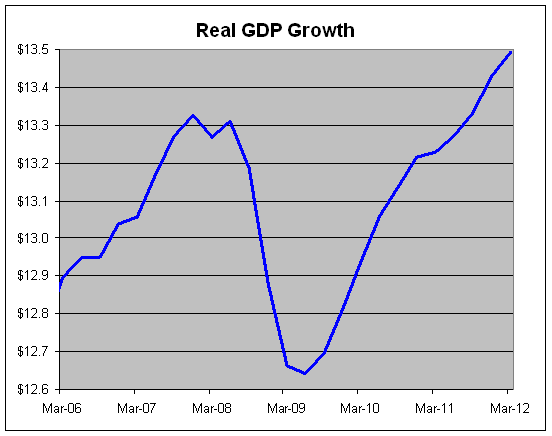
During the recession, real GDP fell for four quarters in a row, and for five out of six. We then had one mildly positive quarter followed by three goods ones. Since then, however, we’ve had very tepid growth. The last seven quarters have averaged less than 2% growth which isn’t enough to push down the unemployment rate. Growth for Q1 came in at just 1.9%.
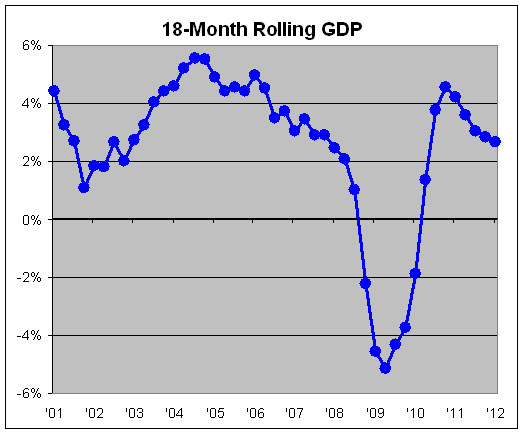
Interestingly we can see the clearest evidence for a trend by looking at real GDP over the trailing six quarters.
Now let’s look at another NBER factor: economy-wide employment. These are the seasonally adjusted non-farm payroll numbers.
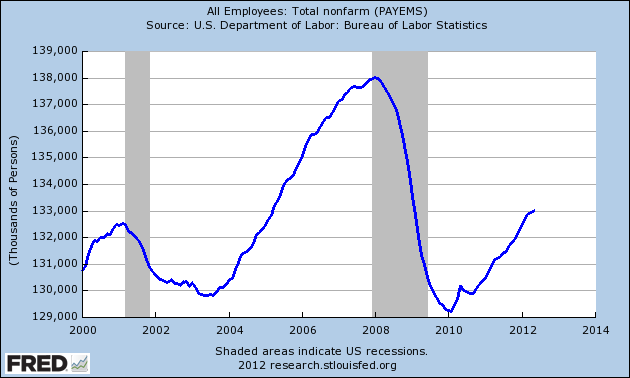
What stands out is the marked contrast between GDP and employment. GDP has already surpassed its peak from before the recession. But we’ve made back less than half the jobs lost during the recession. Moreover, the rate of job gains is slowing. Last month, the economy created just 69,000 jobs. Nearly nine million were lost during the recession. Employment is clearly the weakest part of the economy.
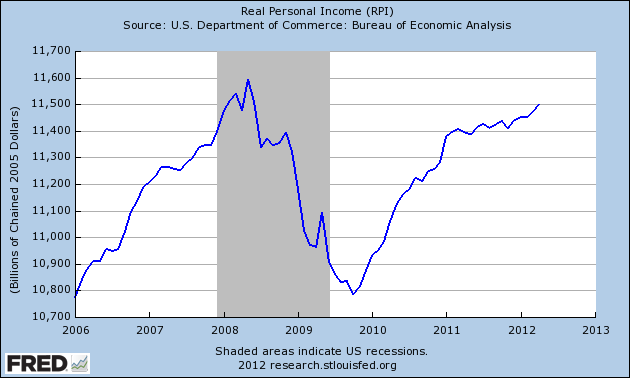
Here’s real personal income. We can see signs of a recovery but the trend dramatically slowed down starting at the beginning of 2011. There’s been a slight uptick recently, but it’s nowhere near the growth rate we saw in 2010.
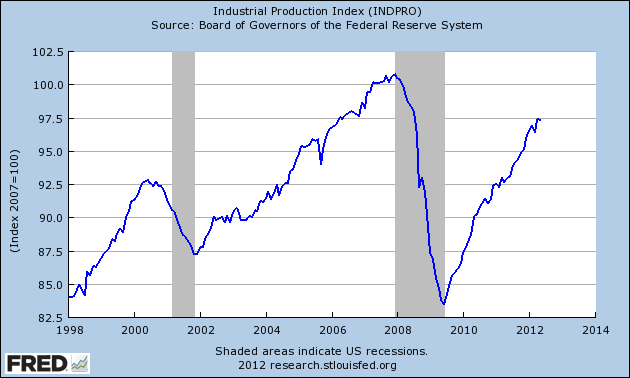
If I wanted to see signs of the economy slowing down, I’d expect to see a sharp drop in industrial production. Notice how IP slowed down before the 2001 recession began. Except for a few bumps, IP has climbed pretty steadily since 2009.
The May IP report showed an unexpected decline of 0.1%. This is probably the clearest sign that the economy may soon be in trouble. But we’ll need to see more data to confirm a trend.
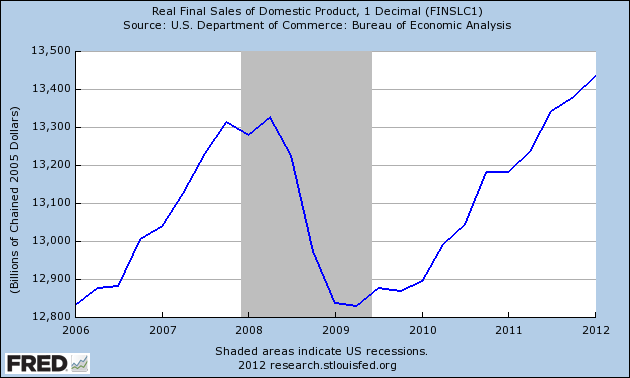
Finally, here’s a look at real sales which is probably the strongest variable. There doesn’t seem to be any visible drop-off yet.
-
Morning News: June 18, 2012
Posted by Eddy Elfenbein on June 18th, 2012 at 8:48 amGreece’s New Democracy Seeks Bailout Coalition
Markets Relief Fades at Greek Election Results
Europe Gets Emerging Market Crisis Ultimatum As G-20 Meet
Spanish Bond Yields Top 7% (Again)
India Shares End Lower as Central Bank Decides Not to Cut Rates
Fitch Cuts India Credit Rating Outlook to Negative
Nomura Excluded From $6 Billion Japan Tobacco Share Sale
Yamana Gold To Buy Extorre For $404 Million To Add Mine
China Home Price Declines Slow, Beijing To Keep Curbs
Solar Boom Heads To Japan Creating $9.6 Billion Market
Rolls Wins 1 Billion UK Nuclear Submarines Deal
Pragmatic Capitalism: The Long-Term Trend In Commodities Is Still Being Driven By China
Credit Writedowns: America’s Slowdown Is Not About Europe, It’s About The Debt
Be sure to follow me on Twitter.
-
New Democracy Wins
Posted by Eddy Elfenbein on June 17th, 2012 at 10:05 pmAt least, according to New Democracy:
ATHENS — Greek voters on Sunday gave a narrow victory in parliamentary elections to a party that had supported a bailout for the country’s failed economy. The vote was widely seen as a last chance for Greece to remain in the euro zone, and the results had an early rallying effect on world markets.
Greece’s choice was also welcomed by the finance ministers of the euro zone countries, who in a statement on Sunday night in Brussels said the outcome of the vote “should allow for the formation of a government that will carry the support of the electorate to bring Greece back on a path of sustainable growth.”
…
Official projections showed New Democracy with 30 percent of the vote and 128 seats in the 300-seat Parliament. The Syriza party, which had surged on a wave of anti-austerity sentiment and spooked Europe with its talk of tearing up Greece’s loan agreement with its foreign creditors, was in second place, with 27 percent of the vote and 72 seats. Syriza officials had rejected calls for a coalition, ensuring its role as a vocal opposition bloc to whatever government emerges.
But unlike in the May 6 election, when New Democracy placed first but was unable to form a government, this time intense international pressure — and the fact that the Greek government is quickly running out of money — made it likely there would be a coalition with New Democracy’s longtime rival, the socialist Pasok party. Pasok placed third in the voting, with 12 percent of the vote and 33 seats. The extreme right Golden Dawn party got 18 seats.
Investors gave an early thumbs-up on Sunday night, pushing up the euro in value against the dollar. “It looks like we’ve avoided the worst-case scenario,” said Darren Williams, a European economist for AllianceBernstein in London. “I think that’s important, because we could have gone to a very bad place very quickly.”
-
Jamie Dimon: A Drag on JPMorgan’s Stock?
Posted by Eddy Elfenbein on June 16th, 2012 at 9:56 am -
My Views on Ford
Posted by Eddy Elfenbein on June 16th, 2012 at 9:52 am -
My Views on Apple
Posted by Eddy Elfenbein on June 16th, 2012 at 9:51 am -
Why You Should Unlike Facebook
Posted by Eddy Elfenbein on June 15th, 2012 at 5:27 pm -
Is America Doomed to Follow Japan?
Posted by Eddy Elfenbein on June 15th, 2012 at 10:29 amHere’s part of an interview I did with Brian Richards of the Motley Fool. I’ll post more portions once they’re available.
Also, I talk with my hands. A lot.
**arms flailing**
-
CWS Market Review – June 15, 2012
Posted by Eddy Elfenbein on June 15th, 2012 at 7:16 amOn Thursday, the S&P 500 closed at its highest level in the last 12 sessions. The index finished the day at 1,329.10 which is almost exactly a 4% gain from June 1st, the lowest close since January. It’s not that stocks are suddenly doing well. Instead, it’s more accurate to say that the market is walking back some of the damage we saw from the very unmerry month of May 2012.
Make no mistake, investors are still very nervous. In fact, Thursday’s auction of 30-year Treasury bonds went off at an all-time low yield of 2.72%. There was a similar record auction for 10-year bonds on Wednesday. Once again, investors are concerned about Europe and what will happen to the euro.
In this week’s CWS Market Review, we’ll take a closer look at the mess in Europe. With the Greek do-over election coming this weekend, I think this is a rare moment for optimism. We’ll also take a look at some upcoming earnings reports for our Buy List stocks. Our stocks have perked up recently; we had a dividend increase from CR Bard ($BCR), its 40th-consecutive dividend hike, and Jamie Dimon’s appearance on Capitol Hill helped give a nice boost to JPMorgan’s ($JPM) stock.
Greek Elections Could Spur Rally
But first, let’s discuss the latest developments in the Old World. This Sunday, Greece will hold another election. Greeks went to the polls last month but no party emerged with enough support to form a governing coalition. The only clear-cut messages were that everyone’s mad at everyone else and no one likes the austerity policies.
As a result, the Greeks have called a do-over and they’re voting again. I suspect that the Greek public got sufficiently freaked out by last month’s uncertainty that they’ll give enough (grudging) support to the New Democracy Party and that they’ll be able to form a pro-European government. This means that they’re not ready to quit the euro just yet. Sure, there will be tons of infighting before we get there, but that seems to be the general course of events. The other major party is Syriza, which is a leftwing party that’s strongly anti-bailout.
A New Democracy victory would probably lead to a rally in Europe and one over here. Some of this week’s strength may be in anticipation of a New Democracy win. Just to give you an example, on Thursday, the Greek stock market soared over 10%. The election in Greece is absolutely critical. Bear in mind that the last two votes taken in Greece that were this important ended in deadlock and hemlock.
Right behind Greece on the worry train is Spain. The difference is that Spain isn’t so small. The EU just promised them 100 billion euros to help their banks. After a quick rally, things once again turned south as investors felt that wasn’t nearly enough. Moody’s didn’t like the increased debt load so they downgraded Spain’s debt by three full notches. They’re now just one rung above officially being junk debt. The 10-year Treasury bond yields in Spain just crossed 7%, which was seen as an important psychological barrier.
As bad as things are, I still believe the authorities are willing to do what needs to be done. The Spanish foreign minister made a good point when he said, “If the Titanic sinks, it takes everyone with it, even those travelling in first class.” The issues don’t end with Greece and Spain. The place of concern behind Spain is Italy where the public debt is already 120% of GDP.
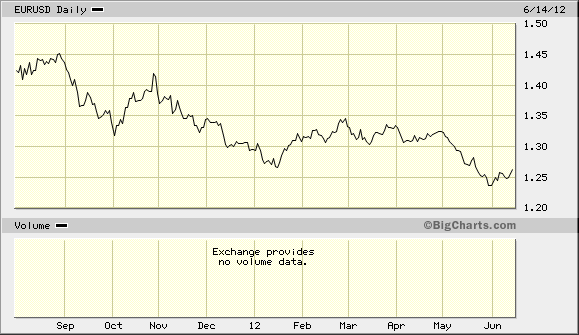
On Monday and Tuesday, the G20 will be meeting in Los Cabos on the southern tip of the Baja Peninsula in Mexico. (The G20 is 19 of the largest economies in the world plus the European Union.) The U.S. stock market got a late-day bounce on Thursday on a report from Reuters that central banks were planning for coordinated action if (if) the Greek elections led to more financial market chaos. What this tells me is how badly the markets want to see more forcefulness from the authorities. In a few minutes, the S&P 500 gained $100 billion in market value. News that tepid about a possible intervention shouldn’t cause a rally that big.
The Federal Reserve meets again next week and the economic outlook here in the U.S. has gotten worse since the Fed last got together in April. Wall Street has been paring back its estimates for Q2 GDP growth. The latest catalyst for the downgrades was the soggy retail sales report. Goldman lowered their GDP growth forecast from 1.8% to 1.6%. Morgan Stanley lowered theirs from 2% to 1.8%. JPM dropped theirs to 2% from 2.5%, and BofA Merrill went from 2.4% to 1.9%.
This has led to speculation that we’ll see another round of easing from the Federal Reserve. I’m still a doubter. For one, people seem to forget that the Federal Open Market Committee is indeed a committee. It’s not whatever Bernanke wants. More easing is clearly unpopular with some Fed officials such as Richard Fisher, the head of the Dallas Fed. Charles Evans of the Chicago Fed is probably a sure vote for more easing. Vice-Chair Janet Yellen and San Francisco President John Williams may be on board as well. But we have a big election coming up and the rest of the committee members seem non-committal. The bottom line is that investors shouldn’t expect more help from the Fed any time soon.
Look for More Good Earnings from BBBY
We have two earnings reports coming next week. On Wednesday, Bed Bath & Beyond ($BBBY) will report its fiscal first-quarter earnings. I’m excited for this report because in April, the company had an outstanding earnings report. For their Q4, which is BBBY’s most important quarter, they earned $1.48 per share which was 15 cents better than Wall Street’s consensus. The stock gapped up on the earnings report but has settled into a trading since then, mostly between $68 and $72.
On the earnings call back in April, Bed Bath & Beyond’s management said to expect Q1 earnings to range between 79 and 83 cents per share. I’ve run the numbers and I think that’s too low. Here’s my take: I think BBBY can earn 88 cents per share, give or take. I realize that sounds very optimistic but BBBY’s business is going very well right now.
I’ve also been impressed by some of Bed Bath & Beyond’s strategic moves recently. They just bought Linen Holdings for $105 million, and a few weeks ago they bought Cost Post for $495 million. These are solid acquisitions. I currently rate BBBY an excellent buy up to $75 per share.
Next Thursday, after the market closes, Oracle ($ORCL) is due to report its fiscal Q4 earnings. Oracle’s last earnings report was very good. I had been worried because the earnings report before that was a dud. Here’s my concern: The weak link in Oracle’s business has been hardware, but Larry Ellison said that that business will pick up later this year. I’m inclined to believe Larry although we haven’t seen the hard evidence just yet.
On the last earnings call, Oracle told us to expect earnings for Q4 to range between 76 cents and 81 cents per share. That sounds about right. I’m curious to hear what kind of guidance, if any, Oracle will provide for the current fiscal year. Wall Street currently thinks Oracle can earn $2.62 per share for the fiscal year ending next May. If so, the stock is pretty cheap at just over 10 times earnings. I’m not expecting a big earnings beat but Oracle is a solid value at this price. I wouldn’t mind seeing a dividend hike either. I rate Oracle a strong buy anytime you see the stock below $30 per share.
CR Bard Raises Dividend for 40th-Straight Year
On Wednesday, CR Bard ($BCR) announced that they’re raising their dividend by 5%. The quarterly payout is rising by a penny from 19 cents to 20 cents per share. Bard has now increased its dividend every year since 1972. Bard also announced a share repurchase program of up to $500 million. I love seeing these long runs of higher dividends especially in an environment of record low bond yields. CR Bard is a very good buy up to $102 per share.
JPMorgan Chase ($JPM) is slowly recovering from the damage of the horrendous trades made out of their London office. CEO Jamie Dimon testified before Congress on Wednesday, and his cocksure attitude helped a nice rally in shares of JPM. The stock briefly broke $35 per share. Last week, the stock bottomed out below $31.
I have mixed feelings about Dimon. On one hand, he’s an excellent manager and he’s done a good job at JPM. On the other hand, he’s a loudmouth who draws too much attention to himself. Banking is done best when it’s boring. I still like JPM’s stock—it’s an excellent value here—but I believe the company and its shareholders would be best served by Mr. Dimon leaving the CEO’s suite. I don’t mind him hanging around as head of the board, but Dimon can no longer be the public face of JPM. I’m tired of him holding the stock back.
That’s all for now. The Greek elections are on Sunday. The G20 meeting in Mexico is on Monday and Tuesday, and the Fed meets on Tuesday and Wednesday. My forecast is for dark suits and lots of jargon. Be sure to keep checking the blog for daily updates. I’ll have more market analysis for you in the next issue of CWS Market Review!
– Eddy
-
Archives
- October 2026
- September 2026
- August 2026
- July 2026
- June 2026
- May 2026
- April 2026
- March 2026
- February 2026
- January 2026
- December 2025
- November 2025
- October 2025
- September 2025
- August 2025
- July 2025
- June 2025
- May 2025
- April 2025
- March 2025
- February 2025
- January 2025
- December 2024
- November 2024
- October 2024
- September 2024
- August 2024
- July 2024
- June 2024
- May 2024
- April 2024
- March 2024
- February 2024
- January 2024
- December 2023
- November 2023
- October 2023
- September 2023
- August 2023
- July 2023
- June 2023
- May 2023
- April 2023
- March 2023
- February 2023
- January 2023
- December 2022
- November 2022
- October 2022
- September 2022
- August 2022
- July 2022
- June 2022
- May 2022
- April 2022
- March 2022
- February 2022
- January 2022
- December 2021
- November 2021
- October 2021
- September 2021
- August 2021
- July 2021
- June 2021
- May 2021
- April 2021
- March 2021
- February 2021
- January 2021
- December 2020
- November 2020
- October 2020
- September 2020
- August 2020
- July 2020
- June 2020
- May 2020
- April 2020
- March 2020
- February 2020
- January 2020
- December 2019
- November 2019
- October 2019
- September 2019
- August 2019
- July 2019
- June 2019
- May 2019
- April 2019
- March 2019
- February 2019
- January 2019
- December 2018
- November 2018
- October 2018
- September 2018
- August 2018
- July 2018
- June 2018
- May 2018
- April 2018
- March 2018
- February 2018
- January 2018
- December 2017
- November 2017
- October 2017
- September 2017
- August 2017
- July 2017
- June 2017
- May 2017
- April 2017
- March 2017
- February 2017
- January 2017
- December 2016
- November 2016
- October 2016
- September 2016
- August 2016
- July 2016
- June 2016
- May 2016
- April 2016
- March 2016
- February 2016
- January 2016
- December 2015
- November 2015
- October 2015
- September 2015
- August 2015
- July 2015
- June 2015
- May 2015
- April 2015
- March 2015
- February 2015
- January 2015
- December 2014
- November 2014
- October 2014
- September 2014
- August 2014
- July 2014
- June 2014
- May 2014
- April 2014
- March 2014
- February 2014
- January 2014
- December 2013
- November 2013
- October 2013
- September 2013
- August 2013
- July 2013
- June 2013
- May 2013
- April 2013
- March 2013
- February 2013
- January 2013
- December 2012
- November 2012
- October 2012
- September 2012
- August 2012
- July 2012
- June 2012
- May 2012
- April 2012
- March 2012
- February 2012
- January 2012
- December 2011
- November 2011
- October 2011
- September 2011
- August 2011
- July 2011
- June 2011
- May 2011
- April 2011
- March 2011
- February 2011
- January 2011
- December 2010
- November 2010
- October 2010
- September 2010
- August 2010
- July 2010
- June 2010
- May 2010
- April 2010
- March 2010
- February 2010
- January 2010
- December 2009
- November 2009
- October 2009
- September 2009
- August 2009
- July 2009
- June 2009
- May 2009
- April 2009
- March 2009
- February 2009
- January 2009
- December 2008
- November 2008
- October 2008
- September 2008
- August 2008
- July 2008
- June 2008
- May 2008
- April 2008
- March 2008
- February 2008
- January 2008
- December 2007
- November 2007
- October 2007
- September 2007
- August 2007
- July 2007
- June 2007
- May 2007
- April 2007
- March 2007
- February 2007
- January 2007
- December 2006
- November 2006
- October 2006
- September 2006
- August 2006
- July 2006
- June 2006
- May 2006
- April 2006
- March 2006
- February 2006
- January 2006
- December 2005
- November 2005
- October 2005
- September 2005
- August 2005
- July 2005
 Eddy Elfenbein is a Washington, DC-based speaker, portfolio manager and editor of the blog Crossing Wall Street. His