-
Morning News: May 9, 2012
Posted by Eddy Elfenbein on May 9th, 2012 at 5:47 amMoody’s Bank Downgrades Risk Choking European Recovery
German Exports, Imports Hit Highs
CAAM: Beijing Should Refrain From Policies Affecting Auto Industry Development
U.S. Millionaires Told Go Away as Tax Evasion Rule Looms
Oil Prices Fall Ahead Of US Data, Rising OPEC Output
Morgan Stanley’s Michael Grimes Is Where Money and Tech Meet
For Morgan Stanley, Third Cut Is the Deepest
Toyota to Treble Profit This Year, Trim Costs
Disney Races to Exploit ‘Avengers’ After 21% Profit Rise
Margin Calls Cost Green Mountain Chairman, Director
Glaxo to Begin Hostile Offer for Human Genome Sciences
Prudential Confident On Outlook As New Business Profits Rise
ING Profit Excluding Charges Beats Estimates, Boosting Shares
Softbank: In Strategic Alliance To Create PayPal Japan
Howard Lindzon: Momentum Tuesday…Cracks!
Epicurean Dealmaker: Occupy Galt’s Gulch
Be sure to follow me on Twitter.
-
DirecTV Earns $1.07 Per Share
Posted by Eddy Elfenbein on May 8th, 2012 at 10:20 amDirecTV ($DTV) reported first-quarter earnings of $1.07 per share. That beat Wall Street’s consensus by either one or two cents, depending on the source. A year ago, DTV earned just 85 cents per share.
DirecTV’s sales rose 12% to $7.05 billion which was $10 million more than consensus. The company has done well in North America, but they see their future lying in Latin America.
Put it this way: DTV added 81,000 subscribers in the U.S. last quarter. In Latin America, they aded 593,000. Yet there are more than twice as many current subscribers in the U.S. as there are in Latin America.
The problem is that it costs more to get a subscriber in Latin America, so that hurts DTV’s margins. This was a good quarter for DTV. The stock is off some because it wasn’t the kind of blowout quarter that we’ve seen.
The company said that it plans to make $4 per share this year and $5 next year. I think they can surpass those marks with ease.
-
The Flash Crash Fairy Tale
Posted by Eddy Elfenbein on May 8th, 2012 at 9:45 amTwo years ago, the stock market crashed in a few minutes, and in almost the same amount of time, it recovered.
The public wanted to know why; how could this have happened?
So the government did what governments do: they filed a report. The official report blamed a securities firm, Waddell & Reed, for dumping too many futures at once and screwing things up.
This is a nice story for the government to tell because it lays the fingers on a known entity. The bad boys at Waddell & Reed screwed up the market.
The government’s story has one small problem — it’s not true. At least not according to Eric Scott Hunsader. Mark Buchanan writes:
The actual crisis struck in the three minutes between 2:41 p.m. and 2:44 p.m., when the market fell another 5 percent to 6 percent. Hunsader’s analysis suggests this plunge was caused by high-frequency traders. They typically act as liquidity providers, standing ready to buy and sell at certain price levels. But the day’s volatility prompted them to dump their holdings to avoid losses. In a matter of minutes, they actively sold an accumulated stock of about 2,000 E-mini contracts. It was this selling, not Waddell & Reed’s passive orders, that caused liquidity to disappear.
There is nothing blameworthy about what the high-frequency traders did. Market makers aren’t charities, and their algorithms were only saving their skins amidst extreme market turbulence. Their actions do, however, rather undermine the common argument that high-frequency traders bring wonderful benefits to the market through the liquidity they provide. That liquidity, as many have pointed out, has a rather ghostly quality and tends to vanish when needed most.
The government’s story boils down to “some big meany came along and harmed our precious market.” They found a culprit and blamed it. That’s what governments do.
The government couldn’t have told us the real reason. So why did the market crash?
The answer is that there’s no answer. It’s just what markets do.
-
Morning News: May 8, 2012
Posted by Eddy Elfenbein on May 8th, 2012 at 5:46 amSocialist Elephants Stampede for Jobs With Hollande
Bankia’s Rato Steps Down as Spain May Offer Banks Rescue
India Vows Cuts in Iranian-Oil Imports as Clinton Visits
Consumer Credit in U.S. Increases by Most in 10 Years
U.S. Could Make $15.1 Billion on AIG Bailout: GAO
HSBC Profit Beats Analysts’ Estimates on Investment Bank
KPN Jumps After America Movil Makes $3.4 Billion Offer
Toshiba Forecasts 83% Profit Increase, Beating Estimates
Electronic Arts Drops as Forecasts Misses Analysts’ Views
MasterCard Heats Up Battle For ‘Mobile Wallet’
Munich Re Returns to Profit as Disaster Claims Fall
As Car Owners Downsize, the Market Is Strong for Their Used S.U.V.’s
Amazon Leaps Into High End of the Fashion Pool
Nigerians Outstrip Americans in London Fashion Spending
Joshua Brown: Where Is Everybody?
Cullen Roche: A New Way of Thinking About the Global Machine…
Be sure to follow me on Twitter.
-
Cognizant Technology Solutions Plunges, But It’s Not a Buy Yet
Posted by Eddy Elfenbein on May 7th, 2012 at 2:49 pmOne of my favorite companies is Cognizant Technologies Solutions ($CTSH). Note that I didn’t say it’s one of my favorite “stocks.” Being a great company and a great stock aren’t necessarily the same thing.
Cognizant has made its mark by running computer call centers in India. This has been a hugely profitable business for them. Check out this growth in EPS since 2005: 53 cents, 78 cents, $1.15, $1.44, $1.78, $2.37 to $2.85. That’s exactly what I like to see–big increases each year.
We had the stock on our Buy List in 2009 and it made 151% for us. But at the end of the year, I thought the stock had become far too expensive at $45 and removed it from the Buy List. For comparison, the company had earned $1.78 per share that year.
Even though I got out early, I didn’t complain. By the end of 2010, Cognizant had run up to $73. By April 2011, CTSH was over $83 per share, meaning it had nearly doubled from a price I thought was too expensive.
This is always the trouble spot for investors. Momentum runs it higher, but anyone with a basic understanding of math can tell you the stock is in trouble. The only question is when. As long as there’s no bad news, the good times can last.
That came to an end today. Cognizant announced that it’s lowering its full-year guidance…are you sitting down?
About 2%.
So the shares are down around 20%. In other words, all the air that had gone into inflating the stock is leaving despite the actual news not being that bad. To be more precise, Cognizant lowered its full-year estimates from $3.69 to $3.62 per share.
The company failed to grow as fast as it had expected, especially in the financial services and pharmaceutical sectors, President Gordon Coburn told Reuters.
The banking sector – which brings in a quarter of Cognizant’s revenue – was flat in the first quarter for the company, hurt by softness among top North American clients.
“In North America … the incredible volatility many of our (banking) clients are seeing right now is causing them to pause,” CEO Francisco D’Souza said on a conference call.
The company counts J.P. Morgan Chase & Co, Rabobank and UBS AG among its core banking clients.
Cognizant said it expects its banking and pharmaceutical sectors to remain sluggish for the rest of the year.
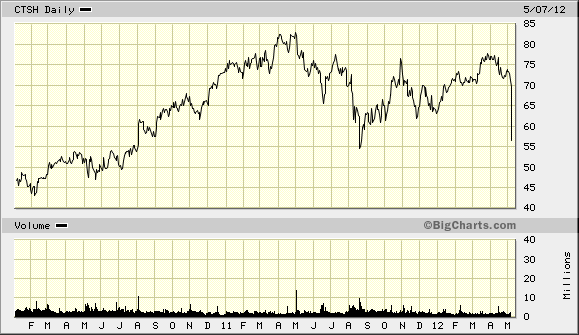
I wouldn’t jump in just yet, but if CTSH can prove that it’s still growing at a rapid clip, I think this could be a very good buy.
-
The Yen’s Impact on AFLAC’s Earnings
Posted by Eddy Elfenbein on May 7th, 2012 at 1:11 pmI’ve been watching AFLAC‘s ($AFL) investor presentation. Since so much of AFLAC’s business is generated in Japan, the yen-to-dollar exchange rate can add or detract to the company’s bottom line.
To their benefit, AFLAC prefers to gauge their performance before the impact of currencies. Here’s how it works: The stronger the yen, the more it helps AFLAC. Last quarter, the exchange rate added four cents to AFLAC’s earnings.
The average exchange rate last year was 79.75. If that holds true for 2012, AFL sees full-year earnings between $6.46 and $6.65.
If the exchange rate is 70, AFLAC estimates that will add 60 cents per share to 2012’s bottom line. If it’s 75, that will add 27 cents per share. At 80, it’s minus one penny. At 75, it’s minus 25 cents per share.
The latest exchange rate is 79.9460. I don’t anticipate this being a major issue for AFLAC this year, but I wanted investors to know the dynamics because this can have a big impact on their business.
On May 15th and 16th, the company will have more to say about guidance for 2013.
-
Sysco Earns 49 Cents Per Share
Posted by Eddy Elfenbein on May 7th, 2012 at 9:10 amFirst-quarter earnings season will soon be coming to a close, but there are still a few key reports left. This morning, Sysco ($SYY) reported adjusted earnings-per-share of 49 cents. Although that was five cents better than Wall Street’s consensus, Sysco’s CEO said the earnings “fell short of our expectations.” It was a one-penny increase over last year.
Let’s dig into the numbers a bit. Sales rose 7.6% to 10.5 billion which is a record for the company. The March quarter was Sysco’s fiscal third. For the first three quarters of the fiscal year, Sysco has earned $1.50 per share compared with $1.38 last year.
Sysco said that food cost inflation is running at 5.5%. I think it’s interesting to note that commodity inflation tends to weigh heavily on low-income consumers. Sysco noted that inflation in meat and poultry is over 10%. The company also said that foreign currency exchange rates knocked 0.2% off their sales growth.
Last November, Sysco raised the quarterly dividend by one penny to 27 cents per share. That was the 42nd-straight annual dividend increase. I don’t know if they’ll raise their dividend again this year. I’m assuming they will to keep the streak alive, but it will most likely be another one-penny increase.
The important part is that Sysco is clearly able to cover their dividend. A dividend decrease is certainly not in the works. Going by Friday’s close, Sysco yields 3.87%.
-
Morning News: May 7, 2012
Posted by Eddy Elfenbein on May 7th, 2012 at 5:57 amGreek Election Gridlock Raises Risk for Bailout, Euro Future
Hollande Signals Return of France as Complicated Ally for West
Swiss Stocks Fall After Elections; Roche, Swiss Re Drop
European Elections Hit Asian Markets
Spanish Banks Resist Idea of ‘Bad Bank’ Bailout
Indonesia 1Q GDP Growth Slows; Central Bank May Be On Hold
U.S. Treasury Sells $5 Billion of AIG Stock
Stock Trading Is Still Falling After ’08 Crisis
UBS Bets on Toxic Debt Demand After Fed’s Record Sale
Buffett Says Berkshire Will Top $34 Billion Railroad Deal
AT&T Making Big Investment in Home Monitoring
Satellite Firm Spurns Bid for Takeover From Rival
Global Bakery Giant CSM Jumps on Shift From Bakery Supplies
Study Says Broker Rebates Cost Investors Billions
Jeff Carter: Entrepreneurship is Merit Based
Stone Street: Some Lingering Thoughts/Observations Economic and Otherwise
Be sure to follow me on Twitter.
-
“Twelve Facts That May Surprise You About the Housing Bust”
Posted by Eddy Elfenbein on May 4th, 2012 at 3:36 pmNick Timiraos has a great post at the WSJ’s Real Estate blog which summarizes the findings of an academic paper. Here are 12 facts about the housing bust that may surprise you:
Fact 1: Resets of adjustable-rate mortgages did not cause the foreclosure crisis.
Fact 2: No mortgage was “designed to fail.” Instead, the products weren’t designed to sustain a drastic decline in home prices.
Fact 3: There was little innovation in mortgage markets in the 2000s.
Fact 4: Government policy toward the mortgage market did not change much from 1990 to 2005.
Fact 5: The originate-to-distribute model was not new.
Fact 6: MBS, CDOs, and other “complex financial products” had been widely used for decades.
Fact 7: Mortgage investors had lots of information.
Fact 8: Investors understood the risks.
Fact 9: Investors were optimistic about house prices.
Fact 10: Mortgage market insiders were the biggest losers.
Fact 11: Mortgage market outsiders were the biggest winners.
Fact 12: Top-rated bonds backed by mortgages did not turn out to be “toxic.” Top-rated bonds in collateralized debt obligations (CDOs) did.
Here’s the paper.
-
NFP = +115,000
Posted by Eddy Elfenbein on May 4th, 2012 at 8:44 amAnother tepid jobs report. The economy created just 115,000 new jobs last month. The unemployment rate is down to 8.1%.
Since February 2009, the economy has created 152,000 new jobs. Between January 2008 and February 2010, the economy lost 8.779 million jobs. We’ve made back 3.745 million (or 43%).
The jobs market peaked 12 years ago when the unemployment rate hit 3.8%. Since then, the civilian non-institutional population has grown by 30.766 million while the labor force has grown by just 11.614 million. The number of employed is up by 4.595 million and the number of unemployed rose by 7.019 million.
For us to have the same jobs-to-population ratio as 12 years ago, we’d need to have 15.324 million more jobs, or 23.669 million fewer people.
The number of Americans either unemployed or not in the workforce now stands at a staggering 101 million. That’s an all-time record.
-
Archives
- June 2026
- May 2026
- April 2026
- March 2026
- February 2026
- January 2026
- December 2025
- November 2025
- October 2025
- September 2025
- August 2025
- July 2025
- June 2025
- May 2025
- April 2025
- March 2025
- February 2025
- January 2025
- December 2024
- November 2024
- October 2024
- September 2024
- August 2024
- July 2024
- June 2024
- May 2024
- April 2024
- March 2024
- February 2024
- January 2024
- December 2023
- November 2023
- October 2023
- September 2023
- August 2023
- July 2023
- June 2023
- May 2023
- April 2023
- March 2023
- February 2023
- January 2023
- December 2022
- November 2022
- October 2022
- September 2022
- August 2022
- July 2022
- June 2022
- May 2022
- April 2022
- March 2022
- February 2022
- January 2022
- December 2021
- November 2021
- October 2021
- September 2021
- August 2021
- July 2021
- June 2021
- May 2021
- April 2021
- March 2021
- February 2021
- January 2021
- December 2020
- November 2020
- October 2020
- September 2020
- August 2020
- July 2020
- June 2020
- May 2020
- April 2020
- March 2020
- February 2020
- January 2020
- December 2019
- November 2019
- October 2019
- September 2019
- August 2019
- July 2019
- June 2019
- May 2019
- April 2019
- March 2019
- February 2019
- January 2019
- December 2018
- November 2018
- October 2018
- September 2018
- August 2018
- July 2018
- June 2018
- May 2018
- April 2018
- March 2018
- February 2018
- January 2018
- December 2017
- November 2017
- October 2017
- September 2017
- August 2017
- July 2017
- June 2017
- May 2017
- April 2017
- March 2017
- February 2017
- January 2017
- December 2016
- November 2016
- October 2016
- September 2016
- August 2016
- July 2016
- June 2016
- May 2016
- April 2016
- March 2016
- February 2016
- January 2016
- December 2015
- November 2015
- October 2015
- September 2015
- August 2015
- July 2015
- June 2015
- May 2015
- April 2015
- March 2015
- February 2015
- January 2015
- December 2014
- November 2014
- October 2014
- September 2014
- August 2014
- July 2014
- June 2014
- May 2014
- April 2014
- March 2014
- February 2014
- January 2014
- December 2013
- November 2013
- October 2013
- September 2013
- August 2013
- July 2013
- June 2013
- May 2013
- April 2013
- March 2013
- February 2013
- January 2013
- December 2012
- November 2012
- October 2012
- September 2012
- August 2012
- July 2012
- June 2012
- May 2012
- April 2012
- March 2012
- February 2012
- January 2012
- December 2011
- November 2011
- October 2011
- September 2011
- August 2011
- July 2011
- June 2011
- May 2011
- April 2011
- March 2011
- February 2011
- January 2011
- December 2010
- November 2010
- October 2010
- September 2010
- August 2010
- July 2010
- June 2010
- May 2010
- April 2010
- March 2010
- February 2010
- January 2010
- December 2009
- November 2009
- October 2009
- September 2009
- August 2009
- July 2009
- June 2009
- May 2009
- April 2009
- March 2009
- February 2009
- January 2009
- December 2008
- November 2008
- October 2008
- September 2008
- August 2008
- July 2008
- June 2008
- May 2008
- April 2008
- March 2008
- February 2008
- January 2008
- December 2007
- November 2007
- October 2007
- September 2007
- August 2007
- July 2007
- June 2007
- May 2007
- April 2007
- March 2007
- February 2007
- January 2007
- December 2006
- November 2006
- October 2006
- September 2006
- August 2006
- July 2006
- June 2006
- May 2006
- April 2006
- March 2006
- February 2006
- January 2006
- December 2005
- November 2005
- October 2005
- September 2005
- August 2005
- July 2005
 Eddy Elfenbein is a Washington, DC-based speaker, portfolio manager and editor of the blog Crossing Wall Street. His