-
Today’s Fed Statement
Posted by Eddy Elfenbein on December 13th, 2011 at 2:44 pmInformation received since the Federal Open Market Committee met in November suggests that the economy has been expanding moderately, notwithstanding some apparent slowing in global growth. While indicators point to some improvement in overall labor market conditions, the unemployment rate remains elevated. Household spending has continued to advance, but business fixed investment appears to be increasing less rapidly and the housing sector remains depressed. Inflation has moderated since earlier in the year, and longer-term inflation expectations have remained stable.
Consistent with its statutory mandate, the Committee seeks to foster maximum employment and price stability. The Committee continues to expect a moderate pace of economic growth over coming quarters and consequently anticipates that the unemployment rate will decline only gradually toward levels that the Committee judges to be consistent with its dual mandate. Strains in global financial markets continue to pose significant downside risks to the economic outlook. The Committee also anticipates that inflation will settle, over coming quarters, at levels at or below those consistent with the Committee’s dual mandate. However, the Committee will continue to pay close attention to the evolution of inflation and inflation expectations.
To support a stronger economic recovery and to help ensure that inflation, over time, is at levels consistent with the dual mandate, the Committee decided today to continue its program to extend the average maturity of its holdings of securities as announced in September. The Committee is maintaining its existing policies of reinvesting principal payments from its holdings of agency debt and agency mortgage-backed securities in agency mortgage-backed securities and of rolling over maturing Treasury securities at auction. The Committee will regularly review the size and composition of its securities holdings and is prepared to adjust those holdings as appropriate.
The Committee also decided to keep the target range for the federal funds rate at 0 to 1/4 percent and currently anticipates that economic conditions–including low rates of resource utilization and a subdued outlook for inflation over the medium run–are likely to warrant exceptionally low levels for the federal funds rate at least through mid-2013.
The Committee will continue to assess the economic outlook in light of incoming information and is prepared to employ its tools to promote a stronger economic recovery in a context of price stability.
Voting for the FOMC monetary policy action were: Ben S. Bernanke, Chairman; William C. Dudley, Vice Chairman; Elizabeth A. Duke; Richard W. Fisher; Narayana Kocherlakota; Charles I. Plosser; Sarah Bloom Raskin; Daniel K. Tarullo; and Janet L. Yellen. Voting against the action was Charles L. Evans, who supported additional policy accommodation at this time.
The only thing here that’s marginally noteworthy is that the Fed nearly admits that it can’t do much about high unemployment despite being part of its dual mandate.
-
An Equity Premium Quandry
Posted by Eddy Elfenbein on December 13th, 2011 at 12:47 pmHere’s something I’ve been thinking about and I’m honestly not sure if it leads anywhere.
Below is a chart I made at the St. Louis Fed’s FRED site. The blue line shows the Wilshire 5000 total return index dividend by the AA Corporate Bond total return index. In other words, it’s how much better stocks are doing than the long-term bond market.
The red line is short-term interest rates. For this, I chose the 1-month AA non-financial rate. Note that this is a rate, not an index.
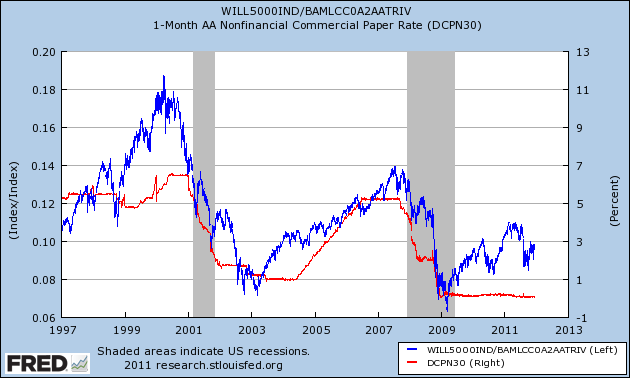
Perhaps this relationship is illusionary but I’m curious if the relationship between long-term rates and equities is itself dependent on short-term rates.
I also think it’s interesting that financially speaking, the 2000-2001 recession last for a much longer time than the gray bar suggests. The later recession, however, lasted roughly as long. In both cases, the market saw the recession before it officially started.
-
Morning News: December 13, 2011
Posted by Eddy Elfenbein on December 13th, 2011 at 5:31 amEU Banks Selling ‘Crown Jewels’ for Cash
Cameron’s Backers Look Past ‘History of Antipathy’
U.K. Inflation Slows on Food, Transport Costs
Pondering a Dire Day: Leaving the Euro
Gold Falls to 7-Week Low on Europe Anxiety
China’s 150 Million Electric Bikes Bolstering Lead
Rating Agency Warnings Bring Down the Markets
Bernanke’s Legacy at Fed: Still a Lagging Indicator
Intel Sees Opportunity in Shortage of Drives
Jive Software Raises $161.3 Million in IPO After Pricing Above Its Range
Sony Shopping is ‘Wrong Direction’ in Apple War
WaMu Ex-Officials Settle FDIC Lawsuit
U.S. Judge Grants Delay in Challenge to AT&T Deal
Google Acquisition of Motorola Delayed in Europe
No Hit Toy to Brighten Retailers’ Christmas
Jeff Carter: Do You Fund Start Ups or Store Fronts?
Cullen Roche: The Role of The Entrepreneur in a Capitalist Economy
Be sure to follow me on Twitter.
-
Where Do Profits Come From?
Posted by Eddy Elfenbein on December 12th, 2011 at 3:31 pmI was listening to today’s EconTalk podcast with Russ Robert and he was talking with Mike Munger about the source of profits. Munger made a good point that profits aren’t about exploitation; they’re really about correcting errors:
I think it is important, and the reason I wanted to start with that, as you pointed out, hilarious joke, that we need to recognize what the source of profits are. The source of profits is correcting errors. The economy around us is full of errors. And what I mean by errors is a maladjustment, a divergence between what we are actually producing and what we “should” produce in order to use the stuff that we have–our mental resources, physical capital, labor–to produce the highest possible level of satisfaction of what the public wants. So, there’s this unobservable thing that nobody knows and nobody can know, and that is: What is it that a consumer-sovereignty oriented society would produce? How are we going to allocate our resources? There’s all sorts of mistakes in the way we are allocating resources. If we not making iPods, if we are not making things that people want to buy, even if they don’t know that they want to buy it. The genius of Steve Jobs was to say: Here’s the way people want to buy these things. They don’t know it, but if we do it, we correct this mistake.
-
Tim Tebow’s Pass Plays
Posted by Eddy Elfenbein on December 12th, 2011 at 3:07 pmI’m not sure if there’s a market lesson here, but here’s a look at all of Tim Tebow’s pass plays from yesterday.
During the second and third quarters, Tebow failed to complete a single pass in nine attempts. Yet in the fourth quarter and overtime, he was amazingly accurate. At one point, he completed ten straight passes.
For his first 16 passes (the fist 48 minutes of the game), Tebow had a passer rating of 13.5. For his last 24, he had a rating of 111.6.
First Quarter
2nd-13, DEN12 10:26 T. Tebow passed to L. Ball to the left for 10 yard gain
3rd-3, DEN22 9:57 T. Tebow incomplete pass to the right
2nd-9, DEN10 6:03 T. Tebow passed to D. Thomas to the left for 12 yard gain
2nd-11, DEN21 4:49 T. Tebow incomplete pass to the left
3rd-16, DEN16 4:42 T. Tebow passed to M. Willis to the left for 23 yard gain
2nd-6, CHI39 2:44 T. Tebow incomplete pass to the right
3rd-6, CHI39 2:26 C. Tillman intercepted T. Tebow for no gainSecond Quarter
1st-10, CHI15 8:15 T. Tebow incomplete pass to the left
3rd-6, CHI11 7:31 T. Tebow incomplete pass to the left
1st-10, DEN42 5:44 T. Tebow incomplete pass to the right
1st-10, DEN33 0:29 T. Tebow incomplete pass to the right
2nd-10, DEN33 0:25 T. Tebow incomplete pass to the right
1st-10, DEN47 0:00 T. Tebow incomplete pass down the middleThird Quarter
2nd-10, DEN45 13:11 T. Tebow incomplete pass down the middle
3rd-10, DEN45 13:05 T. Tebow incomplete pass to the left
1st-10, DEN20 5:19 T. Tebow incomplete pass to the rightFourth Quarter
1st-20, DEN27 11:12 T. Tebow passed to D. Thomas to the left for 14 yard gain
2nd-6, DEN41 10:34 T. Tebow passed to D. Thomas to the left for 9 yard gain
1st-10, 50 10:05 T. Tebow passed to M. Willis to the left for 14 yard gain
1st-10, DEN7 6:50 T. Tebow passed to E. Decker to the left for 23 yard gain
1st-10, DEN30 6:22 T. Tebow incomplete pass to the left
2nd-10, DEN30 6:18 T. Tebow incomplete pass to the right
3rd-10, DEN30 6:12 T. Tebow passed to E. Decker to the right for 1 yard gain
1st-10, DEN37 4:34 T. Tebow passed to L. Ball to the right for 6 yard gain
2nd-4, DEN43 4:05 T. Tebow passed to L. Ball to the right for 10 yard gain
1st-10, CHI47 3:42 T. Tebow passed to J. Johnson down the middle for 8 yard gain
2nd-2, CHI39 3:17 T. Tebow passed to J. Johnson to the left for 3 yard gain
1st-10, CHI36 3:11 T. Tebow passed to M. Willis down the middle for 19 yard gain
1st-10, CHI17 2:39 T. Tebow passed to D. Thomas down the middle for 7 yard gain
2nd-3, CHI10 2:08 T. Tebow passed to D. Thomas to the right for 10 yard touchdown.
1st-10, DEN20 0:56 T. Tebow passed to E. Decker to the left for 9 yard gain
2nd-1, DEN29 0:53 T. Tebow passed to L. Ball to the left for 11 yard gain
1st-10, DEN40 0:53 T. Tebow incomplete pass down the middle
2nd-10, DEN40 0:30 T. Tebow passed to M. Willis to the right for 19 yard gain
1st-10, CHI41 0:23 T. Tebow incomplete pass to the right
2nd-10, CHI41 0:18 T. Tebow incomplete pass to the leftOvertime
1st-10, DEN33 12:47 T. Tebow incomplete pass to the left
2nd-10, DEN34 12:37 T. Tebow passed to W. McGahee to the right for 2 yard gain
3rd-8, DEN36 12:12 T. Tebow passed to D. Thomas to the right for 10 yard gain
2nd-12, DEN44 11:15 T. Tebow passed to D. Thomas to the right for 16 yard gain -
Intel Slides on Lower Guidance
Posted by Eddy Elfenbein on December 12th, 2011 at 1:12 pmIntel ($INTC) is getting clipped today on news that it’s lowering guidance.
Intel, a technology bellwether, said it now expected fourth-quarter revenue of $13.4 billion to $14 billion. It had previously forecast revenue of $14.2 billion to $15.2 billion for the holiday quarter.
Analysts polled by FactSet were expecting revenue of $14.65 billion.
Intel is the world’s largest maker of microprocessors, the brains of computers. The company said it expected personal computer sales to be up from the previous quarter. But it said computer makers are reducing inventories and microprocessor purchases because of hard drive shortages.
Intel has been a supremely frustrating stock for us because I’ve played it exactly wrong — or perhaps we were too early. Still, I always want to look at our bad calls to see what we can learn.
I had Intel on last year’s Buy List and it started off as a good position for us. By April, it was an 18% winner for us. The stock then dropped about 25% and recovered to make us a slight gain for the year but it still trailed the overall market.
After a lot of consideration, I felt that my original thesis no longer held and I decide to boot it from the Buy List for this year. Once again, I was right — at first. Intel underperformed the market at the beginning of this year, then around April it started a large out-performance.
The stock has beaten earnings pretty consistently for the past few years. I had even considered adding back on for 2012. But I couldn’t help feeling that Intel had over-run its value. Only today, now that 2011 is nearly over, do we see some cracks in the company’s business.
The lesson for investors is that your thesis can be right but it may take a long time to see it pay off. I remember Peter Lynch saying that his stocks did best in the second or third year that he owned them.
-
Refining the Gold Model
Posted by Eddy Elfenbein on December 12th, 2011 at 12:09 pmIn this morning’s news roundup, I linked to an interesting post by Willem Weytjens who took my gold model and refined it with updated inputs. I’m happy to see this and I strongly encourage any stat geeks out there to run with this.
My goal for my model was to establish a model for a model of the price of gold. My original description has the price of gold rising eight-fold, in the opposite direction, for each percentage point real rates are from 2%.
As I said in my original post, “if the real rates are at 1%, gold will move up at an 8% annualized rate. If real rates are at 0%, then gold will move up at a 16% rate (that’s been about the story for the past decade). Conversely, if the real rate jumps to 3%, then gold will drop at an 8% rate.”
Weytjens found a better fit using a deflator of 2.15% and 2.2%, and a leverage ratio of 5.7 and 6.95. Check out his charts; the fit looks really good. He found that the model forecasts a gold price of $4,380 in two years.
-
Morning News: December 12, 2011
Posted by Eddy Elfenbein on December 12th, 2011 at 4:51 amEuro Undermined as Draghi Undoes Trichet Rates
European Leaders’ Fiscal Accord May Solve Next Crisis, Not This One
Russian Economy Hampered by ‘Poor’ Business Climate, OECD Says
India’s Industrial Output Slumps, Pressures Central
Royal Bank of Scotland Report Blames Bank Managers for Collapse
European Banks Hunt for Ways to Raise Cash
Oil Drops as Europe Debt Outlook Counters Iran Calls for OPEC Output Cuts
Bank Credit Highest Since Before Lehman as U.S. Growth Continues
Fed to Weigh Publishing a Forecast on Rates
A Romance With Risk That Brought On a Panic
Etihad Orders More Boeing 787-9s, 777s in $2.8 Billion Deal
Whitehaven Buys Aston Resources
Pincus Faceoff With Zuckerberg Shows Fearsome Prelude to Zynga’s IPO
Gold Model Forecasts $4380 Gold Price
Howard Lindzon: The Year 2012…The World Is a Startup and/or Armageddon Gets a Rest
Stone Street: With Un-Verified Reviews (Almost) Everyone Loses, So Why Are They Still So Prevalent?
Be sure to follow me on Twitter.
-
Warren Buffett: If I See A Shirt I Like, I’ll Usually Just Buy It
Posted by Eddy Elfenbein on December 11th, 2011 at 11:52 amThe Onion has Oracle’s commentary:
I’m not really the kind of person to get caught up in the latest trends or fashions or anything like that. But some days, if I get out of work early and have a little time to kill before dinner, I’ll go do some window-shopping in the downtown Omaha area. Usually I just stick to browsing, but occasionally I’ll see a shirt I like, and if I try it on and it looks good, I’ll say, “What the heck,” and go ahead and buy it.
Because why not, right?
If you think about it, we’re only talking $50 or $60 tops here. I’ve had a steady income for years now, and I’m at the point in my life where I just refuse to feel guilty about treating myself to a decent shirt every once in a while. See, because it’s not even about the money. It’s about feeling good. So if I come across a nice blue button-down or a really sharp Tommy Hilfiger polo, I just think, “Warren, in the span of a lifetime are you really going to miss the $40 you spent on a shirt you might wear for upwards of 10 years?” Of course not.
Look, I’m old enough to understand that it’s okay to spend a little cash on something that makes you happy. To tell the truth, I wish I’d learned that lesson years ago.
Now, I’m not saying you should go hog wild and buy 200 shirts at a time or anything. That’d be crazy. And no matter how much money you have, spending $150 on a shirt is just plain silly: I’d bet you dollars to doughnuts that someone somewhere makes a shirt that looks just as nice for half the price. For example, the Men’s Wearhouse at Oak View Mall typically has nice dress shirts for decent prices by all the top name brands, like Ralph Lauren, Geoffrey Beene, and so on. It’s not cheap stuff by any means, but if you have a member card you can get a 15 percent discount, and why not take advantage of a good deal when you see one.
I don’t know about Men’s Wearhouses outside Omaha, but I assume they have a similar discount at their other locations, as well.
When you’re used to pinching pennies and watching where every dollar goes, it can be hard to let loose and just splurge on something. Believe me, I know. But, hey, I’ll drop $8 on a movie once in a while, and it doesn’t even have to be the greatest film in the world, either. And, sure, a $30 box of chocolates for your wife might be a bit extravagant, but the look on her face when you give it to her is more than worth it. (And, let’s be honest, that $30 isn’t exactly going to break the bank!)
I will say that I never buy just to buy. Having some extra sawbucks lying around doesn’t mean they need to be spent. In fact, just last week I walked into a Banana Republic—I like their sweaters a lot—looked around for about 15, 20 minutes, and walked right out. Seriously, just walked right on out.
But, yeah, if something catches my eye, I’m not going to ignore it. I’m going to try it on, see how it looks with the pants I’m wearing, maybe try on a pair of khakis to see if they go with it better. If I like the khakis enough, I’ll buy them, too. Even if it adds up to $160, it’s an outfit I’ll be able to wear many times, and I know I’ll feel confident every time I wear it. That sounds like a bargain to me.
After all, I work hard. I deserve it.
One more thing: I learned the hard way to always try clothes on first. That’s just smart shopping. Case in point: I recently bought this turtleneck at Eddie Bauer without seeing if it fit. Well, you know where that turtleneck is now? Collecting dust in my closet. Sometimes I wear it under a sports coat, but very rarely. Sixty-five dollars down the drain.
But you know what? It’s just 65 bucks, for crying out loud. Big deal.
-
Mercedes Benz
Posted by Eddy Elfenbein on December 9th, 2011 at 4:00 pmIt’s 4 pm and the markets are closed. Let Janis get your weekend started — and I figure we might as well help the German economy while we’re at it..
-
Archives
- October 2026
- September 2026
- August 2026
- July 2026
- June 2026
- May 2026
- April 2026
- March 2026
- February 2026
- January 2026
- December 2025
- November 2025
- October 2025
- September 2025
- August 2025
- July 2025
- June 2025
- May 2025
- April 2025
- March 2025
- February 2025
- January 2025
- December 2024
- November 2024
- October 2024
- September 2024
- August 2024
- July 2024
- June 2024
- May 2024
- April 2024
- March 2024
- February 2024
- January 2024
- December 2023
- November 2023
- October 2023
- September 2023
- August 2023
- July 2023
- June 2023
- May 2023
- April 2023
- March 2023
- February 2023
- January 2023
- December 2022
- November 2022
- October 2022
- September 2022
- August 2022
- July 2022
- June 2022
- May 2022
- April 2022
- March 2022
- February 2022
- January 2022
- December 2021
- November 2021
- October 2021
- September 2021
- August 2021
- July 2021
- June 2021
- May 2021
- April 2021
- March 2021
- February 2021
- January 2021
- December 2020
- November 2020
- October 2020
- September 2020
- August 2020
- July 2020
- June 2020
- May 2020
- April 2020
- March 2020
- February 2020
- January 2020
- December 2019
- November 2019
- October 2019
- September 2019
- August 2019
- July 2019
- June 2019
- May 2019
- April 2019
- March 2019
- February 2019
- January 2019
- December 2018
- November 2018
- October 2018
- September 2018
- August 2018
- July 2018
- June 2018
- May 2018
- April 2018
- March 2018
- February 2018
- January 2018
- December 2017
- November 2017
- October 2017
- September 2017
- August 2017
- July 2017
- June 2017
- May 2017
- April 2017
- March 2017
- February 2017
- January 2017
- December 2016
- November 2016
- October 2016
- September 2016
- August 2016
- July 2016
- June 2016
- May 2016
- April 2016
- March 2016
- February 2016
- January 2016
- December 2015
- November 2015
- October 2015
- September 2015
- August 2015
- July 2015
- June 2015
- May 2015
- April 2015
- March 2015
- February 2015
- January 2015
- December 2014
- November 2014
- October 2014
- September 2014
- August 2014
- July 2014
- June 2014
- May 2014
- April 2014
- March 2014
- February 2014
- January 2014
- December 2013
- November 2013
- October 2013
- September 2013
- August 2013
- July 2013
- June 2013
- May 2013
- April 2013
- March 2013
- February 2013
- January 2013
- December 2012
- November 2012
- October 2012
- September 2012
- August 2012
- July 2012
- June 2012
- May 2012
- April 2012
- March 2012
- February 2012
- January 2012
- December 2011
- November 2011
- October 2011
- September 2011
- August 2011
- July 2011
- June 2011
- May 2011
- April 2011
- March 2011
- February 2011
- January 2011
- December 2010
- November 2010
- October 2010
- September 2010
- August 2010
- July 2010
- June 2010
- May 2010
- April 2010
- March 2010
- February 2010
- January 2010
- December 2009
- November 2009
- October 2009
- September 2009
- August 2009
- July 2009
- June 2009
- May 2009
- April 2009
- March 2009
- February 2009
- January 2009
- December 2008
- November 2008
- October 2008
- September 2008
- August 2008
- July 2008
- June 2008
- May 2008
- April 2008
- March 2008
- February 2008
- January 2008
- December 2007
- November 2007
- October 2007
- September 2007
- August 2007
- July 2007
- June 2007
- May 2007
- April 2007
- March 2007
- February 2007
- January 2007
- December 2006
- November 2006
- October 2006
- September 2006
- August 2006
- July 2006
- June 2006
- May 2006
- April 2006
- March 2006
- February 2006
- January 2006
- December 2005
- November 2005
- October 2005
- September 2005
- August 2005
- July 2005
 Eddy Elfenbein is a Washington, DC-based speaker, portfolio manager and editor of the blog Crossing Wall Street. His