-
Morning News: December 7, 2011
Posted by Eddy Elfenbein on December 7th, 2011 at 5:21 amMerkel’s Path: Brinkmanship for Debt Crisis
New European Bank Chief Takes a Bold Approach
‘Buy French’ Becomes Crisis Battle Cry in France
China Growth Calls Ease as Export Outlook Darkens
India Suspends Foreign Retail Plan on Protests
Geithner Backs French-German Plan for Tighter EU
Geithner: Europe ‘Will Succeed’
Separating Fact From Fiction on the Fed’s Loans
Fed Lashes Out at ‘Errors’ in Reporting
Prudential Sells Real Estate Brokerage, Relocation Business to Brookfield
Daimler Losing to BMW as Pure Luxury Wins
Limited Choices for Yahoo, Each One With Its Own Risks
Olympus Report Seeks Purge of ‘Yes Men’ Who Failed to Act
Joshua Brown: Should You Follow Tom DeMark?
Jeff Miller: Weighing the (rest of the) Week Ahead: The Eurozone Summit
Be sure to follow me on Twitter.
-
The New Buy List
Posted by Eddy Elfenbein on December 6th, 2011 at 3:21 pmI’m going to unveil the 2012 Buy List on Thursday, December 15th.
Although the Buy List won’t take effect until January 1st (the first day of trading in 2012 will be Tuesday, January 3rd), I like to pre-announce the new list so no one can claim that I’m trying to “front-run” my picks.
As usual, the Buy List will have 20 names. Once the list is chosen, the names are locked and sealed, and I can’t make any change for the entire year. Also, as per usual, I’m only going to add and delete five names to the Buy List.
My goal is to show investors that by being disciplined, investors can beat the market.
For tracking purposes, I assume the Buy List is a portfolio of $1 million that’s equally weighted among the 20 stocks based on the price at the start of the year.
-
Packers Sell $400,000 in Stock in 11 Minutes
Posted by Eddy Elfenbein on December 6th, 2011 at 1:23 pmThe Green Bay Packers just sold $400,000 worth of stock in 11 minutes today.
There is, however, some downside to owning the Packers. For example, the stock doesn’t pay any dividends and can never be sold. It will never appreciate.
Come to think of it, it’s only downside.
The team is riding their success on the field this year by raising money in this offering. The Packers are trying to sell 250,000 shares at $250 each for a total of $62.5 million. Let’s see how it goes. If you’re interested, you can buy the shares at PackersOwner.com.
Some explanation is needed. This is from a post I wrote on the Packers five years ago:
CNBC’s Darren Rovell has a good story on the business of the Green Bay Packers. Rovell only briefly touches on this, but the Packers are one of the more interesting businesses in America today. The team is organized as a non-profit, community-owned corporation.
There are about 4.7 million shares, but they don’t pay a dividend and they can’t be traded. Think about that. You just buy them and watch. If you want, you can sell the shares back to the team for a teeny amount of money.
The Packer fans are so loyal that they’ve bought shares, and financially rescued the team more than once over the past 80 years.
The team was organized as a community-owned company in 1923. To add some context, this was at the high tide as progressive movement, which found its epicenter in Wisconsin (i.e., the Wisconsin Idea).
In 1924, Senator Robert “Fighting Bob” La Follette, Sr. of Wisconsin ran for president as a third party candidate. He won 17% of the vote and carried his home state.
The senior La Follette died in 1925, but was succeeded by his son, Robert La Follette, Jr., who held the seat until 1946 when he was upset by Joseph McCarthy (with the help of the Communist Party).
Milwaukee was the country’s only large city to have a socialist mayor, or at least, an admitted socialist mayor. In fact, the city had three socialist mayors over 38 years between 1910 and 1960 (would they have nationalized Arnold’s?). The last one died a few weeks ago at the age of 93.
-
The Fed Strikes Back
Posted by Eddy Elfenbein on December 6th, 2011 at 1:04 pmLast week, Bloomberg had an article claiming that the Federal Reserve gave $13 billion to banks without telling Congress. Today, Bernanke shot back and sent this letter to the Senate Banking Committee. The language in the letter is surprisingly strong.
-
Breaking Down Oracle
Posted by Eddy Elfenbein on December 6th, 2011 at 11:03 amSometime next week Oracle ($ORCL) will probably release its fiscal Q2 earnings report. Wall Street expects the company to report earnings of 57 cents per share. I think it will be closer to 60 cents per share.
Even if I’m wrong, Oracle is still a fairly inexpensive stock. Below is a chart of Oracle’s stock along with its earnings-per-share. The stock follows the left scale and the earnings follow the right. The two are scaled at a ratio of 15-to-1 which means that the P/E Ratio is exactly 15 whenever the lines cross. The red line is Wall Street’s estimate.
I use 15 not as a projection of what I think the earnings multiple ought to be but simply because that’s been a close enough valuation for the last several quarters. More recently, however, Oracle has fallen to a cheaper valuation.
Using some rough interpolation, Wall Street thinks Oracle can earn $2.52 per share for the entire 2012 calendar year. (Note this is just an estimate, Oracle’s quarters don’t follow the March/June/September/December cycle.) At 15 times that, Oracle’s stock could reach $37.95 by the end of next year which is a 19% rise from here.
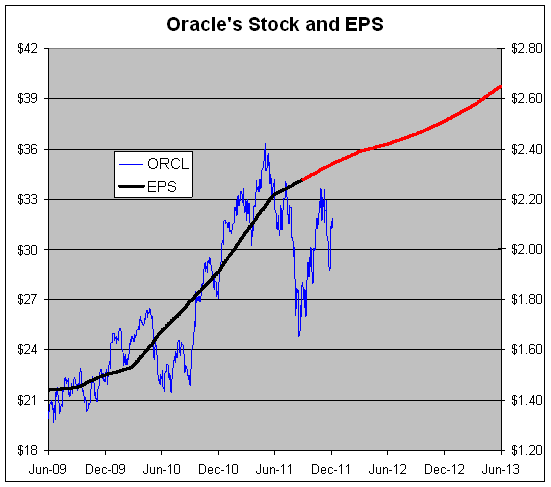
This also doesn’t take into account the fact that Oracle has a decent track record of exceeding analysts expectations. You can even see how the red line’s trajectory seems a bit subdued from recent history. Understandably, we want our projections to be somewhat conservative.
A few years ago, Oracle started paying a modest dividend. I wouldn’t call this a major factor in the share price but it’s very possible that the company will bump up the dividend in the next few months. If Oracle raises the quarterly dividend from six cents per share to eight cents per share, the stock will then have a yield of 1%. Not much, but it’s better than nothing.
If Oracle’s earnings trend continues, then I think it’s very possible the share price will hit $40 sometime next year.
-
Morning News: December 6, 2011
Posted by Eddy Elfenbein on December 6th, 2011 at 5:32 amMerkel, Sarkozy Unite as S&P Issues Warning
Wal-Mart Debate Rages in India
BNP, Credit Agricole Knocked Off Top Equity Spot
Telecom Italia Sees Tech Lag Hampering Cloud Growth
In Ireland, Austerity Is Praised but Painful
Power in Numbers: China Aims for High-Tech Primacy
S.&P. Warns Euro Zone of Ratings Downgrades
Oil Snaps Two-Day Gain as S&P Threatens European Credit Rating Downgrades
Gold Ends Lower as European Progress Dulls Demand
Geithner to Add U.S. Weight to Euro Zone Talks
It’s Tone, Not Taxes, a Tycoon Tells the President
Afghanistan Taps Aussie Miners
Birinyi Says Buy Iconic Brands to Beat Market
Olympus Remains Delisting Risk After Report, Exchange Says
Jeff Carter: CFTC Might Perpetuate Fraud
Roger Nusbaum: The Slog Continues
Be sure to follow me on Twitter.
-
Highest Close Since Mid-November
Posted by Eddy Elfenbein on December 5th, 2011 at 6:24 pmAlthough we gave back some of our gains in the afternoon, this was still a pretty good day for the market. The S&P 500 gained 1.03% to reach its highest close since November 15th. Our Buy List added 1.33% to extend its lead over the overall market. The S&P 500 is still below its 200-day moving average.
Nicholas Financial ($NICK) briefly touched $12 per share. We also saw decent gains from Stryker ($SYK) and Medtronic ($MDT). Some of the medical supply companies were hit hard late last week. On the Buy List, every stock but Johnson & Johnson ($JNJ) and Fiserv ($FISV) was up today.
Leucadia ($LUK) just announced its annual dividend of 25 cents per share. I’m not sure why they even bother. The dividend amounts to just over 1%.
-
“Essentially Identical”
Posted by Eddy Elfenbein on December 5th, 2011 at 4:14 pmConsider the following:
Banks pour huge amounts of money into one particular asset class. They are encouraged to do this by public policymakers, although there is some dispute about whether that was the main reason for their decisions. These assets have a long tradition of doing well, although a close look at the evidence would have raised red flags. The asset market in question suddenly takes a big dive as default risk increases sharply. This drags down many large banks, forcing policymakers to provide assistance.
What have I just described? The sub-prime fiasco or the PIGS sovereign debt fiasco? I’d say both. I’d say these two crises are essentially identical. (I should clarify that by “essentially identical” I mean in essence, not in every detail.)
-
The S&P 500 Is Up to 1,265
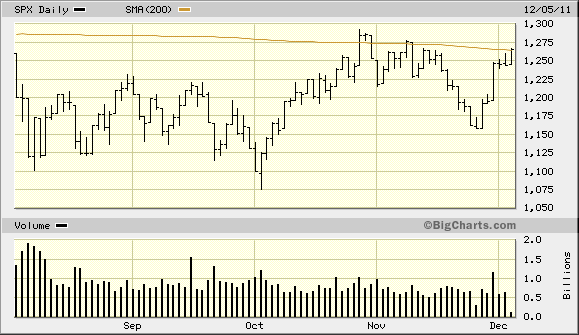
Posted by Eddy Elfenbein on December 5th, 2011 at 10:40 amThe market is rallying again today. The S&P 500 has been as high as 1,265 this morning. That’s a gain of 9.1% since the Friday after Thanksgiving which was only six trading days ago.
Keep a close eye on 1,264.56. That’s the average of the last 199 days so if we close above that, we’ll be above the 200-DMA.
The market now has a real shot of making a four-month high soon. The current high close of the last four months was 1,285.09 from October.
The financials and Energy sectors are leading the charge. On our Buy List, the standouts are Ford ($F), JPMorgan Chase ($JPM) and Medtronic ($MDT). AFLAC ($AFL) is about to poke its head above $45 per share. Ten weeks ago, AFL was trading near $31.
The next earnings report for the Buy List will be from Oracle ($ORCL) and that should come some time next week, though I don’t know which day. Wall Street expects earnings of 57 cents per share compared with 51 cents per share one year ago. I think that’s a little low. My numbers say that Oracle should earn 60 cents per share. I think this company is doing very well right now.
-
Morning News: December 5, 2011
Posted by Eddy Elfenbein on December 5th, 2011 at 6:01 amMerkel Heads to Paris as EU Leaders Seek Debt Strategy
Monti’s Austerity Debut Risks Italian Wrath
U.K. Service-Sector Job Losses Gather Pace
Indian Retailers Slump as Singh May Suspend FDI Decision
China Signals Reluctance to Rescue E.U.
China’s Stocks Decline, Extending Fourth Weekly Loss, on Property Concerns
Faulty Forecasts Roil Corn Market
Zynga Lets Bing Gordon Turn $35 Million Into $650 Million
British Airways Bid for BMI to Plug Asia Gaps
SAP Sheds M&A Shyness as Oracle Rivalry Moves to the Cloud
SAP to Buy SuccessFactors for $3.4 Billion
Commercial Metals Rejects Icahn’s $1.7 Billion Bid
Troubled Bank Dexia Gets New Financing Lifeline
Rich-Poor Divide Is Widening, OECD Says
Howard Lindzon: Bring on 2012…The Abundance Showdown!
Stone Street: (O’)Taylor Rules!
Be sure to follow me on Twitter.
-
Archives
- October 2026
- September 2026
- August 2026
- July 2026
- June 2026
- May 2026
- April 2026
- March 2026
- February 2026
- January 2026
- December 2025
- November 2025
- October 2025
- September 2025
- August 2025
- July 2025
- June 2025
- May 2025
- April 2025
- March 2025
- February 2025
- January 2025
- December 2024
- November 2024
- October 2024
- September 2024
- August 2024
- July 2024
- June 2024
- May 2024
- April 2024
- March 2024
- February 2024
- January 2024
- December 2023
- November 2023
- October 2023
- September 2023
- August 2023
- July 2023
- June 2023
- May 2023
- April 2023
- March 2023
- February 2023
- January 2023
- December 2022
- November 2022
- October 2022
- September 2022
- August 2022
- July 2022
- June 2022
- May 2022
- April 2022
- March 2022
- February 2022
- January 2022
- December 2021
- November 2021
- October 2021
- September 2021
- August 2021
- July 2021
- June 2021
- May 2021
- April 2021
- March 2021
- February 2021
- January 2021
- December 2020
- November 2020
- October 2020
- September 2020
- August 2020
- July 2020
- June 2020
- May 2020
- April 2020
- March 2020
- February 2020
- January 2020
- December 2019
- November 2019
- October 2019
- September 2019
- August 2019
- July 2019
- June 2019
- May 2019
- April 2019
- March 2019
- February 2019
- January 2019
- December 2018
- November 2018
- October 2018
- September 2018
- August 2018
- July 2018
- June 2018
- May 2018
- April 2018
- March 2018
- February 2018
- January 2018
- December 2017
- November 2017
- October 2017
- September 2017
- August 2017
- July 2017
- June 2017
- May 2017
- April 2017
- March 2017
- February 2017
- January 2017
- December 2016
- November 2016
- October 2016
- September 2016
- August 2016
- July 2016
- June 2016
- May 2016
- April 2016
- March 2016
- February 2016
- January 2016
- December 2015
- November 2015
- October 2015
- September 2015
- August 2015
- July 2015
- June 2015
- May 2015
- April 2015
- March 2015
- February 2015
- January 2015
- December 2014
- November 2014
- October 2014
- September 2014
- August 2014
- July 2014
- June 2014
- May 2014
- April 2014
- March 2014
- February 2014
- January 2014
- December 2013
- November 2013
- October 2013
- September 2013
- August 2013
- July 2013
- June 2013
- May 2013
- April 2013
- March 2013
- February 2013
- January 2013
- December 2012
- November 2012
- October 2012
- September 2012
- August 2012
- July 2012
- June 2012
- May 2012
- April 2012
- March 2012
- February 2012
- January 2012
- December 2011
- November 2011
- October 2011
- September 2011
- August 2011
- July 2011
- June 2011
- May 2011
- April 2011
- March 2011
- February 2011
- January 2011
- December 2010
- November 2010
- October 2010
- September 2010
- August 2010
- July 2010
- June 2010
- May 2010
- April 2010
- March 2010
- February 2010
- January 2010
- December 2009
- November 2009
- October 2009
- September 2009
- August 2009
- July 2009
- June 2009
- May 2009
- April 2009
- March 2009
- February 2009
- January 2009
- December 2008
- November 2008
- October 2008
- September 2008
- August 2008
- July 2008
- June 2008
- May 2008
- April 2008
- March 2008
- February 2008
- January 2008
- December 2007
- November 2007
- October 2007
- September 2007
- August 2007
- July 2007
- June 2007
- May 2007
- April 2007
- March 2007
- February 2007
- January 2007
- December 2006
- November 2006
- October 2006
- September 2006
- August 2006
- July 2006
- June 2006
- May 2006
- April 2006
- March 2006
- February 2006
- January 2006
- December 2005
- November 2005
- October 2005
- September 2005
- August 2005
- July 2005
 Eddy Elfenbein is a Washington, DC-based speaker, portfolio manager and editor of the blog Crossing Wall Street. His