-
S&P 500 Total Return Index
Posted by Eddy Elfenbein on November 1st, 2011 at 11:27 amThrough October, the S&P 500 is down 0.35% but including dividends, it’s up 1.30%. Here’s a look at the total return index of the S&P 500 going back to 1997.

-
October ISM = 50.8
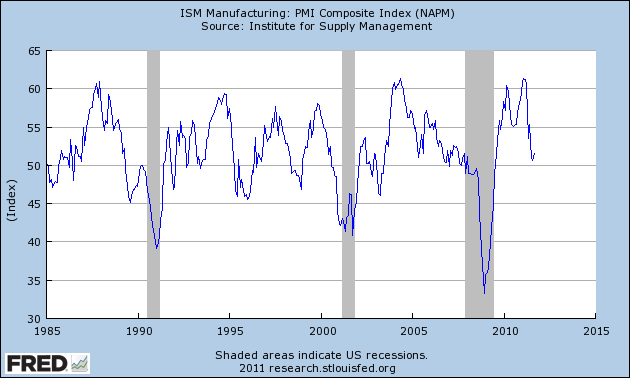
Posted by Eddy Elfenbein on November 1st, 2011 at 10:15 amThe October ISM just printed at 50.8 which is a decline from 51.6 for September. Economists were expecting a reading of 52.
Whenever the ISM is over 50 it means the economy is expanding. When it’s below 50, it’s contracting. The ISM has fallen between 50.0 and 52.0 a total of 89 times; just five have been recessions.
-
Morning News: November 1, 2011
Posted by Eddy Elfenbein on November 1st, 2011 at 6:14 amEurope Debt Crisis Threatens Asian Growth
China PMI Drops to Lowest in Almost 3 Years
Markets Tumble as Greece Sets Referendum on Latest Europe Aid Deal
Euro Weakens on Renewed Greek Default Concern; Dollar, Yen Gain
Italian Bonds Slide, Premium to Bunds Reaches Record, Amid Greece Concern
Czech PMI Falls to Lowest in 22 Months as Export Orders Dry Up
Japan Acts Alone to Weaken Its Currency
Report Says New York Fed Didn’t Cut Deals on A.I.G.
Retreat From Debit-Card Fees Continues
MF Global Suspended From LME Trade, CME Clearing on Filing
MF Global Bankruptcy Leaves Star Bankers Adrift
Time Warner Trims Its Excesses
British Security Firm G4S’ Bid for Danish ISS Scuppered by Shareholder Backlash
Japanese Brokerage Giant Nomura Posts First Loss in Two Years
Allstate Adds Corporate Debt, Shuns ‘Too-Low’ Treasury Yields
Edward Harrison: Greek Referendum Could Mean CDS Greek Default Trigger
Paul Kedrosky: Doing Austerian Math
Be sure to follow me on Twitter.
-
More on Stocks Against Bonds
Posted by Eddy Elfenbein on October 31st, 2011 at 1:45 pmHere’s another look at the epic battle of stocks against bonds. As a proxy for the long-term bond markets, I used Vanguard’s Long-Term Investment-Grade Index Fund (VWESX) and for stocks, I used Vanguard’s 500 Index (VFINX). It’s not perfect but it’s good enough to make my point.
The graph below shows VFINX divided by VWESX so whenever the line is rising, stocks are outperforming bonds.
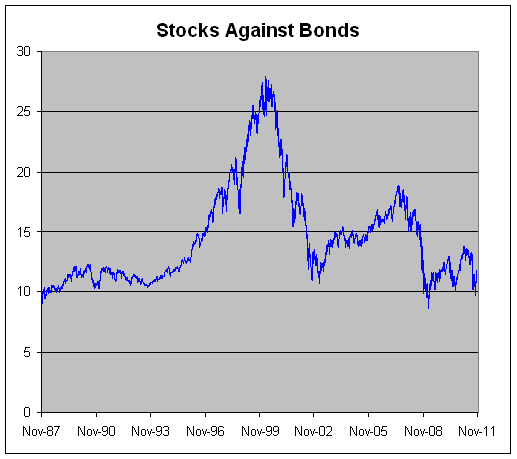
As you can see, bonds have held their own for a long time which runs counter to established wisdom that there’s a “premium” in holding equities. I still think there is an equity premium but it’s much smaller than most folks realize. Furthermore, the premium is very volatile so it’s not unusual to experience long phases where bonds beat stocks.
Despite how well the stock market has done since the March 2009 low, it’s dead even with corporate bonds since May 8, 2009.
Since July 13, 2007, corporate bonds have gained 46.74% while stocks have lost 9.38%.
-
Even More Innumeracy from Jeremy Siegel
Posted by Eddy Elfenbein on October 31st, 2011 at 11:43 amWhen Wharton Professor Jeremy Siegel takes on math, it’s usually not pretty. I’ve caught him making basic math errors a few times before.
He’s still doing it.
In the Bloomberg article I linked to before, Siegel has a long quote:
“The rally in bonds is a once in a millennium event, but it’s absolutely mathematically impossible for bonds to get any kind of returns like this going forward whereas stock returns can repeat themselves, and are likely to outperform,” he said. “If you missed the rally in bonds, well, then that’s it.”
He may be right about the direction of bonds, but he’s simply and obviously incorrect about the mathematical impossibility of bonds outperforming.
Just because yields are low doesn’t mean they can’t go lower.
Let’s take a 30-year bond with a coupon of 10%. If the bond sees its price jump by 50%, that brings the yield down to 6.28%.
But if we take a 30-year bond with a coupon of 5% and if its price soars by 50%, that brings the yield down to 2.59%.
In other words, as yields go lower each basis point is worth a greater price.
Yes, bond yields are low, but there’s absolutely no rule in the realm of mathematics that prevents bonds from seeing the sames kinds of returns they’ve experienced.
-
For the First Time on 150 Years….
Posted by Eddy Elfenbein on October 31st, 2011 at 9:43 amThe 30-year return of bonds has beaten stocks (from Bloomberg):
The biggest bond gains in almost a decade have pushed returns on Treasuries above stocks over the past 30 years, the first time that’s happened since before the Civil War.
Fixed-income investments advanced 6.25 percent, almost triple the 2.18 percent rise in the Standard & Poor’s 500 Index through last week, according to Bank of America Merrill Lynch indexes. Debt markets are on track to return 7.63 percent this year, the most since 2002, the data show. Long-term government bonds have gained 11.5 percent a year on average over the past three decades, beating the 10.8 percent increase in the S&P 500, said Jim Bianco, president of Bianco Research in Chicago.
The combination of a core U.S. inflation rate that has averaged 1.5 percent this year, the Federal Reserve’s decision to keep its target interest rate for overnight loans between banks near zero through 2013, slower economic growth and the highest savings rate since the global credit crisis have made bonds the best assets to own this year. Not only have bonds knocked stocks from their perch as the dominant long-term investment, their returns proved everyone from Bill Gross to Meredith Whitney and Nassim Nicholas Taleb wrong.
“The generation-long outperformance of bonds over stocks has been the biggest investment theme that everyone has just gotten plain wrong,” Bianco said in an Oct. 26 telephone interview. “It’s such an ingrained idea in everyone’s head that such low yields should be shunned in favor of stocks, that no one wants to disrupt the idea, never mind the fact that it has been off.”
Part of this stat is due to timing — 30 years ago was the trough of the bond market. However, I think this underscores a point I’ve made for some time: the expected return of stocks over bonds is smaller than most experts believe. If I had to guess, I’d say that the equity premium of stocks over long-term bonds is probably 1.5% to 2%.
-
Morning News: October 31, 2011
Posted by Eddy Elfenbein on October 31st, 2011 at 5:57 amBerlusconi Defiant as EU’s Focus Shifts to Italy
Draghi Takes ECB Helm in Battle Mode
Danish Banks May Shun $76 Billion Cash Lifeline
Iceland Passes Final Hurdle in $11.4B Payout
Sarkozy Criticized for Seeking China’s Help
Japanese Officials Intervene to Weaken Yen
Japanese Companies Question Long-Term Effect of Yen Intervention
Oil Declines, Paring Biggest Monthly Increase Since May 2009
As Meeting Approaches, Fed Panel Is Divided on Direction
Chinese Internet Portal Sohu.com Profit Rises 14%
Barclays Q3 Profit Climbs Amid Sovereign Crisis
MF Global Said to Be in Deal Talks With Interactive Brokers
Cable Is Holding Web TV at Bay, Earnings Show
Jeff Miller: Weighing the Week Ahead: Will the Modest Economic Rebound Continue?
Be sure to follow me on Twitter.
-
Comment From Seeking Alpha
Posted by Eddy Elfenbein on October 29th, 2011 at 9:00 pmHere’s a comment courtesy of rschus at Seeking Alpha regarding my recent post on Amazon‘s ($AMZN) super-rich valuation.
Not only does rschus prove my point that investors in Amazon refuse to look at the numbers, but I find all his criticisms to be rather complimentary:
Mr Elfenbein strikes me as a technocrat rigidly locked into rules and numbers without considering the kind of positive vibes that a company like Amazon generates for the individuals who shop there and its iconic name (akin to Google) in the wider world. This is a powerful and well-run company that, despite occasional stumbles, will only grow because shopping there gets you what you want with comparison shopping, great prices, reviews and whatever you don’t get by dragging yourself to stores with usually uninformed salesmen and limited inventory. P/E? Shmee/E? Amazon will grow.
He’s right — I don’t consider positive vibes when looking at a stock.
-
CWS Market Review – October 28, 2011
Posted by Eddy Elfenbein on October 28th, 2011 at 5:05 amThursday was one of the most spectacular days in the history of Crossing Wall Street. It’s odd for us to see the market behave so irrationally for so long and then suddenly, in a matter of a few hours, see nearly all of our views vindicated. On Thursday, six of our Buy List stocks rallied by more than 7%. Over the last 18 sessions, our Buy List has gained a staggering 18.72%.
The market has finally turned our way and it’s done so in a very dramatic fashion.
Let’s break down some of the numbers from Thursday’s amazing day. The S&P 500 soared 42.59 points or 3.43%, making it one of the best days of the year. October, in fact, is shaping up to be one of the best months for the stock market since reliable records have been kept. Plus, an important event that I’ve been waiting for has finally come to pass—the S&P 500 just broke its 200-day moving average. Historically, that’s a very good sign for equities. Furthermore, the index is now positive for the year.
Best of all, we’re outperforming a strong bull. Our Buy List soared 4.38% on Thursday which is a full 0.95% better than the market. We had several big winners. In last week’s CWS Market Review, I told you that AFLAC ($AFL) could easily earn $1.64 per share which was a bold call since it was four cents higher than Wall Street’s consensus. It turns out that I wasn’t optimistic enough! AFLAC reported Q3 operating earnings of $1.66 per share. The stock exploded higher on Thursday. At one point, AFLAC was up 11.5% for the day.
AFLAC also raised its full-year EPS guidance for 2011 from $6.09 – $6.34 to $6.30 – $6.37. So I guess their European investments are bankrupting them! This earnings report confirms what I’ve been saying for weeks—AFLAC continues to perform extremely well. The company is also benefiting from the strong yen. (Check out the CEO on CNBC.) AFLAC boosted its dividend by 10% making this the 29th year in a row that the company has increased its dividend.
Over the last five weeks, AFLAC has gained more than 43%. The stock continues to be an outstanding buy. I’m raising my buy price on AFLAC to $50.
Our biggest winner on Thursday was little Nicholas Financial ($NICK). No one on Wall Street follows this company, but I gave my forecast on the blog recently. I said NICK could earn between 44 and 46 cents per share, and the company hit the top end of my range perfectly.
Once again, my view on NICK was confirmed by the earnings report. This financer for used cars is doing very well and its business strategy is sound. The shares responded by rallying over 10% on Thursday. Even at that higher price, NICK yields close to 3.5%.
Despite how well NICK has done, I still believe the shares are vastly underpriced. I think a reasonable buy-out price for NICK is at least $17 per share. However, if you’re looking to invest in NICK, I should warn you that the stock can be very thinly traded so be careful when placing buy orders. If you’re not careful, you could wind up pushing the price out of reach. NICK is an excellent buy for more aggressive small-cap investors.
We also had a strong earnings report from Deluxe ($DLX). The company earned 78 cents per share which was three cents more than estimates. Deluxe is one of our quieter stocks but it’s doing very well. I really like the stock’s high dividend yield.
For Q4, Deluxe sees earnings ranging between 77 cents and 84 cents per share on revenue between $359 million and $369 million. Wall Street had been expecting 82 cents per share on revenue of $362.84 million so there’s no surprise here. This is a solid buy.
On Wednesday, Ford Motor ($F) reported earnings of 46 cents per share which was two cents better than Wall Street’s consensus. This is the automaker’s 10th-straight quarter of profitability. Actually, Ford’s earnings could have been much better. The company was hurt by weakness in Europe and also by rising commodity prices. Despite these challenges, the company delivered strong results.
The stock actually fell on Wednesday but gained much of it back on Thursday. Thanks to a recent deal with its union, Ford had its credit rating upgraded. The company is even considering restoring its dividend. Now that I’ve had a chance to dig through the earnings report, I feel confident in saying that Ford is a strong buy up to $14 per share.
So far this earnings season, eight of our nine stocks have beaten Wall Street’s expectations which is a ratio that’s far better than the rest of the market. Our only miss so far came from Reynolds American ($RAI). For Q3, Reynolds earned 70 cents per share which was three cents below consensus. The company also narrowed its full-year EPS range to $2.63 – $2.68 per share which implies a Q4 range of 67 – 72 cents per share.
In my opinion, the more important news is that the company raised its quarterly dividend by three cents per share. Shares of RAI now yield 5.82% which beats just about everything else you can find. I’m not at all worried about a slight earnings miss for Reynolds. They missed earnings in the second quarter but that didn’t stop the stock from rallying. Reynolds American continues to be a very good buy for income-oriented investors.
The final earnings report for this week came from Gilead Sciences ($GILD). For Q3, GILD earned $1.02 per share which was one penny better than expectations. This comes as a relief because the earnings report for the first quarter was a dud. I’m glad to see that Gilead is back on track. I like this stock a lot. Going by Thursday’s close, Gilead is selling for less than 10 times next year’s earnings estimate. This could easily be a $50 stock. It went as high as $57 three years ago and earnings are much higher today.
That’s all for now. Coming next week, we’re going to have Buy List earnings reports from Moog ($MOG-A), Becton Dickinson ($BDX), Fiserv ($FISV) and Wright Express ($WXS). Be sure to keep checking the blog for daily updates. I’ll have more market analysis for you in the next issue of CWS Market Review!
– Eddy
-
Morning News: October 28, 2011
Posted by Eddy Elfenbein on October 28th, 2011 at 5:04 amCalling Bankers’ Bluff, Merkel Got Europe a Debt Plan
EU Bank Debt Plan May Struggle to Thaw Funding Market
Greek Prime Minister Praises European Debt Deal
Gauging the Fallout of Another Rescue
Europe Looks to IMF, China for Rescue-Fund Cash
U.S. Economy Picks Up Pace, Averting a Stall
Oil Drops on Japan Output, Pares Biggest Weekly Gain Since March
Oil Industry Hums as Higher Prices Bolster Quarterly Profits at Exxon and Shell
PetroChina Gains Top Sinopec as Crude Counters Refining Loss
Samsung Overtakes Apple in Smartphone Sales
HP Ditches Costly PC Unit Spin-off
Potash Third-Quarter Profit More Than Doubles on Higher Fertilizer Prices
Some MF Global Clients Move Money Away as Troubles Grow
Advertising Giant WPP Predicts Full-Year Revenue Growth to Slow
Disney Channel to Be Introduced in Russia
Roger Nusbaum: Now That Would Be A Disclaimer
Jeff Carter: Occupy Wall Street and Entrepreneur Investment
Be sure to follow me on Twitter.
-
Archives
- October 2026
- September 2026
- August 2026
- July 2026
- June 2026
- May 2026
- April 2026
- March 2026
- February 2026
- January 2026
- December 2025
- November 2025
- October 2025
- September 2025
- August 2025
- July 2025
- June 2025
- May 2025
- April 2025
- March 2025
- February 2025
- January 2025
- December 2024
- November 2024
- October 2024
- September 2024
- August 2024
- July 2024
- June 2024
- May 2024
- April 2024
- March 2024
- February 2024
- January 2024
- December 2023
- November 2023
- October 2023
- September 2023
- August 2023
- July 2023
- June 2023
- May 2023
- April 2023
- March 2023
- February 2023
- January 2023
- December 2022
- November 2022
- October 2022
- September 2022
- August 2022
- July 2022
- June 2022
- May 2022
- April 2022
- March 2022
- February 2022
- January 2022
- December 2021
- November 2021
- October 2021
- September 2021
- August 2021
- July 2021
- June 2021
- May 2021
- April 2021
- March 2021
- February 2021
- January 2021
- December 2020
- November 2020
- October 2020
- September 2020
- August 2020
- July 2020
- June 2020
- May 2020
- April 2020
- March 2020
- February 2020
- January 2020
- December 2019
- November 2019
- October 2019
- September 2019
- August 2019
- July 2019
- June 2019
- May 2019
- April 2019
- March 2019
- February 2019
- January 2019
- December 2018
- November 2018
- October 2018
- September 2018
- August 2018
- July 2018
- June 2018
- May 2018
- April 2018
- March 2018
- February 2018
- January 2018
- December 2017
- November 2017
- October 2017
- September 2017
- August 2017
- July 2017
- June 2017
- May 2017
- April 2017
- March 2017
- February 2017
- January 2017
- December 2016
- November 2016
- October 2016
- September 2016
- August 2016
- July 2016
- June 2016
- May 2016
- April 2016
- March 2016
- February 2016
- January 2016
- December 2015
- November 2015
- October 2015
- September 2015
- August 2015
- July 2015
- June 2015
- May 2015
- April 2015
- March 2015
- February 2015
- January 2015
- December 2014
- November 2014
- October 2014
- September 2014
- August 2014
- July 2014
- June 2014
- May 2014
- April 2014
- March 2014
- February 2014
- January 2014
- December 2013
- November 2013
- October 2013
- September 2013
- August 2013
- July 2013
- June 2013
- May 2013
- April 2013
- March 2013
- February 2013
- January 2013
- December 2012
- November 2012
- October 2012
- September 2012
- August 2012
- July 2012
- June 2012
- May 2012
- April 2012
- March 2012
- February 2012
- January 2012
- December 2011
- November 2011
- October 2011
- September 2011
- August 2011
- July 2011
- June 2011
- May 2011
- April 2011
- March 2011
- February 2011
- January 2011
- December 2010
- November 2010
- October 2010
- September 2010
- August 2010
- July 2010
- June 2010
- May 2010
- April 2010
- March 2010
- February 2010
- January 2010
- December 2009
- November 2009
- October 2009
- September 2009
- August 2009
- July 2009
- June 2009
- May 2009
- April 2009
- March 2009
- February 2009
- January 2009
- December 2008
- November 2008
- October 2008
- September 2008
- August 2008
- July 2008
- June 2008
- May 2008
- April 2008
- March 2008
- February 2008
- January 2008
- December 2007
- November 2007
- October 2007
- September 2007
- August 2007
- July 2007
- June 2007
- May 2007
- April 2007
- March 2007
- February 2007
- January 2007
- December 2006
- November 2006
- October 2006
- September 2006
- August 2006
- July 2006
- June 2006
- May 2006
- April 2006
- March 2006
- February 2006
- January 2006
- December 2005
- November 2005
- October 2005
- September 2005
- August 2005
- July 2005
 Eddy Elfenbein is a Washington, DC-based speaker, portfolio manager and editor of the blog Crossing Wall Street. His