-
No New Jobs Made Last Month
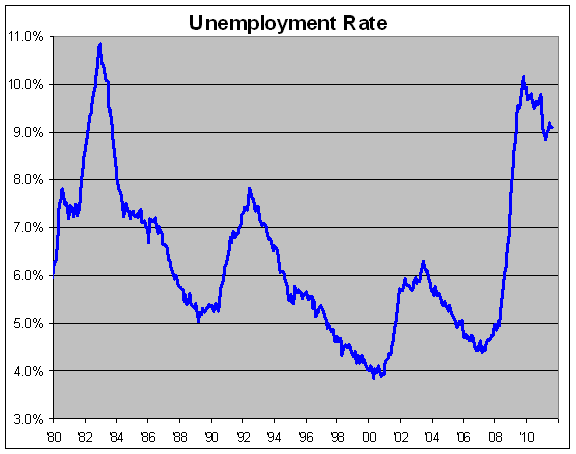
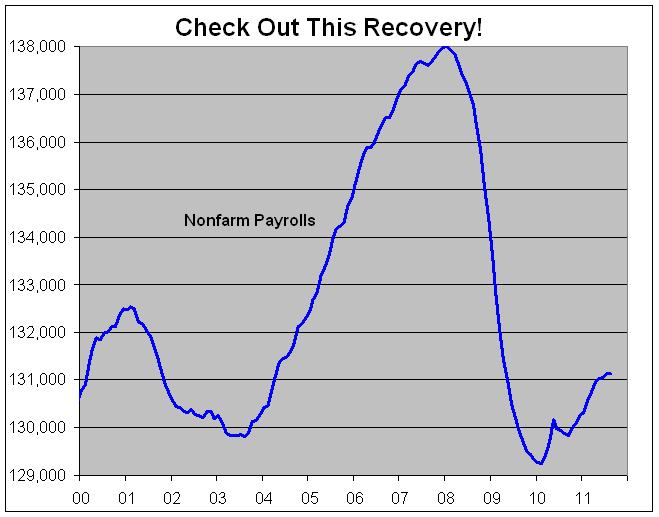
Posted by Eddy Elfenbein on September 2nd, 2011 at 8:31 amThe U.S. economy didn’t create one single new job last month. The unemployment rate stayed at 9.1%. The private sector created 17,000 jobs.
Breaking out the digits, the unemployment rate increased from 9.092% to 9.093%. Over the last seven years, the labor force has grown by 6.03 million and there are only 54,000 new jobs.
The economy showed no job growth in August, the first time there has been no increase in net jobs in the United States in 11 months.
The flat performance in the job market was down sharply from a revised 85,000 gain of jobs in July, the Labor Department said Friday, and was far below a consensus forecast by economists of 60,000. The unemployment rate stayed constant at 9.1 percent in August.
The nonfarm payrolls numbers were unchanged in August after a prolonged increase in economic anxiety that began with the brinksmanship in Washington’s debt-ceiling debate and was followed by the country’s loss of its triple-A credit rating, stock market whiplash and renewed concerns about Europe’s sovereign debt.
The jobs figure, a monthly statistical snapshot by the Department of Labor, may appear more negative because it does not include 45,000 Verizon workers who were on strike when the survey was taken.
-
CWS Market Review – September 2, 2011
Posted by Eddy Elfenbein on September 2nd, 2011 at 7:24 amContinuing with my theme from last week’s CWS Market Review, the “Fear Trade” that gripped Wall Street in July and August is slowly retreating. Every investor needs to understand how this dynamic is driving trading right now.
What’s interesting is that the stock market isn’t so much rallying on good news as it’s rallying on the lack of bad news (or lack of “bad as expected” news). That’s how scared traders are. Nor is the market really rallying as much as it’s walking back to the ground it hurriedly fled from during the jittery days of July and August. My advice to investors is to expect the Fear Trade to continue to fade. Specifically, this means that stocks will cautiously gain ground while bonds, gold and volatility will pull back.
From Friday through Wednesday, the S&P 500 put on its first four-day win streak in nearly two months. In fact, we’re probably two good days’ rallies away from breaking above the 50-day moving average. Some of this week’s rally was due to Hurricanes Irene and Bernanke not causing as much damaged as was feared.
We can’t say this for certain yet, but imagine if this statement turned out to be true: “The summer sell-off ended 25 days ago and we’ve already made back 40% of the money we lost.” That may turn out to be correct and it has a very good chance of doing so, but you’d never know it by listening to some of the folks out there.
Remember that the stock market isn’t a great predictor of the economy. Since 1945, the S&P 500 has fallen 17% or more 14 times, and nine of those times have seen recessions. The bond market, however, has a better track record. Bloomberg writes, “the economy has never contracted with the difference between 10-year and 30-year Treasury yields as wide as the current 1.38 percentage points, or 138 basis points.” That’s pretty eye-opening.
Through Wednesday, the S&P 500 posted its best eight-day gain since 2009. At one point on Wednesday, the S&P 500 got as high as 1,230.71. Thursday looked like it was going to be our fifth-straight up day until more jitters about Friday’s employment report took hold (more on that in a bit). The initial good news on Thursday was that the ISM Manufacturing Index came in at 50.6 which was better-than-expected. There were even whispers that the ISM could print as low as the mid-40s. Fear, I suppose, is contagious.
Let me explain this a little. The ISM Index has a decent track record of aligning with recessions and expansions and we’re still well above the danger zone. The worry was that we were rapidly falling into the danger zone. Historically, the economy has done fairly well, on average, when the ISM is in this territory. I checked the numbers and found that there were 49 times when the ISM printed between 50.0 and 51.0 and only three of those months have been during official NBER recessions.
One month ago, Wall Street was rattled by the reports on consumer spending and factory orders. However, those reports were for the month of June which is in the second quarter. Well, we already knew that the economy was sluggish during Q2, yet the bears had a field day and smacked the bulls around. Now, one month later, those two reports for July turn out to be not so bad. We learned that consumer spending rebounded by 0.8% in July, which topped expectations by 0.3%. That was the biggest jump in five months. On Wednesday, the Commerce Department reported that factory orders rose by 2.4% in July. That was the biggest increase since March. Yet the bulls are still the scared ones.
So far, the Double Dip hypothesis has been sound and fury signifying not a whole lot. Let me be clear that I’m not saying a Double Dip won’t happen; I’m saying that the evidence proving the case, for now, is very small. At CWS Market Review, we’re guided by facts, not emotions. The good news for us is that we don’t need to predict the future with perfect accuracy to be good investors. But we do need to make reasonable judgments about the here and now.
The fact is that the overall stock market is inexpensive. Let’s look at some numbers: Second quarter earnings for the S&P 500 came in at $24.85. That’s an 18.9% increase from one year ago. Wall Street currently expects 3Q earnings of $24.95 which is a 15.7% increase over last year. So far, we haven’t seen many companies lower guidance and this is particularly true for our Buy List stocks. In fact, they’ve been raising guidance.
For all of 2011, Wall Street expects earnings of $98.59 for the S&P 500 (though I think $100 is possible). Since we’re already two-thirds of the way through the year, that forecast is probably pretty accurate. For 2012, Wall Street expects earnings of $112.67. Since that’s further out, we shouldn’t consider that number to be as reliable, and I think it may be too high.
This means that going by Thursday’s close, the S&P 500 is trading at 12.22 times this year’s earnings estimate. Flip that over and you get an earnings yield of 8.19% which demolishes just about anything you can find in the frothy bond market. A ten-year T-bond is supposed to offer safety but…c’mon, is that really worth 600 basis points? I don’t think so. The Fear Trade has simply gone too far.
The slightly better economic news comes at a crucial time for the Federal Reserve. The last FOMC meeting saw the largest dissension in two decades. The next meeting is scheduled for September 20-21. It was originally supposed to be a one-day meeting. I think the “hawks” now have the upper hand and I don’t expect another round of quantitative easing. For now.
I’m writing this on Friday morning and Wall Street expects another dismal jobs report later today (expectations are for 70,000). I don’t blame them. However, the same dynamic is in play: traders expect to be disappointed so anything that fails to live up to that (or down to that) will be seen as good news. Be sure to check the blog to see how the August jobs report shakes out.
As investors, we should continue to focus our attention on solid companies that are delivering steady earnings growth. Speaking of which, let’s jump to the best news of the week and that was the strong second-quarter earnings report from our Buy List member, Jos. A. Bank Clothiers ($JOSB). Three months ago, JOSB missed earnings by two cents and the stock got taken to the woodshed. This time, Wall Street was expecting 68 cents per share which I thought was on the low side. The earnings turned out to be even better than I expected. For Q2, JOSB reported earnings of 74 cents per share. Sales came in at $230.7 million which was $20 million more than consensus.
On Wednesday, the stock gapped up as much as 11.8%. All across the board, Joey Bank’s numbers look very good. Same-store sales rose 14.7% and year-over-year direct marketing sales rose 27.8%. The company has grown its earnings for 39 of the last 40 quarters, including the last 21 quarters in a row.
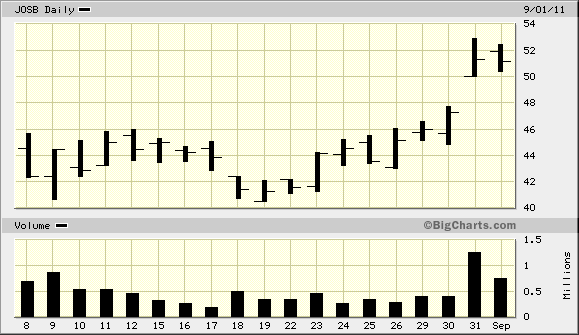
I had cautioned investors not to chase JOSB because I wanted to be certain that the company is on a firm footing. Now we have solid proof. I think JOSB can do $3.50 per share for this fiscal year. As a result, I’m raising my buy price on Jos. A. Bank Clothiers to $54 per share. This is our top-performing stock of the year, but I have to warn you that it can be highly volatile.
I was surprised to see Nicholas Financial ($NICK) announce that it will start paying a quarterly dividend of 10 cents per share. Based on Thursday’s close, that works out to a yield of 3.78%. Not bad. If you’re a regular reader of Crossing Wall Street, you know that this is one of my favorite stocks. I think a fair price for NICK is at least $17 per share.
I can’t say that I’m a huge fan of NICK paying a dividend, but I will say that there are many things worse that a company can do with shareholders’ money (poor acquisitions, share buybacks). You’ll never go broke cashing a dividend check, and NICK will have no trouble covering this dividend. I don’t have much faith that companies can engineer a higher share price outside of their very basic duty of delivering higher profits.
I still believe that NICK can earn as much as $1.70 per share for this calendar year. The news that the Fed will keep rates low helps NICK, and the company just extended their credit line to $150 million. This is a really solid outfit. Nicholas Financial is an excellent buy up to $14 and it’s especially good below $11.
Some other Buy List stocks that look particularly attractive here include Oracle ($ORCL), Reynolds American ($RAI), AFLAC ($AFL) and Wright Express ($WXS).
That’s all for now. The market will be closed on Monday for Labor Day. I hope everyone has a restful long weekend. Be sure to keep checking the blog for daily updates. I’ll have more market analysis for you in the next issue of CWS Market Review!
– Eddy
-
Morning News: September 2, 2011
Posted by Eddy Elfenbein on September 2nd, 2011 at 5:17 amMerkel Brings Debt Crisis to Party Campaign
Greek EU-IMF Financing Review to Resume Later This Month, Official Says
India Factory Output Growth Falls to 29-Month Low
UBS Cuts Target for Asia Stocks as Data Signals Regional Economies Slowing
Taiwan to Relax Rules on Banks Investing in China
China Benefits as U.S. Solar Industry Withers
U.S. Is Set to Sue a Dozen Big Banks Over Mortgages
Fed Asks Bank of America to List Contingency Plan
SAP Wins Bid to Reject $1.3B Oracle Verdict
T-Mobile May Suffer if AT&T Deal Fails
AstraZeneca Shares Fall on Crestor Study Result
Ross’s 60%-Off Nikes Set to Overtake Gap
BMW’s U.S. Sales Rise, Outselling Mercedes
Tech Blogger to Invest in Start-Ups
Jeff Miller: August Employment Preview
Phil Pearlman: The First Wireless Phone Circa 1913
Be sure to follow me on Twitter.
-
The S&P 500 Total Return Index
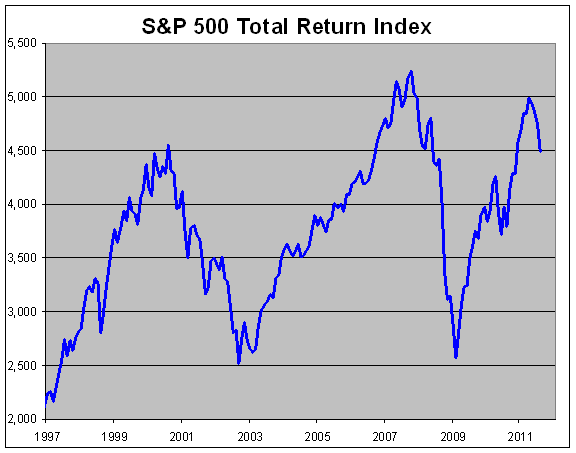
Posted by Eddy Elfenbein on September 1st, 2011 at 2:08 pmThrough August, the S&P 500 is down 3.08% for the year and the total return index, which includes dividends, is down 1.77%. Since August 2000, the Total Return Index is down 1.31%.
Even though dividend yields are low, they do add up over time. Over the last five years, dividends have added 11.22% to your returns. That’s microscopic at even a monthly level, but it does slowly make a difference.
If you pulled a Rip Van Winkle in early 1997 and started ignoring the market, only to wake up today, you probably wouldn’t be too surprised to learn where the market is. How it got there…well, that’s another story.
By the way, the chart below begins in January 1997. Alan Greenspan made his famous Irrational Exuberance speech on December 5, 1996. I only have monthly data, so including all of December 1996, the total return of the S&P 500 is up 109% since then.
-
Nicholas Financial Extends Credit Line
Posted by Eddy Elfenbein on September 1st, 2011 at 10:30 amCLEARWATER, Fla., Sept. 1, 2011 — Nicholas Financial, Inc., announced that the Company has executed an amendment to its Bank Credit Line that increases the size of the Credit Line from $140 million to $150 million and extends the maturity date to November 30, 2013. All other terms and conditions of the Company’s Credit Line remain in effect.
According to Peter L. Vosotas, Chairman and CEO, “We are extremely pleased that our consortium of bank lenders has agreed to increase our Credit Line and extend the maturity date. The Credit Line increase will allow us to continue our expansion strategy during the next few years. The Company is very proud to continue its lending relationship with Bank of America which began in March of 1993 and also includes Wells Fargo Preferred Capital, Capital One Bank, First Horizon Bank, and Bank of Montreal as participating banks.”
-
August ISM = 50.6
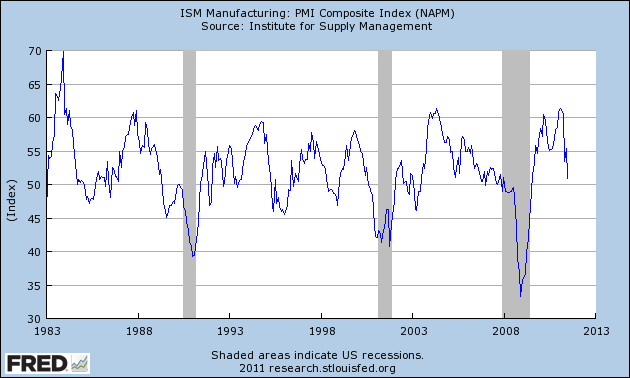
Posted by Eddy Elfenbein on September 1st, 2011 at 10:28 amOn the first business day of each month, the ISM Manufacturing number comes out. This is the report that has been freaking people out recently.
Let me explain: The break-even point for the ISM is 50. Any number above that indicates a growing economy; anything below 50 indicates a shrinking one.
The ISM for April was 60.4 which is very high. That dropped to 53.5 for May. In June, it bumped up to 55.3. Then in July, the ISM dropped to 50.9.
So there you have it: a clear downward trend to recession. Well, not exactly. Some folks were expecting today’s ISM report for August to continue the trend and hit the mid-40s. Instead, it seems to have stalled just above 50, which is perfectly fine.
Historically, the odds of a recession shoot up when the ISM is below 45 and we’re still way above that. I ran the numbers and found that the ISM printed between 50.0 and 51.0 forty-nine times, and only three of those were official NBER recessions. In other words, there’s still no solid proof that a Double Dip is on the way. It may happen, but the numbers don’t yet show it.
I keep harping on the “Fear Trade” but this is exactly what’s driving the markets. Notice that stocks turned higher when the ISM came out. So we rallied, not on good news, but simply because the bad news failed to show up. That tells you how fearful traders are.
For now, it’s not so much that stocks are going up and bonds are going down, but they’re walking back the ground they unreasonably took over the last several weeks. This should continue.
-
Thank You!
Posted by Eddy Elfenbein on September 1st, 2011 at 10:16 amWe just finished a record traffic month here at Crossing Wall Street. So while the market was falling apart, folks were coming here!
All told, we had over 84,000 visitors and 114,000 page views during the month of August. I want to thank everyone who came on by and I hope you become a regular visitor to our humble home.
-
Morning News: September 1, 2011
Posted by Eddy Elfenbein on September 1st, 2011 at 5:21 amIMF, ECB at Odds Over Sovereign-Debt Damage to Banks, FT Says
Euro-Zone Manufacturing Contracts
China Shares End Down After Wen’s Comments, Higher August PMI
BRICs No Cure for Global Economy This Time
East Asian Bond Issuance Drops
U.K. House Prices Decline Most in 10 Months
London Loses as Banks Look to Book Trades Overseas
Deutsche Telekom Unprepared for AT&T Deal Collapse
In T-Mobile Suit, Consumers Are Central
European Distilling Giant Pernod’s Earnings Get Boost From Emerging Markets
Solar Firm Aided by Federal Loans Shuts Doors
Sony Tablets Face Tough Sell on Price, Hardware
Bank of New York Mellon Chief Resigns in a Shake-Up
James Altucher: Abolish the Presidency. It’s a Useless Job.
Stone Street: AT&T Bringing Call Center Jobs Back to The U.S. Hooray!!! Wait, What?
Be sure to follow me on Twitter.
-
Another Look at the Fear Trade
Posted by Eddy Elfenbein on August 31st, 2011 at 10:40 amThe bulls are charging today. The S&P 500 broke through 1,230 this morning. Joey Bank ($JOSB) has been up as much as 12% today. This is a pretty stunning reversal from just a few days ago.
Once again, stocks are up while bonds, gold and volatility are down. As I described before, this is the unwinding of the “Fear Trade” which gripped Wall Street this summer.
Here’s a closer look at the Fear Trade:
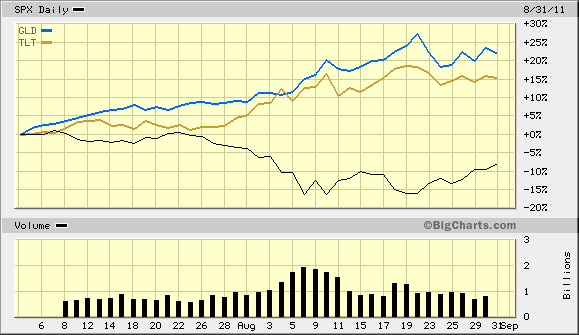
Notice how closely gold ($GLD) and bonds ($TLT) moved together and both moved in the opposite direction of stocks.
-
Jos. A Bank’s Blow-Out Quarter
Posted by Eddy Elfenbein on August 31st, 2011 at 9:31 amThe S&P 500 looks to open higher again today. I think the index has a good chance of breaking 1,220 today, the final trading day of the month. Frankly, August has been a terrible month for the market. We closed July at 1,292.28.
Today could be the fourth up day in a row. I have to repeat myself from the other day. Imagine if this statement turned out to be true: “The sell-off ended three weeks ago and we’ve already gained back close to 40% of what we lost.”
The big economic news this morning was the ADP report which showed that the economy created 91,000 private sector jobs in August. The government will release its employment numbers on Friday.
Jos. A Bank Clothiers ($JOSB) reported outstanding second-quarter earnings this morning of 74 cents per share which was six cents more than estimates. Revenues were very strong, up 22.5% to $230.7 million. The consensus was $210.8 million so that’s a big beat. Same-store sales rose 14.7% and year-over-year direct marketing sales rose 27.8%.
After the hiccup we saw for Q1, I can safely say that this was a very strong quarter.
“With this quarter’s results, we have achieved earnings growth in 39 of the past 40 quarters when compared to the respective prior year periods, including 21 quarters in a row,” said R. Neal Black, the company’s president and CEO, in a statement. “While sales are just one component of overall profit and August is a relatively small sales month, our comparable store sales in August are up slightly compared to the same period last year, despite the impact of the recent hurricane.”
The stock has gapped up 10% this morning.
-
Archives
- October 2026
- September 2026
- August 2026
- July 2026
- June 2026
- May 2026
- April 2026
- March 2026
- February 2026
- January 2026
- December 2025
- November 2025
- October 2025
- September 2025
- August 2025
- July 2025
- June 2025
- May 2025
- April 2025
- March 2025
- February 2025
- January 2025
- December 2024
- November 2024
- October 2024
- September 2024
- August 2024
- July 2024
- June 2024
- May 2024
- April 2024
- March 2024
- February 2024
- January 2024
- December 2023
- November 2023
- October 2023
- September 2023
- August 2023
- July 2023
- June 2023
- May 2023
- April 2023
- March 2023
- February 2023
- January 2023
- December 2022
- November 2022
- October 2022
- September 2022
- August 2022
- July 2022
- June 2022
- May 2022
- April 2022
- March 2022
- February 2022
- January 2022
- December 2021
- November 2021
- October 2021
- September 2021
- August 2021
- July 2021
- June 2021
- May 2021
- April 2021
- March 2021
- February 2021
- January 2021
- December 2020
- November 2020
- October 2020
- September 2020
- August 2020
- July 2020
- June 2020
- May 2020
- April 2020
- March 2020
- February 2020
- January 2020
- December 2019
- November 2019
- October 2019
- September 2019
- August 2019
- July 2019
- June 2019
- May 2019
- April 2019
- March 2019
- February 2019
- January 2019
- December 2018
- November 2018
- October 2018
- September 2018
- August 2018
- July 2018
- June 2018
- May 2018
- April 2018
- March 2018
- February 2018
- January 2018
- December 2017
- November 2017
- October 2017
- September 2017
- August 2017
- July 2017
- June 2017
- May 2017
- April 2017
- March 2017
- February 2017
- January 2017
- December 2016
- November 2016
- October 2016
- September 2016
- August 2016
- July 2016
- June 2016
- May 2016
- April 2016
- March 2016
- February 2016
- January 2016
- December 2015
- November 2015
- October 2015
- September 2015
- August 2015
- July 2015
- June 2015
- May 2015
- April 2015
- March 2015
- February 2015
- January 2015
- December 2014
- November 2014
- October 2014
- September 2014
- August 2014
- July 2014
- June 2014
- May 2014
- April 2014
- March 2014
- February 2014
- January 2014
- December 2013
- November 2013
- October 2013
- September 2013
- August 2013
- July 2013
- June 2013
- May 2013
- April 2013
- March 2013
- February 2013
- January 2013
- December 2012
- November 2012
- October 2012
- September 2012
- August 2012
- July 2012
- June 2012
- May 2012
- April 2012
- March 2012
- February 2012
- January 2012
- December 2011
- November 2011
- October 2011
- September 2011
- August 2011
- July 2011
- June 2011
- May 2011
- April 2011
- March 2011
- February 2011
- January 2011
- December 2010
- November 2010
- October 2010
- September 2010
- August 2010
- July 2010
- June 2010
- May 2010
- April 2010
- March 2010
- February 2010
- January 2010
- December 2009
- November 2009
- October 2009
- September 2009
- August 2009
- July 2009
- June 2009
- May 2009
- April 2009
- March 2009
- February 2009
- January 2009
- December 2008
- November 2008
- October 2008
- September 2008
- August 2008
- July 2008
- June 2008
- May 2008
- April 2008
- March 2008
- February 2008
- January 2008
- December 2007
- November 2007
- October 2007
- September 2007
- August 2007
- July 2007
- June 2007
- May 2007
- April 2007
- March 2007
- February 2007
- January 2007
- December 2006
- November 2006
- October 2006
- September 2006
- August 2006
- July 2006
- June 2006
- May 2006
- April 2006
- March 2006
- February 2006
- January 2006
- December 2005
- November 2005
- October 2005
- September 2005
- August 2005
- July 2005
 Eddy Elfenbein is a Washington, DC-based speaker, portfolio manager and editor of the blog Crossing Wall Street. His