Great earnings from Becton Dickinson ($BDX). The company reported adjusted earnings of $1.51 per share which was eight cents more than Wall Street was expecting. Becton also raised its full-year EPS guidance range from $5.55 to $5.65, to $5.65 to $5.78. Wall Street’s estimate was $5.62 per share.
The company earned $343 million, or $1.53 a share, in the second quarter, higher than year-earlier earnings of $306.9 million, or $1.29 a share.
Income from continuing operations in the latest quarter was $1.51 a share; analysts surveyed by Thomson Reuters were expecting the company to earn $1.43 a share.
Revenue rose 10% to $2.01 billion, above analysts’ estimates of $1.99 billion.
“Gross margin expansion reflecting favorable product mix has offset some of the headwinds we have been facing as a result of a challenging macroeconomic environment and increased raw material costs,” said Chairman and CEO Edward Ludwig, in a statement Tuesday.
Becton Dickinson said 2011 revenue is expected to be at the higher end of its previously estimated range of 5% to 6% from fiscal 2010 because of the effects of a favorable currency.
After bouncing off the 200-day moving average twice in June, the index has now broken below it.

It’s interesting that the market is slightly higher than the June bounces but it’s the 200-DMA that’s come up.
Here’s a look at the total return of the S&P 500 adjusted for inflation. We’re still below the peaks from 2000 and 2007. In fact, we’re less than 5% higher than where we were 13 years ago.

Note that the July CPI report isn’t out yet so I assumed 0% inflation for the last data point.
The July ISM index dropped to 50.9. The index is down nearly 10 points in the last three months.
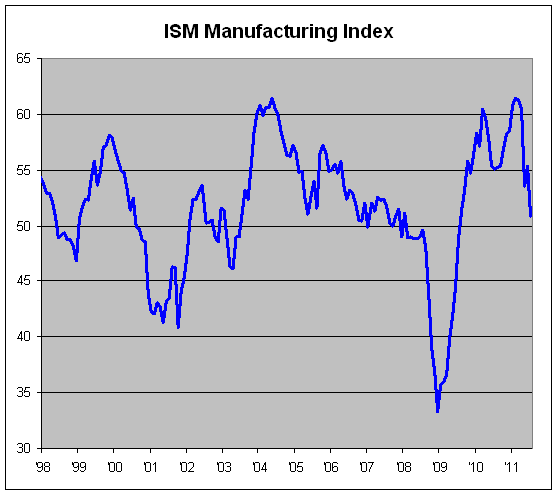
Whenever the ISM drops to 44.4 or less, the odds of a recession jump much higher. We’re still above the danger zone. The ISM has fallen between 50.0 and 51.0 a total of 49 times. Only three of those readings come during official recessions.
Here’s a look at total months and months in a recession by different ISM readings:
| From:: |
To: |
Months |
Mos in Recession |
| 70 more |
|
6 |
0 |
| 65 |
69.9 |
30 |
0 |
| 60 |
64.9 |
83 |
3 |
| 55 |
59.9 |
186 |
3 |
| 50 |
54.9 |
214 |
9 |
| 45 |
49.9 |
136 |
25 |
| 40 |
44.9 |
56 |
33 |
| 35 |
39.9 |
39 |
36 |
| Under 35 |
|
13 |
13 |
During the 10-year expansion from April 1991 to March 2001, the ISM came in at today’s reading or less 46 times, yet none was a recession.
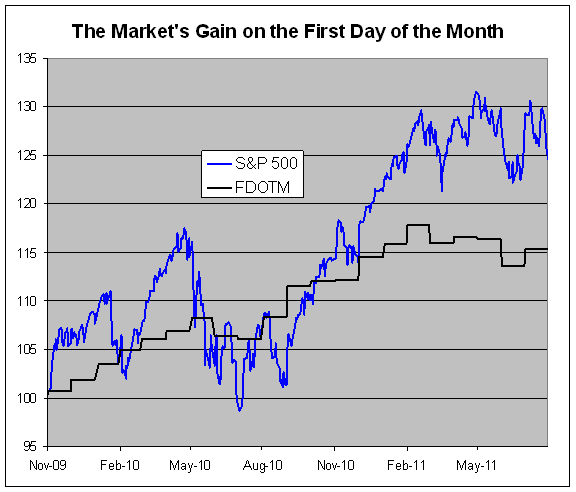
The S&P 500 has risen on the first day of the month for 23 of the last 28 months.
Going back to November of 2009, more than half of the S&P 500’s gain has come on the first day of the month.
The market was up earlier today but we just slipped into the red.
He sums it up well:
“They take it out of the ground in South Africa, ship it to the Federal Reserve, where they put it back in the ground,” Buffett said in answer to a question about commodities on April 30 at Berkshire Hathaway’s annual meeting in Omaha, Nebraska. “If you were watching from Mars you might think it’s a little peculiar.”
-
 Eddy Elfenbein is a Washington, DC-based speaker, portfolio manager and editor of the blog Crossing Wall Street. His Buy List has beaten the S&P 500 over the last 20 years. (more)
-
Archives