-
10% Above Last Week’s Low
Posted by Eddy Elfenbein on August 17th, 2011 at 10:22 amLast Tuesday, the S&P 500 hit a low of 1,101.54. We’ve bounced pretty strongly since then. The index got as high as 1,208.18 this morning. The rally will be 10% once we get to 1,211.69.

-
The Double Dippers Are on the Defensive
Posted by Eddy Elfenbein on August 17th, 2011 at 9:02 amThe futures currently indicate that the bears are going to give it another chance this morning. Just like last year, the Double Dip thesis is now on the defensive. The industrial production report combined with retail sales figures show that the economy isn’t heading off the cliff during the third quarter. We’re still far from healthy, but as of yet, there are few signs that the economy is actually losing ground.
What really stands out in my mind is what we’re hearing from companies. Or rather, what we’re not hearing. Overall, companies aren’t announcing massive layoffs or plans of business retrenchment (though a few have, they’re exceptions).
The good earnings news continues as both Staples ($SPLS) and Target ($TGT) beat estimates this morning. Yesterday, Walmart ($WMT) and Home Depot ($HD) beat estimates and guided higher. I think that should be getting more attention than it has.
Something else that’s helping the economy is that gasoline prices have eased back a little. Yes, gasoline is still expensive, but it’s not as expensive as before. Cheaper fuel has a major impact on consumer spending which is the key driver of the U.S. economy.
-
Morning News: August 17, 2011
Posted by Eddy Elfenbein on August 17th, 2011 at 6:39 amIceland Raises Rates for First Time Since 2008
Franc Gains as Switzerland Stops Short of Peg
Europe’s Debt Crisis Weakens Quarterly Growth
Brent Oil Rises to $110, U.S. Gasoline Supports
Fitch, in Affirming U.S. as Triple-A, Leaves S&P a Solo Act
U.S. Makes Special Purchase of $40 Million of Chicken Products
On Economy, Raw Data Gets a Grain of Salt
Retailers Glean Profit in Slow Sales
Dell Posts Flat Sales but Its Profit Rises 63%
Maersk’s Tanker Subsidiary Extends Losses Into a Third Year
British SABMiller Goes Hostile in Pursuit of Australian Brewer Foster’s
Carlsberg Cuts Full-Year Profit Forecast as Beer Market in Russia Declines
Manchester United Said to Plan $1 Billion Initial Share Sale in Singapore
Phil Pearlman: Magazine Covers Do Not Mark Bottoms
Jeff Miller: The Wall Street Parrot
Todd Sullivan: Buyback Expected
Be sure to follow me on Twitter.
-
Where Will the S&P 500 End the Year?
Posted by Eddy Elfenbein on August 16th, 2011 at 7:35 pm -
What’s Driving the Bond Rally?
Posted by Eddy Elfenbein on August 16th, 2011 at 4:17 pmTreasury bond yields have plunged recently which may seem odd since long-term Treasuries were famously downgraded by Standard & Poor’s. So what’s driving the bond rally?
We can never say for certain but we can shine a light on some of the usual suspects underpinning the bond market.
Here’s a look at the yield on the 10-year Treasury bond (blue) along with the 10-year TIPs (or Treasury Inflation-Protected security in red).
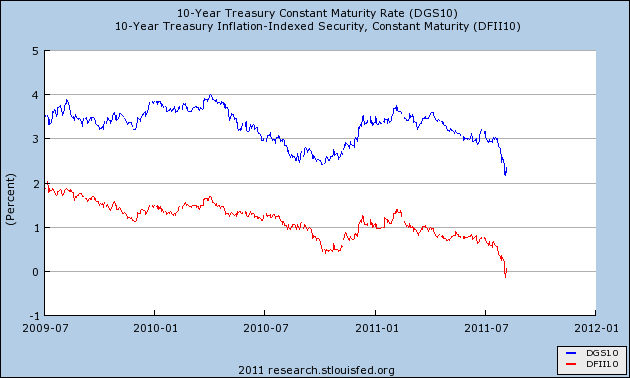
The 10-year TIPs yield recently turned slightly negative which means that investors are so frightened that they’re willing to forgo all of their real profits just for the safety of the Treasury market. Or rather, the supposed safety of the Treasury market. (In fact, it may even be worse for bond holders since the CPI probably understates inflation.)
The key for us to watch is the spread between the two lines which represents the inflation premium. Since both lines have plunged in near tandem, this means the market isn’t expecting inflation to either ramp up or slow down. The inflation premium is currently around 2.2% and that’s been pretty stable (between 2.2% and 2.6% for the last several months). Instead, the plunge in yields is almost entirely due to lower real rates.
That’s mostly the result of a worsening economic outlook and a desire from investors to hold anything liquid.
Now here’s the chart which I think is particularly fascinating and should be getting a lot more attention. It shows how the 10-year inflation premium (in red, meaning the difference between the two lines above) has closely matched the S&P 500 (blue) over the last three-and-a-half years.
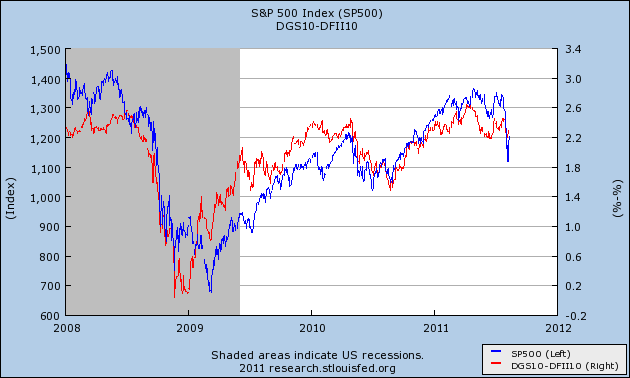
This is a chart Lord Keynes (and Paul Krugman) might enjoy because it seems that the market has rallied as inflation expectations rose. This is the exact opposite of what happened during the 1970s when inflation slowly ground down stock valuations. I should add the proper caveat that correlation doesn’t mean causation. The higher inflation expectations, of course, might be a response to higher share prices — or the correlation might be entirely illusionary.
But another interesting angle is that the recent equity sell-off marked the first major departure between these lines in quite some time. This lends evidence to the idea that the lower real bond yields are the result of a dreary economic outlook.
The lines have just recently gotten together again. For now, the stock market may be asking for some more inflation. I recently ran the numbers from Professor Robert Shiller’s website to see how stocks perform relative to different inflation rates. The stock market clearly hates inflation, but historically, the hatred doesn’t kick in until inflation hits 5.3%. We’re still a long way from there.
The sad story might be that the Fed’s only clear-cut triumph of the last 30 years (defeating inflation) might be exactly what we don’t need right now.
-
Sarkel Kills the Rally
Posted by Eddy Elfenbein on August 16th, 2011 at 1:42 pmI always get nervous whenever the president speaks during market hours. Today I learned that talking European politicians can kill a rally just as well as any American politician.

Right before the Sarkozy/Merkel joint press conference, the S&P 500 got as high as 1,204.22 which was just 0.02% below yesterday’s close. Now we’re more than 1.5% below yesterday’s close.
-
Industrial Production Rose 0.9% in July
Posted by Eddy Elfenbein on August 16th, 2011 at 10:50 amSo far, we’ve had some negative economic data points for the month of July, but today’s industrial production report was pretty good. Industrial production rose by 0.9% last month which is the strongest growth this year. The number for June was revised to 0.4%. Over the last two years, industrial production is up by 11.5%.
I often hear people say “we don’t make anything in this country anymore.” That’s simply not true. The U.S. is a manufacturing powerhouse. The difference is that many fewer people do the work.

-
Market to Open Lower as HD and WMT Raise Guidance
Posted by Eddy Elfenbein on August 16th, 2011 at 8:38 amThe stock market looks to open lower today as Germany reported economic growth of just 0.1% for the second quarter. That’s just terrible. The whole Eurozone economy grew by 0.2% in the second quarter which was down from 0.8% for Q1.
This news doesn’t come at a good time for Europe as Sarkozy and Merkel are meeting today in a summit. There had been some talk about Europe issuing “eurobonds” to help fix the mess everyone’s in, but apparently that’s not on the agenda for today’s meeting.
Perhaps the most important market news this morning is Walmart’s ($WMT) earnings report. The company already told us that Q2 (which ends with July) would come in between $1.05 and $1.10 per share. They weren’t lying; WMT earned $1.09 per share although same-store sales were flat.
More importantly, Walmart said that Q3 should range between 95 cents and $1 per share. The company also raised its full-year EPS range from $4.35 to $4.50, to $4.41 to $4.51. This means the stock is going for just 11.6 times the midpoint of the new full-year guidance.
They’re not the only one boosting guidance. Home Depot ($HD), which is also a Dow stock, just reported a 14% earnings increase. For Q2, HD earned 86 cents per share which was three cents better than estimates. The company raised full-year EPS guidance from $2.24 to $2.34. The stock is going for 13.4 times this year’s estimate which seems about right.
-
It’s Cheaper Now to Buy Than Rent
Posted by Eddy Elfenbein on August 16th, 2011 at 8:06 amCNN Money has an interesting article saying that it’s now cheaper to buy a home rather than renting one:
Home prices have taken such a beating and demand for rental units has increased so much that it’s now cheaper to buy a two-bedroom home than to rent one in most major U.S. cities.
According to real estate web site Trulia, buying was cheaper than renting in 74% of the country’s 50 largest cities in July. In just 12% of the cities, including New York, Seattle and San Francisco, renting was cheaper. In the remaining 14% of cities, renting was less expensive but close to the cost of buying.
In addition to a continuing decline in home prices, rock-bottom interest rates have added a lot of weight to the buy side of the scale. The overnight average rate for a 30-year fixed was just 4.19% on Monday, according to Bankrate.com. A 15-year fixed averaged just 3.43%.
-
Stocks on Sale
Posted by Eddy Elfenbein on August 16th, 2011 at 7:18 amAmid Warren Buffett’s call to raise taxes on himself, he also had fairly positive things to say about the economy. He even said that the economy might pick up faster than the Fed expects. That’s not all. The latest filings show that Buffett made his biggest bets of the year on August 8th as the stock market was falling.
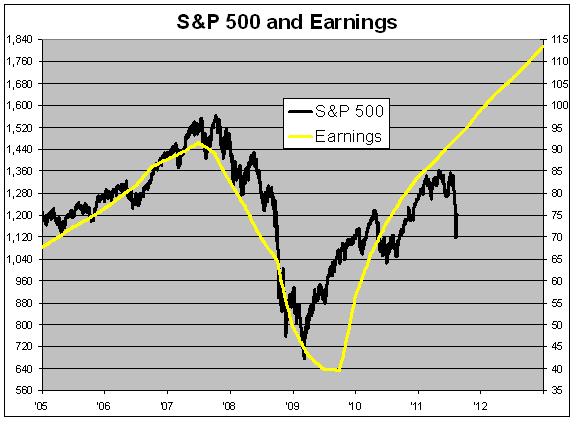
Clearly Buffett believes the market is cheap and the numbers back him up. According to the latest data, the Price/Earnings Ratio for the S&P 500 fell all the way down to 12.1 last week which is the lowest it’s been since May 1989.
Yet the latest earnings data showed that the second quarter was a very strong one for the S&P 500. With 94% of its companies reporting, the S&P 500 is on track to earn $24.88 for Q2. That surpasses the previous record of $24.06 from the second quarter of 2007.
Interestingly, Wall Street has only cut earnings estimates very slightly for the near future. For the third quarter, which we’re already halfway through, Wall Street expects earnings of $25.10. That represents growth of 16.4% over the third quarter of 2010.
For all of 2011, Wall Street expects the S&P 500 to earn $98.94, and another $113.47 for next year. It’s very possible that earnings estimates will fall, but for now, the S&P 500 is going for 10.6 times next year’s earnings. That’s pretty cheap.
-
Archives
- October 2026
- September 2026
- August 2026
- July 2026
- June 2026
- May 2026
- April 2026
- March 2026
- February 2026
- January 2026
- December 2025
- November 2025
- October 2025
- September 2025
- August 2025
- July 2025
- June 2025
- May 2025
- April 2025
- March 2025
- February 2025
- January 2025
- December 2024
- November 2024
- October 2024
- September 2024
- August 2024
- July 2024
- June 2024
- May 2024
- April 2024
- March 2024
- February 2024
- January 2024
- December 2023
- November 2023
- October 2023
- September 2023
- August 2023
- July 2023
- June 2023
- May 2023
- April 2023
- March 2023
- February 2023
- January 2023
- December 2022
- November 2022
- October 2022
- September 2022
- August 2022
- July 2022
- June 2022
- May 2022
- April 2022
- March 2022
- February 2022
- January 2022
- December 2021
- November 2021
- October 2021
- September 2021
- August 2021
- July 2021
- June 2021
- May 2021
- April 2021
- March 2021
- February 2021
- January 2021
- December 2020
- November 2020
- October 2020
- September 2020
- August 2020
- July 2020
- June 2020
- May 2020
- April 2020
- March 2020
- February 2020
- January 2020
- December 2019
- November 2019
- October 2019
- September 2019
- August 2019
- July 2019
- June 2019
- May 2019
- April 2019
- March 2019
- February 2019
- January 2019
- December 2018
- November 2018
- October 2018
- September 2018
- August 2018
- July 2018
- June 2018
- May 2018
- April 2018
- March 2018
- February 2018
- January 2018
- December 2017
- November 2017
- October 2017
- September 2017
- August 2017
- July 2017
- June 2017
- May 2017
- April 2017
- March 2017
- February 2017
- January 2017
- December 2016
- November 2016
- October 2016
- September 2016
- August 2016
- July 2016
- June 2016
- May 2016
- April 2016
- March 2016
- February 2016
- January 2016
- December 2015
- November 2015
- October 2015
- September 2015
- August 2015
- July 2015
- June 2015
- May 2015
- April 2015
- March 2015
- February 2015
- January 2015
- December 2014
- November 2014
- October 2014
- September 2014
- August 2014
- July 2014
- June 2014
- May 2014
- April 2014
- March 2014
- February 2014
- January 2014
- December 2013
- November 2013
- October 2013
- September 2013
- August 2013
- July 2013
- June 2013
- May 2013
- April 2013
- March 2013
- February 2013
- January 2013
- December 2012
- November 2012
- October 2012
- September 2012
- August 2012
- July 2012
- June 2012
- May 2012
- April 2012
- March 2012
- February 2012
- January 2012
- December 2011
- November 2011
- October 2011
- September 2011
- August 2011
- July 2011
- June 2011
- May 2011
- April 2011
- March 2011
- February 2011
- January 2011
- December 2010
- November 2010
- October 2010
- September 2010
- August 2010
- July 2010
- June 2010
- May 2010
- April 2010
- March 2010
- February 2010
- January 2010
- December 2009
- November 2009
- October 2009
- September 2009
- August 2009
- July 2009
- June 2009
- May 2009
- April 2009
- March 2009
- February 2009
- January 2009
- December 2008
- November 2008
- October 2008
- September 2008
- August 2008
- July 2008
- June 2008
- May 2008
- April 2008
- March 2008
- February 2008
- January 2008
- December 2007
- November 2007
- October 2007
- September 2007
- August 2007
- July 2007
- June 2007
- May 2007
- April 2007
- March 2007
- February 2007
- January 2007
- December 2006
- November 2006
- October 2006
- September 2006
- August 2006
- July 2006
- June 2006
- May 2006
- April 2006
- March 2006
- February 2006
- January 2006
- December 2005
- November 2005
- October 2005
- September 2005
- August 2005
- July 2005
 Eddy Elfenbein is a Washington, DC-based speaker, portfolio manager and editor of the blog Crossing Wall Street. His