Archive for 2014
-
It’s Official: Oracle to Buy Micros for $5.3 Billion
Eddy Elfenbein, June 23rd, 2014 at 9:42 amThe news from this weekend is now official — Oracle ($ORCL) is buying Micros Systems ($MCRS) for $5.3 billion. Net of cash, the deal comes to $4.6 billion.
The buyout price is $68 per share which is a modest premium over MCRS’s share price from Friday. However, the stock got a big move last week after the rumors came out. This is Oracle’s biggest deal since Sun Microsystems in 2010. In the past 10 years, Oracle has shelled out $50 billion to buy about 100 companies.
In early 1988, shares of MCRS were worth 12.5 cents per share. This deal represents a gain of 544-fold in 26 years.
Let me add a quick note about insider trading. It’s often hard to spot it, but here’s a good example. Check out the minute-by-minute chart below of MCRS for the last week.
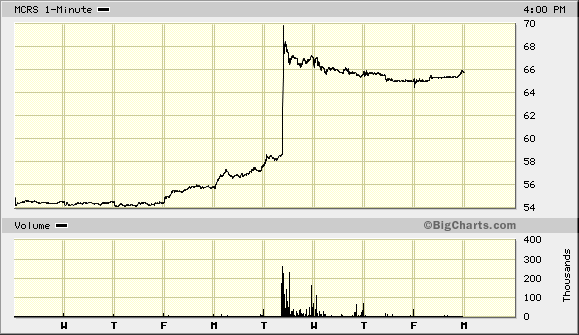
You can see when the news broke last Tuesday. But also, look at how the stock crept higher just before that — on Friday and Monday. Is that proof? I don’t know but it’s awfully suspicious.
-
Morning News: June 23, 2014
Eddy Elfenbein, June 23rd, 2014 at 6:46 amDraghi Says Unlimited Cash Through 2016 Is Rate Signal
China’s Factories Lift Australian Shares
BNP Said Close to $9 Billion Sanctions Accord With U.S.
GE Deal ‘Victory’ for Role of the French State in Economy
Banco Santander to Buy Nordic Units of GE Money
Rising Oil Prices Can Pull Down Markets: Fact or Myth?
In Yellen We Trust Is Bond Mantra as Inflation Threats Dismissed
Ex-Im Bank Hits Hurdle in New GOP Leadership
SEC Files Lawsuit to Enforce Subpoenas Issued to Congress
Oracle Nears $5 Billion Deal for Micros Systems
RadioShack is Now a Penny Stock
An Employee Dies, and the Company Collects the Insurance
American Apparel’s Charney Fighting Board
Sober Look: Betting Against the FOMC Could End Badly
Jeff Miller: Weighing the Week Ahead: Is the Fed Behind the Curve?
Be sure to follow me on Twitter.
-
Oracle to Buy Micros for $5 Billion
Eddy Elfenbein, June 23rd, 2014 at 12:14 amThe deals have been heating up lately. The WSJ is reporting that Oracle ($ORCL) is prepared to buy Micros Systems ($MCRS) for about $5 billion. Expect an official announcement tomorrow.
Micros sells Internet-connected cash registers, and the software and technical services to power them, to restaurants, retail shops, casinos and other companies.
Analysts have said a purchase of Micros, which long has been a rumored acquisition target for Oracle, would be a sign the database giant is interested in grabbing a bigger foothold in the retail and hospitality industries. FBR Capital Markets said in a recent research note that Oracle, which has $39 billion in cash and marketable securities and a $190 billion market capitalization, needs to “go on the deal warpath” to expand into emerging areas of corporate technology where the company doesn’t currently generate much revenue.
-
Barron’s on Express Scripts
Eddy Elfenbein, June 22nd, 2014 at 11:22 pmVito J. Racanelli at Barron’s has good things to say about Express Scripts ($ESRX):
Express Scripts will continue to benefit from all the long-term tail winds we’ve noted in previous items about the company: good growth in generic drugs in response to brand drug inflation; an aging U.S. population; health-care reform, expanding health coverage, and ongoing drives to reduce drug costs.
In particular, its mail and specialty pharma business is high margin and keeps growing well, adds Retzler. The firm has one of the best pharmacy-benefit management systems around, with all clients on a single information platform, making it easier to, for example, update for new rules, regulations, and formulas, he adds.
It doesn’t hurt that Express Scripps happens to be a well-managed company with a good balance sheet, too, with $9.3 billion in net debt, and a debt to equity ratio of about 40%.
Here’s a company getting good growth at a time when it seems only Internet stocks are showing that, Retzler notes. Mr. Market’s sell-off has rendered Express Scripts valuation reasonable again, he says. By various metrics, the stock is significantly cheaper than its long-term history. The price/earnings ratio of 16 is below the median of 22, and attractive given the company’s 2014 EPS guidance.
Express Scripts is a solid business that should recover if the bull market continues and should also prove defensive should a bear market unexpectedly appear. The new worries should recede over the next two to four quarters. As that happens, a 10% rise from here over the next 12 months seems, well, fair.
Q2 earnings are due out in another month. They had lowered full-year guidance, but as Racanelli notes, it’s still for EPS growth of 12%.
-
The Economist: Medtronic’s deal with Covidien makes sense
Eddy Elfenbein, June 20th, 2014 at 11:51 amFrom The Economist:
As American hospital operators consolidate, medical-device companies can no longer woo individual doctors over filet mignon, but must present their wares to sceptical, centralised hospital bureaucracies.
Medtronic, like many other device firms, is trying to respond to these changes. Last year it announced a new business to help hospitals become more efficient—it wants them to start seeing it as an ally, not an adversary. Its collaborations include running two catheter labs for Britain’s National Health Service. Medtronic is also seeking to develop not just slightly improved products, but much better ones. Its new implanted heart monitor, about the size of a paper clip, sends a patient’s data to his doctor and nurses, so they can immediately spot problems. And Medtronic has enthusiastically chased growth in emerging markets. In 2012 it spent more than $800 million buying Kanghui, a Chinese maker of replacement hips and knees.
Covidien will help it do more. As in any merger between similar firms, there will be scope for cutting overlapping costs. Their product ranges are complementary: Medtronic excels at specialist gear for cardiology, neurology and diabetes; Covidien’s strengths include tools for general surgery. In rich countries, being able to offer bundles of kit will give the group a better negotiating position with governments and hospitals. And in emerging markets, Medtronic will be able to reach a broader set of patients, notes Matthew Dodds, an analyst at Citigroup. Medtronic’s sophisticated implants are well suited to upmarket urban hospitals in China, for example. But even less advanced hospitals are likely to buy Covidien’s sutures and staples, used in all kinds of surgery.
-
Oracle’s Q1 Guidance
Eddy Elfenbein, June 20th, 2014 at 10:51 amHere’s Safra Catz, Oracle’s President and CFO, on yesterday’s conference call:
Now, let’s move to the guidance. Software and cloud revenue on a GAAP and non-GAAP basis which includes new software license, software support, SaaS and PaaS and IaaS is expected to grow 6% to 8% in U.S. dollars, 5% to 7% in constant currency.
SaaS and PaaS, one of the line items on a non-GAAP basis is expected to grow 25% to 35% in U.S. dollars, 24% to 34% in constant currency. SaaS and PaaS on a GAAP basis is expected to grow 27% to 37% in U.S. dollars, 26% to 36% in constant currency.
Next, another one at the line, cloud IaaS on a GAAP and non-GAAP basis is expected to grow 10% to 20% in U.S. dollars and 9% to 19% in constant currency. Hardware system revenues on a GAAP and non-GAAP basis, which includes hardware systems products and hardware system support is expected to be between negative one and positive three or negative two to positive two in constant currency.
Total revenue on a GAAP and non-GAAP basis is expected to range from 4% to 6% in U.S. dollars and 3% to 5% in constant currency.
Non-GAAP EPS is expected to be somewhere between $0.62 and $0.66 in U.S. dollars, $0.61 and $0.65 in constant currency. GAAP EPS is expected to be somewhere between $0.49 and $0.53 in U.S. dollars and $0.48 to $0.52 in constant currency. Now, this guidance assumes a GAAP tax rate of 22% and a non-GAAP tax rate of 23.5%. Of course it may end up being different and with that I’ll turn it over to Larry.
-
CWS Market Review – June 20, 2014
Eddy Elfenbein, June 20th, 2014 at 7:06 am“In this game, the market has to keep pitching, but you don’t have to swing. You can stand there with the bat on your shoulder for six months until you get a fat pitch.” – Warren Buffett
The news got a lot more interesting this week. First, Medtronic ($MDT) announced a mega-merger deal with Ireland’s Covidien. The shares celebrated by jumping to an all-time high. MDT is a 13% winner on the year for us.
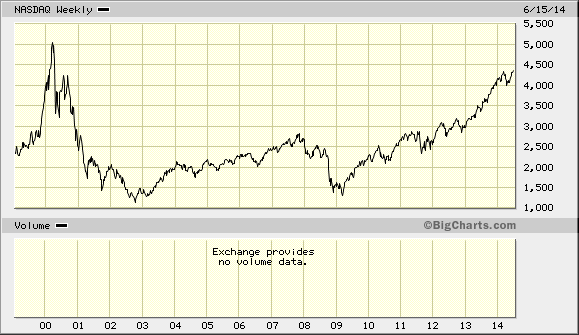
Also this week, the Federal Reserve decided on another taper, their fifth in a row. Investors liked what they saw, and the S&P 500 has now rallied for five days in a row. That’s our longest winning streak since April. The index just notched its 21st record high this year. The Nasdaq touched a 14-year high (see below), and the Volatility Index plunged to an 88-month low.
In this issue of CWS Market Review, I’ll walk you through the Medtronic-Covidien deal. Frankly, it’s not ideal, but I recognize that Medtronic had to make a move, and it’s probably the best deal they could get. I’ll also take a look at the recent earnings report from Oracle, and we’ll preview next week’s earnings report from Bed Bath & Beyond. BBBY has gotten beaten down this year, and I think it’s going for a very good price here. I’ll also discuss the Fed’s latest taper move and why the economy is finally looking better (no, really). But first, let’s take a closer look at the $42.9-billion deal Medtronic did with Covidien.
Medtronic Buys Covidien for $42.9 Billion
Two weeks ago, I told you that Medtronic ($MDT) was seriously considering a merger with Smith & Nephew ($SNN). This past weekend, however, the company announced that it’s buying Ireland’s Covidien ($COV) for $42.9 billion. In 2007, Covidien was spun off from Tyco International ($TYC).
What makes this deal interesting is that it’s an “inversion,” which means that Medtronic’s HQ will move from Minneapolis to Ireland, where corporate taxes are much lower. Americans are often surprised to learn that our corporate tax rate is higher than many European countries’ rates. The main corporate rate in Ireland is 12.5%, compared with 35% in the U.S. I think we can expect to see more of these inversion deals in the future. In Medtronic’s case, the tax savings won’t be that dramatic since they already have a modest tax bill thanks to R&D tax breaks.
The deal calls for Medtronic to pay $93.22 per share for Covidien ($35.19 in cash and 0.956 shares of MDT). That was a 29% premium to Covidien’s share price. As an interesting footnote, to qualify as an inversion, the deal has to be at least 20% in stock. With acquisitions, the rule of thumb is that the acquirer’s stock falls. Not this time. Shares of Medtronic initially stumbled, but then a rash of upgrades caused traders to push MDT as high as $65.50 per share on Thursday. That’s an all-time high.
Is this a good deal for Medtronic? It’s complicated. I’m not a fan of mega-mergers. Small rollups are fine, but trying to merge two large enterprises is often more difficult than the planners realize. Having said that, I realize that Medtronic had to make a move. All medical device companies need to. After all, their customers (hospitals and physician groups) have been merging for the last few years, and the device makers are facing those same economic pressures. You can be sure that many of these upcoming deals will be inversions, so expect to hear more talk about Stryker ($SYK) and Britain’s Smith & Nephew.
Ironically, by setting up in Ireland, Medtronic will be able to free up more cash, which they can reinvest in the United States. Medtronic said they plan to invest $10 billion in the U.S. over the next ten years. A lot of these inversions will be between companies that make strange bedfellows, but Medtronic and Covidien are a natural fit. For all the options Medtronic faced, this was the best deal for them to make, so I cautiously support this deal.
As if there’s not enough Medtronic news this week, the company also announced an 8.9% increase to its dividend. I love me a good dividend increase. The quarterly dividend will rise from 28 cents per share to 30.5 cents per share. For the year, that’s $1.22 per share. This is the 37th year in a row that Medtronic has increased its dividend. Going by Thursday’s close, Medtronic yields 1.9%. This week, I’m raising my Buy Below on Medtronic to $67 per share.
The Fed Tapers Again
The Federal Reserve held a two-day meeting this week, and as everyone expected, the central bank tapered its bond purchases again. Starting in July, the Fed will purchase $20 billion in Treasuries each month, plus $15 billion per month in mortgage-backed securities. This is the fifth-straight meeting in which the Fed has tapered.
Tapering by $10 billion at each meeting ($5 billion in Treasuries and $5 billion in MBS) has been the Fed’s game plan all year, and they’ve stuck to it, even when the economy got polar-vortexed earlier this year. In their post-meeting statement, the Fed said that the economy is slowly improving, although housing remains weak.
The Fed has four more meetings left this year. So if we assume they stay on course, they’ll be done with Quantitative Easing (QE) by the end of the year. (I’m assuming the final $5 billion in Treasuries will be tapered in December, but there could be a clear-the-decks move in October.) Janet Yellen has said to expect a rate increase about six months after the end of QE.
As part of this Fed meeting, they also updated their economic projections. You can see them here. Let me caution you that the Fed isn’t exactly known for its accuracy, but it’s interesting to see what its assumptions are. Here’s where it gets interesting. Check out Figure 2 on the PDF. The broad consensus is that the first rate hike will come next year. Twelve of the 16 members agree on that, and I think they’re right. But the consensus falls apart for year-end 2015. There’s a small clustering around 1% to 1.25%, which means that real rates are projected to be negative for at least another 18 months. As long as the lid stays on inflation, that’s very good for the stock market and our Buy List. One of the basic rules about finance is that the stock market loves cheap money.
This week’s inflation report shows that inflation continues to trend upward. Of course, we’re still far from it being a problem, but the rate of inflation is no longer falling. That’s key. The Bureau of Labor Statistics reported on Tuesday that core inflation rose at its fastest rate since October 2009, which is still quite modest. Only now is inflation finally moving into the Fed’s target area.
The Fed’s consensus for year-end 2016 is even more scattered. Their range for short-term interest rates goes from 0.5% to 4.25%, and there are never more than two members that agree on any one rate. I don’t expect a consensus, but I’m shocked to see so little agreement on where the economy will be in 30 months. In short, they see rates going up, but there’s no agreement on how high.
I should point out that two Fed regional surveys this week were quite optimistic. The Philly Fed Manufacturing Survey noticed a big increase in activity this month. Also, the Empire State survey showed that activity in New York is quite good. On Monday, the Fed reported that Industrial Production rose a healthy 0.6% last month. For the first time in a long time, we can say that things are looking up for the economy. Expect to see the economy average over 3% annualized growth for the next few quarters. After five years, the recovery is beginning to be felt on Main Street.
Oracle Misses Earnings by Three Cents per Share
After the closing bell on Thursday, Oracle ($ORCL) reported fiscal Q4 earnings of 92 cents per share. Frankly, that’s disappointing; it’s three cents below Wall Street’s consensus. Oracle said they lost two cents per share due to the currency loss in Venezuela. Shares of ORCL, which had rallied to a 14-year high during the day on Thursday, got smacked around for a 6% loss in the after-hours market.
Three months ago, Oracle said to expect Q4 earnings to range between 92 and 99 cents per share. As it turns out, they hit the low end of their guidance, and business was pretty sluggish in Q4. Quarterly revenue rose 3.4% to $11.32 billion, which was $160 million below expectations.
One of the keys for Oracle‘s business is sales of new software licenses. For Q4, that came in at $3.77 billion, which is flat. Their hardware revenue, now finally growing, rose only 2% to $1.5 billion. One bright spot is that Oracle’s cloud revenue jumped 23% to $327 million. There have also been rumors that Oracle is considering buying Micros Systems ($MCRS) for $5 billion, which would be their largest deal since they bought Sun Microsystems four years ago. Micros makes software for hotels, restaurants and retailers.
Now for guidance. On the earnings call, Oracle said they see Q1 earnings ranging between 62 and 66 cents per share. That’s not so bad. Wall Street had been expecting 64 cents per share. Oracle sees quarterly revenue growth between 4% and 6%. Breaking that down, they expect new software-license revenue to be up by 6% to 8%. Hardware will be between -1% and 3%, but cloud revenue is expected to be up by 25% to 35%. If this guidance is accurate, that tells us that last quarter’s weakness won’t last. Oracle remains a good buy up to $44 per share.
Stay Tuned for Bed Bath & Beyond’s Earnings Report
Our biggest dud this year, by far, has been Bed Bath & Beyond ($BBBY). The stock is off more than 24% YTD. Last week, the shares traded below $60 for the first time in 15 months.
I apologize for the rough ride with this one, but make no mistake, I haven’t given up on BBBY. In the CWS Market Review from May 9, I announced that I was ready to pound the tables for BBBY. This coming Wednesday, June 25, is our first big test. That’s when BBBY will report their fiscal Q1 earnings.
Let’s review where we stand. Three months ago, Bed Bath & Beyond reported terrible results for Q4 (December, January, February). The home-furnishings store earned $1.60 per share. That was eight cents lower than the year before. That was quite a shock, because BBBY delivered earnings increases like clockwork. They estimated that poor weather knocked six to seven cents off their bottom line.
For their Q1 outlook, BBBY had more bad news. They said to expect earnings to range between 92 and 97 cents per share. The consensus on Wall Street had been for $1.03 per share. They made $4.79 all of last year, and for this fiscal year, they expect earnings to rise by “mid-single digits.” If we take that to mean 4% to 6%, their guidance works out to a range of $4.98 to $5.08 per share. Wall Street had been expecting $5.27 per share.
Now let’s look at the items in BBBY’s favor. First is the low share price. The stock is going for about 12 times forward earnings. If we look at one of my favorite valuation metrics, Enterprise Value/EBITDA, BBBY’s is down to 6.15, which is quite low. The company also has a very clean balance sheet: no debt and lots of cash. Let’s remember that the store is well managed, and they’ve ridden through storms such as this before. As the Fed indicated this week, the housing market is still weak, but that won’t last, and stronger housing helps BBBY. You need to be patient with this one, but Bed Bath & Beyond remains a very good buy up to $66 per share.
That’s all for now. Next week is the last full week of Q2. On Wednesday, the government will revise its Q1 report for the second time. The initial report showed growth of 0.1%, but last month it was revised down to -1%. I’m curious to see what happens this time. Also on Wednesday, we’ll get a key report on orders for durable goods. On Thursday, we’ll get the report on personal income. Also on Wednesday, we’ll get the earnings report from Bed Bath & Beyond. Be sure to keep checking the blog for daily updates. I’ll have more market analysis for you in the next issue of CWS Market Review!
– Eddy
-
Morning News: June 20, 2014
Eddy Elfenbein, June 20th, 2014 at 6:55 amInternational Monetary Fund Says Europe Should Weigh Bond-Buying
What Will Argentina Do With Its Vultures?
Treasury Inflation Linked Auction Tail Dims Sale for Dealers
The Social Security Administration’s Diminishing Footprint
Shire Rejects AbbVie’s $46.5 Billion Takeover Bid
Siemens-Mitsubishi Raise Alstom Offer as End-Game Nears
Oracle Earnings, Revenue Miss Estimates; Shares Plunge
BlackBerry Results Top Forecasts, Fueling Recovery Hopes
Strong TSB Debut Lifts Prospects for Future Share Sales
I.P.O. Values Euronext Exchange Operator at $1.9 Billion
Latvian Rating Raised by Fitch on Positive Debt Dynamics
BofA Must Face U.S. Suit Over Mortgage-Securities Fraud
Ousted American Apparel CEO Undone by Controversial Past
Cullen Roche: 5 Investment Lessons We Can Learn From Futbol (Err, Soccer)
Joshua Brown: “Hedge Funds Set the Price of Stocks”
Be sure to follow me on Twitter.
-
Unemployment and Future Stock Returns
Eddy Elfenbein, June 19th, 2014 at 11:29 am“Be greedy when others are fearful” is one the old adages of investing, and the numbers appear to back that up, at least going by the unemployment rate. I went through the historical data and took the current employment rate going back to 1956 (black line, left scale) and compared with the future 10-year real returns of the stock market (blue line, right scale). So that includes both dividends and inflation.
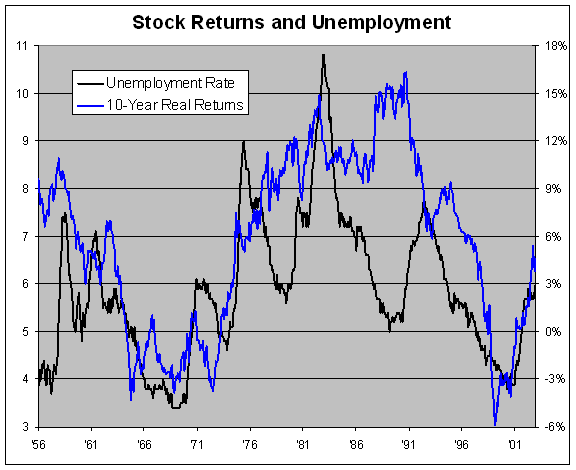
The lines seem to line up fairly well. Let me caution you that it’s dangerous to read too much into charts like this. Instead, investors should understand the broad lesson that it’s usually a good time to invest when the economy is flat on its back. Conversely, when the economy is roaring along, that’s often a sign of trouble for stocks. In fact, one of the better estimates of the real cost of equity capital just might be the current employment rate.
(You can sign up for my free newsletter here.)
-
Morning News: June 19, 2014
Eddy Elfenbein, June 19th, 2014 at 6:44 amChina Shares Post Biggest Loss Since Late April as IPOs Divert Funds
Japan Business Mood Defies Economic Headwinds, Backs BOJ Optimism
Argentina Says Next Bond Payment ‘Impossible’, Default Looms
Beware the Hype Over the Shale Boom
Post FOMC: What Strategists Read in Yellen’s Words
Currency Probe Widens as U.S. Said to Target Markups
Wheat Extends Gains as Rain Threatens to Thwart U.S. Harvest
Siemens Joins Mitsubishi to Pledge Guarantees for Alstom
Adobe Brings Lightroom To iPhone, Adds Photoshop Tablet App
FedEx Delivers A 33% Dividend Increase And Stronger Than Expected Earnings
Rolls Royce to Return 1 Billion Pounds to Investors, Shares Jump
Why Elon Musk Is Doubling Down on Solar Power
Are The Two Most Notorious Men in Fashion Finally Getting Their Comeuppance?
Jeff Carter: Defending the For Profit Exchange
Be sure to follow me on Twitter.
-
Archives
- September 2026
- August 2026
- July 2026
- June 2026
- May 2026
- April 2026
- March 2026
- February 2026
- January 2026
- December 2025
- November 2025
- October 2025
- September 2025
- August 2025
- July 2025
- June 2025
- May 2025
- April 2025
- March 2025
- February 2025
- January 2025
- December 2024
- November 2024
- October 2024
- September 2024
- August 2024
- July 2024
- June 2024
- May 2024
- April 2024
- March 2024
- February 2024
- January 2024
- December 2023
- November 2023
- October 2023
- September 2023
- August 2023
- July 2023
- June 2023
- May 2023
- April 2023
- March 2023
- February 2023
- January 2023
- December 2022
- November 2022
- October 2022
- September 2022
- August 2022
- July 2022
- June 2022
- May 2022
- April 2022
- March 2022
- February 2022
- January 2022
- December 2021
- November 2021
- October 2021
- September 2021
- August 2021
- July 2021
- June 2021
- May 2021
- April 2021
- March 2021
- February 2021
- January 2021
- December 2020
- November 2020
- October 2020
- September 2020
- August 2020
- July 2020
- June 2020
- May 2020
- April 2020
- March 2020
- February 2020
- January 2020
- December 2019
- November 2019
- October 2019
- September 2019
- August 2019
- July 2019
- June 2019
- May 2019
- April 2019
- March 2019
- February 2019
- January 2019
- December 2018
- November 2018
- October 2018
- September 2018
- August 2018
- July 2018
- June 2018
- May 2018
- April 2018
- March 2018
- February 2018
- January 2018
- December 2017
- November 2017
- October 2017
- September 2017
- August 2017
- July 2017
- June 2017
- May 2017
- April 2017
- March 2017
- February 2017
- January 2017
- December 2016
- November 2016
- October 2016
- September 2016
- August 2016
- July 2016
- June 2016
- May 2016
- April 2016
- March 2016
- February 2016
- January 2016
- December 2015
- November 2015
- October 2015
- September 2015
- August 2015
- July 2015
- June 2015
- May 2015
- April 2015
- March 2015
- February 2015
- January 2015
- December 2014
- November 2014
- October 2014
- September 2014
- August 2014
- July 2014
- June 2014
- May 2014
- April 2014
- March 2014
- February 2014
- January 2014
- December 2013
- November 2013
- October 2013
- September 2013
- August 2013
- July 2013
- June 2013
- May 2013
- April 2013
- March 2013
- February 2013
- January 2013
- December 2012
- November 2012
- October 2012
- September 2012
- August 2012
- July 2012
- June 2012
- May 2012
- April 2012
- March 2012
- February 2012
- January 2012
- December 2011
- November 2011
- October 2011
- September 2011
- August 2011
- July 2011
- June 2011
- May 2011
- April 2011
- March 2011
- February 2011
- January 2011
- December 2010
- November 2010
- October 2010
- September 2010
- August 2010
- July 2010
- June 2010
- May 2010
- April 2010
- March 2010
- February 2010
- January 2010
- December 2009
- November 2009
- October 2009
- September 2009
- August 2009
- July 2009
- June 2009
- May 2009
- April 2009
- March 2009
- February 2009
- January 2009
- December 2008
- November 2008
- October 2008
- September 2008
- August 2008
- July 2008
- June 2008
- May 2008
- April 2008
- March 2008
- February 2008
- January 2008
- December 2007
- November 2007
- October 2007
- September 2007
- August 2007
- July 2007
- June 2007
- May 2007
- April 2007
- March 2007
- February 2007
- January 2007
- December 2006
- November 2006
- October 2006
- September 2006
- August 2006
- July 2006
- June 2006
- May 2006
- April 2006
- March 2006
- February 2006
- January 2006
- December 2005
- November 2005
- October 2005
- September 2005
- August 2005
- July 2005
 Eddy Elfenbein is a Washington, DC-based speaker, portfolio manager and editor of the blog Crossing Wall Street. His