Archive for 2014
-
The Stock Market’s Reaction
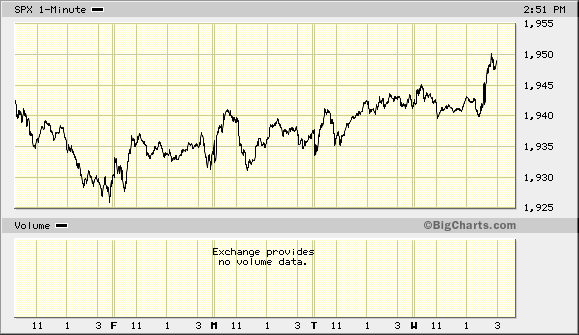
Eddy Elfenbein, June 18th, 2014 at 2:55 pmThe stock market seems mildly pleased with today’s Fed statement:
-
The Fed’s Economic Projections
Eddy Elfenbein, June 18th, 2014 at 2:34 pmHere are the updated economic projections from today’s FOMC meeting.
The bottom line is that the Fed sees the economy and labor market improving. Most Fed members think that the first rate increase will come next year. The blue dots for interest rate projections are very widely dispersed for 2016. In other words, there’s little consensus on what will happen beyond 18 months out.
-
Today’s Fed Statement
Eddy Elfenbein, June 18th, 2014 at 2:04 pmMore tapering. Starting in July, the Fed will buy $20 billion in Treasuries and $15 billion in MBS. Here’s today’s Fed statement:
Information received since the Federal Open Market Committee met in April indicates that growth in economic activity has rebounded in recent months. Labor market indicators generally showed further improvement. The unemployment rate, though lower, remains elevated. Household spending appears to be rising moderately and business fixed investment resumed its advance, while the recovery in the housing sector remained slow. Fiscal policy is restraining economic growth, although the extent of restraint is diminishing. Inflation has been running below the Committee’s longer-run objective, but longer-term inflation expectations have remained stable.
Consistent with its statutory mandate, the Committee seeks to foster maximum employment and price stability. The Committee expects that, with appropriate policy accommodation, economic activity will expand at a moderate pace and labor market conditions will continue to improve gradually, moving toward those the Committee judges consistent with its dual mandate. The Committee sees the risks to the outlook for the economy and the labor market as nearly balanced. The Committee recognizes that inflation persistently below its 2 percent objective could pose risks to economic performance, and it is monitoring inflation developments carefully for evidence that inflation will move back toward its objective over the medium term.
The Committee currently judges that there is sufficient underlying strength in the broader economy to support ongoing improvement in labor market conditions. In light of the cumulative progress toward maximum employment and the improvement in the outlook for labor market conditions since the inception of the current asset purchase program, the Committee decided to make a further measured reduction in the pace of its asset purchases. Beginning in July, the Committee will add to its holdings of agency mortgage-backed securities at a pace of $15 billion per month rather than $20 billion per month, and will add to its holdings of longer-term Treasury securities at a pace of $20 billion per month rather than $25 billion per month. The Committee is maintaining its existing policy of reinvesting principal payments from its holdings of agency debt and agency mortgage-backed securities in agency mortgage-backed securities and of rolling over maturing Treasury securities at auction. The Committee’s sizable and still-increasing holdings of longer-term securities should maintain downward pressure on longer-term interest rates, support mortgage markets, and help to make broader financial conditions more accommodative, which in turn should promote a stronger economic recovery and help to ensure that inflation, over time, is at the rate most consistent with the Committee’s dual mandate.
The Committee will closely monitor incoming information on economic and financial developments in coming months and will continue its purchases of Treasury and agency mortgage-backed securities, and employ its other policy tools as appropriate, until the outlook for the labor market has improved substantially in a context of price stability. If incoming information broadly supports the Committee’s expectation of ongoing improvement in labor market conditions and inflation moving back toward its longer-run objective, the Committee will likely reduce the pace of asset purchases in further measured steps at future meetings. However, asset purchases are not on a preset course, and the Committee’s decisions about their pace will remain contingent on the Committee’s outlook for the labor market and inflation as well as its assessment of the likely efficacy and costs of such purchases.
To support continued progress toward maximum employment and price stability, the Committee today reaffirmed its view that a highly accommodative stance of monetary policy remains appropriate. In determining how long to maintain the current 0 to 1/4 percent target range for the federal funds rate, the Committee will assess progress–both realized and expected–toward its objectives of maximum employment and 2 percent inflation. This assessment will take into account a wide range of information, including measures of labor market conditions, indicators of inflation pressures and inflation expectations, and readings on financial developments. The Committee continues to anticipate, based on its assessment of these factors, that it likely will be appropriate to maintain the current target range for the federal funds rate for a considerable time after the asset purchase program ends, especially if projected inflation continues to run below the Committee’s 2 percent longer-run goal, and provided that longer-term inflation expectations remain well anchored.
When the Committee decides to begin to remove policy accommodation, it will take a balanced approach consistent with its longer-run goals of maximum employment and inflation of 2 percent. The Committee currently anticipates that, even after employment and inflation are near mandate-consistent levels, economic conditions may, for some time, warrant keeping the target federal funds rate below levels the Committee views as normal in the longer run.
Voting for the FOMC monetary policy action were: Janet L. Yellen, Chair; William C. Dudley, Vice Chairman; Lael Brainard; Stanley Fischer; Richard W. Fisher; Narayana Kocherlakota; Loretta J. Mester; Charles I. Plosser; Jerome H. Powell; and Daniel K. Tarullo.
I need to add that there’s no excuse for an FOMC statement to ramble on this long. It should be short and to the point.
-
Morning News: June 18, 2014
Eddy Elfenbein, June 18th, 2014 at 6:33 amNew EU Resolution Rules Mark Progress in Removing Support
Gilts Advance as BOE Minutes Damp Bets of Imminent Rate Increase
BOJ to Provide Almost 5 Trillion Yen to Banks to Boost Lending
Japan’s Parliament Begins Debate on Introducing Casinos
China’s Shipping Alliance Rejection Underscores Protectionist Worries
Grand Central: Why The market Doubts Fed Rate Dot Plot
Consumer Price Index Jumps 0.4% in May as Inflation Heats Up
French Government Rejects Siemens-Mitsubishi Bid for Alstom
Elon Musk Seeks to Hasten Shift to Solar By Building Factory
Why Buying Micros Would Be a Bad Deal for Oracle
Popeyes Buys Its Recipes for $43 Million. Wait, Popeyes Didn’t Own Its Recipes?
What’s Up With This Green Coca-Cola?
Adobe’s Cloud Solutions Fuel Strong Financial Results
Roger Nusbaum: Nothing New Under the Sun
Joshua Brown: “the essence of shadow banking is giving people a liquid claim on illiquid assets.”
Be sure to follow me on Twitter.
-
Benzinga’s PreMarket Prep
Eddy Elfenbein, June 17th, 2014 at 12:06 pmYesterday, I was on Benzinga’s PreMarket Prep show. I think my audio was a bit low, which isn’t what I’m like in real life. Thanks to everyone at Benzinga for inviting me!
-
Inflation Continues to Rise
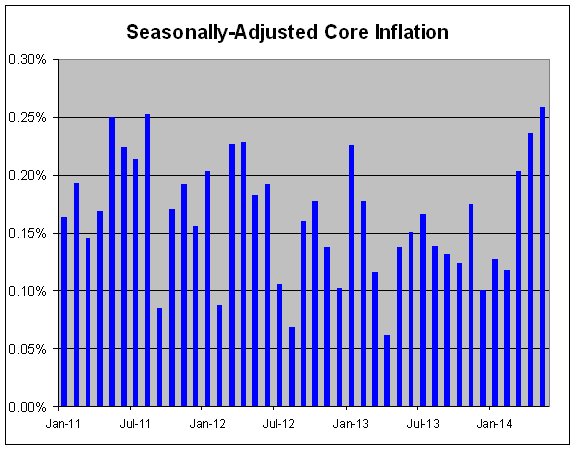
Eddy Elfenbein, June 17th, 2014 at 11:32 amThe government reported that inflation rose again last month. Consumer prices edged up 0.4% in May which was the largest increase in more than a year. The “core rate,” which excludes food and energy, rose by 0.3% which was the largest increase since 2009.
I want to be careful not to overstate the case. No, there’s no danger of hyperinflation. Rather, the trend of disinflation, lower price increases, seems to have come to an end. In the last year, headline inflation is up 2.1% and core inflation is up 2.0%. Overall, I think this is a good thing as inflation moves closer to the Fed’s target zone.
-
Middleby to Split 3-for-1
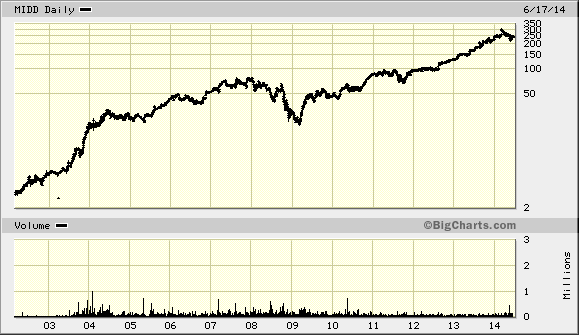
Eddy Elfenbein, June 17th, 2014 at 10:52 amApple ($AAPL) recently split 7-for-1 but there’s another high-priced stock that’s due to split. Next week, Middleby ($MIDD) will split its shares 3-for-1.
Middleby is not very well known but it’s been an amazing performer. The shares are currently at $246. Shortly after 9/11, they hit $2. That’s a 123-fold gain in less than 13 years.
So you’d think Middleby would be a highly popular stock, right? Not at all. Only a few analysts follow it. I think the high nominal share price may scare some traders away. Miidleby usually trades about 150,000 shares each day. That may sound like a lot but consider the action at Bank of America which often trades more than 70 million shares per day.
Here’s how Middleby describes itself:
The Middleby Corporation is a global leader in the foodservice equipment industry. The company develops, manufactures, markets and services a broad line of equipment used for commercial food cooking, preparation and processing.
Sexy, I know.
Too many investors think that a great company has to be someone inventing the 12th dimension. That’s simply not the case. It can often be a boring company in a dull industry that does its job very, very well.
Side note: I’m glad to see the decline and fall of stock splits. In the 90s, companies split their shares by small amounts all the time. In my opinion, splits should be at least 2-for-1, and more often 3-for-1 or 4-for-1. Splits should happen once every 15 years or so. The airliner JetBlue split 3-for-2 three times in three years despite the stock not really doing much.
-
Morning News: June 17, 2014
Eddy Elfenbein, June 17th, 2014 at 6:45 amIMF Cuts Growth Outlook, Says Full Employment Years Off
Aussie Declines as Central Bank Says Recovery Uncertain
UK House Prices ‘Rise 9.9% in a Year’
Argentina Vows to Service Debt Despite New Legal Blow
Economists: Take Fed ‘Dot Plots’ With a Big Grain Of Salt
Moody’s Raises New York State’s GO Bond Rating to Aa1
Siemens, Mitsubishi Value Alstom Unit at $19.2 Billion
GM Safety Crisis Grows With Recall of 3 Million More Cars for Ignition Issues
Hillshire Takes Tyson Deal, Drops Its Own Bid for Pinnacle Foods
Australia’s Woodside Petroleum In Play As A Takeover Target After Shell Makes Its Exit
The Fusion of Solid State Storage
S.E.C. Fines Hedge Fund in Demotion of Whistle-Blowing Employee
Stephen Colbert’s In-House Tech Startup Wants to Fix TV Scripts
Cullen Roche: The Bankrupt Economics of David Brat
Jeff Carter: To Innovate Don’t Ask, “What Else Can Be Ubered?”
Be sure to follow me on Twitter.
-
Industrial Production Rises 0.6%
Eddy Elfenbein, June 16th, 2014 at 10:21 amOn the economic news front this morning, the Federal Reserve reported that Capacity Utilization rose last month to 79.1%. That’s close to a six-year high. In theory, that’s supposed to be an early warning sign of inflation, but I don’t think it’s a very good barometer. During much of the 1980s and 90s, Capacity Utilization was much higher than where we are now, and inflation wasn’t much of an issue.
The Fed also reported that U.S. Industrial Production jumped 0.6% last month. Economists had been expecting an increase of 0.5%. The rise for May is especially good to see after the drop of 0.3% we had in April. In the past year, Industrial Production is up 4.3%.
The Fed meets tomorrow and on Wednesday. Expect to see another tapering announcement. The FOMC will also update their economic projections.
-
Medtronic Raises Dividend by 9%
Eddy Elfenbein, June 16th, 2014 at 9:53 amI was very curious to see how Medtronic ($MDT) would open today, and the shares have opened higher. As a very general rule, stocks of acquiring companies usually fall on the news of a buyout, while the company being bought soars. Covidian (COV), not surprisingly, is much higher today, but it’s interesting that Medtronic is up as well. I suspect the market likes this deal and is particularly fond of the tax issue.
As if there’s not enough Medtronic news this morning, the company also announced a 9% increase to its dividend. The quarterly dividend will rise from 28 cents per share to 30.5 cents per share. For the year, that’s $1.22 per share. This is the 37th year in a row that Medtronic has increased its dividend.
The stock is currently at $63.35 which is a gain of 4.37%.
-
Archives
- September 2026
- August 2026
- July 2026
- June 2026
- May 2026
- April 2026
- March 2026
- February 2026
- January 2026
- December 2025
- November 2025
- October 2025
- September 2025
- August 2025
- July 2025
- June 2025
- May 2025
- April 2025
- March 2025
- February 2025
- January 2025
- December 2024
- November 2024
- October 2024
- September 2024
- August 2024
- July 2024
- June 2024
- May 2024
- April 2024
- March 2024
- February 2024
- January 2024
- December 2023
- November 2023
- October 2023
- September 2023
- August 2023
- July 2023
- June 2023
- May 2023
- April 2023
- March 2023
- February 2023
- January 2023
- December 2022
- November 2022
- October 2022
- September 2022
- August 2022
- July 2022
- June 2022
- May 2022
- April 2022
- March 2022
- February 2022
- January 2022
- December 2021
- November 2021
- October 2021
- September 2021
- August 2021
- July 2021
- June 2021
- May 2021
- April 2021
- March 2021
- February 2021
- January 2021
- December 2020
- November 2020
- October 2020
- September 2020
- August 2020
- July 2020
- June 2020
- May 2020
- April 2020
- March 2020
- February 2020
- January 2020
- December 2019
- November 2019
- October 2019
- September 2019
- August 2019
- July 2019
- June 2019
- May 2019
- April 2019
- March 2019
- February 2019
- January 2019
- December 2018
- November 2018
- October 2018
- September 2018
- August 2018
- July 2018
- June 2018
- May 2018
- April 2018
- March 2018
- February 2018
- January 2018
- December 2017
- November 2017
- October 2017
- September 2017
- August 2017
- July 2017
- June 2017
- May 2017
- April 2017
- March 2017
- February 2017
- January 2017
- December 2016
- November 2016
- October 2016
- September 2016
- August 2016
- July 2016
- June 2016
- May 2016
- April 2016
- March 2016
- February 2016
- January 2016
- December 2015
- November 2015
- October 2015
- September 2015
- August 2015
- July 2015
- June 2015
- May 2015
- April 2015
- March 2015
- February 2015
- January 2015
- December 2014
- November 2014
- October 2014
- September 2014
- August 2014
- July 2014
- June 2014
- May 2014
- April 2014
- March 2014
- February 2014
- January 2014
- December 2013
- November 2013
- October 2013
- September 2013
- August 2013
- July 2013
- June 2013
- May 2013
- April 2013
- March 2013
- February 2013
- January 2013
- December 2012
- November 2012
- October 2012
- September 2012
- August 2012
- July 2012
- June 2012
- May 2012
- April 2012
- March 2012
- February 2012
- January 2012
- December 2011
- November 2011
- October 2011
- September 2011
- August 2011
- July 2011
- June 2011
- May 2011
- April 2011
- March 2011
- February 2011
- January 2011
- December 2010
- November 2010
- October 2010
- September 2010
- August 2010
- July 2010
- June 2010
- May 2010
- April 2010
- March 2010
- February 2010
- January 2010
- December 2009
- November 2009
- October 2009
- September 2009
- August 2009
- July 2009
- June 2009
- May 2009
- April 2009
- March 2009
- February 2009
- January 2009
- December 2008
- November 2008
- October 2008
- September 2008
- August 2008
- July 2008
- June 2008
- May 2008
- April 2008
- March 2008
- February 2008
- January 2008
- December 2007
- November 2007
- October 2007
- September 2007
- August 2007
- July 2007
- June 2007
- May 2007
- April 2007
- March 2007
- February 2007
- January 2007
- December 2006
- November 2006
- October 2006
- September 2006
- August 2006
- July 2006
- June 2006
- May 2006
- April 2006
- March 2006
- February 2006
- January 2006
- December 2005
- November 2005
- October 2005
- September 2005
- August 2005
- July 2005
 Eddy Elfenbein is a Washington, DC-based speaker, portfolio manager and editor of the blog Crossing Wall Street. His