Archive for 2014
-
Morning News: June 16, 2014
Eddy Elfenbein, June 16th, 2014 at 6:44 amRussia Cuts Gas Supply to Ukraine
Draghi Unites Euro Bulls With Bears Watching $1.35
ECB Seen Buying Assets Within a Year as Draghi Rate Cuts End
China Capital Flows Slow Sharply
China Surpasses U.S. as Largest Corporate Debt Issuer
BNP Keeps Investors Guessing About U.S. Sanctions Penalty
Metronic to Buy Covidien for $42.9 Billion, Rebase in Ireland
Vodafone Expands Into Car Electronics with Italian Deal
With An Amazon Smartphone, the Retailer Seeks a Tether to Consumers
Airbus, Safran Create Space Launch Joint Venture
Siemens and Mitsubishi Heavy Industries Nearing an Offer for Alstom
Bank Account Screening Tool Is Scrutinized as Excessive
‘Bitcoin Jesus’ Calls Rich to Tax-Free Tropical Paradise
Roger Nusbaum: The Fascination With Tiny Houses
Jeff Miller: Weighing the Week Ahead: What Does The Iraq Conflict mean For Markets?
Be sure to follow me on Twitter.
-
It’s Official: Medtronic is Buying Covidien for $43 Billion
Eddy Elfenbein, June 15th, 2014 at 8:01 pmThe deal is done. Medtronic ($MDT) is buying Covidien ($COV) for $42.9 billion. The deal is an “inversion” which means that Medtronic will move its HQ from Minneapolis to Ireland where corporate taxes are much lower.
Medtronic will pay $93.22 per share for Covidien. That’s a 29% premium to Friday’s close. The deal is in cash and stock.
-
Medtronic and Covidien in Talks to Merge
Eddy Elfenbein, June 14th, 2014 at 3:27 pmHere’s a biggie. The Wall Street Journal is reporting today that Medtronic and Covidien are in advanced talks about merging. The deal could be worth $40 billion.
The deal, which could be announced Monday, would be structured as a so-called tax inversion, according to one of the people. In such deals, acquirers buy companies domiciled in countries with lower corporate tax rates than their own as a means of reducing their overall rate. Covidien is based in Ireland, which is known for having a relatively low tax rate: its main corporate tax rate is 12.5%. In the U.S., home to Medtronic, the 35% rate is one of the world’s highest.
Remember that these are just talks, and anything can fall apart.
-
Priceline Buys Open Table
Eddy Elfenbein, June 13th, 2014 at 12:21 pmThe stock market is up cautiously at midday. One laggard is Bed Bath & Beyond ($BBBY) which dropped to another 52-week low today. The home furnishings store will report earnings later this month, and I don’t think investors expect much.
One of the stocks on My Watch List, Open Table ($OPEN), is up 47% today on the news that it’s going to be bought out by Priceline ($PCLN) for $2.6 billion.
A former Buy List stock, Intel ($INTC), is up 6.9% today after the company raised its revenue guidance. This surprised a lot of tech watchers. The stock is at a 10-year high today.
Not much in the way of economic reports today. Consumer confidence slipped to 81.2 from 81.9 last month. The Street was expecting 83.0. One surprise is that wholesale prices dropped 0.2% last month. Wall Street had been expecting a gain on 0.1%. Core PPI fell 0.1%. The CPI report is next week.
-
CWS Market Review – June 13, 2014
Eddy Elfenbein, June 13th, 2014 at 7:04 am“If you have trouble imagining a 20% loss in the stock market, you shouldn’t be in stocks.” – Jack Bogle
After rallying 11 times in 13 days, the S&P 500 has now pulled back for three days in a row. Despite Wall Street’s give and take, the truly interesting aspects of this market have been the low volatility and very low trading volume. Consider this: Thursday was the market’s worst day in four weeks, and even that was a measly 0.74% loss. It’s been more than two months since the S&P 500 dropped more than 1% in a single day (see chart below). Overall, this has been a very placid spring.
Now some folks are worried about—wait for it—the market’s complacency! Sheesh, some folks aren’t happy unless they’re worried about something. Personally, I’m not too worried about other people worrying about the lack of worrying. They say that bull markets crawl a wall of worry, and that’s certainly true. As usual, we look past our emotions and concentrate on the facts. We’re nearly halfway though the year, and the outlook continues to be moderately favorable for stocks. Sure, the market got a little spooked this week by the troubling events in Iraq, and the price of oil surged higher, but the fundamentals of this market remain quite good. I’ll go into more details in a bit.

I also want to cover the news of the latest jobs report and tell you what it means for us and our portfolios. My take: It’s mostly good news. The economy is improving, but at a tepid rate. The Fed is still on our side, and I’ll let you know what Buy List stocks look especially good here.
This week, we also had a small dividend increase from CR Bard, and I’ll discuss the latest from a former Buy List favorite, Nicholas Financial. The used-car loan company has officially pulled out of its merger deal with Prospect Capital. (Frankly, I didn’t like that deal from Day One.) I’ll also highlight the upcoming earnings reports from Oracle. But first, let’s look at the (mostly) good news from last Friday’s jobs report.
The Economy Added 217,000 Jobs Last Month
Shortly after I sent out last week’s CWS Market Review, the government released the big May jobs report. According to the Labor Department, the U.S. economy created 217,000 jobs last month. (That’s net, of course. The economy is always creating and destroying jobs at the same time.) That’s a decent number, but I’d like to see monthly jobs gains close to 300,000. The unemployment rate was unchanged at 6.3%.
These jobs numbers certainly aren’t great, but they are an improvement. In fact, this latest jobs report marked an important milestone: The number of nonfarm payrolls finally surpassed the pre-recession peak. Of course, the population has grown over that time as well.
This raises the other concern about the jobs market, which is the dramatic decline in workforce participation. To put it bluntly, more and more people have simply left the workforce. The workforce participation rate is at a 35-year low. According to the government’s numbers, when you stop looking for a job, you’re not even counted as unemployed.
An important stat I like to watch is the number of people working compared with the total population. (Note: For population, econo-nerds like to track the civilian non-institutional population over the age of 16.) The ratio of people working to the population has barely budged since the recovery started (check out the chart see below). Part of this can be explained by demographics. Baby Boomers have started to retire, and that’s not going to stop anytime soon. But demographics don’t explain all of the lower participation.

I should add an important caveat to the government’s jobs report. It’s just an estimate, and by the government’s admission, it carries a high error range. They also revise the figures, sometimes considerably, each month. We should pay more attention to the overall trend rather than obsess over an individual statistic.
How is the jobs report important to us as investors? There are two main reasons it’s important. For one, it gives us a good read of where the economy is at the moment. Believe it or not, at the end of this month, the U.S. economy’s recovery officially turns five years old. But many Americans haven’t experienced a recovery at all.
In response to the recession, U.S. companies cut back on their overheads, and that means lower labor costs. The good news is that profit margins soared. While that is good news because it means companies became leaner and meaner, the problem is that profit margins can’t keep rising forever. At some point, you need to get more folks coming through the front door. More consumers come from more employed folks, and that’s how a recovery becomes a positive cycle, each turn reinforcing the next.
Corporate profits and dividends are still growing, although the rate of growth has slowly come down. The latest numbers from S&P 500 show that Wall Street expects index-adjusted earnings from the S&P 500 of $119.65 for this year and $137.30 for 2015. I strongly suspect the latter figure is too high, but let’s work with it for now. If we put a multiple of 16 to it, that gives us a S&P 500 of nearly 2,200 at the end of next year. That’s a gain of 13.8% in a little over 18 months. Please don’t mistake this for a target price for the market. Instead, I want to see if the current valuation is reasonable, and I think it clearly is. For now, any bubble talk is nonsense (although there are some tech values I´m suspicious of).
The other reason why the jobs report is important to us is due to inflation. Once the jobs market gets tight, employment costs start to rise, and that leads to a rise in consumer prices. According to last week’s jobs report, hourly earnings are up 2.1% over the last year. The problem with the lower workforce participation is that we don’t really know how much slack there is in the labor force. The old rules no longer seem to apply.
A lot of commentators have predicted that increased inflation, even hyperinflation, is just around the corner. Please. Every single one of those predictions has fallen flat on its face. Now, however, there are some quiet signs of a little more inflation. Or more accurately, the decline of inflation (disinflation) has come to an end. This is what Janet Yellen and her friends inside the Fed are watching. Remember that inflation is the vital enemy of all central bankers, and the Fed doesn’t want us to go back to the 1970s. Chairwoman Yellen has indicated the Fed will start raising interest rates about one year from now, give or take. Last Friday’s jobs report was another sign that the free-money party will be coming to an end. The Fed meets again next week, and we can expect to hear another taper announcement.
As long as the Fed is on our side, stocks are a good place to be. Some of the best bargains on our Buy List include AFLAC ($AFL), Bed Bath & Beyond ($BBBY), Ford ($F), Oracle ($ORCL), Ross Stores ($ROST) and eBay ($EBAY). Be disciplined with your buying, and don’t chase stocks. Pay attention to my Buy Below prices.
CR Bard’s Amazing Dividend Streak
At the end of last week’s issue, I said to expect a dividend increase very soon from CR Bard ($BCR). That’s exactly what happened a few days later. I wish I could say that this was due to my most amazing powers of prognostication. Sadly, it’s not. Bard has increased its dividend every year since 1972, and they kept that streak going one more year.
Actually, that sums up our investing strategy. We predict the perfectly obvious and wait until the payoff is good. Whenever I hear that someone predicted this or forecast that, I’m immediately suspicious. Bard said they’re raising their quarterly payout from 21 to 22 cents per share. That’s an increase of 4.76%, which isn’t much, but I’ll take it. The dividend is payable on August 1 to shareholders of record at the close of business on July 21.
Shares of Bard have gotten dinged recently. Given the new dividend, the medical-equipment company now yields 0.62%. CR Bard remains a good buy up to $151 per share.
Earnings Preview for Oracle
Oracle ($ORCL) has been one of the hotter stocks on our Buy List. The shares are up nearly 10% for the year, and they just hit another 14-year high. We’re closing in on Oracle’s all-time high of $46.47 from September 1, 2000. Oracle is due to release its fiscal fourth-quarter earnings report after the closing bell on Thursday, June 19. The stock has perked up lately, which is nice to see because there are a lot of Oracle haters.
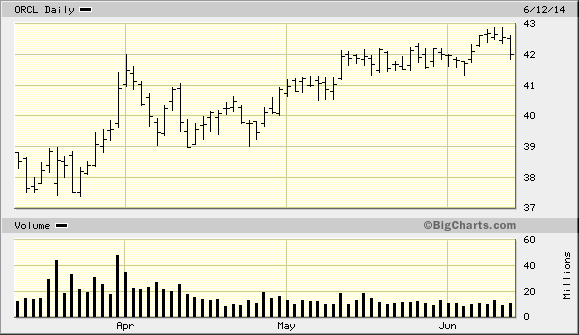
In March, Oracle reported earnings of 68 cents per share, which was two cents below consensus. Interestingly, Oracle got pounded in after-hours trading. Fortunately, we don’t get involved in the short-term trading game. Instead, we sat back and waited. Sure enough, sense returned to the market, and Oracle is up significantly since then.
On the March earnings call, Oracle said that Q4 earnings should range between 92 and 99 cents per share. That’s a decent forecast. The Street had been expecting 96 cents per share. Oracle also said Q4 sales should rise between 3% and 7%. The company gave a range of 0% to 10% for hardware sales, new software-license revenue and cloud sales. Last quarter was the first increase in hardware sales since Oracle bought Sun Microsystems four years ago.
A lot of techies will be looking out for the guidance Oracle offers for Q1. Wall Street currently expects earnings of 64 cents per share. I suspect that might be at the high end of Oracle’s range, but I’m not yet sure. For FY 2015 (ending next May), we can expect earnings of about $3.20 per share, which means the stock is still going for a good value. Tech writer Ashlee Vance pointed out what “Oracle has done perhaps better than any other major business software maker, which is make the transition from the old to the new in a highly profitable way.” Oracle remains a solid buy up to $44 per share.
The Prospect Capital/Nicholas Financial Deal Is Dead
I wanted to give you an update on one of our old Buy List stocks, Nicholas Financial ($NICK). I took NICK off this year’s Buy List after the company got a buyout offer from Prospect Capital ($PSEC). I wasn’t thrilled with the deal, as I thought NICK was selling itself for too little.
According to the terms of the deal, if it wasn’t closed by June 12, then NICK had the right to walk away. As soon as the deal was announced, there were problems. The SEC wanted PSEC to restate their financials, and that caused the deal to drag on and on.
Finally, on June 11, the SEC reversed itself and said PSEC didn’t have to restate their financials. But that wasn’t enough to placate Nicholas Financial. NICK’s board met and decided to terminate the deal. That’s a difficult call, but I think it was the right decision.
I honestly don’t know where this leaves NICK. The stock dropped down to $14.68 by Thursday’s close. I think the most likely outcome is that another bidder will come along to snatch them up, but who knows when or at what price? I think a private equity firm could get a very good deal, but the bottom line is that I don’t believe NICK is an attractive buy here.
The lesson for us is that merger deals can be tricky things. Never expect some white knight to come along to solve all your problems. This same lesson can be applied to the AT&T/DirecTV deal. While I think that deal will eventually close, we have to keep in mind that it, too, has risks. Anything from shareholder objections to government regulations can trip up the deal. No deal is a sure thing.
That’s all for now. The Federal Reserve meets again next week. Expect to hear another $10 billion taper announcement on Wednesday afternoon. We’ll also get the Industrial Production report on Monday and the Consumer Price Inflation report on Tuesday. The last two CPI reports have shown emerging signs of inflation. It will be interesting to see if this trend continues. Be sure to keep checking the blog for daily updates. I’ll have more market analysis for you in the next issue of CWS Market Review!
– Eddy
-
Morning News: June 13, 2014
Eddy Elfenbein, June 13th, 2014 at 6:42 amIEA Sees Much Higher Demand for OPEC Oil for Rest of 2014
China Output, Consumption Pick Up in May: Government
BOJ Sticks With Easing as Analysts Delay Action Calls
Fitch Lowers South Africa Credit-Rating Outlook to Negative
Treasury Yield Curve Flattens Amid Fed Interest-Rate Speculation
Senate Confirms Two Fed Governors, Makes Fischer Vice Chairman
Hostile Takeover Bids for Big Firms Across Industries Make a Comeback
Intel Boosts Revenue Forecast as Business Demand Picks Up
Canada’s Amaya Gaming Buys PokerStars Owner for $4.9 Billion
Express Soars After Sycamore Partners Says It Plans to Make Bid
Twitter Exec Steps Down as Stock Falls
Nokia to Buy Smart Data Firm For Its Map Business
BMW and Tesla Executives Meet to Discuss Electric Cars
Joshua Brown: The World Cup Will Do Nothing For Brazil’s Economy
Stocktwits Trending Tickers on Marketwatch… The Data has Signal and Signal Can Make You Money.
Be sure to follow me on Twitter.
-
It’s Offical: The Nicholas Financial-Prospect Capital Deal Is Dead
Eddy Elfenbein, June 12th, 2014 at 2:13 pmRemember what I said earlier today? The opposite just happened. NICK has killed the deal:
CLEARWATER, Fla., June 12, 2014 (GLOBE NEWSWIRE) — Nicholas Financial, Inc. (the “Company”) (NICK) is filing this Current Report on Form 8-K to report that, on June 11, 2014, the Company’s Board of Directors (the “Board”) held a special meeting to consider the status of the Company’s proposed transaction with Prospect Capital Corporation (“Prospect”) in light of the pending June 12, 2014 termination deadline. As previously disclosed, on December 17, 2013, the Company entered into an arrangement agreement (the “Arrangement Agreement”) whereby the Company agreed to sell all of its issued and outstanding Common Shares to an indirect wholly-owned subsidiary of Prospect, pursuant to a plan of arrangement (the “Arrangement”) under the Business Corporations Act (British Columbia). Prospect (PSEC) (www.prospectstreet.com) is a closed-end investment company that has filed an election to be treated as a business development company under the Investment Company Act of 1940. It focuses on lending to and investing in private businesses. Prospect’s investment objective is to generate both current income and long-term capital appreciation through debt and equity investments.
The termination deadline for completion of the Arrangement pursuant to the Arrangement Agreement is June 12, 2014. At its June 11, 2014 meeting, the Company’s Board of Directors determined to terminate the Arrangement Agreement on the basis that certain conditions requisite to consummation of the Arrangement could not be satisfied by the termination deadline. The Board of Directors further determined to continue to retain Janney Montgomery Scott LLC as its independent financial advisor to assist the Board in evaluating strategic alternatives for the Company, including, but not limited to, the possible sale of the Company to Prospect or another third party, potential acquisition and expansion opportunities, and/or a possible debt or equity financing.
-
Microsoft’s Strategy Is Paying Off
Eddy Elfenbein, June 12th, 2014 at 10:35 amHere’s some good news about Microsoft ($MSFT). We’ve been hearing for a long time how the company is unable to reform itself, but Satya Nadella seems to be shaking things up:
Microsoft’s strategy for moving customers to its cloud email and productivity software is resonating with many corporate customers. Microsoft says the number of commercial seats for Office 365, its flagship productivity and email cloud service, more than doubled over the 12 months ending March 2014. It hopes its moves will lead to sales of a broader array of services to existing customers, including more complex business applications and cloud infrastructure services. But it remains to be seen whether it can convince customers who don’t see the need to switch to cloud-based computing just yet.
Although Microsoft has been selling cloud software, in which it rents email and other applications to customers, for the last several years, that strategy has accelerated under current CEO Satya Nadella, who called for a “mobile first, cloud first” approach to selling software when he assumed the job in February.
Many chief information officers have decided to swap their existing portfolios of productivity software, which includes Microsoft Office and email, to Microsoft’s cloud-based Office 365 service, because they believe making Microsoft the custodian of their email and productivity software enables them to redeploy IT staff to more innovative projects. Microsoft has also made Office 365 more attractive to customers by changing its licensing terms. Now, employees can use the software on up to five devices for the cost of a single license. That option, made available in February 2013, has become increasingly attractive as greater numbers of employees do their work from home, on personal devices, and on the road.
-
Nicholas Financial Merger Possibly Back On
Eddy Elfenbein, June 12th, 2014 at 10:15 amWe took Nicholas Financial ($NICK) off this year’s Buy List, and I’m glad we did. NICK and Prospect Capital ($PSEC) have been trying to close out their merger deal and it hasn’t gone well.
The SEC told PSEC that they had to restate their past earnings, and that hurt both stocks. Now, however, the SEC has apparently reversed that decision (although they’ll need to restate future earnings). Both NICK and PSEC rallied yesterday.
NICK said it would give PSEC until June 12th, which is today, to close the deal. After that, it would make a call about their relationship and that could include walking away from the deal. I assume that now the deal is back on.
-
Morning News: June 12, 2014
Eddy Elfenbein, June 12th, 2014 at 6:51 amGrowing Iran Oil Exports Challenge U.S. Nuclear Sanctions
Crude Tops $111 on Iraq Unrest
New Zealand Central Bank Guidance Surprises Market
Indonesia Prolongs Halt in Rate Increases as Expansion Slows
Brazil Needs More Than a World Cup Win
Uber Protests Snarl Paris Traffic as London Cabs Gather
Why Amazon Loves Local — and Why It Absolutely Shouldn’t
Goldman Sachs Misses Out on Big Alibaba Payoff
France Still Talking With GE to Improve Bid for Alstom’s Power-Equipment Unit
BNP Paribas Bank Says Chief Operating Officer Georges Chodron de Courcel to Quit Amid US Probe
Change of Guard at Infosys: Can New CEO Vishal Sikka Lift Embattled Company?
Lululemon Reduces Forecast Even as Earnings Exceed Estimates
TCP Capital Corp. Prices $100 Million Of 5.25% Convertible Senior Notes Due 2019
Jeff Carter: Should You Quit Your Corporate Job?
Cullen Roche: How Much Longer Will the Dollar Remain the Reserve Currency of the World?
Be sure to follow me on Twitter.
-
Archives
- September 2026
- August 2026
- July 2026
- June 2026
- May 2026
- April 2026
- March 2026
- February 2026
- January 2026
- December 2025
- November 2025
- October 2025
- September 2025
- August 2025
- July 2025
- June 2025
- May 2025
- April 2025
- March 2025
- February 2025
- January 2025
- December 2024
- November 2024
- October 2024
- September 2024
- August 2024
- July 2024
- June 2024
- May 2024
- April 2024
- March 2024
- February 2024
- January 2024
- December 2023
- November 2023
- October 2023
- September 2023
- August 2023
- July 2023
- June 2023
- May 2023
- April 2023
- March 2023
- February 2023
- January 2023
- December 2022
- November 2022
- October 2022
- September 2022
- August 2022
- July 2022
- June 2022
- May 2022
- April 2022
- March 2022
- February 2022
- January 2022
- December 2021
- November 2021
- October 2021
- September 2021
- August 2021
- July 2021
- June 2021
- May 2021
- April 2021
- March 2021
- February 2021
- January 2021
- December 2020
- November 2020
- October 2020
- September 2020
- August 2020
- July 2020
- June 2020
- May 2020
- April 2020
- March 2020
- February 2020
- January 2020
- December 2019
- November 2019
- October 2019
- September 2019
- August 2019
- July 2019
- June 2019
- May 2019
- April 2019
- March 2019
- February 2019
- January 2019
- December 2018
- November 2018
- October 2018
- September 2018
- August 2018
- July 2018
- June 2018
- May 2018
- April 2018
- March 2018
- February 2018
- January 2018
- December 2017
- November 2017
- October 2017
- September 2017
- August 2017
- July 2017
- June 2017
- May 2017
- April 2017
- March 2017
- February 2017
- January 2017
- December 2016
- November 2016
- October 2016
- September 2016
- August 2016
- July 2016
- June 2016
- May 2016
- April 2016
- March 2016
- February 2016
- January 2016
- December 2015
- November 2015
- October 2015
- September 2015
- August 2015
- July 2015
- June 2015
- May 2015
- April 2015
- March 2015
- February 2015
- January 2015
- December 2014
- November 2014
- October 2014
- September 2014
- August 2014
- July 2014
- June 2014
- May 2014
- April 2014
- March 2014
- February 2014
- January 2014
- December 2013
- November 2013
- October 2013
- September 2013
- August 2013
- July 2013
- June 2013
- May 2013
- April 2013
- March 2013
- February 2013
- January 2013
- December 2012
- November 2012
- October 2012
- September 2012
- August 2012
- July 2012
- June 2012
- May 2012
- April 2012
- March 2012
- February 2012
- January 2012
- December 2011
- November 2011
- October 2011
- September 2011
- August 2011
- July 2011
- June 2011
- May 2011
- April 2011
- March 2011
- February 2011
- January 2011
- December 2010
- November 2010
- October 2010
- September 2010
- August 2010
- July 2010
- June 2010
- May 2010
- April 2010
- March 2010
- February 2010
- January 2010
- December 2009
- November 2009
- October 2009
- September 2009
- August 2009
- July 2009
- June 2009
- May 2009
- April 2009
- March 2009
- February 2009
- January 2009
- December 2008
- November 2008
- October 2008
- September 2008
- August 2008
- July 2008
- June 2008
- May 2008
- April 2008
- March 2008
- February 2008
- January 2008
- December 2007
- November 2007
- October 2007
- September 2007
- August 2007
- July 2007
- June 2007
- May 2007
- April 2007
- March 2007
- February 2007
- January 2007
- December 2006
- November 2006
- October 2006
- September 2006
- August 2006
- July 2006
- June 2006
- May 2006
- April 2006
- March 2006
- February 2006
- January 2006
- December 2005
- November 2005
- October 2005
- September 2005
- August 2005
- July 2005
 Eddy Elfenbein is a Washington, DC-based speaker, portfolio manager and editor of the blog Crossing Wall Street. His