Author Archive
-
+889.35
Eddy Elfenbein, October 28th, 2008 at 9:21 pmToday was the sixth-best day ever for the Dow. The fifth-best day came just two weeks ago yesterday.
You know you’re in a different environment when you’re up 10% and it’s not even the best day of the month. -
The Dow to S&P Ratio
Eddy Elfenbein, October 28th, 2008 at 3:00 pmLeaving aside arguments over price-weighted indexes, the Dow has recently been doing better—or rather—falling slightly less dramatically than the S&P 500. The two indexes generally move in tandem, but divergences aren’t unusual and we’re seeing one now.
The ratio of the Dow to the S&P 500 is now at a six-year high. As of today’s close, the Dow is 9.64 times the S&P 500. (This is, of course, index value and not the market value of the two indexes.)
If this trend continues, the ratio could soon reach a 32-year high—and if the trend continues further still, the ratio could break 10.0 for the first time in 42 years.
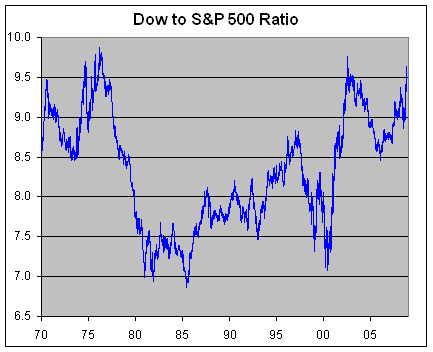
If the Dow had performed as well as the S&P 500 since early 2006, it would be over 1,000 points lower today. -
Consumer Confidence Plunges to Record Low
Eddy Elfenbein, October 28th, 2008 at 12:13 pmConsumer confidence is now at the lowest reading since the survey started in 1967:
The survey’s “confidence index” fell to 38 in October, down from 61.4 in September, on a scale where a reading of 100 represents the consumer outlook on the economy in 1985. Expectations for the future also reached an all-time low. The survey dates to 1967.
I think it’s interesting that the stock market is reflecting consumers attitudes. Years ago, not many Americans participated in the market. Today, it’s a general barometer of consumers’ feelings.
-
Iceland Goes Full Volcker
Eddy Elfenbein, October 28th, 2008 at 11:52 amThe Icelandic Fed, and yes, there is such a thing, just raised interest rates to 18%.
Iceland’s central bank has raised its key interest rate to 18% from 12% as it battles against financial collapse.
The rise comes less than two weeks after Iceland cut rates from 15.5%.
The central bank governor said the increase was part of its agreement with the International Monetary Fund, from which it borrowed $2bn (£1.3bn).
Iceland’s prime minister said the country needed another $4bn in loans and had approached the European Central Bank and the US Federal Reserve. -
Goldman Was Considering Merging with Citi
Eddy Elfenbein, October 27th, 2008 at 10:58 amGoldman Sachs CEO Lloyd Blankfein called Vikram Pandit, his Citigroup counterpart, last month to discuss a merger, in a dramatic example of the secret manoeuvring that preceded the government bailout of the financial sector. The call, made at the tentative suggestion of the regulatory authorities or at least with their blessing, was shortly after Goldman won surprise approval to convert itself into a commercial bank on Sept. 21. The conversation was brief as Pandit rejected the proposal at once. A deal would have been structured as a Citi takeover of Goldman. Seperately, The Telegraph reports Goldman Sachs could this week appoint its smallest number of new partners since its flotation, as the bank downsizes in the face of the financial crisis.
-
What’s America’s Most Overrated Product
Eddy Elfenbein, October 25th, 2008 at 11:03 amMart Nemko argues it’s the bachelor’s degree:
Today, amazingly, a majority of the students whom colleges admit are grossly underprepared. Only 23 percent of the 1.3 million high-school graduates of 2007 who took the ACT examination were ready for college-level work in the core subjects of English, math, reading, and science.
Perhaps more surprising, even those high-school students who are fully qualified to attend college are increasingly unlikely to derive enough benefit to justify the often six-figure cost and four to six years (or more) it takes to graduate. Research suggests that more than 40 percent of freshmen at four-year institutions do not graduate in six years. Colleges trumpet the statistic that, over their lifetimes, college graduates earn more than nongraduates, but that’s terribly misleading. You could lock the collegebound in a closet for four years, and they’d still go on to earn more than the pool of non-collegebound — they’re brighter, more motivated, and have better family connections.Of course, locking kids up in college does something very important: it reduces the labor supply. I remember reading in Road to Wigan Pier how the boys around 15 or 16 wanting to get into the mines. They thought staying in school was useless, boring and effeminate.
-
The S&P 500’s Real Capital Gain
Eddy Elfenbein, October 24th, 2008 at 9:10 pmThe S&P 500 reached a cyclical high on February 9, 1966 at 94.06. With today’s close of 876.77, that’s a gain of 832.14%.
Let’s look at inflation since then. We won’t get the October inflation report for a few more weeks, but from January 1966 through September 2008, the CPI is up 588.00%.
That works out to a real capital gain of 35.49% stretched over 42.7 years. That’s an annualized gain of 0.71%.
Obviously I’m playing with data a little bit since I’m measuring from a cyclical high to a cyclical trough. But it’s interesting that nearly your entire gain since then has been due to dividends. -
When Will It Turnaround?
Eddy Elfenbein, October 24th, 2008 at 8:08 pmNow that the S&P 500 hit another new low today, investors are curious when things will finally turnaround. Is every rally just a bear market rally? The market hit a major intra-day level low exactly tow weeks ago, and we’ve been hovering above it ever since.
I’m no technical analyst but it does seem that the market likes to test its recent lows, and if no new low is made, prices rally. Fortunately, we didn’t break through the intra-day low from October 10. What impresses me is that most of the rally since October 10 was in pretty bad stocks, while the higher quality stocks, like our Buy List, haven’t been doing too well. That just tells me that this two-week interlude was merely a reaction against the reaction.
Today is also the 79th anniversary of Black Thursday, and it’s the 101st anniversary of J.P. Morgan bailing out the economy during the Panic of 1907. The panic ended when J.P. said so — I wish he were around today. Still, spotting a bottom is tough business, and the rally often begins when things look terrible.
A perfect example is what happened 18 years ago. Note the chart below. The black line is the S&P 500 (left scale) and the gold line is earnings (right scale). The two axes are scaled at a ratio of 16 to 1.
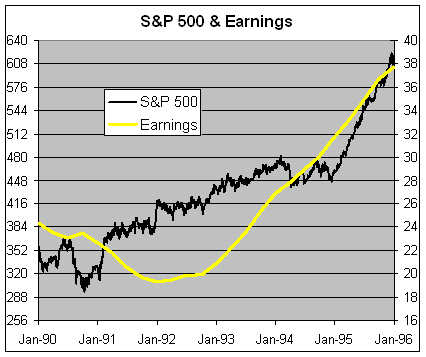
The market rallied while earnings continued to fall through 1990 and 1991. Due to the rising market, P/E ratios soared, but that would have been a false signal that stocks were overpriced. Earnings were still plenty lousy through 1992. It wasn’t until 1993 that earnings growth really got going. The yellow line finally caught up to the black line in 1994, but both kept on rising.
The point is that the market can turnaround anytime now. I grew used to clients saying that they’re just “waiting for the smoke to clear.” It doesn’t work that way. The market has already crashed. It can certainly go down further, but most of the risk is gone. -
The 30-Year T-Bond Hits Lowest Yield Ever
Eddy Elfenbein, October 24th, 2008 at 12:20 pmThe 30-year T-Bond (^TYX) fell below 4%.
Treasuries rose, sending the yield on the 30-year bond to the lowest since regular issuance of the securities began in 1977, as widening financial turmoil wiped more than $10 trillion off stock markets worldwide this month.
U.S. notes rallied on speculation the global slowdown will deepen. The U.K. economy shrank more than forecast, a report showed today. Trading in U.S. stock-index futures was limited after declines of more than 6 percent. U.S. government securities returned 1.6 percent in October, the most since January, according to Merrill Lynch & Co.’s U.S. Treasury Master index, as tumbling stocks spurred demand for the safest assets. -
It’s Official: The New York Times Is Junk
Eddy Elfenbein, October 24th, 2008 at 11:25 amTheir credit rating that is. Of course, credit ratings are also pretty much junk.
-
Archives
- July 2026
- June 2026
- May 2026
- April 2026
- March 2026
- February 2026
- January 2026
- December 2025
- November 2025
- October 2025
- September 2025
- August 2025
- July 2025
- June 2025
- May 2025
- April 2025
- March 2025
- February 2025
- January 2025
- December 2024
- November 2024
- October 2024
- September 2024
- August 2024
- July 2024
- June 2024
- May 2024
- April 2024
- March 2024
- February 2024
- January 2024
- December 2023
- November 2023
- October 2023
- September 2023
- August 2023
- July 2023
- June 2023
- May 2023
- April 2023
- March 2023
- February 2023
- January 2023
- December 2022
- November 2022
- October 2022
- September 2022
- August 2022
- July 2022
- June 2022
- May 2022
- April 2022
- March 2022
- February 2022
- January 2022
- December 2021
- November 2021
- October 2021
- September 2021
- August 2021
- July 2021
- June 2021
- May 2021
- April 2021
- March 2021
- February 2021
- January 2021
- December 2020
- November 2020
- October 2020
- September 2020
- August 2020
- July 2020
- June 2020
- May 2020
- April 2020
- March 2020
- February 2020
- January 2020
- December 2019
- November 2019
- October 2019
- September 2019
- August 2019
- July 2019
- June 2019
- May 2019
- April 2019
- March 2019
- February 2019
- January 2019
- December 2018
- November 2018
- October 2018
- September 2018
- August 2018
- July 2018
- June 2018
- May 2018
- April 2018
- March 2018
- February 2018
- January 2018
- December 2017
- November 2017
- October 2017
- September 2017
- August 2017
- July 2017
- June 2017
- May 2017
- April 2017
- March 2017
- February 2017
- January 2017
- December 2016
- November 2016
- October 2016
- September 2016
- August 2016
- July 2016
- June 2016
- May 2016
- April 2016
- March 2016
- February 2016
- January 2016
- December 2015
- November 2015
- October 2015
- September 2015
- August 2015
- July 2015
- June 2015
- May 2015
- April 2015
- March 2015
- February 2015
- January 2015
- December 2014
- November 2014
- October 2014
- September 2014
- August 2014
- July 2014
- June 2014
- May 2014
- April 2014
- March 2014
- February 2014
- January 2014
- December 2013
- November 2013
- October 2013
- September 2013
- August 2013
- July 2013
- June 2013
- May 2013
- April 2013
- March 2013
- February 2013
- January 2013
- December 2012
- November 2012
- October 2012
- September 2012
- August 2012
- July 2012
- June 2012
- May 2012
- April 2012
- March 2012
- February 2012
- January 2012
- December 2011
- November 2011
- October 2011
- September 2011
- August 2011
- July 2011
- June 2011
- May 2011
- April 2011
- March 2011
- February 2011
- January 2011
- December 2010
- November 2010
- October 2010
- September 2010
- August 2010
- July 2010
- June 2010
- May 2010
- April 2010
- March 2010
- February 2010
- January 2010
- December 2009
- November 2009
- October 2009
- September 2009
- August 2009
- July 2009
- June 2009
- May 2009
- April 2009
- March 2009
- February 2009
- January 2009
- December 2008
- November 2008
- October 2008
- September 2008
- August 2008
- July 2008
- June 2008
- May 2008
- April 2008
- March 2008
- February 2008
- January 2008
- December 2007
- November 2007
- October 2007
- September 2007
- August 2007
- July 2007
- June 2007
- May 2007
- April 2007
- March 2007
- February 2007
- January 2007
- December 2006
- November 2006
- October 2006
- September 2006
- August 2006
- July 2006
- June 2006
- May 2006
- April 2006
- March 2006
- February 2006
- January 2006
- December 2005
- November 2005
- October 2005
- September 2005
- August 2005
- July 2005
 Eddy Elfenbein is a Washington, DC-based speaker, portfolio manager and editor of the blog Crossing Wall Street. His