-
Morning News: December 31, 2010
Posted by Eddy Elfenbein on December 31st, 2010 at 8:19 amStock Indexes Headed Lower on Last Day of Year
Oil Heads For Highest Annual Close Since 2007
Dollar Weakens for Third Day as Emerging Markets Gain; Cotton, Copper Soar
Tax Breaks May Boost Paychecks by $40 Per Week
Sugar Rebounds in New York on Shortage Outlook; London Ends 2010 Up 9.5%
Estonia Joins Euro Club Riven by Crisis, Others Wary
Rousseff Is No Lula as Brazil Stocks Slump Before Inauguration
Kenyan Stocks, sub-Sahara’s Second-Best, Gain a First Year in 4 on Economy
Skype Could Be Designated Illegal in China
U.S. Unveils Plan to Sell Stake in Ally, Once GMAC
-
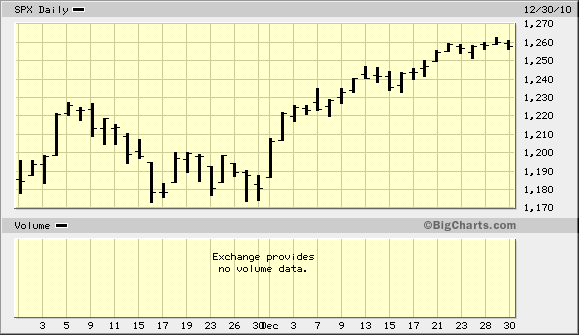
The Plunge In Volatility
Posted by Eddy Elfenbein on December 30th, 2010 at 4:36 pmIt’s hard to show the market’s plunging volatility, but here’s a good chart. This is the S&P 500 since the beginning of November. While the market has gone up, notice the trend in the difference between the daily high and low (the top of each bar and its bottom).
-
Ever Wonder What It’s Like to Fly Your Own Drone Over New York City?
Posted by Eddy Elfenbein on December 30th, 2010 at 2:37 pmWonder no more:
-
One Day Left
Posted by Eddy Elfenbein on December 30th, 2010 at 1:56 pmUnfortunately, the 2010 Buy List is limping to the finish line. We’re still ahead of the market, but our lead has closed some over the last few weeks.
The problem is that the Buy List is fairly light on cyclical stocks so we didn’t catch the biggest part of the recent updraft. We don’t have any energy stocks and that area has done especially well.
Since November 5, the S&P 500 is up 2.77% while the Buy List is up just 0.28%. Honestly it’s not that bad, but it takes some luster off what’s been a very good year.
Still, through yesterday’s close the Buy List is up 14.86% to the S&P 500’s 12.97%. That doesn’t include dividends. I’ll have the complete numbers this weekend, but dividends will add about 2% to the S&P 500 and about 1.65% for our Buy List.
-
Business Activity in U.S. Grows at Fastest Pace in Two Decades
Posted by Eddy Elfenbein on December 30th, 2010 at 1:43 pmMore good economic news:
Businesses in the U.S. expanded in December at the fastest pace in two decades, adding to evidence the world’s largest economy is accelerating heading into 2011.
The Institute for Supply Management-Chicago Inc. said today its business barometer rose to 68.6 this month, exceeding the most optimistic forecast of economists surveyed by Bloomberg News and the highest level since July 1988. Figures greater than 50 signal expansion.
Gains in business investment on new equipment and growing exports to emerging economies will keep factories churning out goods in the coming year, contributing to the recovery. Reports showing consumer spending is also picking up mean retailers will need to restock shelves, giving manufacturing a further lift.
“The economy is gathering momentum,” John Silvia, chief economist at Wells Fargo Securities Inc. in Charlotte, North Carolina, said in an interview on Bloomberg Television. “New orders will follow the better business confidence that is showing up. Once the American consumer starts kicking in, we will see stronger orders data.”
The median forecast of 49 economists surveyed by Bloomberg News projected the gauge would fall to 61. Estimates ranged from 59 to 63.7.
I’m starting to think that the Q4 GDP growth number is going to come in very strong, possibly 5% or more.
-
Jobless Claims at Two-Year Low
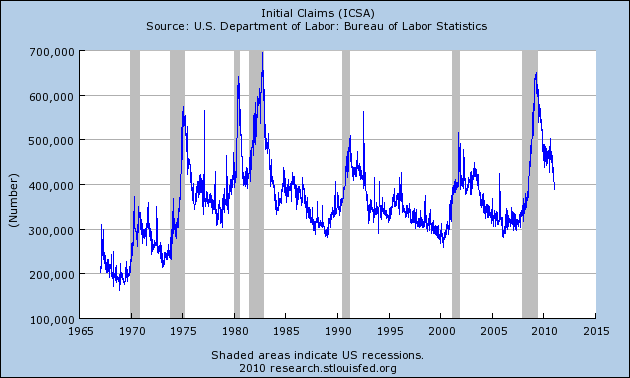
Posted by Eddy Elfenbein on December 30th, 2010 at 11:08 amMore good news for the economy: the number of Americans who filed for their first week of jobless claims fell below 400,000 for the first time in over two years.
For the week that ended on December 25, 388,000 thousand Americans filed first-time claims. That’s down by 34,000 from the week before. This is very good news, but I’m not ready celebrate just yet. We’ll get more information with next Friday’s employment report.
While the economy has definitely pulled out of recession, the growth hasn’t filtered down much to the employment sector. For businesses to continue to see improvement in profits, sales need to start growing and that means more jobs. Today’s news is good, but we need to see a lot more of this.
-
Morning News: December 30, 2010
Posted by Eddy Elfenbein on December 30th, 2010 at 7:52 amWorld Stocks Eye Two-year High
M&A Bankers Forecast India Deal Volumes to Surpass Record 2010
Chinese PMI Drops But Shanghai Composite Keeps Rolling
Pope Benedict Binds Vatican to European Money-Laundering Laws
Natural Gas Boom Coming—But So Are Major Obstacles
Three Hedge Funds Got Inside Data From Consultant, U.S. Says
U.S. Snowstorm Cost Retailers $1 Billion
Groupon Draws New Investors and Works on an I.P.O.
GE Leads $3 Trillion in Company Bond Sales as Yields Fall
PAA Natural Gas Storage to Buy Mississippi Facility for $750 Million
-
Motricity Under $20
Posted by Eddy Elfenbein on December 29th, 2010 at 2:18 pmI’ve wanted to post more this week, but honestly, nothing is happening. This market is about as dull as it can be.
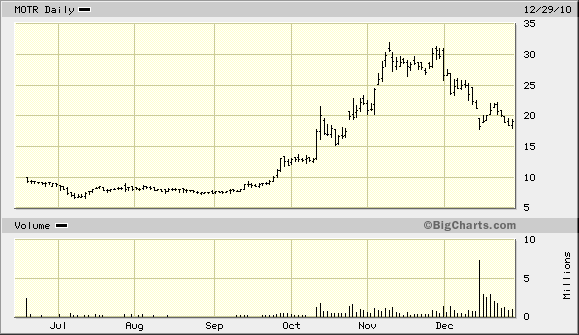
I’ve had my eye on Motricity (MOTR) which is an interesting stock. It’s a bit too speculative to put on the Buy List, but it’s recently fallen under $20 per share. I think that’s a good price for more aggressive investors.
The company IPO’d in June at $10. Actually, the IPO was severely cut back. The company originally wanted a much larger offering. Still, the stock struck a chord on Wall Street and by November it was over $30 per share. Now it’s back below $20. Wall Street currently expects earnings next year of 80 cents per share.
-
Reminder: The 2011 Buy List
Posted by Eddy Elfenbein on December 29th, 2010 at 1:02 pmWith half a week to go in 2010, here again is the 2011 Buy List. The new list will take effect starting on Monday:
Abbott Laboratories (ABT)
AFLAC (AFL)
Becton, Dickinson & Co. (BDX)
Bed Bath & Beyond (BBBY)
Deluxe Corp. (DLX)
Fiserv (FISV)
Ford Motor Company (F)
Gilead Sciences (GILD)
Johnson & Johnson (JNJ)
Jos. A Bank Clothiers (JOSB)
JPMorgan Chase (JPM)
Leucadia National (LUK)
Medtronic (MDT)
Moog (MOG-A)
Nicholas Financial (NICK)
Oracle (ORCL)
Reynolds American (RAI)
Stryker (SYK)
Sysco (SYY)
Wright Express (WXS) -
Keeping Tabs on Economic Bets
Posted by Eddy Elfenbein on December 29th, 2010 at 9:48 amThirty years ago, Julian Simon and Paul Erlich made a famous bet on the direction of commodity prices. Erlich was one of those “gloom and doom” writers who said that we’re living in an age of scarcity.
Simon asked Erlich to choose any five commodities and averred that the prices would decrease over the next decade. Erlich avowed that they would increase. Erlich chose copper, chromium, nickel, tin, and tungsten. All five went down and in 1990, Erlich paid up.
Now John Tierney and Matthew R. Simmons have just settled a five-year-old $5,000 bet over whether or not oil would average $200 in 2010.
The bet was occasioned by a cover article in August 2005 in The New York Times Magazine titled “The Breaking Point.” It featured predictions of soaring oil prices from Mr. Simmons, who was a member of the Council on Foreign Relations, the head of a Houston investment bank specializing in the energy industry, and the author of “Twilight in the Desert: The Coming Saudi Oil Shock and the World Economy.”
I called Mr. Simmons to discuss a bet. To his credit — and unlike some other Malthusians — he was eager to back his predictions with cash. He expected the price of oil, then about $65 a barrel, to more than triple in the next five years, even after adjusting for inflation. He offered to bet $5,000 that the average price of oil over the course of 2010 would be at least $200 a barrel in 2005 dollars.
I took him up on it, not because I knew much about Saudi oil production or the other “peak oil” arguments that global production was headed downward. I was just following a rule learned from a mentor and a friend, the economist Julian L. Simon.
As the leader of the Cornucopians, the optimists who believed there would always be abundant supplies of energy and other resources, Julian figured that betting was the best way to make his argument. Optimism, he found, didn’t make for cover stories and front-page headlines.
So how did oil prices do? At first, things were going in Mr. Simmons’ direction. Oil hit $145 per barrel by 2008. Then the recession came and oil dropped to $50. For 2010, oil has averaged $80. Adjusted for inflation that’s about $71 per barrel which isn’t too far from the $65 when the bet was made in 2005.
It’s true that the real price of oil is slightly higher now than it was in 2005, and it’s always possible that oil prices will spike again in the future. But the overall energy situation today looks a lot like a Cornucopian feast, as my colleagues Matt Wald and Cliff Krauss have recently reported. Giant new oil fields have been discovered off the coasts of Africa and Brazil. The new oil sands projects in Canada now supply more oil to the United States than Saudi Arabia does. Oil production in the United States increased last year, and the Department of Energy projects further increases over the next two decades.
The really good news is the discovery of vast quantities of natural gas. It’s now selling for less than half of what it was five years ago. There’s so much available that the Energy Department is predicting low prices for gas and electricity for the next quarter-century. Lobbyists for wind farms, once again, have been telling Washington that the “sustainable energy” industry can’t sustain itself without further subsidies.
As gas replaces dirtier fossil fuels, the rise in greenhouse gas emissions will be tempered, according to the Department of Energy. It projects that no new coal power plants will be built, and that the level of carbon dioxide emissions in the United States will remain below the rate of 2005 for the next 15 years even if no new restrictions are imposed.
Maybe something unexpected will change these happy trends, but for now I’d say that Julian Simon’s advice remains as good as ever. You can always make news with doomsday predictions, but you can usually make money betting against them.
In April 2008, Prieur du Plessis and Barry Ritholtz highlighted a $1 million bet from Jim Sinclair that gold would hit $1,650 per ounce by the second week of January 2011.
I don’t know if anyone took him up on his offer. There are only a few days left and unless gold stages a big rally, it looks like Sinclair will have lost.
-
Archives
- June 2026
- May 2026
- April 2026
- March 2026
- February 2026
- January 2026
- December 2025
- November 2025
- October 2025
- September 2025
- August 2025
- July 2025
- June 2025
- May 2025
- April 2025
- March 2025
- February 2025
- January 2025
- December 2024
- November 2024
- October 2024
- September 2024
- August 2024
- July 2024
- June 2024
- May 2024
- April 2024
- March 2024
- February 2024
- January 2024
- December 2023
- November 2023
- October 2023
- September 2023
- August 2023
- July 2023
- June 2023
- May 2023
- April 2023
- March 2023
- February 2023
- January 2023
- December 2022
- November 2022
- October 2022
- September 2022
- August 2022
- July 2022
- June 2022
- May 2022
- April 2022
- March 2022
- February 2022
- January 2022
- December 2021
- November 2021
- October 2021
- September 2021
- August 2021
- July 2021
- June 2021
- May 2021
- April 2021
- March 2021
- February 2021
- January 2021
- December 2020
- November 2020
- October 2020
- September 2020
- August 2020
- July 2020
- June 2020
- May 2020
- April 2020
- March 2020
- February 2020
- January 2020
- December 2019
- November 2019
- October 2019
- September 2019
- August 2019
- July 2019
- June 2019
- May 2019
- April 2019
- March 2019
- February 2019
- January 2019
- December 2018
- November 2018
- October 2018
- September 2018
- August 2018
- July 2018
- June 2018
- May 2018
- April 2018
- March 2018
- February 2018
- January 2018
- December 2017
- November 2017
- October 2017
- September 2017
- August 2017
- July 2017
- June 2017
- May 2017
- April 2017
- March 2017
- February 2017
- January 2017
- December 2016
- November 2016
- October 2016
- September 2016
- August 2016
- July 2016
- June 2016
- May 2016
- April 2016
- March 2016
- February 2016
- January 2016
- December 2015
- November 2015
- October 2015
- September 2015
- August 2015
- July 2015
- June 2015
- May 2015
- April 2015
- March 2015
- February 2015
- January 2015
- December 2014
- November 2014
- October 2014
- September 2014
- August 2014
- July 2014
- June 2014
- May 2014
- April 2014
- March 2014
- February 2014
- January 2014
- December 2013
- November 2013
- October 2013
- September 2013
- August 2013
- July 2013
- June 2013
- May 2013
- April 2013
- March 2013
- February 2013
- January 2013
- December 2012
- November 2012
- October 2012
- September 2012
- August 2012
- July 2012
- June 2012
- May 2012
- April 2012
- March 2012
- February 2012
- January 2012
- December 2011
- November 2011
- October 2011
- September 2011
- August 2011
- July 2011
- June 2011
- May 2011
- April 2011
- March 2011
- February 2011
- January 2011
- December 2010
- November 2010
- October 2010
- September 2010
- August 2010
- July 2010
- June 2010
- May 2010
- April 2010
- March 2010
- February 2010
- January 2010
- December 2009
- November 2009
- October 2009
- September 2009
- August 2009
- July 2009
- June 2009
- May 2009
- April 2009
- March 2009
- February 2009
- January 2009
- December 2008
- November 2008
- October 2008
- September 2008
- August 2008
- July 2008
- June 2008
- May 2008
- April 2008
- March 2008
- February 2008
- January 2008
- December 2007
- November 2007
- October 2007
- September 2007
- August 2007
- July 2007
- June 2007
- May 2007
- April 2007
- March 2007
- February 2007
- January 2007
- December 2006
- November 2006
- October 2006
- September 2006
- August 2006
- July 2006
- June 2006
- May 2006
- April 2006
- March 2006
- February 2006
- January 2006
- December 2005
- November 2005
- October 2005
- September 2005
- August 2005
- July 2005
 Eddy Elfenbein is a Washington, DC-based speaker, portfolio manager and editor of the blog Crossing Wall Street. His