-
Morning News: December 29, 2010
Posted by Eddy Elfenbein on December 29th, 2010 at 7:45 amIn the Rearview, a Year That Fizzled
Sweden Shows Central Bankers How to Fight Next Asset Bubble
Consumer Confidence Dips on Worries
Oil Steadies Above $91 Ahead of U.S. Inventory Data
Copper Climbs to Record in London on Speculation of More Growth
Washington Region Posts Gains as Home Prices Still Falling in Most U.S. Cities
Derivatives Clearing Group Decides Against Registration
Hot Trade in Private Shares of Facebook
Groupon Files for $950 Million Equity Financing Round
GM Stock Hits $35.32 Per Share
The Shanghai Divergence (a Low-Probability Bet on Repatriation)
-
Snore!
Posted by Eddy Elfenbein on December 28th, 2010 at 11:26 amOMG, this is a dull trading day. Dull, dull, dull.
Of the 100 stocks in the S&P 100, 91 are up or down less than 0.9%.
Only nine are up or down by more than 1%. Not one currently has a swing of more than 1.5%.
-
Happy 100th Birthday Ronald Coase
Posted by Eddy Elfenbein on December 28th, 2010 at 10:11 am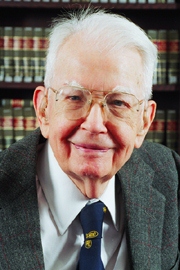
Here are some questions to ponder: Why are there are companies? Why doesn’t everyone work for themselves as independent contractors? Why is it necessary for people to congregate into companies, some small and some very large?
In 1937, Ronald Coase had an answer:
His central insight was that firms exist because going to the market all the time can impose heavy transaction costs. You need to hire workers, negotiate prices and enforce contracts, to name but three time-consuming activities. A firm is essentially a device for creating long-term contracts when short-term contracts are too bothersome. But if markets are so inefficient, why don’t firms go on getting bigger for ever? Mr Coase also pointed out that these little planned societies impose transaction costs of their own, which tend to rise as they grow bigger. The proper balance between hierarchies and markets is constantly recalibrated by the forces of competition: entrepreneurs may choose to lower transaction costs by forming firms but giant firms eventually become sluggish and uncompetitive.
Dr. Coase turns 100 tomorrow. He’s also said that he’s been working on his next book.
Here’s a lecture he gave at the University of Chicago Law School in 2003:
-
Ugly Case Shiller Report
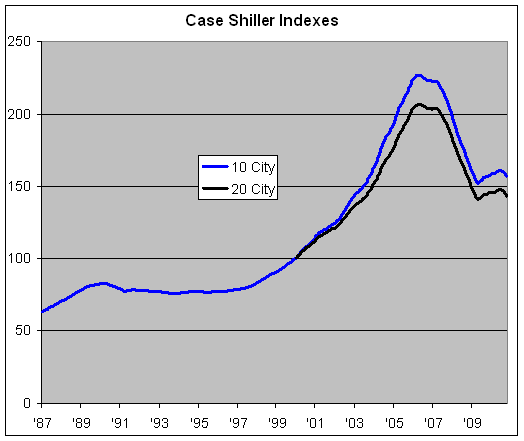
Posted by Eddy Elfenbein on December 28th, 2010 at 9:46 amThere’s still not much strength in housing. Today’s Case Shiller report showed that home prices actually fell last month.
The Case Shiller Index tracks a 20-city index and a 10-city index. Both indexes peaked in April 2006 and hit bottom in May 2009. Both indexes dropped by roughly one-third over that 37-month period.
The year-to-year increases were seen in Los Angeles, San Diego, San Francisco and Washington. While composite prices remain above their spring 2009 lows, six markets hit their lowest levels since home prices began dropping in 2006 and 2007: Atlanta, Charlotte, N.C., Portland, Ore., Miami, Seattle and Tampa, Fla.
David Blitzer, chairman of S&P’s index committee, said “The double-dip is almost here, as six cities set new lows for the period since the 2006 peaks. There is no good news in October’s report. Home prices across the country continue to fall.”
The indexes, based on the three-month averages of home prices, turned lower in August for the first time in four months, a delayed response to the housing-market weakness after federal home-buyer tax credits expired in April. Prices declined again in September, with the rate of decline showing signs of accelerating.
However, recent data show home sales are recovering a bit despite high unemployment, a sluggish economy and worries about flaws in foreclosure documents. The National Association of Realtors said last week that sales of previously occupied homes increased a less-than-expected 5.6% in November after falling 2.2% in October. Prices for existing homes edged up for the first time since August, rising 0.4% from a year earlier but little changed from October.
The Case-Shiller index of 10 major metropolitan areas declined 1.2% from September, while the 20-city index fell 1.3%. However, they were up 0.2% and down 0.8%, respectively, from a year earlier. Adjusted for seasonal factors, the sequential declines were 0.9% and 1%, respectively.
In October, prices in every metropolitan statistical area covered by the index fell from September. Month-to-month decliners were led by Atlanta and Detroit, which were down 2.9% and 2.5%, respectively.
-
Morning News: December 28, 2010
Posted by Eddy Elfenbein on December 28th, 2010 at 8:06 amFed Bond Buys Unlikely to Top $600 Billion
Dollar Weakens a Fourth Day Before U.S. Home Data; Franc Rises
Retail Sales Rebound, Beating Forecasts
China Cuts First-Round Rare Earth Export Quotas by 11%
Bailed-Out Banks Remain in Danger of Failing: 98 Banks at Risk
Gold Rises in New York as Dollar’s Drop Boosts Investor Demand
Housing Starts Seen Rising to 3-Year High With Boost for Jobs
AIG Gets $4.3 Billion of Credit as Insurer Sees Bailout Exit `Finish Line’
Alcatel to Pay $137 Million to Settle Bribery Charges
Dai-ichi to Take Over Australia’s Tower for $1.2 Billion
-
The S&P 500’s Price/Earnings Ratio
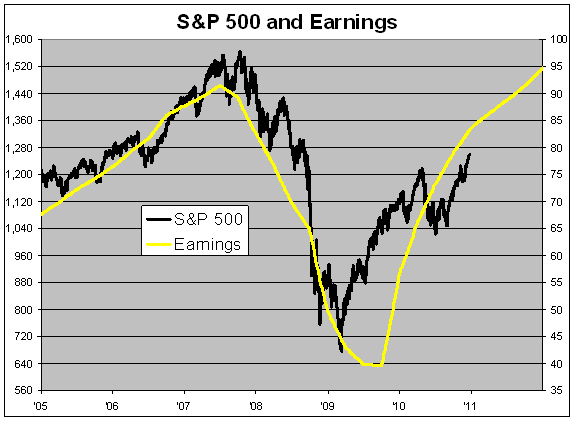
Posted by Eddy Elfenbein on December 27th, 2010 at 1:54 pmAlthough the market has had a strong run over the past 21 months, the S&P 500 doesn’t appear to be overpriced according to the market’s P/E Ratio.
For 2008, the market earned just $48.51. Last year, earnings climbed to $56.86. This year, earnings are projected to be $83.68. Earnings for next year are projected to be $94.76.
Here’s a look at the S&P 500 (black line, left scale) along with its trailing operating earnings (gold line, right scale). The two lines are scaled at a ratio of 16 to 1 which means that when the lines cross, the P/E Ratio is exactly 16.
-
The New Normal
Posted by Eddy Elfenbein on December 27th, 2010 at 11:14 amIn the NYT, Paul Lim explains why investor optimism may be a red flag:
It’s worth remembering that even though a strong year-end surge has pushed the Standard & Poor’s 500-stock index up 20 percent since the start of September, it’s just part of a tremendous rally over the past two years.
Since the bull market began in March 2009, the S.& P. 500 has climbed more than 86 percent. And investments that are considered riskier than blue-chip domestic stocks — such as emerging-market equities or shares of fast-growing but volatile small companies — have done even better during this stretch. Both the Russell 2000 small-stock index and the Morgan Stanley Capital International Emerging Market index have gained 130 percent.
“We were told that this was supposed to be a ‘new normal’ era where investors should expect lower returns and shouldn’t take much risk as a result,” says James W. Paulsen, chief investment strategist at Wells Capital Management. “But the performance of risk assets over the past 18 months shows that this was anything but a new normal.”
Risk-taking hasn’t been rewarded over just the last 18 months. Despite all the talk about what a “lost decade” this has been for investors, risky asset classes have actually produced sizable gains over the last 10 years. For instance, though the average fund that invests in large-capitalization domestic stocks gained just 1.5 percent, annualized, in that period, small-stock funds returned nearly 7 percent a year. And emerging-market stock funds returned nearly 15 percent, annualized, during that stretch, according to Morningstar.
Risk-taking was also well rewarded in the fixed-income markets. While safe government bond funds gained 4.8 percent, on average, for the past decade, slightly riskier investment-grade corporate bond funds gained 5.4 percent, annualized, and high-yield bond funds — even riskier — returned nearly 7 percent a year.
In general, the more risk you took in asset allocation, the greater your relative performance over the past decade, says Jeffrey N. Kleintop, chief market strategist at LPL Financial.
But that can’t go on forever. Sam Stovall, chief investment strategist at S.& P., looked at how bull markets have unfolded historically since 1949. He found that while the S.& P. has soared 35 percent, on average, in the first 12 months of a new rally, those gains have slowed to an average of 17 percent in the second year of a bull market and just 5 percent in the third year.
-
Stocks Down In Early Trading
Posted by Eddy Elfenbein on December 27th, 2010 at 10:34 amI hope everyone had a great weekend. The stock market has started the week down slightly. Trading volume will probably be light today since much of the northeast has been affected by snow (we barely got any in D.C.). I’ve noticed that several airline stocks are down today.
The major concern weighing on stocks is that China just raised rates by 0.25%. The stocks feeling the most pain are raw material stocks that do a lot of business with China. Oil is near a 26-month high.
The yield on the two-year Treasury is up 7 basis points to reach a new six-month high. That sounds more impressive than it is since the yield is now just 0.72%. Still, the movement out of bonds continues. The 10-year yield is now up to 3.41%.
For our Buy List, five stocks are up, fourteen are down and Nicholas Financial hasn’t traded yet.
-
Morning News: December 27, 2010
Posted by Eddy Elfenbein on December 27th, 2010 at 7:29 amDollar Weakens Against Euro as Asia Stock Gains Counter China Rate Concern
China Stocks, Bonds Drop on Concern Central Bank Will Boost Rates Further
New Voters May Sway Fed Actions
Stocks, U.S. Futures Drop as China Moves to Cool Economy; Treasuries Fall
Oil Trades Near 26-Month High on China Growth Speculation, U.S. Stockpiles
Euro Pain Turns to 23% Gain for Europeans Through S&P Rally
Retailers Hurt by East Coast Blizzard as Post-Christmas Shoppers Stay Home
Sony to Spend $1.2 Billion to Double Image Sensor Output
Hon Hai to Invest $1.2 billion in Hitachi LCD Unit
Russian Watchdog Favors PepsiCo’s Buy of Wimm-Bill-Dann
-
RIP: Roy R. Neuberger
Posted by Eddy Elfenbein on December 26th, 2010 at 10:51 amAmazing obituary in the NYT:
Roy R. Neuberger, who drew on youthful passions for stock trading and art to build one of Wall Street’s most venerable partnerships and one of the country’s largest private collections of 20th-century masterpieces, died on Friday at his home at the Pierre Hotel in Manhattan. He was 107 and had lived in New York City for 101 years.
His death was confirmed by a grandson, Matthew London.
Mr. Neuberger had set out to study art, but ended up as a stockbroker, a life path once likened to Gauguin’s in reverse. As a founder of the investment firm Neuberger & Berman, he was one of the few people to experience three of Wall Street’s major market crises, in 1929, 1987 and 2008. Although his artistic ability left no lasting impact, his wealth did.
Believing that collectors should acquire art being produced in their own time and then hold on to it, giving the public access but never selling, Mr. Neuberger accumulated hundreds of paintings and sculptures by Milton Avery, Jackson Pollock, Willem de Kooning and others, becoming one of America’s leading art patrons. Those works are now spread over more than 70 institutions in 24 states, many of them in the permanent collection of the Neuberger Museum of Art, which opened in 1974 on the Purchase College campus of the State University of New York.
The money to buy the works came from his investments at Neuberger & Berman (now Neuberger Berman), the brokerage and investment firm he founded in 1939 with Robert B. Berman. The firm catered to wealthy individuals but also took on a less affluent clientele with the establishment, in 1950, of the Neuberger Guardian mutual fund, one of the first funds to be sold without the usual 8.5 percent upfront sales commission.
His art collecting drew on the lessons he learned in the financial world. Each year he would buy more than he had bought the previous year, often purchasing large lots at a time. In 1948, for example, he bought 46 paintings by Milton Avery, whom Mr. Neuberger counted as a close friend. He eventually owned more than 100 Avery works.
“My experience on Wall Street made it possible for me to be comfortable buying a lot of art at once,” he later wrote. “In my investment firm, when we like a security after careful analysis, we buy a modest quantity. Sometimes after the purchase, we will find that we like it very much. If a large quantity of the stock then becomes available, and we are still enthusiastic about its value and its future, we will buy in quantity quickly, even though the day before we had no such plan and no knowledge that the stock would be available.”
“The same principle,” he added, “applied to my purchase of the Avery paintings.”
Roy Rothschild Neuberger was born on July 21, 1903, in Bridgeport, Conn. His father, Louis, who was 52 when Roy was born, had come to the United States from Germany as a boy. His mother, the former Bertha Rothschild, was a native of Chicago, a lover of music (she played the piano) and a “nervous, troubled woman from a large, well-to-do Jewish family, not related to the famous Rothschilds,” Mr. Neuberger wrote in an autobiography, “So Far, So Good: The First 94 Years” (John Wiley & Sons, 1997).
His father was half owner of the Connecticut Web and Buckle Company and had an interest in the stock market, owning thousands of shares in a Montana copper company. The Neuberger family moved to Manhattan in 1909, settling on Claremont Avenue opposite Barnard College on the Upper West Side. Mr. Neuberger attended DeWitt Clinton High School, where in his senior year he was captain of the tennis team that won the Greater New York championship.
“Looking back on my youthful addiction to tennis, I find it not much different from my fascination with the market,” Mr. Neuberger wrote in his autobiography. “You have to make fast decisions. You can’t wait to think about it overnight.”
A similar impatience led him to leave New York University after a single year. He felt, he wrote, “that I could learn much more out in the world of business.”
It was while working for two years as a buyer of upholstery fabrics for the department store B. Altman & Company that he said he developed an eye for painting and sculpture as well as a sense for trading. Both would greatly influence his later life, as would John Galsworthy’s series of novels “The Forsyte Saga,” which described the practice among well-to-do English families of educating their children on the European continent, and “Vincent van Gogh,” a biography by Floret Fels.
The first book led Mr. Neuberger to a sojourn in Europe. Using money inherited from his father, he set out in June 1924 for a life of leisure. While living mainly on the Left Bank in Paris, he spent afternoons at a cafe, played in tennis tournaments in Cannes and traveled to Berlin and other European capitals.
In Paris, Mr. Neuberger was inspired by the van Gogh biography to collect and support the work of living artists.
“Of course, to do so, I had to have capital of considerably more than the inheritance that gave me an annual income of about $2,000,” he later wrote. “In those days you could live very comfortably, almost luxuriously, on $2,000, but you couldn’t buy art in quantity. So I decided to go back to work in earnest.”
He arrived on Wall Street in the spring of 1929, as the bull market was roaring toward its peak. Hired for $15 a week as a runner for the brokerage firm Halle & Stieglitz, he soon learned all aspects of the business, at the same time managing his own money.
One of the first big trades he executed on his own behalf was designed to hedge his own wealth against the possibility that the stock market might fall from its precarious height. He sold short 100 shares of the Radio Corporation of America, the most popular stock of the era, betting that its price would decline from its lofty level of $500.
In October 1929 came the crash that ushered in the Great Depression, and while Mr. Neuberger’s blue-chip stocks fell, his bet against RCA paid off well: the stock’s price eventually fell into the single digits. He said he lost only 15 percent of his money in the crash, while many others lost everything.
On June 29, 1932, the Dow Jones industrial average dipped to 42 and Mr. Neuberger married Marie Salant, a graduate in economics from Bryn Mawr who had gone to work in the research department of Halle & Stieglitz two years earlier.
“I can report that by June 29, 1996, the Dow Jones industrial average had climbed to 5,704 and Marie and I had had 64 wonderful years together,” Mr. Neuberger later wrote. Mrs. Neuberger died in 1997.
Besides Mr. London, Mr. Neuberger is survived by his daughter, Ann Neuberger Aceves; his sons, Roy S. Neuberger of Lawrence, N.Y., and James A. Neuberger of New York City; seven other grandchildren; and 30 great-grandchildren.
Emboldened by his management of his own assets, Mr. Neuberger became a stockbroker at Halle & Stieglitz in 1930, leaving nine years later to start his own firm, Neuberger & Berman. The firm was later acquired by Lehman Brothers, but spun off in 2008 as a stand-alone company with Lehman’s bankruptcy. Mr. Neuberger continued to go to his Neuberger Berman office every day until he was 99, Mr. London said.
Mr. Neuberger began to build his art collection in the late 1930s, and although he was asked to do so many times, he never sold a painting by a living artist. “I have not collected art as an investor would,” he said. “I collect art because I love it.”
He preferred to share his love by donating works to museums and colleges. In May 1965, Mr. Neuberger received an anonymous offer to buy his art collection for $5 million, a sum he considered a fortune at the time.
Years later he learned that the offer had come from Nelson A. Rockefeller, then governor of New York. Mr. Rockefeller went on to play a key role in Mr. Neuberger’s art collection. In May 1967, while Mr. Neuberger was visiting Mr. Rockefeller at his Pocantico Hills estate in Westchester County, the governor offered to have New York State build a museum to house the collection at the State University campus at Purchase.
Designed by Philip Johnson, the museum opened in May 1974. Mr. Neuberger often said that the true spirit of his collection could be found on the second floor, which held seminal paintings by Pollock, Stuart Davis, Edward Hopper and Georgia O’Keeffe, as well as many Milton Averys.
Mr. Neuberger made an additional gift of $1.3 million to the State University at Purchase in 1984 and other major gifts to the Museum of Modern Art and the Metropolitan Museum of Art. He also served as a president of the New York Society for Ethical Culture and the American Federation of Arts.
Mr. Neuberger’s second memoir, “The Passionate Collector,” was published by John Wiley & Sons in 2003. At a White House ceremony in 2007, President Bush presented Mr. Neuberger with a National Medal of Arts.
Like any collector, Mr. Neuberger rued the ones that got away. He remembered passing up a Grant Wood painting as well as refusing to pay $300 for a Jasper Johns in the late 1950s. One time a dealer offered him a Picasso sculpture for $1,500, but he declined because he was buying works only by American artists. “I was such a square that I stupidly didn’t buy it,” he told The New York Times in an interview in 2003.
Mr. Neuberger bought all his works himself, usually through dealers. And his taste ran toward the bold. “I liked adventuresome work that I often didn’t understand,” he told The Times as he was celebrating his 100th birthday. “For art to be very good it has to be over your head.”
But he said he enjoyed the challenge that the work posed to the viewer. “Those who understand the mysteries of art,” he said, “are made happier by doing so.”
-
Archives
- June 2026
- May 2026
- April 2026
- March 2026
- February 2026
- January 2026
- December 2025
- November 2025
- October 2025
- September 2025
- August 2025
- July 2025
- June 2025
- May 2025
- April 2025
- March 2025
- February 2025
- January 2025
- December 2024
- November 2024
- October 2024
- September 2024
- August 2024
- July 2024
- June 2024
- May 2024
- April 2024
- March 2024
- February 2024
- January 2024
- December 2023
- November 2023
- October 2023
- September 2023
- August 2023
- July 2023
- June 2023
- May 2023
- April 2023
- March 2023
- February 2023
- January 2023
- December 2022
- November 2022
- October 2022
- September 2022
- August 2022
- July 2022
- June 2022
- May 2022
- April 2022
- March 2022
- February 2022
- January 2022
- December 2021
- November 2021
- October 2021
- September 2021
- August 2021
- July 2021
- June 2021
- May 2021
- April 2021
- March 2021
- February 2021
- January 2021
- December 2020
- November 2020
- October 2020
- September 2020
- August 2020
- July 2020
- June 2020
- May 2020
- April 2020
- March 2020
- February 2020
- January 2020
- December 2019
- November 2019
- October 2019
- September 2019
- August 2019
- July 2019
- June 2019
- May 2019
- April 2019
- March 2019
- February 2019
- January 2019
- December 2018
- November 2018
- October 2018
- September 2018
- August 2018
- July 2018
- June 2018
- May 2018
- April 2018
- March 2018
- February 2018
- January 2018
- December 2017
- November 2017
- October 2017
- September 2017
- August 2017
- July 2017
- June 2017
- May 2017
- April 2017
- March 2017
- February 2017
- January 2017
- December 2016
- November 2016
- October 2016
- September 2016
- August 2016
- July 2016
- June 2016
- May 2016
- April 2016
- March 2016
- February 2016
- January 2016
- December 2015
- November 2015
- October 2015
- September 2015
- August 2015
- July 2015
- June 2015
- May 2015
- April 2015
- March 2015
- February 2015
- January 2015
- December 2014
- November 2014
- October 2014
- September 2014
- August 2014
- July 2014
- June 2014
- May 2014
- April 2014
- March 2014
- February 2014
- January 2014
- December 2013
- November 2013
- October 2013
- September 2013
- August 2013
- July 2013
- June 2013
- May 2013
- April 2013
- March 2013
- February 2013
- January 2013
- December 2012
- November 2012
- October 2012
- September 2012
- August 2012
- July 2012
- June 2012
- May 2012
- April 2012
- March 2012
- February 2012
- January 2012
- December 2011
- November 2011
- October 2011
- September 2011
- August 2011
- July 2011
- June 2011
- May 2011
- April 2011
- March 2011
- February 2011
- January 2011
- December 2010
- November 2010
- October 2010
- September 2010
- August 2010
- July 2010
- June 2010
- May 2010
- April 2010
- March 2010
- February 2010
- January 2010
- December 2009
- November 2009
- October 2009
- September 2009
- August 2009
- July 2009
- June 2009
- May 2009
- April 2009
- March 2009
- February 2009
- January 2009
- December 2008
- November 2008
- October 2008
- September 2008
- August 2008
- July 2008
- June 2008
- May 2008
- April 2008
- March 2008
- February 2008
- January 2008
- December 2007
- November 2007
- October 2007
- September 2007
- August 2007
- July 2007
- June 2007
- May 2007
- April 2007
- March 2007
- February 2007
- January 2007
- December 2006
- November 2006
- October 2006
- September 2006
- August 2006
- July 2006
- June 2006
- May 2006
- April 2006
- March 2006
- February 2006
- January 2006
- December 2005
- November 2005
- October 2005
- September 2005
- August 2005
- July 2005
 Eddy Elfenbein is a Washington, DC-based speaker, portfolio manager and editor of the blog Crossing Wall Street. His