-
Morning News: November 24, 2010
Posted by Eddy Elfenbein on November 24th, 2010 at 7:47 amChina, Russia to Drop Dollar in Bilateral Trade
Ireland Rating Cut Two Steps by S&P as `Barbarians’ Gather
Consumer, Business Spending in U.S. Probably Rose in October
Fed Lowers Economic Expectations for 2011
U.S. Hedge Funds and Mutual Funds Get Subpoenas
Wallets Out, Wall St. Dares to Indulge
10 Fascinating Facts About U.S. Currency
Bloomberg Announcement: Keep Calm and Carry On
Why Was 3rd Quarter GDP Revised Up to 2.5%?
Zombie Bears: Time to Admit the Recession is Over
Oracle Ruling Tarnishes SAP’s U.S. Reputation
A Trading Style Not Easily Executed
San Francisco Board Overrides Veto of Happy Meal Ban -
Eaton Vance Beats By Two Cents
Posted by Eddy Elfenbein on November 23rd, 2010 at 3:02 pmMedtronic (MDT) wasn’t our only Buy List stock to report earnings. Eaton Vance (EV) reported fiscal Q4 earnings of 41 cents per share, two cents better than expectations.
This was a good quarter for EV. Net inflows rose to $3.4 billion from $500 million. Revenue jumped 19% to $303.6 million from $254.1 million. Wall Street was looking for revenue of $287.4 million.
The details here look solid:
Investment advisory and administration fees — money the Boston-based company collects for managing mutual funds and separate accounts — increased 18 percent, reflecting an increase in assets under management. Eaton Vance’s managed assets total was $185.2 billion as of Oct. 31, up 20 percent from the year-ago figure of $154.9 billion.
The higher asset total was the result of investment gains, and of investors putting more money in than they took out. Eaton Vance reported a net inflow of $3.2 billion into funds and separate accounts in the latest quarter. However, the inflow total fell from $5.5 billion in last year’s fourth quarter, and from $4.8 billion in this year’s third quarter.
Operating expenses rose 11 percent to $197.5 million from $177.3 million in the year-ago quarter. The increase was driven in part by higher employee compensation expenses, and growth in asset- and sales-based distribution expenses.
Unfortunately, this stock has been stuck in a trading range for the past six months. Shares of EV have barely strayed from $30.
Last month, Eaton Vance raised its dividend for the 30th year in a row. The new dividend is 18 cents per share which is a 12.5% increase from the old dividend of 16 cents per share.
-
Medtronic Beats Earnings, Lowers Guidance
Posted by Eddy Elfenbein on November 23rd, 2010 at 1:30 pmMedtronic (MDT) reported fiscal Q2 earnings (quarter ending in October) this morning of 82 cents per share. Wall Street’s consensus was for 81 cents per share. I had seen earlier reports that the consensus was for 82 cents; perhaps it came down some. If so, we have an earnings beat.
I had said in last week’s CWS Market Review (what, you still haven’t signed up? It’s FREE) that I thought Medtronic could lower their full-year guidance. Well, that’s exactly what they did. To recap, in August they lowered their 2011 EPS guidance to a range of $3.40 to $3.48 from $3.45 to $3.55. Today, they brought it down to $3.38 to $3.44.
Let’s see how that stacks up: For the first half of their fiscal year, MDT has earned $1.61 per share. That means they need to earn between $1.77 and $1.83 per share for the second half to hit their guidance. Last year they made $1.67 per share in the back half, so given the recent growth rate, the new forecast is very reasonable.
Sales of defibrillators and pacemakers fell 2 percent to $1.25 billion for the quarter, while sales of stents, heart valves and other heart implants grew 6 percent to $738 million, helped by sales in China, Latin America and other emerging markets.
Sales of restorative therapies, which include spinal, diabetes and other products, rose 2 percent to $1.81 billion. Within that group, spinal sales fell 1 percent to $850 million, but that was well ahead of analyst estimates for $825 million.
Medtronic spent nearly $4 billion to acquire spinal implant maker Kyphon in 2007 and sales have continued to lag behind Wall Street expectations.
“Our pipeline, which we’ve been talking about for some time, is starting to show results and is going to allow us to drive market growth and ultimately put us in position to gain share,” said Chief Executive Bill Hawkins.
Spinal procedures tend to be expensive and highly invasive and the rate of procedures has not kept pace with company estimates.
Despite improved performance, the company still scaled back its scaled back its overall growth expectations for the device market to 2-3 percent from 2-4 percent for the second half of the year.
I haven’t been thrilled with Medtonic’s earnings recently, and this quarter is no exception. Put it this way: the CFO said, “The fact that it’s not getting any worse out there gives us the excitement that we are in the right markets and they will eventually return to their historical growth.”
Still, the numbers are very favorable. Medtronic should make $3.40 per share this fiscal year. The stock is currently going for slightly more than 10 times that. On top of that, the shares currently offer a nice 22.5-cent quarterly dividend (2.6% annualized). Medtronic is an excellent buy below $34 per share.
-
Monday Is the Best Day of 2010
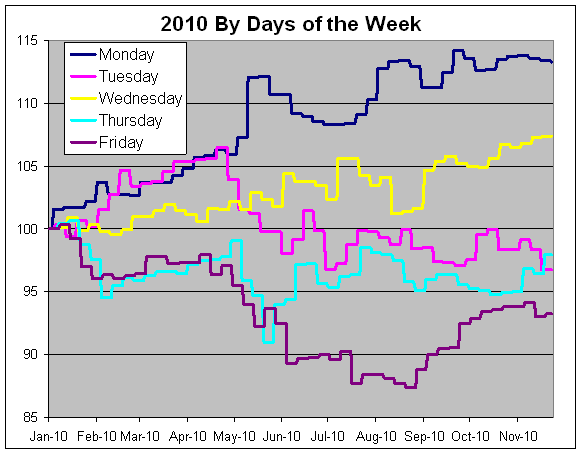
Posted by Eddy Elfenbein on November 23rd, 2010 at 12:26 pmEven with yesterday’s slight loss, Monday is shaping up to be the big winner for 2010.
For the year so far, the S&P 500 is up a collective +13.27% on Mondays. The other four days of the week combined are down -5.17%.
Tuedays combined are -3.29% (today not included). Wednesdays are the only other positive day, +7.35%. Thursdays are -2.08%. Fridays are the biggest loser, -6.72%.
-
Corporate Profits = 11.24% of GDP
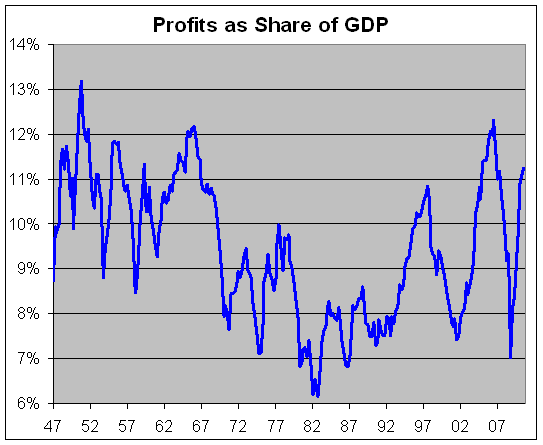
Posted by Eddy Elfenbein on November 23rd, 2010 at 10:44 amI wanted to follow-up on the earlier post about corporate profits hitting an all-time high. Not only are profits so high in nominal terms but they’re also very high as a portion of the GDP.
According to today’s report, corporate profits make up 11.24% of the GDP. This figure plunged dramatically during the recession, reaching a 21-year low of 7.01% for the fourth quarter of 2008.
Before the recession started, profits rose to 12.3% of GDP in the third quarter of 2006. That was the highest level since 1950. The number for last quarter is higher than any reading from 1966 to 2004.
Think of the chart below as a profit margin chart for the entire economy. The good news is that corporate profits have grown thanks to margin expansion. The problem is that, judging by historical standards, profits margins can’t improve that much more.
For profits to continue to grow, sales need to start growing. That means the economy had better start improving by adding new consumers, meaning more workers. More workers, more sales, more profits.
-
Becton Dickinson Raises Dividend for 38th Straight Year
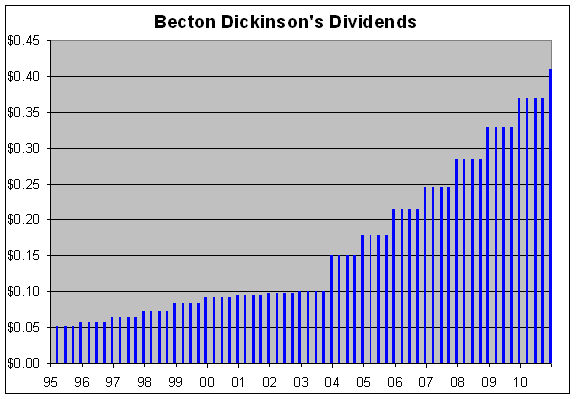
Posted by Eddy Elfenbein on November 23rd, 2010 at 9:19 amGood news for shareholders of Becton Dickinson (BDX)! The company has announced that it’s raising its quarterly dividend from 37 cents per share to 41 cents per share. That’s an increase of 10.8% and BDX has now increased its dividend for 38 straight years!
Going by the new yearly payout of $1.64, BDX currently yields 2.1%. The 5-year Treasury is going for 1.37%. If you bought the stock 20 years ago, you’re currently yielding close to 20%.
The dividend appears to be very safe. Earlier this month, BDX gave guidance for the fiscal year ending September 2011 of $5.45 to $5.55 per share. They made $4.90 this past year. In my opinion, any entry below $80 is a good value.
Here’s a look at their quarterly dividends for the past few years:
-
Third-Quarter GDP Revised to +2.5%
Posted by Eddy Elfenbein on November 23rd, 2010 at 8:49 amThis is some good news. The GDP report for the third quarter was revised higher from the initial report of 2% growth to 2.5% growth. The good news is that this was higher than Wall Street’s consensus of 2.4% growth. The downside is that 2.5% is right about the rate the economy needs to grow in order to absorb new workers.
In other words, the good news is that we’re standing still. At least we’re not where we were, which was falling backwards very quickly.
The revised increase in gross domestic product compares with a 2 percent estimate issued last month and a 1.7 percent rise in the second quarter, figures from the Commerce Department showed today in Washington. Corporate profits grew last quarter at a slower pace and an increase in employee wages in the prior three months was almost twice as much as initially reported.
While gains in earnings are giving companies the wherewithal to hire, the pace of growth is failing to bring down a jobless rate hovering near 10 percent. Unemployment along with a cooling of inflation as retailers such as Wal-Mart Stores Inc. reduce prices underscore the Federal Reserve’s decision to inject more money into the economy.
“This is still, by the standards of history, only a half- speed expansion,” said Avery Shenfeld, chief economist at CIBC World Markets in Toronto, who correctly forecast the revised increase in GDP. Inflation “is very tame and 2.5 percent growth is not fast enough to put Americans back to work by any extent.”
Today’s figures showed bigger gains in exports, consumer spending and business investment in new equipment than previously estimated.
An interesting tidbit is that corporate profits are now at the highest level ever recorded.
The nation’s workers may be struggling, but American companies just had their best quarter ever.
American businesses brought in $1.66 trillion at an annual rate in the third quarter, according to a Commerce Department report released Tuesday. That is the highest figure recorded since the government began keeping track over 60 years ago, at least in nominal or non-inflation-adjusted terms.
Corporate profits have been going gangbusters for a while. Since their cyclical low in the fourth quarter of 2008, profits have grown for seven consecutive quarters at some of the fastest rates in history.
This breakneck pace can be partly attributed to strong productivity growth — which means companies have been able to make more with less — as well as the fact that some of the profits of American companies come from abroad. Economic conditions in the United States may still be sluggish, but many emerging markets like India and China, are expanding rapidly.
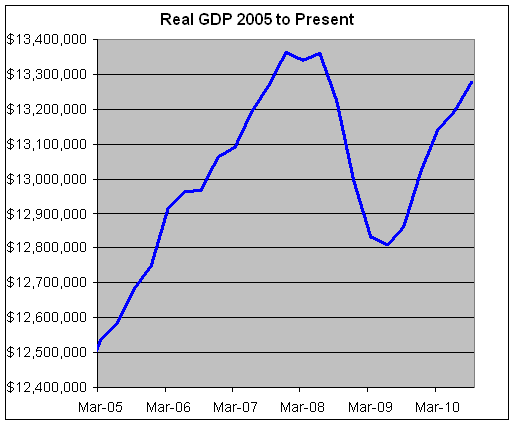
See that teeny little crook at the end of the chart? That’s what all the Double Dip fuss was about this summer. Yes, that’s all it was.
-
Morning News: November 23, 2010
Posted by Eddy Elfenbein on November 23rd, 2010 at 7:50 amStock Futures Lower as Korean Tensions Rise, GDP Awaited
Canada Inflation Quickens to 2-year High in October on Surge in Gasoline
Dollar Bears Go Into Hibernation as QE2 Attacks Prove Unfounded
Irish Rescue Plan Shifts Focus to Portugal, Spain
F.B.I. Agents Raid 3 Hedge Fund Offices
China Bans Hoarding of Oil, Coal to Cool Prices
Rescue of Ireland Would Dwarf Greece’s Bailout on Cost of Shoring Up Banks
J. Crew Reportedly Close to Massive Buyout
Netflix Offers Stream-only Service, Hikes Prices
HP Results Show Seesawing Nature of Tech Recovery
Momentum is a Drug, Value is in The Eye of the Beholder and Certainty is Death
-
More Evidence on the Return of Risk
Posted by Eddy Elfenbein on November 22nd, 2010 at 2:51 pmThanks to the Fed’s assistance, investors are increasing their appetite for risk:
The riskiest junk bonds are providing a refuge for investors concerned that inflation will accelerate as the Federal Reserve attempts to bolster the economy.
Debt issues from iStar Financial Inc., the commercial real- estate lender, and Atlanta-based credit-card processor First Data Corp. are leading returns of 0.22 percent this month for bonds rated CCC and lower, while higher-ranked BB tier debt is down 0.76 percent, Bank of America Merrill Lynch index data show. Investment-grade debt losses average 1.15 percent.
The lowest-tier notes offer yields of about 11.5 percent, compared with 6.4 percent for BB bonds, providing a buffer in case consumer prices rise at a faster pace as the Fed prints money to buy $600 billion of Treasuries. When inflation accelerated in 2006, returns on the CCC bonds were 18.6 percent, almost double the 9.9 percent gain for BB debt and 4.64 percent for high-grade securities.
“The wider the spread the more cushion you have” against rising consumer prices eating into interest payments, said James Serhant, senior vice president and head of high-yield fixed income at Hartford Investment Management Co. in Hartford, Connecticut, who oversees the $448.6 million Hartford High Yield Fund.
-
Netflix Is Worth Nearly $10 Billion
Posted by Eddy Elfenbein on November 22nd, 2010 at 1:33 pmAt 1:30 pm, the stock market is having a rough day. The Dow is off more than 119 points and the S&P 500 is down nearly one full percent.
Perhaps the most fantastically overpriced stock on the market is Netflix (NFLX) which has just bounded up to another 52-week high. The stock is up more than $100 per share since I called it “The Absolute Worst Stock to Buy Right Now.” Yeesh–not one of my better calls. I thought it was overpriced then and I think it’s even more so now.
The guys at Bespoke list some of the companies that Netflix is now larger than. This includes companies like Sara Lee (SLE) and ConAgra (CAG). Netflix is now worth close to $10 billion.
Only three stocks from the Buy List are up for the day: Eaton Vance (EV), Sysco (SYY) and Joey Banks (JOSB). Nicholas Financial (NICK) has been as low as $9.60 today which is off since it’s down $1 from its recent high despite there being no news on it.
-
Archives
- October 2026
- September 2026
- August 2026
- July 2026
- June 2026
- May 2026
- April 2026
- March 2026
- February 2026
- January 2026
- December 2025
- November 2025
- October 2025
- September 2025
- August 2025
- July 2025
- June 2025
- May 2025
- April 2025
- March 2025
- February 2025
- January 2025
- December 2024
- November 2024
- October 2024
- September 2024
- August 2024
- July 2024
- June 2024
- May 2024
- April 2024
- March 2024
- February 2024
- January 2024
- December 2023
- November 2023
- October 2023
- September 2023
- August 2023
- July 2023
- June 2023
- May 2023
- April 2023
- March 2023
- February 2023
- January 2023
- December 2022
- November 2022
- October 2022
- September 2022
- August 2022
- July 2022
- June 2022
- May 2022
- April 2022
- March 2022
- February 2022
- January 2022
- December 2021
- November 2021
- October 2021
- September 2021
- August 2021
- July 2021
- June 2021
- May 2021
- April 2021
- March 2021
- February 2021
- January 2021
- December 2020
- November 2020
- October 2020
- September 2020
- August 2020
- July 2020
- June 2020
- May 2020
- April 2020
- March 2020
- February 2020
- January 2020
- December 2019
- November 2019
- October 2019
- September 2019
- August 2019
- July 2019
- June 2019
- May 2019
- April 2019
- March 2019
- February 2019
- January 2019
- December 2018
- November 2018
- October 2018
- September 2018
- August 2018
- July 2018
- June 2018
- May 2018
- April 2018
- March 2018
- February 2018
- January 2018
- December 2017
- November 2017
- October 2017
- September 2017
- August 2017
- July 2017
- June 2017
- May 2017
- April 2017
- March 2017
- February 2017
- January 2017
- December 2016
- November 2016
- October 2016
- September 2016
- August 2016
- July 2016
- June 2016
- May 2016
- April 2016
- March 2016
- February 2016
- January 2016
- December 2015
- November 2015
- October 2015
- September 2015
- August 2015
- July 2015
- June 2015
- May 2015
- April 2015
- March 2015
- February 2015
- January 2015
- December 2014
- November 2014
- October 2014
- September 2014
- August 2014
- July 2014
- June 2014
- May 2014
- April 2014
- March 2014
- February 2014
- January 2014
- December 2013
- November 2013
- October 2013
- September 2013
- August 2013
- July 2013
- June 2013
- May 2013
- April 2013
- March 2013
- February 2013
- January 2013
- December 2012
- November 2012
- October 2012
- September 2012
- August 2012
- July 2012
- June 2012
- May 2012
- April 2012
- March 2012
- February 2012
- January 2012
- December 2011
- November 2011
- October 2011
- September 2011
- August 2011
- July 2011
- June 2011
- May 2011
- April 2011
- March 2011
- February 2011
- January 2011
- December 2010
- November 2010
- October 2010
- September 2010
- August 2010
- July 2010
- June 2010
- May 2010
- April 2010
- March 2010
- February 2010
- January 2010
- December 2009
- November 2009
- October 2009
- September 2009
- August 2009
- July 2009
- June 2009
- May 2009
- April 2009
- March 2009
- February 2009
- January 2009
- December 2008
- November 2008
- October 2008
- September 2008
- August 2008
- July 2008
- June 2008
- May 2008
- April 2008
- March 2008
- February 2008
- January 2008
- December 2007
- November 2007
- October 2007
- September 2007
- August 2007
- July 2007
- June 2007
- May 2007
- April 2007
- March 2007
- February 2007
- January 2007
- December 2006
- November 2006
- October 2006
- September 2006
- August 2006
- July 2006
- June 2006
- May 2006
- April 2006
- March 2006
- February 2006
- January 2006
- December 2005
- November 2005
- October 2005
- September 2005
- August 2005
- July 2005
 Eddy Elfenbein is a Washington, DC-based speaker, portfolio manager and editor of the blog Crossing Wall Street. His