-
Stocks and Bonds Part Ways
Posted by Eddy Elfenbein on November 22nd, 2010 at 10:24 amFor the first time since the financial crisis started, U.S. shares are moving independently of the bond market, a sign that profits and valuations are guiding investors more than concern about the economy.
The 30-day correlation coefficient measuring how often the Standard & Poor’s 500 Index moves in tandem with 10-year Treasury yields fell to minus 0.42 from a record 0.89 in June, data compiled by Bloomberg show. Readings of 1 indicate prices are moving together, while zero shows no link and minus 1 means they are going in opposite directions. Stocks and debt are ending a lockstep relationship that began in July 2007 and lasted through the worst recession since the 1930s.
This is exactly what I said would happen with QE2. The Federal Reserve wants investors to leave secure assets like bonds and turn to riskier assets like stocks.
Here’s a look at the S&P 500 (in black) compared with an ETF of long-term Treasuries (in gold):
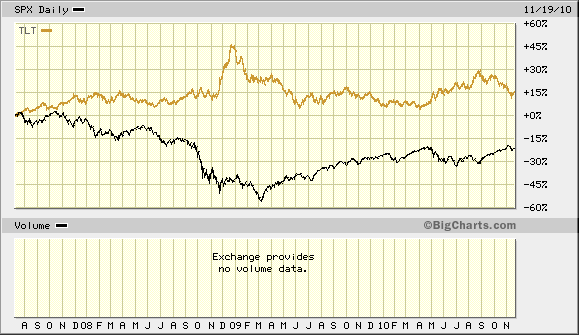
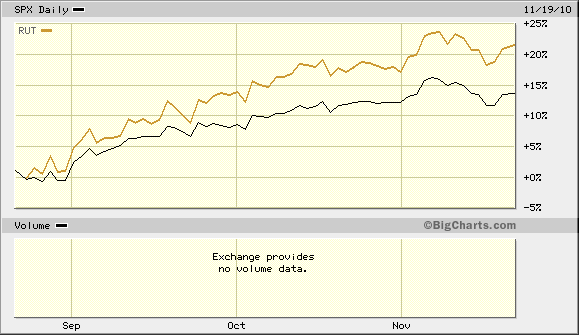
It’s almost like a mirror image. In fact, I’m not quite sure what Bloomberg is referring to as a “period of positive correlation” during June. But let’s leave that aside for now because what we’re also seeing is that within stocks, investors are moving to riskier classes.
Check out the difference between the small-cap Russell 2000 (gold) and the S&P 500 (black) over the last three months.
-
“After all, I am just another heartless Wall Street bastard myself.”
Posted by Eddy Elfenbein on November 22nd, 2010 at 9:36 amI want to give a quick shout-out to The Epicurean Dealmaker, one of best and funniest blogs about Wall Street, for making it into John Cassidy’s article in the most recent New Yorker:
Given the code of silence that Wall Street firms impose on their employees, it is difficult to get mid-level bankers to speak openly about what they do. There is, however, a blog, The Epicurean Dealmaker, written by an anonymous investment banker who has for several years been providing caustic commentary on his profession. The biography on his site notes, “I facilitate, justify, and advise parties to M&A transactions, when I am not advising against them.” In March, 2008, when some analysts were suggesting that the demise of Bear Stearns would lead to a change of attitudes on Wall Street, TED—the shorthand appellation the author uses—wrote, “I, for one, think these bankers will be even more motivated to rape and pillage the financial system in order to rebuild their ill-gotten gains.” Seven months later, on the eve of the bank bailout, TED opined, “Let hundreds of banks fail. Let tens of thousands of financial workers lose their jobs and their personal wealth. . . . The financial sector has had a really, really good run for a lot of years. It is time to pay the piper, and I, for one, have little interest in using my taxpayer dollars to cushion the blow. After all, I am just another heartless Wall Street bastard myself.”
In September, TED and I met at a diner near my office. He looked like an investment banker: middle-aged, clean-cut, wearing an expensive-looking gray suit. Our conversation started out with some banter about the rivalry between bankers and traders at many Wall Street firms. As the traders came out on top in recent years, TED recalled, “they would say, ‘You guys are the real parasites, going to expensive lunches and doing deals on the back of our trading operations.’ ” He professed to be unaffected by this ribbing, but he said, “In my experience, the proprietary traders are always the clowns who make twenty million dollars a year until they lose a hundred million.”
In September, 2009, addressing the popular anger about bankers’ pay, TED wrote that he wouldn’t “attempt to rationalize stratospheric pay in the industry on the basis of some sort of self-aggrandizing claim to the particular socioeconomic utility or virtue of what I and my peers do,” and he cautioned his colleagues against making any such claim: “You mean to tell me your work as a [fill in the blank here] is worth more to society than a firefighter? An elementary school teacher? A combat infantryman in Afghanistan? A priest? Good luck with that.” The fact was, TED went on, “my pay is set according to one thing and one thing only: the demand in the marketplace for my services. . . . Investment bankers get paid a lot of money because that is what the market will bear.”
While not inaccurate, this explanation raises questions about how competition works in the financial industry. If Hertz sees much of its rental fleet lying idle, it will cut its prices to better compete with Avis and Enterprise. Chances are that Avis and Enterprise will respond in kind, and the result will be lower profits all around. On Wall Street, the price of various services has been fixed for decades. If Morgan Stanley issues stock in a new company, it charges the company a commission of around seven per cent. If Evercore or JPMorgan advises a corporation on making an acquisition, the standard fee is about two per cent of the purchase price. I asked TED why there is so little price competition. He concluded it was something of a mystery. “It’s a commodity business,” he said. “I can do what Goldman Sachs does. You can do what I can do. Nobody has a proprietary edge. And if you do have a proprietary edge you’ll only have it for a few weeks before somebody reverse engineers it.”
After thinking it over, the best explanation TED could come up with was based on a theory of relativity: investment-banking fees are small compared with the size of the over-all transaction. “You are a client, and you are going to do a five-billion-dollar deal,” he said. “It’s the biggest deal you’ve ever done. It’s going to determine your future, and the future of your firm. Are you really going to fight about whether a certain fee is 2.5 per cent or 3.3 per cent? No. The old cliché we rely on is this: When you need surgery, do you go to the discount surgeon or to the one you trust and know, who charges more?”
I asked him how he and his co-workers felt about making loads of money when much of the country was struggling. “A lot of people don’t care about it or think about it,” he replied. “They say, it’s a market, it’s still open, and I’ll sell my labor for as much as I can until nobody wants to buy it.” But you, I asked, what do you think? “I tend to think we do create value,” he said. “It’s not a productive value in a very visible sense, like finding a cure for cancer. We’re middlemen. We bring together two sides of a deal. That’s not a very elevated thing, but I can’t think of any elevated economy that doesn’t need middlemen.”
-
Ireland To Get Bailed Out
Posted by Eddy Elfenbein on November 22nd, 2010 at 8:54 amNow it’s Ireland’s turn for a bailout. This is a tough one since Ireland had been the shining star of the benefits of European economic integration. Sure, we all kinda knew that Greece was a mess, but Ireland? They were supposed to be the good student doing it right.
European Union officials, who had been pushing Ireland to accept help, quickly agreed to the request late Sunday, committing a staggering amount of funds to an ailing member for the second time in six months.
The total amount of the package was not announced, but several officials said it would be €80 billion to €90 billion, or $109 billion to $123 billion. Last spring, Europe disbursed €110 billion to Greece to save it from bankruptcy.
What happened is that Ireland, like many countries, bailed out its banks two years ago. The problem was that Irish banks were in much bigger trouble than everyone thought, and now the bailouters need a bailout. The reason it’s taken so long between 2008 and today is that only now have investors wised up and started to dump Irish bonds. Up until two weeks ago, the Irish government was telling us that nothing was wrong. The lesson is that markets, for all their noise, are more honest than governments.
Now there are worries that Spain and Portugal are next. The Prime Minister of Luxembourg, Jean-Claude Juncker, said “Speculative actions against Portugal and Spain are not justified, though it can’t be excluded.” Hate to break this to you, Jean-Claude, but if they can’t be excluded, they are by a certain measure, justified. For reasons unclear, Mr. Juncker is a big-time muckety muck in European affairs.
There’s an odd perception/reality game in these situations. If people think Ireland will be bailed out, the yield spreads on Irish debt will narrow and that will greatly help the country’s fiscal situation. If the EU had elected to “Bear Stearnsify” Ireland, well…things would be very different right now.
-
Morning News: November 22, 2010
Posted by Eddy Elfenbein on November 22nd, 2010 at 7:54 amIreland is Second Euro Nation to Seek Aid as Banks Wobble
Stock Index Futures Rise After Irish Bailout
After Ireland, traders turn to Portugal, Spain
Lack of Hiring to Restrain U.S. Economy in 2011, Survey Shows
Yuan Loses to Taiwan Dollar as Growth Rates Converge at 10%: China Credit
Economists See ‘Sub-par’ Growth Ahead
Top Banks Face $100 Billion Basel Shortfall
China Takes Aim at Inflation Expectations
Orascom Telecom to Sell Tunisia Stake in $1.2B Deal
-
Happy Birthday Otto
Posted by Eddy Elfenbein on November 22nd, 2010 at 7:04 amI’d like to wish a belated happy birthday to Otto von Habsburg who turned 98 on Saturday.
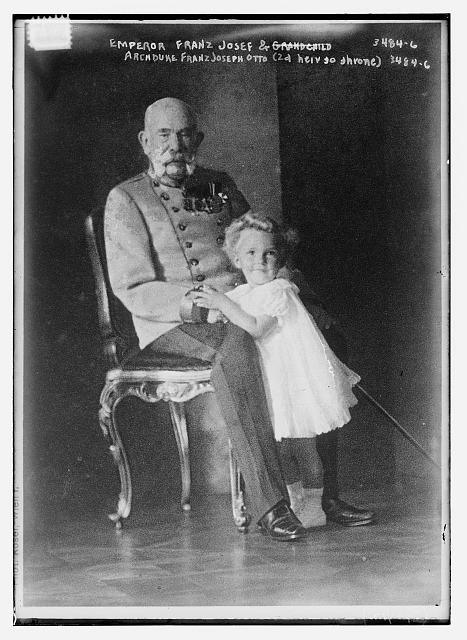
For the last 88 years, he’s been the pretender to the Austrian throne. His father, Charles I, was the last Emperor of Austria and King of Hungary. Charles became emperor after Franz Joseph, who was born in 1830, died in 1916. He had been on the throne since 1848.
The heir had been Archduke Franz Ferdinand, but in 1914…well, you probably know what happened. After that, Charles was next in line, and Otto after Charles.
If things had worked out differently, Austria would have had two kings for 156 of the last 162 years.
Here’s a picture of Otto with Franz Joseph. In others, he’s a picture of a man alive today with a man born 180 years ago.
-
Reader Poll: Which State Would You Kick Out?
Posted by Eddy Elfenbein on November 19th, 2010 at 4:24 pm
-
Time to Shut Down the Laptop
Posted by Eddy Elfenbein on November 19th, 2010 at 4:01 pmThe weekend is here. Enjoy some classic E&B:
-
Days of Wine and Liquidity
Posted by Eddy Elfenbein on November 19th, 2010 at 3:04 pmGary Alexander celebrates what would be Johnny Mercer’s 101st birthday (yesterday) with some market talk:
Call me Old Fashioned, but if I Had my Druthers, markets would rise Day In and Day Out, Come Rain or Come Shine. But Jeepers Creepers, the Days of Wine and Roses can also be a Charade. Fools Rush In, seeking Out of This World riches, while those who Hit the Road to Dreamland may be Building Up for an Awful Letdown, and I Wanna Be Around to Pick up the Pieces when they sing The Blues in the Night.
Turning to the Fed, Something’s Gotta Give in the war between inflation and deflation, so the Lazy Bones at the Fed use That Old Black Magic to print more money, saying “This Time the Dream’s on Me.”
Seasonally, markets tend to fall in Early Autumn, when Autumn Leaves begin to fall In the Cool, Cool, Cool of the Evening. But When October Goes, If I Had a Million Dollars (One for My Baby and Another One for the Road), my Dream (My Shining Hour) would be to Take the Long Road Home, on the Atcheson, Topeka and the Santa Fe, with my Dearly Beloved Satin Doll (Laura), to Moon River, where the Skylark and Bob White sing. After all, Any Place I Hang My Hat is Home. It’s all Too Marvelous for Words!
-
Hansen Natural Takes Out 2006 High
Posted by Eddy Elfenbein on November 19th, 2010 at 1:00 pmHow’s this for a comeback? Hansen Natural (HANS), the Monster Energy Drink stock, just took out its 2006 high.

For those of you keeping score at home, the stock went from 50 cents (post-split) in 2003 to a high of $52.72 in 2006. HANS then dropped to $26 before rising to an all-time high of $68. By October 2008, it was back below $21 and now it’s been as high as $52.85 today.
We try to analyze stocks as best as we can using reason and logic, yet sometimes the market has other ideas.
-
Harrah’s Shelves IPO
Posted by Eddy Elfenbein on November 19th, 2010 at 10:33 amHarrah’s Entertainment Inc. was set to IPO this week but canceled due to “market conditions.” I’m not sure what changed so much over the past week, but they didn’t ask my opinion.
In the years leading up to the financial crisis, gobs of companies were taken off the market by private equity firms. Now the companies are being unloaded and many are for losses. Bloomberg estimates that 40% of the IPOs from private equity firms are for losses.
Harrah’s had been bought out by Apollo Global Management and TPG Capital in January 2008. The stock had been hugely successful for investors over the years.
-
Archives
- October 2026
- September 2026
- August 2026
- July 2026
- June 2026
- May 2026
- April 2026
- March 2026
- February 2026
- January 2026
- December 2025
- November 2025
- October 2025
- September 2025
- August 2025
- July 2025
- June 2025
- May 2025
- April 2025
- March 2025
- February 2025
- January 2025
- December 2024
- November 2024
- October 2024
- September 2024
- August 2024
- July 2024
- June 2024
- May 2024
- April 2024
- March 2024
- February 2024
- January 2024
- December 2023
- November 2023
- October 2023
- September 2023
- August 2023
- July 2023
- June 2023
- May 2023
- April 2023
- March 2023
- February 2023
- January 2023
- December 2022
- November 2022
- October 2022
- September 2022
- August 2022
- July 2022
- June 2022
- May 2022
- April 2022
- March 2022
- February 2022
- January 2022
- December 2021
- November 2021
- October 2021
- September 2021
- August 2021
- July 2021
- June 2021
- May 2021
- April 2021
- March 2021
- February 2021
- January 2021
- December 2020
- November 2020
- October 2020
- September 2020
- August 2020
- July 2020
- June 2020
- May 2020
- April 2020
- March 2020
- February 2020
- January 2020
- December 2019
- November 2019
- October 2019
- September 2019
- August 2019
- July 2019
- June 2019
- May 2019
- April 2019
- March 2019
- February 2019
- January 2019
- December 2018
- November 2018
- October 2018
- September 2018
- August 2018
- July 2018
- June 2018
- May 2018
- April 2018
- March 2018
- February 2018
- January 2018
- December 2017
- November 2017
- October 2017
- September 2017
- August 2017
- July 2017
- June 2017
- May 2017
- April 2017
- March 2017
- February 2017
- January 2017
- December 2016
- November 2016
- October 2016
- September 2016
- August 2016
- July 2016
- June 2016
- May 2016
- April 2016
- March 2016
- February 2016
- January 2016
- December 2015
- November 2015
- October 2015
- September 2015
- August 2015
- July 2015
- June 2015
- May 2015
- April 2015
- March 2015
- February 2015
- January 2015
- December 2014
- November 2014
- October 2014
- September 2014
- August 2014
- July 2014
- June 2014
- May 2014
- April 2014
- March 2014
- February 2014
- January 2014
- December 2013
- November 2013
- October 2013
- September 2013
- August 2013
- July 2013
- June 2013
- May 2013
- April 2013
- March 2013
- February 2013
- January 2013
- December 2012
- November 2012
- October 2012
- September 2012
- August 2012
- July 2012
- June 2012
- May 2012
- April 2012
- March 2012
- February 2012
- January 2012
- December 2011
- November 2011
- October 2011
- September 2011
- August 2011
- July 2011
- June 2011
- May 2011
- April 2011
- March 2011
- February 2011
- January 2011
- December 2010
- November 2010
- October 2010
- September 2010
- August 2010
- July 2010
- June 2010
- May 2010
- April 2010
- March 2010
- February 2010
- January 2010
- December 2009
- November 2009
- October 2009
- September 2009
- August 2009
- July 2009
- June 2009
- May 2009
- April 2009
- March 2009
- February 2009
- January 2009
- December 2008
- November 2008
- October 2008
- September 2008
- August 2008
- July 2008
- June 2008
- May 2008
- April 2008
- March 2008
- February 2008
- January 2008
- December 2007
- November 2007
- October 2007
- September 2007
- August 2007
- July 2007
- June 2007
- May 2007
- April 2007
- March 2007
- February 2007
- January 2007
- December 2006
- November 2006
- October 2006
- September 2006
- August 2006
- July 2006
- June 2006
- May 2006
- April 2006
- March 2006
- February 2006
- January 2006
- December 2005
- November 2005
- October 2005
- September 2005
- August 2005
- July 2005
 Eddy Elfenbein is a Washington, DC-based speaker, portfolio manager and editor of the blog Crossing Wall Street. His