-
Nicholas Financial Breaks Out
Posted by Eddy Elfenbein on April 7th, 2010 at 10:44 amShares of Nicholas Financial (NICK) seem to be breaking out today. It’s still early but the trading looks very good. As I write this, NICK is at $7.98. The stock hasn’t been over $8 since 2007.
Today’s volume is over 23,000 which is very high. This is unusual for not being near earnings. NICK usually trades around 2,000 to 5,000 shares. The spread has narrowed to just four cents.
I guess someone is buying! -
Johnson & Johnson’s Dividend Streak
Posted by Eddy Elfenbein on April 6th, 2010 at 3:41 pmSometime later this month Johnson & Johnson (JNJ) will announce its 48th consecutive annual dividend increase. This dividend hike probably won’t make much news but I urge all serious investors to take notice. Half a century of rising dividends is a remarkable achievement.
JNJ’s current quarterly dividend is 49 cents a share which works out to a yield of about 3%. Last year’s increase was fairly small, just 7.7%. Alan Brochstein speculates that this year’s increase will be 10%, which brings the dividend to 54 cents a share. That sounds about right to me. If that’s the case, then JNJ currently yield about 3.3%.
If you want to see how important dividends are for long-term investing, consider that a person who bought JNJ 25 years ago may soon be getting close 100% a year just in dividends. -
CEO Pay
Posted by Eddy Elfenbein on April 6th, 2010 at 8:49 amThe NYT has a neat graphic detailing CEO pay at many top firms. On a side note, it turns out that many CEOs are middle-aged white guys.
-
I Smell Pulitzer
Posted by Eddy Elfenbein on April 6th, 2010 at 8:27 amThe WSJ bravely uncovers the story of Americans who have plunged from the Upper-Middle-Upper Class all the way down to the Middle-Upper-Middle Class.
Indeed, the bank of Mom and Dad is closing at a time when young people are having trouble borrowing from traditional lenders. Some 22% of young people between the ages of 18 and 34 said they’ve been turned down for a mortgage, loan or credit card in the past year, according to a February survey from FindLaw.com, a legal marketing and information site. That’s double the percentage of any other age group in its survey.
As a result, many young people are now moving home to save on rent. About 21% of young adults say they’ve either moved in with a friend or relative, or had a friend or relative move in with them because of the economy, according to a study from the Pew Research Center.First Haiti, now this! Why God? WHY??
-
Growth Has Been Leading Value
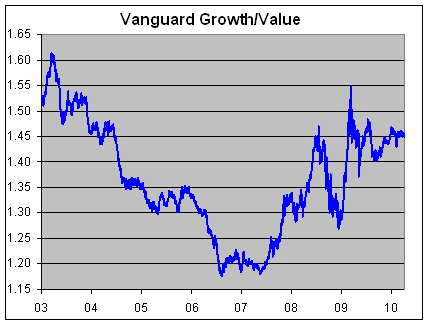
Posted by Eddy Elfenbein on April 5th, 2010 at 3:16 pmSince the summer of 2006, growth has been leading value. Much of the reason is that financial stocks have crowded the value side. Right now, I’m not sure if either side has a big advantage. Simply due to the wide yield curve, I’d still lean towards growth.
Here’s a look at the Vanguard Growth Fund (VIGRX) divided by the Vanguard Value Fund (VIVAX):
-
Mauboussin and Surowiecki
Posted by Eddy Elfenbein on April 5th, 2010 at 12:49 pm
(Via: Kedrosky) -
Uncle Sam Made 8.5% on Bailouts
Posted by Eddy Elfenbein on April 5th, 2010 at 12:14 pmFrom Reuters:
U.S. taxpayers earned an annualized 8.5 percent return from the government’s bailout of 49 financial firms, underscoring efforts by the industry to speed up repayments and warrant repurchases, according to a report by SNL Financial.
Firms such as Citigroup (C.N), which still has common shares held by the U.S. Treasury Department, and rivals that have made partial redemptions were excluded from the analysis, SNL Financial said in a statement on Monday.
Proceeds from Troubled Asset Relief Program (TARP) warrant repurchases and auctions led to a surge in returns through March 30, SNL said. So far, since the start of the program in late 2008, 64 institutions have fully repaid government aid.
For months, taxpayers balked at government efforts to help banks, which they saw as the main culprit behind the worst U.S. recession since the 1930s, as the collapse of investment bank Lehman Brothers shook global financial markets in late 2008.
The biggest banks, such as Goldman Sachs Group Inc (GS.N), repaid the money they owed the Treasury last year and earlier this year. Still, more than 600 smaller banks are left in the program, and owe roughly $130 billion to taxpayers.
Goldman alone produced a return of 20 percent to taxpayers at the time of repayment in July last year, according to SNL.
Overall, firms that have exited the programs, plus those 18 that have fully redeemed their TARP preferred stock but still have their warrants held by the Treasury, returned 7.6 percent in the period, SNL Financial noted.I wasn’t too worried about the money going to the top banks. As for AIG and the car companies, well, that’s another story.
-
Thought for the Day
Posted by Eddy Elfenbein on April 5th, 2010 at 11:06 amFrom Arnold Kling:
My take on the mortgage finance boom/bust, TARP, the stimulus, health care reform, and the global warming crusade is that they represent a series of ruling-class mistakes. From my perspective, these mistakes are in the tradition of such ruling-class mistakes as World War I and Vietnam.
I attach paramount importance to resisting the ruling class at this time. I view ethnic and cultural controversies as devices used by the ruling class to keep the resistance divided. The ruling class wants you to think that if you don’t support their entrenched power, the country will be over-run by a bunch of anti-intellectual racists and homophobes. I call baloney sandwich on that one.If there were a stock or ETF tied to the public policy of “libertarianism for the rich/paternalism for the poor,” I’d rate it a very strong long-term buy.
-
Freakonomist Keeps Close Eye On GE Stock Versus Height Of Mexican Weightlifters
Posted by Eddy Elfenbein on April 5th, 2010 at 10:53 amCHICAGO—A University of Chicago freakonomics professor told General Electric investors Monday to keep a close eye on recent fluctuations in the heights of competitive powerlifters from Mexico. “Usually we can count on a stable average of 5 feet 8 inches, but last month’s quarter-inch drop in height among Mexican dead-lift competitors in the middle-heavyweight division could spell disaster for GE’s aviation and software subsidiaries,” freakonomist James Duncan said. “But, like anything else, a shrewd investor must always ask himself one thing: How many hot dogs did I eat last year?” Duncan previously gained recognition for tracking first-time home ownership and teenage mothers’ gum purchases against the Times Tom Jones Is Played Per Day Index.
-
The Buy List Is Now Up Over 10% YTD
Posted by Eddy Elfenbein on April 5th, 2010 at 10:23 amThe day is still young, but the CWS Buy List officially crossed the 10% line for the year. This is why I don’t try to time the market. I never would have said that we’d make 10% in a little over one quarter. Joey Banks (JOSB) is at another new high.
-
Archives
- June 2026
- May 2026
- April 2026
- March 2026
- February 2026
- January 2026
- December 2025
- November 2025
- October 2025
- September 2025
- August 2025
- July 2025
- June 2025
- May 2025
- April 2025
- March 2025
- February 2025
- January 2025
- December 2024
- November 2024
- October 2024
- September 2024
- August 2024
- July 2024
- June 2024
- May 2024
- April 2024
- March 2024
- February 2024
- January 2024
- December 2023
- November 2023
- October 2023
- September 2023
- August 2023
- July 2023
- June 2023
- May 2023
- April 2023
- March 2023
- February 2023
- January 2023
- December 2022
- November 2022
- October 2022
- September 2022
- August 2022
- July 2022
- June 2022
- May 2022
- April 2022
- March 2022
- February 2022
- January 2022
- December 2021
- November 2021
- October 2021
- September 2021
- August 2021
- July 2021
- June 2021
- May 2021
- April 2021
- March 2021
- February 2021
- January 2021
- December 2020
- November 2020
- October 2020
- September 2020
- August 2020
- July 2020
- June 2020
- May 2020
- April 2020
- March 2020
- February 2020
- January 2020
- December 2019
- November 2019
- October 2019
- September 2019
- August 2019
- July 2019
- June 2019
- May 2019
- April 2019
- March 2019
- February 2019
- January 2019
- December 2018
- November 2018
- October 2018
- September 2018
- August 2018
- July 2018
- June 2018
- May 2018
- April 2018
- March 2018
- February 2018
- January 2018
- December 2017
- November 2017
- October 2017
- September 2017
- August 2017
- July 2017
- June 2017
- May 2017
- April 2017
- March 2017
- February 2017
- January 2017
- December 2016
- November 2016
- October 2016
- September 2016
- August 2016
- July 2016
- June 2016
- May 2016
- April 2016
- March 2016
- February 2016
- January 2016
- December 2015
- November 2015
- October 2015
- September 2015
- August 2015
- July 2015
- June 2015
- May 2015
- April 2015
- March 2015
- February 2015
- January 2015
- December 2014
- November 2014
- October 2014
- September 2014
- August 2014
- July 2014
- June 2014
- May 2014
- April 2014
- March 2014
- February 2014
- January 2014
- December 2013
- November 2013
- October 2013
- September 2013
- August 2013
- July 2013
- June 2013
- May 2013
- April 2013
- March 2013
- February 2013
- January 2013
- December 2012
- November 2012
- October 2012
- September 2012
- August 2012
- July 2012
- June 2012
- May 2012
- April 2012
- March 2012
- February 2012
- January 2012
- December 2011
- November 2011
- October 2011
- September 2011
- August 2011
- July 2011
- June 2011
- May 2011
- April 2011
- March 2011
- February 2011
- January 2011
- December 2010
- November 2010
- October 2010
- September 2010
- August 2010
- July 2010
- June 2010
- May 2010
- April 2010
- March 2010
- February 2010
- January 2010
- December 2009
- November 2009
- October 2009
- September 2009
- August 2009
- July 2009
- June 2009
- May 2009
- April 2009
- March 2009
- February 2009
- January 2009
- December 2008
- November 2008
- October 2008
- September 2008
- August 2008
- July 2008
- June 2008
- May 2008
- April 2008
- March 2008
- February 2008
- January 2008
- December 2007
- November 2007
- October 2007
- September 2007
- August 2007
- July 2007
- June 2007
- May 2007
- April 2007
- March 2007
- February 2007
- January 2007
- December 2006
- November 2006
- October 2006
- September 2006
- August 2006
- July 2006
- June 2006
- May 2006
- April 2006
- March 2006
- February 2006
- January 2006
- December 2005
- November 2005
- October 2005
- September 2005
- August 2005
- July 2005
 Eddy Elfenbein is a Washington, DC-based speaker, portfolio manager and editor of the blog Crossing Wall Street. His