-
Crimson in the Red
Posted by Eddy Elfenbein on August 1st, 2007 at 10:59 amFrom the WSJ:
Harvard University’s endowment fund has graduated some of the most sought-after money managers in the hedge-fund world.
Now one of those stars is teaching Harvard a lesson of its own.
In the past month, the university lost about $350 million through an investment in Sowood Capital Management, a hedge-fund firm founded by Jeffrey Larson. Mr. Larson managed Harvard’s foreign-stock holdings until 2004, when he left to set up Sowood, which recently lost more than 50% of its value amid bad bond investments.
Mr. Larson isn’t the only high-profile former Harvard-endowment manager with a mixed record since leaving the ivory tower. Jack Meyer, Harvard’s former top investment manager, last year raised a $6 billion hedge fund, Convexity Capital, including an initial $500 million investment from Harvard. While Convexity’s returns were subpar early on, its performance has improved lately, according to people familiar with the figures.(Via Joe DealBreaker)
-
Murdoch Wins
Posted by Eddy Elfenbein on August 1st, 2007 at 9:42 amIt’s over. Murdoch won his bid for Dow Jones (DJ). This was a silly spectacle and after a lot of drama the only thing Bancroft family did was embarrass themselves.
Here’s all you need to know:
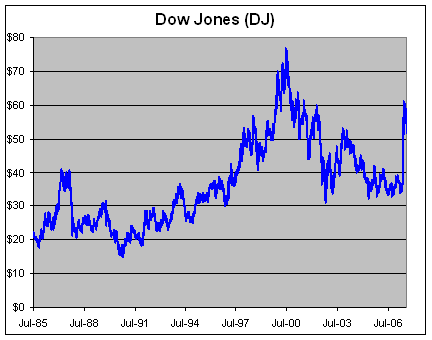
DJ’s stock has barely moved in a generation. That last uptick is from Murdoch’s $60 a share offer. -
The King and Buy
Posted by Eddy Elfenbein on August 1st, 2007 at 9:30 amIt turns out that one of Thailand’s best investors is the king:
Mondays are different in Thailand. It’s the day of the week on which the world’s longest-reigning monarch, Bhumibol Adulyadej, was born.
And in this Southeast Asian nation, the sidewalks, trains, ferries and food stalls selling fiery curries take on a canary- colored glow as Thais — from chief executive officers to street sweepers — pay respect to their king by dressing in the royal color of yellow.
Investors are finding reasons to be enthusiastic about Bhumibol too: The $5 billion of shares that the 79-year-old king controls through the Crown Property Bureau, the asset management company established by Thailand’s government, are weathering the nation’s vicissitudes better than most. -
The Dividend Aristocrats
Posted by Eddy Elfenbein on July 31st, 2007 at 11:02 amS&P tracks its list of “Dividend Aristocrats,” these are S&P 500 stocks that have increased their dividend every year for the last 25 years.
Here’s the list ranked by current dividend yield:
FHN 5.51%
BAC 5.34%
ED 5.29%
USB 5.21%
PFE 4.92%
BBT 4.81%
CMA 4.73%
RF 4.68%
FITB 4.43%
MO 4.09%
KEY 4.09%
CINF 3.55%
LEG 3.44%
GCI 3.24%
LLY 3.12%
KMB 3.10%
SNV 2.85%
GE 2.83%
JNJ 2.72%
BUD 2.69%
PPG 2.68%
CLX 2.61%
MTB 2.60%
KO 2.59%
ROH 2.58%
ABT 2.57%
AVY 2.56%
VFC 2.51%
CBSS 2.47%
CB 2.27%
PEP 2.27%
PG 2.24%
SWK 2.21%
EMR 2.20%
MMM 2.15%
MCD 2.05%
SLM 2.01%
WWY 2.01%
ADP 1.96%
WMT 1.90%
SHW 1.77%
GWW 1.57%
SVU 1.54%
FDO 1.50%
DOV 1.43%
MHP 1.34%
ADM 1.34%
STT 1.28%
BDX 1.25%
JCI 1.17%
LOW 1.14%
SIAL 1.01%
STR 0.95%
TGT 0.90%
WAG 0.85%
NUE 0.84%
BCR 0.75%
CTL 0.56%
PGR 0.19% -
Quote of the Day
Posted by Eddy Elfenbein on July 31st, 2007 at 12:30 amPrivate equity firms are draining the capital out of our communities, and draining the lifeblood of our country.
-
RIP: Chet Currier
Posted by Eddy Elfenbein on July 31st, 2007 at 12:14 amLong-time financial writer, Chet Currier, died on Sunday. This is from his final Bloomberg column:
For one long-standing indicator of shifting moods in the stock market, a now-or-never moment is at hand.
The gauge in question, which focuses on cash reserves held by managers of stock-mutual funds, has been emitting increasingly bearish signals about the market outlook.
But nobody has been paying much attention. The indicator’s once-stellar record of accuracy has been less than compelling lately. What’s more, the whole premise behind it may be out of date. -
GDP Revisions
Posted by Eddy Elfenbein on July 30th, 2007 at 2:02 pmOne of my constant complaints about the government’s economic data is that it’s subject to endless revisions. Then the revisions are updated and the updates are subsequently revised. Geez, folks. Just wait till you get a final number and give it to me.
In Friday’s GDP report, the government revised all the GDP numbers going back to 2004. It turns out that the economy was a bit weaker than it originally said. They were only off by about $120 billion. Unless, of course, that gets revised.
Funny, I don’t feel any different.
Anyway, here’s a look at GDP, new numbers and old:
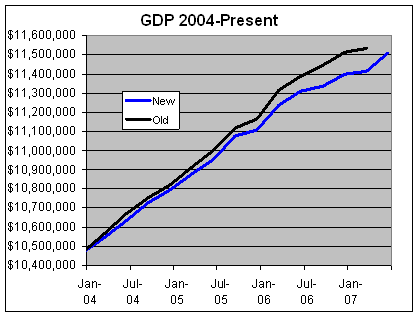
Eleven of the 13 quarters were revised lower. Here’s a look at the quarterly growth numbers:
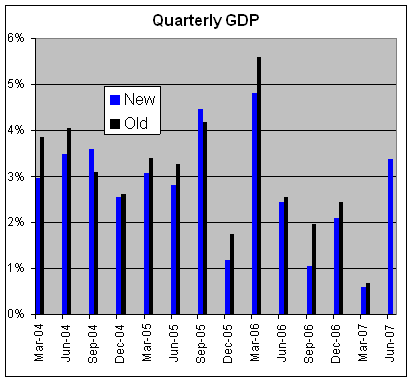
…………………….Old………..…..New
Q1-04………..3.85%………….2.96%
Q2-04………..4.04%………….3.48%
Q3-04………..3.10%………….3.60%
Q4-04………..2.61%………….2.55%
Q1-05………..3.40%………….3.07%
Q2-05………..3.26%………….2.81%
Q3-05………..4.18%………….4.46%
Q4-05………..1.76%………….1.19%
Q1-06………..5.58%………….4.82%
Q2-06………..2.56%………….2.44%
Q3-06………..1.96%………….1.07%
Q4-06………..2.45%………….2.09%
Q1-07………..0.69%………….0.60%
Q2-07………………..…………….3.38%
(We pass the graphics savings on to you.) -
Dow 14000
Posted by Eddy Elfenbein on July 29th, 2007 at 9:13 pmFrom The Onion:
The Dow Jones closed at over 14,000 for the first time last week. What are the contributing factors?
Certain knowledge that crashes like those of 1819, 1837, 1869, 1873, 1929, 1987, 1989, 2000, and 2001 will absolutely never happen again
Record number of contributions during annual Dow Jones telethon
Federal Reserve Chairman Ben Bernanke showing a little more hustle
Market theorist Harry S. Dent’s forecast that people in the fourth quarter of 2007 will like having lots of money
Traders trying to impress cute girl who works at Wall Street Blimpie’s
Dow Jones’ takeover of Marianne’s and other mom-and-pop indexes
Someone forgot to ring the closing bell, resulting in 17 additional hours of trading
Less selling, more buying -
Economy Grew By 3.4% in Q2
Posted by Eddy Elfenbein on July 27th, 2007 at 10:20 amFrom Bloomberg:
The 3.4 percent annual pace of expansion, the most in more than a year, followed a revised gain of 0.6 percent in January to March, the Commerce Department reported today in Washington. The Federal Reserve’s preferred inflation gauge rose at the slowest pace in four years.
Spending on commercial construction projects rose at the fastest pace in 13 years, helping to overcome another drop in homebuilding. Factories ramped up production to fill orders from Europe and Asia that made up for a slowdown in consumer spending. Treasury securities erased gains, stock-index futures trimmed losses and the dollar remained higher.
“The good news is that capital spending and exports are growing,” said Nariman Behravesh, chief economist at Global Insight Inc. in Lexington, Massachusetts. Still, “the economy is plodding along. We’re very vulnerable to a shock.” -
Radio Silence
Posted by Eddy Elfenbein on July 26th, 2007 at 11:59 pmI apologize for the lack of posting earlier. I’m at the Money Show investor conference in San Francisco.
There’s not much I have to add to today’s news except to say that it was very ugly out there. The Buy List, however, was down -1.32%, which was 101 basis points better than the S&P 500. I guess that’s sorta good news.
Also, I’m not buying that this is about valuations. The Value Index (^SVX) was down more than the Growth Index (^SGX). Actually, the Value Index has beaten the Growth Index for seven straight days. That seems a bit odd of a sell-off.
-
Archives
- August 2026
- July 2026
- June 2026
- May 2026
- April 2026
- March 2026
- February 2026
- January 2026
- December 2025
- November 2025
- October 2025
- September 2025
- August 2025
- July 2025
- June 2025
- May 2025
- April 2025
- March 2025
- February 2025
- January 2025
- December 2024
- November 2024
- October 2024
- September 2024
- August 2024
- July 2024
- June 2024
- May 2024
- April 2024
- March 2024
- February 2024
- January 2024
- December 2023
- November 2023
- October 2023
- September 2023
- August 2023
- July 2023
- June 2023
- May 2023
- April 2023
- March 2023
- February 2023
- January 2023
- December 2022
- November 2022
- October 2022
- September 2022
- August 2022
- July 2022
- June 2022
- May 2022
- April 2022
- March 2022
- February 2022
- January 2022
- December 2021
- November 2021
- October 2021
- September 2021
- August 2021
- July 2021
- June 2021
- May 2021
- April 2021
- March 2021
- February 2021
- January 2021
- December 2020
- November 2020
- October 2020
- September 2020
- August 2020
- July 2020
- June 2020
- May 2020
- April 2020
- March 2020
- February 2020
- January 2020
- December 2019
- November 2019
- October 2019
- September 2019
- August 2019
- July 2019
- June 2019
- May 2019
- April 2019
- March 2019
- February 2019
- January 2019
- December 2018
- November 2018
- October 2018
- September 2018
- August 2018
- July 2018
- June 2018
- May 2018
- April 2018
- March 2018
- February 2018
- January 2018
- December 2017
- November 2017
- October 2017
- September 2017
- August 2017
- July 2017
- June 2017
- May 2017
- April 2017
- March 2017
- February 2017
- January 2017
- December 2016
- November 2016
- October 2016
- September 2016
- August 2016
- July 2016
- June 2016
- May 2016
- April 2016
- March 2016
- February 2016
- January 2016
- December 2015
- November 2015
- October 2015
- September 2015
- August 2015
- July 2015
- June 2015
- May 2015
- April 2015
- March 2015
- February 2015
- January 2015
- December 2014
- November 2014
- October 2014
- September 2014
- August 2014
- July 2014
- June 2014
- May 2014
- April 2014
- March 2014
- February 2014
- January 2014
- December 2013
- November 2013
- October 2013
- September 2013
- August 2013
- July 2013
- June 2013
- May 2013
- April 2013
- March 2013
- February 2013
- January 2013
- December 2012
- November 2012
- October 2012
- September 2012
- August 2012
- July 2012
- June 2012
- May 2012
- April 2012
- March 2012
- February 2012
- January 2012
- December 2011
- November 2011
- October 2011
- September 2011
- August 2011
- July 2011
- June 2011
- May 2011
- April 2011
- March 2011
- February 2011
- January 2011
- December 2010
- November 2010
- October 2010
- September 2010
- August 2010
- July 2010
- June 2010
- May 2010
- April 2010
- March 2010
- February 2010
- January 2010
- December 2009
- November 2009
- October 2009
- September 2009
- August 2009
- July 2009
- June 2009
- May 2009
- April 2009
- March 2009
- February 2009
- January 2009
- December 2008
- November 2008
- October 2008
- September 2008
- August 2008
- July 2008
- June 2008
- May 2008
- April 2008
- March 2008
- February 2008
- January 2008
- December 2007
- November 2007
- October 2007
- September 2007
- August 2007
- July 2007
- June 2007
- May 2007
- April 2007
- March 2007
- February 2007
- January 2007
- December 2006
- November 2006
- October 2006
- September 2006
- August 2006
- July 2006
- June 2006
- May 2006
- April 2006
- March 2006
- February 2006
- January 2006
- December 2005
- November 2005
- October 2005
- September 2005
- August 2005
- July 2005
 Eddy Elfenbein is a Washington, DC-based speaker, portfolio manager and editor of the blog Crossing Wall Street. His