-
Today’s Investing Lesson: Diversify
Posted by Eddy Elfenbein on January 25th, 2007 at 4:50 pmThe S&P 500 had a big up day yesterday, and a big down day today. It’s almost back where it started, yet our Buy List managed to beat the index on both days.
What’s particularly impressive is that we were able to stay ahead of the market today even though shares of Varian Medical Systems (VAR) got a super atomic wedgie. The stock dropped 8.6% today. The 11.4% jump in Respironics (RESP) helped ease the pain.
Too many investors never give a thought about diversifying across industries. Or they think diversity means owning several tech stocks. You can own only a few stocks and track the market very closely. Also, you can own hundreds of stocks and have a very low correlation to the rest of the market. -
Interest Rates Are Climbing Higher
Posted by Eddy Elfenbein on January 25th, 2007 at 1:31 pm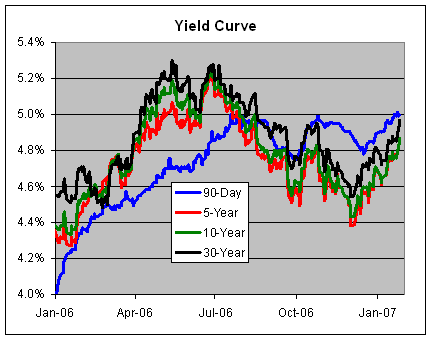
After plunging from May to December, interest rates are rising again. The yield on the 90-day Treasury bill just peaked above 5%. The yield on the 30-year bond is also climbing fast and will probably break through 5% any day now. In fact, the yield may soon “revert” from its inverted status.
In May, the yield on the 30-year was 60 basis points over the 90-day. Then in December, it was 35 points under. Now they’re just about even. -
Earnings from Danaher and Respironics
Posted by Eddy Elfenbein on January 25th, 2007 at 10:42 amThe bad news today is that Varian Medical Systems (VAR) is sharply lower thanks to yesterday’s earnings report. The stock is currently down about 8%. But the good news is we got positive earnings from Danaher (DHR) and Respironics (RESP).
Danaher earned 95 cents a share, two cents more than estimates. For the year, the company earned $3.48 a share which was up from $2.76 in the year before. The company also reaffirmed its 2007 forecast of $3.68 per share to $3.78 per share.
Respironics reported earnings of 40 cents a share, which was also two cents more than expectations. The company earned 33 cents a share in last year’s fourth quarter. Respironics said that it’s comfortable with 2007 estimates of $1.74 to $1.77, which doesn’t include 12 to 13 cents a share in stock compensation. The stock is up about 10% today (woo!), and it’s close to breaking the all-time high of $43.03 reached in October 2005. -
S&P 500 Hits 1,440
Posted by Eddy Elfenbein on January 24th, 2007 at 4:25 pmThe S&P 500 broke through 1,440 for the first time in 75 months. The index was up 0.85% today to 1,440.13. Our Buy List also did well, rising 0.89%. The Dow closed at an all-time high of 12,621.77.
Amphenol (APH) did particularly well as it added $1.44 a share. The stock is now up 8.4% on the year. Also, SEI Investments (SEIC) made a new 52-week high.
After the bell, Varian Medical Systems (VAR) reported earnings of 37 cents a share for the fourth quarter, two cents more than estimates. Even though the company continues to do well, I’ve been surprised by the stock’s sluggish performance over the past year.
In the press release, Timothy Guertin, Varian’s CEO said, “Net earnings should be in the range of $1.89 to $1.91 per diluted share for the year, and approach $0.46 for the second quarter.” Wall Street was expecting 48 cents a share, so the stock is down sharply after hours.
Also, Fair Isaac (FIC) reported earnings of 52 cents a share.The company said that expects to make approximately 48 cents a share for the March quarter, and $2.15 for FY 2007. -
A Look at Government Spending
Posted by Eddy Elfenbein on January 24th, 2007 at 1:46 pmToday is the day that the Congressional Budget Office releases its big report on what the government is (ahem) supposed to spend over the next few years.
One of the things I find interesting is that spending by the federal government has been much less variable than most people realize. From the sound of political debate, you’d think this was highly volatile number, but that’s not the case.
For the last thirty years, non-defense spending has averaged about 16.3% of GDP. When the economy does poorly, the number rises to around 17%. When the economy does well, the number falls to around 15.5%. From Carter to Reagan to Bush to Clinton to Bush, that rule has been pretty consistent.
Please note that I’m saying what the government should spenf, or even what it will spend. I’m simply noting what has happened. Here’s non-defense spending as a part of GDP going back to 1976:

Here’s the data. -
Coach’s Earnings
Posted by Eddy Elfenbein on January 24th, 2007 at 10:16 am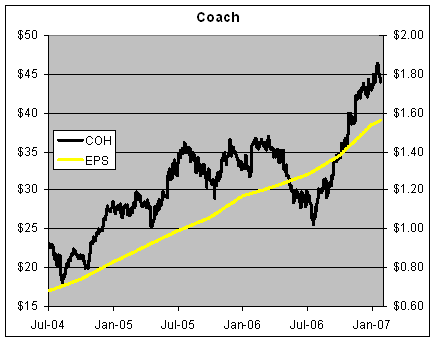
Coach (COH) is one of those rare stocks that keeps delivering. Every time you think it’s over for them, Coach comes through. The company had yet another strong earnings report yesterday. Of course, given their prices, it’s hard to see how they’re not making a lot of money.
For the fourth quarter, Coach earned 61 cents a share, which topped Wall Street’s estimates by three cents a share. Sales grew by 29%. The company also raised its FY 2007 earnings forecast by eight cents to $1.71 a share.
Coach has been one of the big success stories of this decade. The company had its IPO in October 2000 at $16 a share. Since then, the stock has split 2-for-1 three times, which means that the IPO price was just $2 a share. So the stock is up more than 2,000% in a little over six years.
Now Business Week wonders if Coach is becoming too popular:Retail investors remember how Calvin Klein and Tommy Hilfiger lost the shine on their images when they flooded the discount market. Image is clearly an issue among upscale brands. Tiffany’s (TIF), for instance, decided to increase the price on its hugely popular silver jewelry items, fearing that huge sales will tarnish its upscale image. Coach, of course, is known for quality craftsmanship and lately high design. In recent years, it has also introduced purses that are more affordable and priced under $200, and even under $100 in its factory outlets. These steps have clearly attracted a new set of middle-income buyers who previously didn’t shop at Coach, and some fear the brand might lose its cachet if its reach extends too far. “There’s always the danger of overextending yourself,” says Passikoff.
Of course, so far Coach has proved many naysayers wrong and been on an unprecedented growth path. Patricia Pao, founder of New York retail consultancy The Pao Principle, believes that Coach will not falter in its expansion plans because the company’s moves are market research-driven, well planned, and well executed. “They really know the game of building a brand, creating customer experience, and introducing goods that keep customers coming into the store on a daily or weekly basis,” Pao says.By the way, this BW article follows one of the most common formulas in business writing. Introduce your straw man (“Coach can do no wrong!”). Add in some criticisms that can apply to almost anything (“yeah…but, remember the Gap”). Then restate a watered-down version of your initial hypothesis as your conclusion.
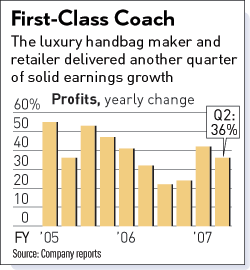
Investor’s Business Daily had a better take. They noted that this was the first quarter in the company’s history where gross margins declined, although operating magins increased:Overall, analysts said, Coach’s high-end success fits in with the bigger market picture. Early returns indicate that luxury retailers such as Tiffany, Nordstrom and Saks all had happy holidays.
Coach is in an interesting position. Although $700 may seem like a lot for a purse, it all depends on where you’re coming from.
“Even their really expensive bags are a bargain compared to the competition,” said Chen, who owns Coach shares. “I know it sounds absurd, because I remember the ’90s, when spending $500 on a bag was spending a lot of money. Now, if you’re not spending at least a grand, it’s not spending a lot of money. That is the perception in the fashion world.”
Coach executives seem to agree, because they steadily have expanded what they consider to be the addressable market. In Tuesday’s conference call, CEO Lew Frankfort remarked that when the firm went public in October 2000, they expected to max out at 250 stores. Now they’re gunning for 400.Here’s IBD‘s chart of Coach’s earnings growth:
-
Banker’s Abrupt Exit Mystery
Posted by Eddy Elfenbein on January 23rd, 2007 at 10:44 amPage 6 of the New York Post:
FINANCIAL giant Citigroup was strangely mum last night on why Todd Thomson, its 45-year-old fair-haired head of wealth management, left the firm suddenly in a management shakeup yesterday. Sources close to the Wall Street giant say Thomson got on the bad side of CEO Chuck Prince by shuttling personal friends – including CNBC’s anchor and “Money Honey” Maria Bartiromo – around the world on the company’s corporate jet.
Sources said that Thomson, whose unit was a financial success story inside the firm, had been warned about his high-flying ways – but that the tipping point came when Bartiromo joined him on the Citi corporate jet between New York and Beijing last year.
A CNBC spokesman later said: “Maria sought and received approval in advance to fly to Asia on Citi’s jet. Billing was handled between CNBC’s corporate parent and Citi.”
Bartiromo, reached via e-mail in Davos, Switzerland, said any connection to Thomson’s departure was “flat-out wrong.”
Thomson, who the firm said left to “pursue other interests,” couldn’t be reached for comment yesterday. Not long ago, he was considered among the front-runners to succeed Prince and was even moved into his current job to be groomed for a run at the CEO post.
Citi has been hypersensitive to any appearances of impropriety ever since its legendary former chief, Sandy Weill, and star analyst Jack Grubman allegedly swapped a positive rating on AT&T stock to get Grubman’s kids into the prestigious 92nd Street Y preschool – one of several legal issues that cost the bank well over $5 billion in fines and court settlements.
And this isn’t the first time a Citigroup jet played a part in corporate embarrassment. Some 15 years ago, then-Chairman John Reed fell in love with a flight attendant on one of the company’s jets.
The joke at the time around Wall Street circles was that when Citi’s jets prepared for landing, passengers were advised: “Please buckle your seat belt, stow your tray table, and put your stewardess in an upright position.” -
Survival of the Fittest
Posted by Eddy Elfenbein on January 22nd, 2007 at 10:51 am
Mr. Adam Monk has beaten the market for the last four years. This year, his picks include Cygne Designs (CYDS), Fresh Del Monte Produce (FDP) and West Pharmaceutical Services (WST).
And yes, he’s the one on the left. -
This Week’s Earnings Schedule
Posted by Eddy Elfenbein on January 22nd, 2007 at 9:59 amThere are four more earnings reports due this week for our Buy List stocks. Fair Isaac (FIC) and Varian (VAR) both report on Wednesday. Then on Thursday, Danaher (DHR) and Respironics (RESP) are due to report.
Next week, Sysco (SYY), Graco (GGG) and Fiserv (FISV) will report. -
Miracle Drug
Posted by Eddy Elfenbein on January 21st, 2007 at 6:11 am
The amazing story of Aspirin:Aspirin was treated as one of the valuable prizes to be divided up by the victors of WWI. The Treaty of Versailles (1919) required Bayer to give up its aspirin trademark in the U.S., Britain, France, and Russia as part of Germany’s war reparations. (Bayer’s U.S. holdings had previously been confiscated and sold to the Sterling Drug Company.) For the next 80 years, Bayer aspirin sold in America was not made by Bayer. It wasn’t until 1994 that the German company bought back the right to use its own name in the United States.
Bayer’s patent expired in the 1930’s and aspirin became a generic drug. Undeterred, Bayer cemented its brand leadership position between the two great wars by sending trucks across Europe with screens and loudspeakers to promote the benefits of Bayer Aspirin. For many thousands of people, the first “moving pictures” they ever saw were images of aspirin use.
In 1950, aspirin was first recognized by the Guinness Book of Records as the world’s best-selling painkiller.
In 1982 the mechanism of action for aspirin – then in use for 83 years – was confirmed as English scientist Professor Sir John Vane and two Swedish colleagues, Sune Bergström and Bengt Samuelsson won the Nobel prize for discovering the role of aspirin in inhibiting prostaglandin production.
Aspirin turned 100 in 1999 with an estimated one trillion tablets having been consumed since its introduction.
The twentieth century was dubbed ‘the age of aspirin’ by Spanish philosopher Jose Ortega y Gasset.
-
Archives
- October 2026
- September 2026
- August 2026
- July 2026
- June 2026
- May 2026
- April 2026
- March 2026
- February 2026
- January 2026
- December 2025
- November 2025
- October 2025
- September 2025
- August 2025
- July 2025
- June 2025
- May 2025
- April 2025
- March 2025
- February 2025
- January 2025
- December 2024
- November 2024
- October 2024
- September 2024
- August 2024
- July 2024
- June 2024
- May 2024
- April 2024
- March 2024
- February 2024
- January 2024
- December 2023
- November 2023
- October 2023
- September 2023
- August 2023
- July 2023
- June 2023
- May 2023
- April 2023
- March 2023
- February 2023
- January 2023
- December 2022
- November 2022
- October 2022
- September 2022
- August 2022
- July 2022
- June 2022
- May 2022
- April 2022
- March 2022
- February 2022
- January 2022
- December 2021
- November 2021
- October 2021
- September 2021
- August 2021
- July 2021
- June 2021
- May 2021
- April 2021
- March 2021
- February 2021
- January 2021
- December 2020
- November 2020
- October 2020
- September 2020
- August 2020
- July 2020
- June 2020
- May 2020
- April 2020
- March 2020
- February 2020
- January 2020
- December 2019
- November 2019
- October 2019
- September 2019
- August 2019
- July 2019
- June 2019
- May 2019
- April 2019
- March 2019
- February 2019
- January 2019
- December 2018
- November 2018
- October 2018
- September 2018
- August 2018
- July 2018
- June 2018
- May 2018
- April 2018
- March 2018
- February 2018
- January 2018
- December 2017
- November 2017
- October 2017
- September 2017
- August 2017
- July 2017
- June 2017
- May 2017
- April 2017
- March 2017
- February 2017
- January 2017
- December 2016
- November 2016
- October 2016
- September 2016
- August 2016
- July 2016
- June 2016
- May 2016
- April 2016
- March 2016
- February 2016
- January 2016
- December 2015
- November 2015
- October 2015
- September 2015
- August 2015
- July 2015
- June 2015
- May 2015
- April 2015
- March 2015
- February 2015
- January 2015
- December 2014
- November 2014
- October 2014
- September 2014
- August 2014
- July 2014
- June 2014
- May 2014
- April 2014
- March 2014
- February 2014
- January 2014
- December 2013
- November 2013
- October 2013
- September 2013
- August 2013
- July 2013
- June 2013
- May 2013
- April 2013
- March 2013
- February 2013
- January 2013
- December 2012
- November 2012
- October 2012
- September 2012
- August 2012
- July 2012
- June 2012
- May 2012
- April 2012
- March 2012
- February 2012
- January 2012
- December 2011
- November 2011
- October 2011
- September 2011
- August 2011
- July 2011
- June 2011
- May 2011
- April 2011
- March 2011
- February 2011
- January 2011
- December 2010
- November 2010
- October 2010
- September 2010
- August 2010
- July 2010
- June 2010
- May 2010
- April 2010
- March 2010
- February 2010
- January 2010
- December 2009
- November 2009
- October 2009
- September 2009
- August 2009
- July 2009
- June 2009
- May 2009
- April 2009
- March 2009
- February 2009
- January 2009
- December 2008
- November 2008
- October 2008
- September 2008
- August 2008
- July 2008
- June 2008
- May 2008
- April 2008
- March 2008
- February 2008
- January 2008
- December 2007
- November 2007
- October 2007
- September 2007
- August 2007
- July 2007
- June 2007
- May 2007
- April 2007
- March 2007
- February 2007
- January 2007
- December 2006
- November 2006
- October 2006
- September 2006
- August 2006
- July 2006
- June 2006
- May 2006
- April 2006
- March 2006
- February 2006
- January 2006
- December 2005
- November 2005
- October 2005
- September 2005
- August 2005
- July 2005
 Eddy Elfenbein is a Washington, DC-based speaker, portfolio manager and editor of the blog Crossing Wall Street. His