-
John Tierney on Neuroeconomics
Posted by Eddy Elfenbein on January 20th, 2007 at 6:42 amFrom the New York Times:
Even the most rational economists, though, realize that the shopper’s mind is more complicated. The brain’s “impartial spectator,” as Adam Smith warned, has to duel with “the passions.” Last year, after surveying shoppers’ passions, behavioral economists at Carnegie Mellon University developed what they call the Tightwad-Spendthrift scale.
But this kind of survey reveals only what shoppers choose to confess. To find out more, the economists teamed with psychologists at Stanford to turn an M.R.I. machine into a shopping mall. They gave each experimental subject $40 in cash and offered the chance to buy dozens of gadgets, appliances, books, DVDs and assorted tchotchkes. Lying inside the scanner, first you’d see a picture of a product. Next you’d see its price, which was about 75 percent below retail. Then you’d choose whether or not you’d like a chance to buy it. Afterward, the researchers randomly chose a couple of items from their mall, and if you had said yes to either one, you bought it; otherwise you went home with the cash.
The good news, for behavioral science, was that the researchers saw telltale patterns, which they report in the Jan. 4 issue of the journal Neuron. “We were frankly shocked at how clear the results were,” said Brian Knutson, the Stanford psychologist who led the experiment. “It was amazing to be able to see brain activity seconds before a decision and predict whether the person would buy it or not.” -
James Surowiecki on CEO Pay
Posted by Eddy Elfenbein on January 19th, 2007 at 12:58 pmFrom the latest New Yorker:
For all the talk of restraining C.E.O. pay, most compensation committees remain what Warren Buffett once called them—“tail-wagging puppy dogs.” At some companies, this is simply because the C.E.O. has packed the board with cronies. But at Home Depot Nardelli did not pick the board members, and most of them were what are usually called independent directors—ones who don’t work for the company or do any business with it. Even when an independent board negotiates a C.E.O.’s contract, however, the directors are often, in a sense, negotiating with themselves. Of the ten independent members of Home Depot’s board, for instance, eight are or have been C.E.O.s. Since C.E.O. pay is often driven by comparisons between companies, directors have a certain interest in keeping executive pay high. Furthermore, the salaries keep escalating because, board members argue, there just aren’t enough good C.E.O. candidates out there. There’s no evidence that this is actually the case, but who is more likely to feel that good C.E.O.s are indispensable and rare than other C.E.O.s?
I’m not so sure interlocking corporate boards is a major source of rising CEO pay. In fact, I’m not convinced that rising CEO is even a problem. Until I see hard evidence, I simply see it as a natural market adjustment. The modern CEO needs more skills to navigate his or her firm through an increasingly complex legal and regulatory environment.
-
Ten Years After
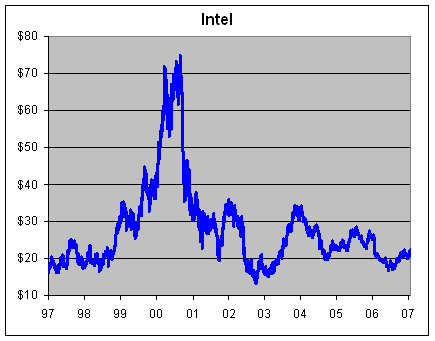
Posted by Eddy Elfenbein on January 19th, 2007 at 7:56 amIntel‘s (INTC) stock is where it was ten years ago.
-
Earnings from HOG and UNH
Posted by Eddy Elfenbein on January 18th, 2007 at 8:51 amThis morning, Harley-Davidson (HOG) reported earnings of 97 cents a share, one penny better than expectations. The Hogs are particularly popular overseas:
Worldwide retail sales of Harley-Davidson motorcycles grew 6.4 percent for the quarter. Shipments grew 6 percent to 92,848 units. Domestically, sales were up only 0.3 percent, but Harley estimated the overall heavyweight motorcycle market was down 1.7 percent for the quarter. Overseas, sales of the iconic bikes were up 29.4 percent, with Canada seeing an increase of 37.4 percent and Europe, an increase of 31.2 percent for the quarter.
UnitedHealth Group (UNH) reported earnings of $1.2 billion. The company didn’t release an earnings-per-share figure because it’s still trying to untangle the stock options mess. As I’ve said before, most of these problems are over. The only impact is that we don’t know exactly what the historical results were. This will probably hang over the stock, but it has zero impact on current operations. The company is doing very well. I think it’s very likely that UNH will make as much as $3.50 a share this year, which means that it’s going for less than 16 times earnings. That’s a good price.
-
Buy List to Date
Posted by Eddy Elfenbein on January 17th, 2007 at 10:33 pmI’m happy to report that the Buy List has gotten the year off to a good start. In just ten days of trading, the 20 stocks on the Buy List are up an average of 2.73% compared with 0.87% for the S&P 500.
Here’s how the 20 stocks have done:Ticker Company YTD Return BBBY Bed Bath & Beyond 10.26% JOSB Jos. A Bank Clothiers 9.40% SEIC SEI Investments 5.34% APH Amphenol 5.28% AFL AFLAC 4.48% GGG Graco 4.29% VAR Varian Medical Systems 4.14% FDS FactSet Research Systems 4.07% UNH UnitedHealth Group 3.57% HOG Harley-Davidson 3.36% RESP Respironics 2.99% DHR Danaher 2.89% FIC Fair Isaac 1.53% MDT Medtronic 1.48% FISV Fiserv 1.32% BMET Biomet 0.97% DCI Donaldson -1.47% NICK Nicholas Financial -2.03% SYY Sysco -2.77% BER WR Berkley -4.55% -
Crossing Wall Street Now Being Studied at Wharton
Posted by Eddy Elfenbein on January 17th, 2007 at 9:57 amSeriously. Under “What Not to Do.”
This is just a little after the course refresher note. I was just doing my web due diligence and I saw a piece at SeekingAlpha that offered some quantitative analysis of the bonds versus stocks for the last months of 2006. The analysis is comically flawed. Have fun with it, and rest assured that no (not even one!) Stat 434 student could make such fundamental, logical errors. Were not talking fancy details here, just stone cold stupidity (mixed with a nice dose of ignorance).
Professor Michael Steele calls my analysis “comically flawed” because I did a regression of prices instead of price changes.
ROFLMAO
OK, maybe it’s not that comical.
Well, I’ll never make that mistake again. In any event, the point I was trying to make was that the stock and bond markets had been rising together until about one month ago. Since then, the two markets have parted ways.
Here lookie:
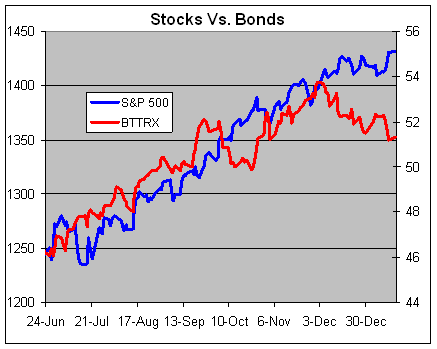
The S&P 500 is the blue (left scale). The American Century Target 2025 fund (BTTRX), which I used as a bond proxy, is the red (right scale).
Note that even the recent up-and-down move in the BTTRX is mirrored by an opposite move in the S&P 500. -
Amphenol’s Earnings Report
Posted by Eddy Elfenbein on January 17th, 2007 at 9:26 amAmphenol (APH) reported earnings this morning of 83 cents a share, two cents more than Wall Street was expecting. This was a 40% increase over last year’s total. Sales rose 30% to $659.4 million.
The company also laid out its future guidance:For the first quarter, the company expects earnings between 80 cents and 82 cents per share on sales between $635 million to $645 million. Analysts are looking for earnings of 80 cents per share on sales of $647.7 million.
For the full year, Amphenol sees earnings between $3.45 and $3.55 per share on sales between $2.65 billion and $2.71 billion. Analysts are expecting earnings of $3.49 per share on sales of 2.7 billion.Going by yesterday’s close, Amphenol is selling for about 18 times 2007’s earnings. The company also annouced a 2-for-1 stock split for late-March.
-
Ameritrade: Keeping It Real
Posted by Eddy Elfenbein on January 16th, 2007 at 2:17 pm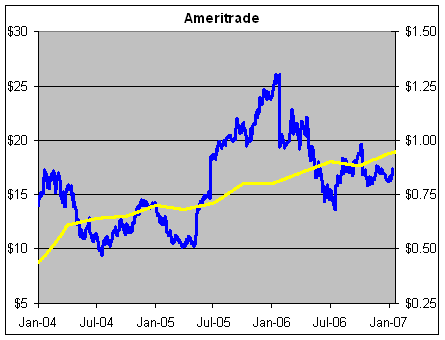
Ugh! Ameritrade (AMTD) is one of those stocks that I kick myself over. It was an obvious buy 18 months ago and I missed it. (The blue line is the price on the left scale, the yellow is the EPS on the right scale.)
In October, the company won my “Earnings Guidance for the Year” award when it changed its FY07 EPS range to $0.98 – $1.22 from $0.99 – $1.21. Glad they cleared that up.
It was only a few months ago that the online brokers took a beating when Bank of America (BAC) announced its free online trading offer (30 trades a month for accounts over $25,000). This morning, Ameritrade reported earnings of 28 cents a share, six cents better than estimates. Profits grew by 69%. The stock is up big in today’s trading. -
NASDAQ 2500!
Posted by Eddy Elfenbein on January 16th, 2007 at 11:59 amI nearly forgot to mention this. On Friday, the NASDAQ Composite (^IXIC) broke 2500. Since I’ve blocked out much of late-1990s, I think this is a new all-time high. It may have gone higher, I don’t remember. Anyway, here’s a long-term chart:
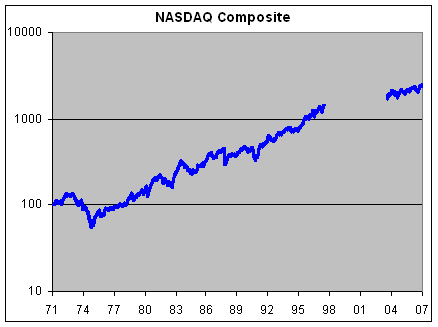
Yep, that’s an all-time high baby! -
Bed Bath & Beyond Makes New 52-Week High
Posted by Eddy Elfenbein on January 16th, 2007 at 10:25 amShares of Bed Bath & Beyond (BBBY) hit a new 52-week high this morning. Lower gas prices basically act like a tax cut for consumers. FactSet (FDS) and SEI Investments (SEIC) are also at new highs.
-
Archives
- October 2026
- September 2026
- August 2026
- July 2026
- June 2026
- May 2026
- April 2026
- March 2026
- February 2026
- January 2026
- December 2025
- November 2025
- October 2025
- September 2025
- August 2025
- July 2025
- June 2025
- May 2025
- April 2025
- March 2025
- February 2025
- January 2025
- December 2024
- November 2024
- October 2024
- September 2024
- August 2024
- July 2024
- June 2024
- May 2024
- April 2024
- March 2024
- February 2024
- January 2024
- December 2023
- November 2023
- October 2023
- September 2023
- August 2023
- July 2023
- June 2023
- May 2023
- April 2023
- March 2023
- February 2023
- January 2023
- December 2022
- November 2022
- October 2022
- September 2022
- August 2022
- July 2022
- June 2022
- May 2022
- April 2022
- March 2022
- February 2022
- January 2022
- December 2021
- November 2021
- October 2021
- September 2021
- August 2021
- July 2021
- June 2021
- May 2021
- April 2021
- March 2021
- February 2021
- January 2021
- December 2020
- November 2020
- October 2020
- September 2020
- August 2020
- July 2020
- June 2020
- May 2020
- April 2020
- March 2020
- February 2020
- January 2020
- December 2019
- November 2019
- October 2019
- September 2019
- August 2019
- July 2019
- June 2019
- May 2019
- April 2019
- March 2019
- February 2019
- January 2019
- December 2018
- November 2018
- October 2018
- September 2018
- August 2018
- July 2018
- June 2018
- May 2018
- April 2018
- March 2018
- February 2018
- January 2018
- December 2017
- November 2017
- October 2017
- September 2017
- August 2017
- July 2017
- June 2017
- May 2017
- April 2017
- March 2017
- February 2017
- January 2017
- December 2016
- November 2016
- October 2016
- September 2016
- August 2016
- July 2016
- June 2016
- May 2016
- April 2016
- March 2016
- February 2016
- January 2016
- December 2015
- November 2015
- October 2015
- September 2015
- August 2015
- July 2015
- June 2015
- May 2015
- April 2015
- March 2015
- February 2015
- January 2015
- December 2014
- November 2014
- October 2014
- September 2014
- August 2014
- July 2014
- June 2014
- May 2014
- April 2014
- March 2014
- February 2014
- January 2014
- December 2013
- November 2013
- October 2013
- September 2013
- August 2013
- July 2013
- June 2013
- May 2013
- April 2013
- March 2013
- February 2013
- January 2013
- December 2012
- November 2012
- October 2012
- September 2012
- August 2012
- July 2012
- June 2012
- May 2012
- April 2012
- March 2012
- February 2012
- January 2012
- December 2011
- November 2011
- October 2011
- September 2011
- August 2011
- July 2011
- June 2011
- May 2011
- April 2011
- March 2011
- February 2011
- January 2011
- December 2010
- November 2010
- October 2010
- September 2010
- August 2010
- July 2010
- June 2010
- May 2010
- April 2010
- March 2010
- February 2010
- January 2010
- December 2009
- November 2009
- October 2009
- September 2009
- August 2009
- July 2009
- June 2009
- May 2009
- April 2009
- March 2009
- February 2009
- January 2009
- December 2008
- November 2008
- October 2008
- September 2008
- August 2008
- July 2008
- June 2008
- May 2008
- April 2008
- March 2008
- February 2008
- January 2008
- December 2007
- November 2007
- October 2007
- September 2007
- August 2007
- July 2007
- June 2007
- May 2007
- April 2007
- March 2007
- February 2007
- January 2007
- December 2006
- November 2006
- October 2006
- September 2006
- August 2006
- July 2006
- June 2006
- May 2006
- April 2006
- March 2006
- February 2006
- January 2006
- December 2005
- November 2005
- October 2005
- September 2005
- August 2005
- July 2005
 Eddy Elfenbein is a Washington, DC-based speaker, portfolio manager and editor of the blog Crossing Wall Street. His