-
Trading Algorithms Grow Increasingly Sophisticated
Posted by Eddy Elfenbein on March 1st, 2006 at 12:48 pmOK, I find this a but unnverving.
The next generation of trading algorithms will be far more flexible, react to unexpected events and handle highly complex relationships, according to a new report released by the Tabb Group, a Westborough, Mass., research firm.
Algorithms, or trading software that seeks to execute trades more efficiently, are now well-entrenched in Wall Street. Adam Sussman, senior consultant at Tabb Group and author of the latest Tabb report, points out how Wall Street firms are developing new products to eliminate the shortcomings of earlier generations of algorithms.
For one thing, Mr. Sussman said that some of the larger brokers are developing multi-asset class algorithms that can trade varied assets such as bonds, stocks and currencies. For instance, someone looking to trade a European stock and wanting to simultaneously hedge their currency risk would find such an algorithm useful. The use of these kinds of algorithms is more prevalent among hedge funds, according to Mr. Sussman. These algorithms help ensure that “you are never exposed to more currency risk or credit risk than you want to be,” he said.
The Tabb study also found that portfolio algorithms are becoming increasingly complex in how they execute orders and are becoming better at formulating an effective execution strategy to trade a portfolio. For instance, some of these algorithms are able to gauge how selling one stock will impact another. The Tabb Group estimates that over the next two years, algorithmic portfolio trading will become as common as single stock algorithms today.What could possbily go wrong?
I know I’ve made some very poor decisions recently, but I can give you my complete assurance that my work will be back to normal. I’ve still got the greatest enthusiasm and confidence in the mission. And I want to help you.
– HAL 9000 in 2001: A Space Odyssey -
Dell CEO Sees Revenue Growth Picking Up
Posted by Eddy Elfenbein on March 1st, 2006 at 12:40 pmDuh.
Dell Inc., which last year disappointed investors with slower-than-forecast revenue growth, expects growth to pick up after the current quarter, Chief Executive Kevin Rollins said on Wednesday.
Dell, the world’s biggest personal computer maker, last month said it expected revenue in its fiscal first quarter to rise 6 percent to 9 percent from a year earlier, much less than the double-digit pace of prior periods.
“Our belief is that we would want to grow faster than that,” Rollins said at a Goldman Sachs technology investment conference in Phoenix, Arizona. “A six to 9 percent growth rate is not something we aspire to.”
Rollins said growth should increase as the company focuses on selling more-expensive products and services after it last year cut prices on entry-level consumer computers, causing it to twice miss analysts’ revenue estimates.The stock is currently less than $1 above its 52-week low.
-
Asbestos, Inc.
Posted by Eddy Elfenbein on March 1st, 2006 at 11:10 amJames Surowiecki on asbestos litigation.
-
H&R Block’s Taxes
Posted by Eddy Elfenbein on March 1st, 2006 at 11:02 amIt can’t be good news when H&R Block messes up its own taxes. Here’s the 8-K report:
The restatement pertains primarily to errors in determining the Company’s state effective income tax rate for the fiscal quarters ended October 31, 2005 and July 31, 2005, fiscal years ended April 30, 2005 and 2004 and the fiscal quarters for fiscal years 2005 and 2004. These errors resulted in a cumulative understatement of state income tax liability (net of federal income tax benefit) of approximately $32 million as of April 30, 2005.
-
SEC: Overstock Isn’t Behind Probe
Posted by Eddy Elfenbein on March 1st, 2006 at 10:57 amThe SEC has said that Overstock.com isn’t behind the investigation into a short-selling ring:
The chief executive of Overstock.com on Wednesday said federal regulators, not the online retailer, were behind the investigation into business journalists as part of a probe into alleged manipulation of the company’s stock.
Patrick Byrne told business news network CNBC that the U.S. Securities and Exchange Commission’s recent subpoenas of journalists who had criticized Overstock came at the agency’s own initiative.
The San Francisco office of the SEC took the unusual step of issuing subpoenas to two Dow Jones & Co. columnists, Carol Remond and Herb Greenberg, to demand telephone records, e-mails and other documents related to Overstock.com.
“It’s my sense that the SEC was onto Herb’s scent long before we came along,” Byrne said. “I have not orchestrated the SEC investigation.”
Byrne acknowledged speaking to SEC officials about the probe, but dismissed the notion that the subpoenas were related to a lawsuit Overstock filed in August against hedge fund Rocker Partners and research firm Gradient Analytics. -
Update on the Buy List
Posted by Eddy Elfenbein on March 1st, 2006 at 10:39 amFor the first two months of the year, the Buy List is up 2.12%. That may not sound like a lot, but it’s ahead of the long-term average, although we’re slightly behind the S&P 500 which is up 2.59% (not including dividends).
-
J&J Is Looking Cheap
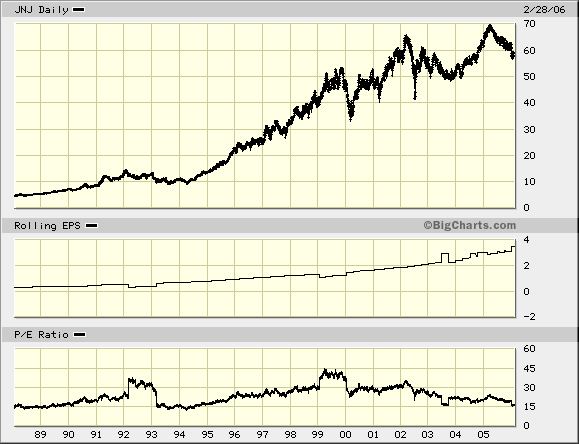
Posted by Eddy Elfenbein on March 1st, 2006 at 10:22 amHas anyone else noticed how cheap Johnson & Johnson (JNJ) is? Good, I thought it was just me. Nearly a year ago, the stock was at $70. Today, it’s around $57.
The company dodged bullet thanks to Boston Scientific (BSX) snatching Guidant (GDT) from them. I was terrified that J&J was going to get stuck with Guidant. As you may have heard me say before, I’m not a fan of mega-mergers.
One of the best ways to find good values on Wall Street is look for the strongest stocks in the weakest sectors. Right now, that’s health care. While Merck (MRK) and Pfizer (PFE) are having their problems, the good stocks like J&J are also being punished.
I’ll give you another good example of this. In 1990, almost all financial stocks were tossed in the garbage. AFLAC (AFL) is one of the best around, and even they saw their stock plunge from (post-split) $3 a share to $1.70. To make a short story shorter, now it’s at $46.
So yes, Johnson & Johnson will manage to survive. The company is Wall Street’s version of a blue blazer. It never goes out of style. The most recent catalyst for J&J’s shares to fall was its “weak” earning report. Of course, for J&J, weak is relative. Earnings came in at 73 cents a share, which was in line with the Street’s estimate. But the surprise was that for the first time in 22 years, revenues declined. The company also guided slightly lower for this quarter.
For the year, J&J sees earnings of $3.78 to $3.85 a share, which means the shares are going for about 15 times earnings. Notice how we saw Medtronic (MDT) also fall on fundamentally good earnings. It’s just because it’s a large-cap health care stock. On Wall Street, you simply can’t argue with a mob. If they want to see bad news, they’ll find it.
I also expect J&J to raise its dividend soon from 33 cents a share to (I’m guessing) 37.5 cents, which is a yield of 2.6%.
Here’s a chart of J&J over the past 18 years. Note the P/E ratio line.
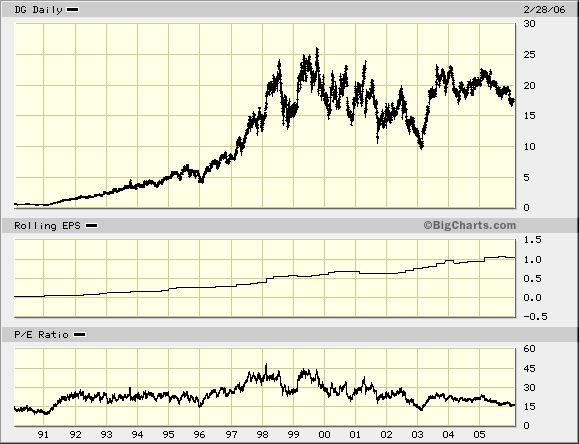
I’ve also included a chart of Dollar General (DG), another stock that’s beginning to look cheap:
-
What’s Your Wonderlic?
Posted by Eddy Elfenbein on February 28th, 2006 at 6:15 pmVince Young got a 6 on his Wonderlic test.
What’s your score? -
Donaldson’s Earnings
Posted by Eddy Elfenbein on February 28th, 2006 at 4:36 pmThe press release makes it sound great, but this was a disappointing quarter for Donaldson (DCI). The company missed the Street’s estimate by a penny a share.
Donaldson Company, Inc. today announced record second quarter diluted earnings per share (“EPS”) of $.32, up from $.31 last year. Net income was a record $26.9 million, versus $26.7 million last year. Sales were a record $392.9 million, up from $388.4 million in fiscal 2005.
For the six-month period, EPS was another record at $.69, up from $.62 last year. Net income increased 9 percent to $59.1 million compared to $54.1 million last year. Sales were a record $796.3 million, up 5 percent from $761.3 million in fiscal 2005.
“Our operating margin improved to 10.2 percent year-to-date from 9.6 percent last year, despite absorbing $2.2 million, or $.02 per share, of stock option expenses into operating profits this year,” said Bill Cook, Chairman, President and CEO. “Donaldson is running very well, with our continued focus on cost reduction efforts offsetting higher commodity prices and driving the improvement in our profit margins. We reduced our full year sales outlook mainly due to currency translation since the dollar is currently weaker against the Euro and Yen than it was in the second half of last year. However, we expect continued positive year-over-year sales growth and for operating margins to continue at these improved levels, giving us confidence in delivering our 17th consecutive year of record earnings.” -
Google Is Having Issues
Posted by Eddy Elfenbein on February 28th, 2006 at 11:28 amGoogle Inc. shares slid as much as 13 percent, their biggest-ever decline, after finance chief George Reyes said growth is slowing at the world’s most-used Internet search engine.
“We’re getting to the point where the law of large numbers starts to take root,” Reyes said today at a Merrill Lynch & Co. investor conference in New York. “Growth will slow. Will it be precipitous? I doubt it.”I wish someone had seen this coming.
More: Mark Hulbert on insider selling at Google (“off the charts”).

-
Archives
- September 2026
- August 2026
- July 2026
- June 2026
- May 2026
- April 2026
- March 2026
- February 2026
- January 2026
- December 2025
- November 2025
- October 2025
- September 2025
- August 2025
- July 2025
- June 2025
- May 2025
- April 2025
- March 2025
- February 2025
- January 2025
- December 2024
- November 2024
- October 2024
- September 2024
- August 2024
- July 2024
- June 2024
- May 2024
- April 2024
- March 2024
- February 2024
- January 2024
- December 2023
- November 2023
- October 2023
- September 2023
- August 2023
- July 2023
- June 2023
- May 2023
- April 2023
- March 2023
- February 2023
- January 2023
- December 2022
- November 2022
- October 2022
- September 2022
- August 2022
- July 2022
- June 2022
- May 2022
- April 2022
- March 2022
- February 2022
- January 2022
- December 2021
- November 2021
- October 2021
- September 2021
- August 2021
- July 2021
- June 2021
- May 2021
- April 2021
- March 2021
- February 2021
- January 2021
- December 2020
- November 2020
- October 2020
- September 2020
- August 2020
- July 2020
- June 2020
- May 2020
- April 2020
- March 2020
- February 2020
- January 2020
- December 2019
- November 2019
- October 2019
- September 2019
- August 2019
- July 2019
- June 2019
- May 2019
- April 2019
- March 2019
- February 2019
- January 2019
- December 2018
- November 2018
- October 2018
- September 2018
- August 2018
- July 2018
- June 2018
- May 2018
- April 2018
- March 2018
- February 2018
- January 2018
- December 2017
- November 2017
- October 2017
- September 2017
- August 2017
- July 2017
- June 2017
- May 2017
- April 2017
- March 2017
- February 2017
- January 2017
- December 2016
- November 2016
- October 2016
- September 2016
- August 2016
- July 2016
- June 2016
- May 2016
- April 2016
- March 2016
- February 2016
- January 2016
- December 2015
- November 2015
- October 2015
- September 2015
- August 2015
- July 2015
- June 2015
- May 2015
- April 2015
- March 2015
- February 2015
- January 2015
- December 2014
- November 2014
- October 2014
- September 2014
- August 2014
- July 2014
- June 2014
- May 2014
- April 2014
- March 2014
- February 2014
- January 2014
- December 2013
- November 2013
- October 2013
- September 2013
- August 2013
- July 2013
- June 2013
- May 2013
- April 2013
- March 2013
- February 2013
- January 2013
- December 2012
- November 2012
- October 2012
- September 2012
- August 2012
- July 2012
- June 2012
- May 2012
- April 2012
- March 2012
- February 2012
- January 2012
- December 2011
- November 2011
- October 2011
- September 2011
- August 2011
- July 2011
- June 2011
- May 2011
- April 2011
- March 2011
- February 2011
- January 2011
- December 2010
- November 2010
- October 2010
- September 2010
- August 2010
- July 2010
- June 2010
- May 2010
- April 2010
- March 2010
- February 2010
- January 2010
- December 2009
- November 2009
- October 2009
- September 2009
- August 2009
- July 2009
- June 2009
- May 2009
- April 2009
- March 2009
- February 2009
- January 2009
- December 2008
- November 2008
- October 2008
- September 2008
- August 2008
- July 2008
- June 2008
- May 2008
- April 2008
- March 2008
- February 2008
- January 2008
- December 2007
- November 2007
- October 2007
- September 2007
- August 2007
- July 2007
- June 2007
- May 2007
- April 2007
- March 2007
- February 2007
- January 2007
- December 2006
- November 2006
- October 2006
- September 2006
- August 2006
- July 2006
- June 2006
- May 2006
- April 2006
- March 2006
- February 2006
- January 2006
- December 2005
- November 2005
- October 2005
- September 2005
- August 2005
- July 2005
 Eddy Elfenbein is a Washington, DC-based speaker, portfolio manager and editor of the blog Crossing Wall Street. His