-
CWS Market Review – April 19, 2021
Posted by Eddy Elfenbein on April 19th, 2021 at 6:26 pm“I want to take you higher.” – Sly Stone
(This is the free version of CWS Market Review. Don’t forget to sign up for the premium newsletter for $20 per month or $200 for the whole year. Thanks for your support.)
The S&P 500 was down modestly today, but the stock market has been in a buoyant mood lately. Through Friday, the index made eight all-time highs in eleven trading sessions. So far this year, the S&P 500 has closed at a new all-time high 23 times. That’s nearly one out of every three trading days.
How Does the Market Act At An All-Time High?
This naturally raises an important question: How has the market performed historically when it’s been at an all-time high?
So I crunched the numbers and counterintuitively, the answer is that the market’s done pretty well. I say counterintuitively because for many investors, the natural response is to get nervous and sell when things are going well. But the smart move, according to the data, is to sit tight and enjoy the rally.
Here’s what I did. First, I took all the daily closes on the S&P 500 going back to 1960 and sorted out all the days when the index closed at an all-time high. There were over 1,000 such days, which is roughly 7% of the time.
Next, I looked at the performance of just those days. On days following an all-time high, the S&P 500 has gained an annualized 14.20%. That’s quite good. On days not following an all-time high, the stock market has risen at an annualized rate of just 6.71%.
In other words, the market’s done better than twice as well when it’s been at an all-time high.
Not only that, but the daily volatility has been much lower as well. Coming off all-time highs, the daily volatility is about half that of the other days. In fact, when the market is at an all-time high, it’s fairly rare to see it jump by more than 1% the following day (although it happened earlier this month).
I found only three times when the market rallied more than 2% coming off an all-time high. The biggest one came on January 5, 1999 when the S&P 500 gained 2.21% after making a new high. That sounds impressive but on all the days since 1960, that day only ranks as the 283rd best.
What does all this mean? The important lesson for us is that the stock market is a momentum-friendly data series. Bull markets tend to build on themselves. Things get better which leads people to think things will get better. The downside is, of course, the turning points because bear markets also build on themselves. Better begets better. Worse begets worse.
This is why fairly simple metrics like the 50-day moving average tend to have a good track record. It couldn’t be simpler. The 50-DMA is just the average price over the last 50 days. Yet most of the best and worst days tend to come when the index is below its 50-DMA. It’s an example of a dumb rule that works because it understands the nature of the market.
What’s interesting is that the big market crashes usually haven’t come at the peak. Instead, they’ve come on growing downward slides from the peak.
Texas Pacific Land Trust
I probably get the most feedback when I write about some obscure company that no one’s heard of that’s creamed the market for years. People often ask me how I know about these stocks and I don’t have a good answer except that I collect them over many years.
Today I want to tell you about a fascinating company called the Texas Pacific Land Trust (TPL). TPL is all about land. Lots and lots of land down in Texas. The Texas Pacific Land Trust currently owns over 900,000 acres in the Lone Star State. As Mark Twain said, “Buy land. They’re not making it anymore.”
TPL has a colorful history. It was born over 130 years ago when the Texas and Pacific Railway went bust. The aim of the T&P was to build a southern transcontinental train route.
You may remember the transcontinental railroad from history class. You know – U.S. Grant, golden spike, Promontory Point. Ring a bell? Well, that ran across the country, but it was mostly through the North. If you were in the South, you had to go north and then go east or west. The aim of the Texas Pacific was to change all that. The plan was to connect Austin to San Diego.
They borrowed tons of money and bought tons of land. Despite the name, the T&P never made it to California. Like many dreamers before them, the railway went bust. Now they had tons of debt. There are vestiges of the old Texas and Pacific Railway. For example, the impressive Texas and Pacific Station still stands in Fort Worth.
Instead of selling off the land, a trust was formed with 3.5 million acres of land. People who held the railway’s worthless bonds got shares of the new land trust. The trust made money, and everyone was happy. Eventually, those shares started trading on the NYSE in 1927. (On a technical point, Texas Pacific Land Trust is not a REIT. It’s a land trust.)
Over the years, TPL has sold off 75% of its holdings. Despite that, it’s still one of the largest private landowners in Texas. The trust gets its income from land sales, oil and gas royalties and grazing fees. They really don’t try to sell their land, and on rare occasions, they’ll actually buy some land. It’s rare, but it happens.
TPL has mostly evaded the looming gaze of Wall Street. Not many people know their story. What I really like that is that much of what TPL owns is in the booming Permian Basin.
But here’s what I really like about TPL. It’s the buyback king. The trust uses any excess cash to buy back its own shares. This is particularly important because as a landowner, the trust doesn’t require large capital investments. They’re just the landlord. Until a few years ago, the entire company employed just ten people. Over the last 40 years, TPL has reduced its share count by two-thirds.
Check out this 30-year chart:
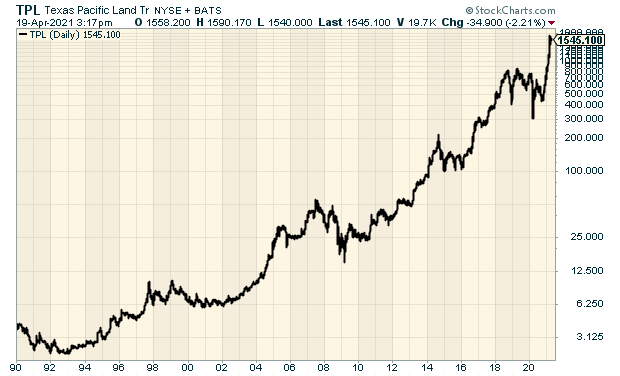
(Pro tip: It’s usually a good sign when a stock has done so well that the log scale numbers on the right turn into a blur.)
Since TPL owns the land outright, they’re not as impacted by the boom-and-bust cycle that characterizes so many companies connected to oil and gas. You’ll notice how often investment bubbles are truly credit bubbles masquerading as something else. That’s not such a problem for TPL since it’s raison d’etre is not being in debt.
TPL was recently the subject of a nasty proxy fight. There were lawsuits and counter suits. Both sides accused the other of fraud. I won’t go into the details except to say that that the legal mess seems to have died down and the two sides have reached an agreement. One side effect is that TPL has converted into a regular corporation. Officially, it’s now the Texas Pacific Land Corporation.
Twenty-five years ago, you could have picked up a share of TPL for about $5. Today that share is worth more than $1,500, and that doesn’t include the dividends you would have collected on the way. In December, TPL paid out a special dividend of $10 per share.
Even though TPL has an amazing track record (+70,000% since 1992) and a market cap of $12 billion, I don’t want you think that it’s completely ignored by Wall Street. Not at all!
Two analysts cover it.
If you haven’t had a chance yet, please subscribe to our premium newsletter. It’s only $20 a month or $200 a year. I’ll have more for you in the next issue of CWS Market Review.
– Eddy
-
Barron’s Highlights Disney
Posted by Eddy Elfenbein on April 19th, 2021 at 10:37 amThe stock market is down a bit this morning but not too much. This looks to be a busy week for earnings, and next week will be even busier. This morning, Coke reported earnings of 55 cents per share. That was five cents more than expectations.
Over the weekend, Barron’s had nice things to say about Disney:
Under Chapek, Disney has faced the severest of financial stress tests and come out ahead. When parks and theaters emptied out a year ago, costs kept rolling in, and the fastest-growing part of the business, streaming, was consuming cash—as it still is. Yet, Disney generated $3.6 billion in free cash during its fiscal year ended last September.
It’s seen producing $3.3 billion this year, before the numbers begin a sharp rebound.
Investors have applauded the story. The company suspended its modest dividend last year. Yet the stock is up 45% since Chapek took over, versus 33% for the S&P 500 index. Netflix had passed Disney by stock market value. Now Disney, recently valued at $340 billion, is ahead by $100 billion, and bullish investors say there’s more to come.
(…)
Back in November 2019, when Disney+ launched, the company had a goal of reaching 60 million to 90 million subscribers by fiscal 2024. In March, it hit 100 million. Netflix took a decade to reach that milestone. It took Disney less than a year and a half. “We were very confident in our proposition, but I think it caught everybody by surprise,” says Chapek.
(…)
Disney bull Alexia Quadrani, who covers the stock for J.P. Morgan, reckons the shares can hit $220 by the end of this year, 18% above their recent quote. That price comes from a sum-of-the-parts analysis that assumes the streaming business is worth 10 times revenue. Netflix trades at eight times revenue.
Earnings are due out on May 13.
-
Morning News: April 19, 2021
Posted by Eddy Elfenbein on April 19th, 2021 at 7:08 am‘We Were Left With Nothing.’ Argentina’s Misery Deepens in the Pandemic.
Harassment Allegations and Fear Haunt European Investment Bank
Bob Diamond’s African Bank Exits Another Market with Botswana Deal
Crypto Stock Mania Tested by Sliding Prices, Bitcoin Slump
‘Britcoin’ Not Bitcoin? UK Considers New Digital Currency
Fearing Foreclosure Crisis, U.S. Watchdog Cracks Down on Mortgage Servicers
The Fed Faces Criticism As It Wades into Climate and Equity Issues
AB InBev Tries to Sell a Better Climate with Solar-Powered Beer
Toyota to Review Climate Stance as Investors Turn Up the Heat
Arizona Mining Fight Pits Economy, EVs Against Conservation, Culture
Tesla Runs on Faith, Exxon Runs on Discipline. Only One Is Right
GameStop CEO George Sherman to Step Down
Howard Lindzon: Brother Can You Spare Me A DOGE? and Was That The Top?
Michael Batnick: It Gets Harder From Here, Have Bear Markets Changed Forever?, Fundamental Growth & Animal Spirits: The Biggest Week For Crypto
Ben Carlson: How Much Should You Have Saved in Your 30s?, What’s A First-Time Homebuyer To Do Right Now? & Talk Your Book: Crypto Update with Zac Prince
Be sure to follow me on Twitter.
-
Nerd Rule
Posted by Eddy Elfenbein on April 16th, 2021 at 10:50 amOne of the important characteristics of the stock market that many newer investors may not realize is how widely distributed the size of companies is on Wall Street.
Simply put, you have a very small group of very, very large companies. You also have a very large group of tiny companies.
Here’s a super nerdy rule of thumb for finding the largest X% of stocks that make up Y% of its total market cap.
Take the square root of X and multiply by 10, and that’s a good ballpark for Y.
For example, the largest 16% of stocks should make up 40% of the total market cap.
Or 49% should make up about 70%. This should work for just about any reasonably-sized index or randomly-selected portfolio.
This is like the 80/20 Rule but in this case, it’s the 50/25 Rule.
No, it’s not perfect, but it’s a pretty good estimate.
-
Morning News: April 16, 2021
Posted by Eddy Elfenbein on April 16th, 2021 at 7:02 amWorld Stocks Near Record Highs as China, U.S. Data Back Global Recovery Hopes
Sanctions on Russian Debt Are Called a ‘First Salvo’ That Sends a Message
China’s Economy Is Booming. Shoppers Are Skittish Anyway.
‘It’s a Roller-Coaster Ride’: Global Chip Shortage Is Making Industries Sweat
Old-School Quant Investor Is Taking a Value Victory Lap
Family Offices Are Targeting 800% Returns With SPAC Economics
Toshiba Bid to Test Japan’s Corporate Governance Rules
As Sanjeev Gupta Rose From Trader to Tycoon, Several Banks Backed Away
Vaccinated Will ‘Likely’ Need Third Pfizer Jab Within 12 Months, Then Annual Shots
The New Mercedes Is a Mix of Tesla and Ferrari
Why the Amazon Workers Never Stood a Chance
Joshua Brown: Five Superpowers
Michael Batnick: Housing Bubble Two Point No
Ben Carlson: Some Thoughts on Coinbase
Be sure to follow me on Twitter.
-
Retail Sales Soar
Posted by Eddy Elfenbein on April 15th, 2021 at 10:48 amThere’s a lot of news this morning. Let’s start with jobless claims which fell to a new pandemic low of 576,000. That’s down from last week’s report of 769,000. The report is still very bad but at least things are moving in the right direction.
This morning’s retail sales report was off the charts. Last month, retail sales rose by 9.8%. This is what happens when you keep people locked up, then release them and give them stimulus checks. Wall Street had been expecting a gain of 6.1%. The number for February was revised upward to a decline of 2.7%.
The critical bar and restaurant industry saw a 13.4% surge, thanks to the increasing relaxing of restrictions as Covid vaccines accelerate to a pace of more than 3 million a day. Sporting goods spending was the highest percentage gainer at 23.5%, followed by clothing and accessories at 18.3% and motor vehicle parts and dealers at 15.1%.
March’s retail sales report was another sign that consumers overall are willing to spend, even though increasing amounts of stimulus checks are going towards savings rather than spending.
Yesterday, the S&P 500 lost 0.41%. That was the index’s worst day in the last three weeks, and it’s not that bad. The stock market is up again to a new all-time high this morning. The S&P 500 has been as high as 4,163.30 this morning. Before yesterday, the S&P 500 had risen seven times in nine sessions.
Thermo Fisher Scientific (TMO) is having a good day. Our Buy Lister said it’s buying PPD for $17.4 billion. That’s $47.50 per share.
From Bloomberg:
The drug-testing field has become a hotbed of activity as companies worldwide seek to roll out new Covid-19 drugs and vaccines, even as they continue to develop new cancer therapies and other treatments. With Covid-19 case numbers remaining high worldwide, and rising concern about future pandemics, the value of CROs is growing.
PPD has worked with Gilead Sciences Inc. on studies of the Covid drug remdesivir and on research involving Roche Holding AG’s Actemra as an arthritis treatment, according to its website. PPD also offers laboratory services.
What Bloomberg Intelligence says:
“ PPD is one of the largest contract research organizations, with scale in clinical, preclinical and central lab end-markets. The marriage of PPD with Thermo’s Patheon manufacturing unit would create a compelling end-to-end offering for biopharma customers, with compelling financial metrics.”
-
Morning News: April 15, 2021
Posted by Eddy Elfenbein on April 15th, 2021 at 7:04 amCoinbase’s Public Listing Is a Cryptocurrency Coming-Out Party
Coinbase Gains as Ark Funds Buy, Analyst Sees ‘Immense’ Upside
With Earnings Soaring, Wall Street Banks See Economic Boom Ahead
Biden to Hit Putin With Russia Sanctions After Summit Offer
Big Business Seeks Unified, Market-Based Approaches Ahead of Climate Summit
JPMorgan Shoots for Green Finance Stratosphere as ESG Target Tops Peer Plans
What Happens When an Oil Giant Walks Away
TSMC Sees Chip Shortage Lasting into 2022, Books Solid Profit
Hundreds of Companies Unite to Oppose Voting Limits, but Others Abstain
Changing Strategy, E.U. Bets Big on Pfizer to Battle Covid
Major Airlines Signal Rejection of New CDC Middle Seat Blocking Guidelines
Bernie Madoff’s Downfall Left Behind A Surprising Legacy
Howard Lindzon: The Coinbase Direct Listing
Joshua Brown: Banks Make a Lot of Money When the Fed + Treasury Outlaw Losses
Michael Batnick: Should I Buy Coinbase? & “Money Losing Companies Hits Record High”
Be sure to follow me on Twitter.
-
Coinbase to IPO Sometime Today
Posted by Eddy Elfenbein on April 14th, 2021 at 11:03 amThe first of the big bank earnings are out today, and they’re looking very good. First up is JPMorgan Chase. The big bank earned $4.50 per share. That beat estimates by $1.40 per share. CEO Jamie Dimon has said the economy is primed for a “Goldilocks moment.”
Next up is Goldman Sachs which earned $18.60 per share. Wall Street had been expecting $10.22 per share.
Also, Wells Fargo made $1.05 per share. Wall Street was looking for 71 cents per share.
Today is the day of the Coinbase IPO. The ticker symbol is COIN. CEO Brian Armstrong owns 20% of the company. He’s going to be a very wealthy man by closing time. The Nasdaq gave them a “reference price” of $250 per share.
Lastly, Bernie Madoff has died age 82. He still had 138 years left on his sentence.
-
Morning News: April 14, 2021
Posted by Eddy Elfenbein on April 14th, 2021 at 7:06 am‘Make or Break’ Call on Inflation Stumps Global Investors
The Biden Administration Is Quietly Keeping Tabs on Inflation
Fed Is More Worried by Inflation Running Too Cold Than Too Hot
Coinbase Listing Marks Latest Step in Crypto’s March to the Mainstream
Dogecoin Price Surpasses 10 Cents to Reach An All-Time High
Hungry for Investors, Some Companies Woo the Little Guy
JPMorgan Posts Investment-Banking Fee Surge While Loans Decline
How the Pandemic Helped Walmart Battle Amazon Marketplace for Sellers
Inside the Secret Battery Lab With a $20 Billion Breakthrough
Broadcast News in Flux as CBS News President Prepares Exit
Controversial Toshiba CEO Steps Down, Shares Jump on Bidding War Expectations
Nick Maggiulli: When Wealth Isn’t Real
Ben Carlson: Overnight Millionaires
Michael Batnick: Animal Spirits: A Shortage of Workers
Howard Lindzon: Crypto – The Beginning of The Beginning… and the Coinbase IPO
Joshua Brown: Nothing To Do Except Gamble, Powell: We’d Rather Clean Up After A Bubble Than Try to Prevent One, You Ever Notice?
Be sure to follow me on Twitter.
-
CWS Market Review – April 13, 2021
Posted by Eddy Elfenbein on April 13th, 2021 at 3:53 pm(This is the free version of CWS Market Review. Don’t forget to sign up for the premium newsletter for $20 per month or $200 for the whole year. Wow, that a deal!)
Highest Monthly Inflation in 12 Years
The big news today was this morning’s CPI report. Normally, the monthly CPI report isn’t that big of a deal, but this month, she was the belle of the ball. That’s because Wall Street expected to see a noticeable upturn in inflation.
That’s for two reasons. The first is simple comparisons. The economy went off the rails one year ago, or was pushed off, so the year-over-over number will seem elevated. The other reason is all the stimulus provided by the federal government. If people are locked up for a year, then allowed outside, plus you give them stimulus checks, well…you might see some inflation.
Wall Street was right: inflation did show up. Last month, consumer prices rose by 0.62%. That’s the highest rate since June 2009. Wall Street had been expecting an increase of 0.5%.
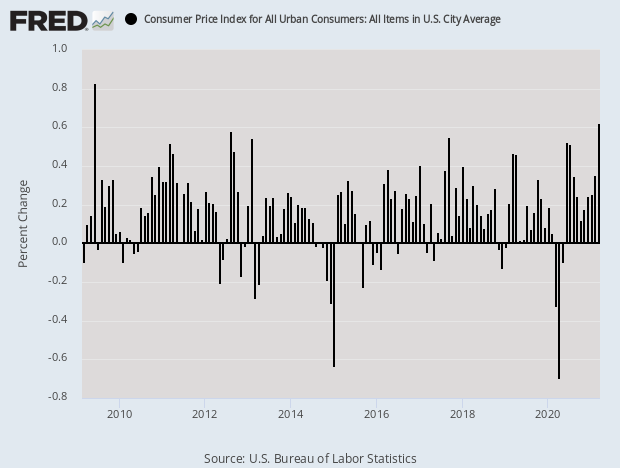
That’s the monthly number. Measured from one year ago, the increase was 2.64%. The year-over-year increase ending in February was just 1.68%. The largest factors for the increase were energy and food.
Gasoline prices were the biggest contributor to the monthly gain, surging 9.1% in March and responsible for about half the overall CPI increase. Gasoline is up 22.5% from a year ago, part of a 13.2% increase in energy prices.
Food nudged higher as well, up 0.1% for the month and 3.5% for the year. The food-at-home category increased 3.3%. All six of the government’s measures of grocery store indexes rose, with the biggest gain of 5.4% in the category of meats, poultry, fish and eggs.
The “core rate,” which excludes food and energy prices, rose by 0.33% last month. Over the past year, core prices are up by 1.65%. What the market really hates is unexpected inflation. Traders really don’t mind Armageddon—as long as it’s on time. This time, the market has been expecting inflation numbers like this, so the effect wasn’t that much on today’s market.
My favorite newsletter used to free but …,
— Rob Masters, Rome, GA (@Chieftain82) April 13, 2021
Touché.
What’s the impact of inflation on the stock market? That’s a good question. Inflation has an unusual impact on earnings. Not all earnings are the same, and inflation exacts a heavy toll on asset-heavy businesses. Companies with high assets relative to their profits tend to report ersatz earnings.
Inflation has an impact similar to putting a magnet near a compass. Everything gets a little screwy. Historically, stocks have not performed well during periods of high inflation. Investors who lived through the 1970s will certainly recall that. It’s no accident that Walmart was such a big winner during the 70s since it was so focused on giving shoppers lower prices.
Here’s a study I did. Professor Robert Shiller, a Nobel prize winner, maintains an online database of historical market data. It goes back 150 years. I took all the monthly data and ranked it by monthly inflation, lowest to highest. I then calculated how the inflation-adjusted stock market had performed when the months were ranked by inflation.
The results were interesting. Historically, the stock market had done pretty well until the annualized inflation rate reached 7.34%. Then it’s been like a light switch. Whenever inflation has exceeded that level, stock returns have gotten markedly worse.
Earlier I mentioned that inflation in March was 0.62%. Annualized, that’s 7.70%. That’s no reason to be scared. Last month was an outlier. I wouldn’t mind seeing inflation drift above 2%, but we’re a long way from the danger zone.
Danaher Raises Revenue Guidance
We had good news today from one of our Buy List stocks. Danaher (DHR) said that its Q1 core revenue will be at the “high end” of its guidance.
For the quarter ended April 2, 2021, the Company expects revenue growth to be approximately 57.0% and non-GAAP core revenue growth including Cytiva to be approximately 29.0%. The better-than-expected performance was broad-based across the portfolio, with particular strength in Life Sciences and Diagnostics.
In its Q4 earnings report from January, Danaher said:
For the first quarter 2021 the Company anticipates that non-GAAP core revenue growth including Cytiva will be in the mid to high-teens range.
For the full year 2021, the Company anticipates non-GAAP core revenue growth including Cytiva will be in the low-double digit range.
This is very good news. The shares were up as much as 5.6% today. Danaher will release its full Q1 earnings report on April 22. I’ll have more details in the premium letter (subscribe here).
WD-40 Drops on Disappointing Earnings
Ever hear a hallway door creek in the middle the night? When your first thought is that it could be home invaders, then you realize that it’s not a job for the police. Instead, it’s a job for WD-40.
A lot of people assume WD-40 is owned by some major industrial like Dow or 3M. Nope. WD-40 is owned by WD-40 (WDFC).
Most every homeowner is familiar with WD-40. The lubricant spray is instantly recognizable by its yellow and blue label. The company dates back to 1953, and the idea of putting WD-40 in an aerosol spray for the consumer market didn’t come about until 1957. Some folks at the firm were working on a Water Displacement formula. The first 39 tries failed, but #40 worked and the name was born.
In 1969, the company decided to rename itself after its only product and four years later, it went public and has traded on the markets ever since. Over the years, the stock has been a big winner for shareholders. Check out this chart:
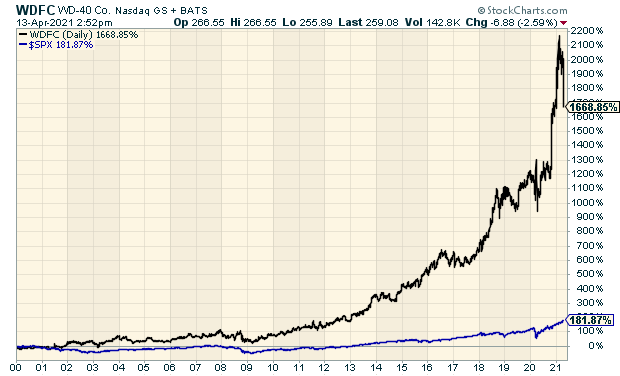
Despite all its success, WD-40 is only followed by two Wall Street analysts. Why has it been so successful? Because it satisfies a basic need. It really isn’t more complicated than that. The company’s offering has grown to include many other applications for WD-40. Consumers love it.
What I like about WD-40 is that it’s a timeless product. Do-it-yourselfers will always have a need for it. No garage is complete without WD-40 and duct tape.
Did you know WD-40 can soften leather? It can also clean tile and erase crayon. It can even unstick Legos. (But do not try it on an iPhone!)
WD-40 now has more than 500 employees across 15 countries. The products are sold in 176 countries around the world. Last year, WD-40 registered sales of more than $408 million. WD-40 currently pays a quarterly dividend of 67 cents per share. That’s up from 27 cents per share 10 years ago.
The reason I bring up WD-40 is that it’s gotten clobbered recently. For its fiscal Q2, the company reported earnings of $1.24 per share. That was eight cents below estimates. Traders were not pleased. Over the past week, shares of WDFC are off about 18%.
I’ve long been a fan of WD-40 and I’ve come close to adding it to our Buy List. The problem is that it’s way too pricey. Well, in the last week, it’s gotten a lot less pricey. This is one to keep an eye on.
If you haven’t had a chance yet, please subscribe to our premium newsletter. It’s only $20 a month or $200 a year.
That’s less than $4 per week.
That’s less than 55 cents per day.
And in leap years, it’s even less!
I’ll have more for you in the next issue of CWS Market Review.
– Eddy
-
Archives
- October 2026
- September 2026
- August 2026
- July 2026
- June 2026
- May 2026
- April 2026
- March 2026
- February 2026
- January 2026
- December 2025
- November 2025
- October 2025
- September 2025
- August 2025
- July 2025
- June 2025
- May 2025
- April 2025
- March 2025
- February 2025
- January 2025
- December 2024
- November 2024
- October 2024
- September 2024
- August 2024
- July 2024
- June 2024
- May 2024
- April 2024
- March 2024
- February 2024
- January 2024
- December 2023
- November 2023
- October 2023
- September 2023
- August 2023
- July 2023
- June 2023
- May 2023
- April 2023
- March 2023
- February 2023
- January 2023
- December 2022
- November 2022
- October 2022
- September 2022
- August 2022
- July 2022
- June 2022
- May 2022
- April 2022
- March 2022
- February 2022
- January 2022
- December 2021
- November 2021
- October 2021
- September 2021
- August 2021
- July 2021
- June 2021
- May 2021
- April 2021
- March 2021
- February 2021
- January 2021
- December 2020
- November 2020
- October 2020
- September 2020
- August 2020
- July 2020
- June 2020
- May 2020
- April 2020
- March 2020
- February 2020
- January 2020
- December 2019
- November 2019
- October 2019
- September 2019
- August 2019
- July 2019
- June 2019
- May 2019
- April 2019
- March 2019
- February 2019
- January 2019
- December 2018
- November 2018
- October 2018
- September 2018
- August 2018
- July 2018
- June 2018
- May 2018
- April 2018
- March 2018
- February 2018
- January 2018
- December 2017
- November 2017
- October 2017
- September 2017
- August 2017
- July 2017
- June 2017
- May 2017
- April 2017
- March 2017
- February 2017
- January 2017
- December 2016
- November 2016
- October 2016
- September 2016
- August 2016
- July 2016
- June 2016
- May 2016
- April 2016
- March 2016
- February 2016
- January 2016
- December 2015
- November 2015
- October 2015
- September 2015
- August 2015
- July 2015
- June 2015
- May 2015
- April 2015
- March 2015
- February 2015
- January 2015
- December 2014
- November 2014
- October 2014
- September 2014
- August 2014
- July 2014
- June 2014
- May 2014
- April 2014
- March 2014
- February 2014
- January 2014
- December 2013
- November 2013
- October 2013
- September 2013
- August 2013
- July 2013
- June 2013
- May 2013
- April 2013
- March 2013
- February 2013
- January 2013
- December 2012
- November 2012
- October 2012
- September 2012
- August 2012
- July 2012
- June 2012
- May 2012
- April 2012
- March 2012
- February 2012
- January 2012
- December 2011
- November 2011
- October 2011
- September 2011
- August 2011
- July 2011
- June 2011
- May 2011
- April 2011
- March 2011
- February 2011
- January 2011
- December 2010
- November 2010
- October 2010
- September 2010
- August 2010
- July 2010
- June 2010
- May 2010
- April 2010
- March 2010
- February 2010
- January 2010
- December 2009
- November 2009
- October 2009
- September 2009
- August 2009
- July 2009
- June 2009
- May 2009
- April 2009
- March 2009
- February 2009
- January 2009
- December 2008
- November 2008
- October 2008
- September 2008
- August 2008
- July 2008
- June 2008
- May 2008
- April 2008
- March 2008
- February 2008
- January 2008
- December 2007
- November 2007
- October 2007
- September 2007
- August 2007
- July 2007
- June 2007
- May 2007
- April 2007
- March 2007
- February 2007
- January 2007
- December 2006
- November 2006
- October 2006
- September 2006
- August 2006
- July 2006
- June 2006
- May 2006
- April 2006
- March 2006
- February 2006
- January 2006
- December 2005
- November 2005
- October 2005
- September 2005
- August 2005
- July 2005
 Eddy Elfenbein is a Washington, DC-based speaker, portfolio manager and editor of the blog Crossing Wall Street. His