-
Retail Sales and Industrial Production
Posted by Eddy Elfenbein on July 16th, 2019 at 11:51 amThis morning, we got two economic reports. The retail sales report for June was quite good. The Commerce Department said retail sales rose 0.4% last month. The numbers for May were revised down to 0.4% from 0.5% growth. Excluding automobiles, gasoline, building materials and food services, retail sales jumped 0.7% last month.
June’s strong gain in core retail sales, coming on the heels of solid increases in April and May, suggested a sharp acceleration in consumer spending in the second quarter.
Consumer spending grew at its slowest pace in a year in the first quarter. Spending is being supported by a tight labor market, even as the broader economy is slowing as weaker business investment, an inventory overhang, a trade war between the United States and China, and softening global growth pressure the manufacturing sector.
The data probably will have little impact on market expectations that the Federal Reserve will cut interest rates this month for the first time in a decade. But signs of strong consumer spending and rising core inflation suggest the U.S. central bank is unlikely to cut rates by 50 basis points at its July 30-31 policy meeting as markets had initially anticipated.
The industrial production report for June was flat. Economists were expecting an increase of 0.2%. Production for manufacturing and mining increased but that was erased by the decline in utilities.
Capacity utilization, which reflects how much industries are producing compared with what they could potentially produce, slipped by 0.2 percentage point to 77.9% in June. Economists had expected 78.1%.
Industrial production has struggled this year, due in part to trade-related headwinds. For the second quarter as a whole, industrial production declined at a 1.2% annual rate, dropping for the second quarter in a row.
Broader economic growth was strong in the first quarter and the labor market has continued to add jobs.
-
Morning News: July 16, 2019
Posted by Eddy Elfenbein on July 16th, 2019 at 7:07 amChristine Lagarde Faces a New Challenge in Europe
China Says Trump ‘Misleading’ People Linking Trade Deal, Slowing Economy
Tariffs on China Don’t Cover the Costs of Trump’s Trade War
Powell Concession on Too-Tight Fed Underlines Shift Toward Cuts
Wall Street Finds Blockchain Hard to Tame After Early Euphoria
Why (Almost) Everybody Hates Facebook’s Cryptocurrency Libra
Citigroup and Other Banks Are Buying Back Their Stocks and That’s Good for Earnings
Amazon Prime Day Brings Sales, and Risks, for Retailers
Tesla Drops Cheapest Model X, S Variants, Cuts Prices to Simplify Lineup
Boeing Max Crisis Hits 2020 Airline Growth as Ryanair Pares Plan
Nestle Creates New Chocolate—With No Added Sugar
Arby’s Has an Answer to Plant-Based Meat: A Meat-Based Carrot
Cullen Roche: My View On: ESG Investing
Michael Batnick: Animal Spirits, Talk Your Book: Agricultural Commodities
Joshua Brown: Everyone Deserves Good Financial Advice. Everyone.
Be sure to follow me on Twitter.
-
Morning News: July 15, 2019
Posted by Eddy Elfenbein on July 15th, 2019 at 7:06 amJapan, Taking a Page From Trump, Uses Trade Against South Korea
China’s Economic Growth Hits 27-Year Low as Trade War Stings
U.S. Firms May Get Nod to Restart Huawei Sales In Two-Four Weeks
Philippine Stocks Propelled Into Bull Market
Peter Thiel Urges U.S. Probe of Google’s ‘Seemingly Treasonous’ Acts
S&P 3,300 – The Bull Vs. Bear Case
‘The Town Hall of Hollywood.’ Welcome to the Netflix Lobby.
Why Budweiser and Bankers Failed to Sell the King of IPOs
More to Come: FTC Fine Doesn’t Spell Closure for Facebook
Gilead to Boost Stake in Belgian Biotech Galapagos as Part of $5.1 Billion Deal
America’s Youth Think They Can Save the World and Get Rich
The Wealthiest 1% Can Be Good for Everybody
Jeff Miller: Weighing the Week Ahead: How Much Has Economic Weakness Hurt Corporate Earnings?
Jeff Carter: The Creative Class
Ben Carlson: Lessons From the 10 Best Years in Stock Market History & What’s in the box!? (The 7 Deadly Sins of Investing)
Be sure to follow me on Twitter.
-
CWS Market Review – July 12, 2019
Posted by Eddy Elfenbein on July 12th, 2019 at 7:08 am“We don’t have any basis, or any evidence, for calling this a hot labor market.”
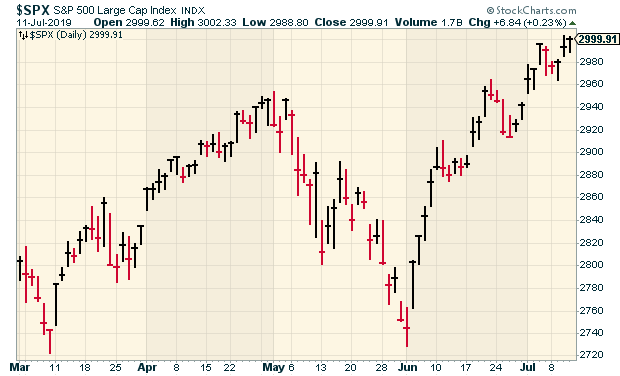
– Jerome PowellFuture historians will note that on Wednesday, July 10 at 9:50 a.m. ET, the S&P 500, for the first time ever, broke through 3,000.
Sure, it fell back again, but it really did happen. Then on Thursday, the Dow broke above 27,000.
What was the cause of this latest rally? That came in the form of Fed Chairman Jay Powell. The Fed head spoke before Congress this week and strongly hinted that the Fed was ready to lower interest rates. How many times is still not known, but Wall Street is pleased with the news. Since June 3, the S&P 500 is up over 9%.
In this week’s CWS Market Review, I’ll go over the latest from the Fed. Also, earnings season is upon us. We have our first Buy List earnings reports coming next week. I’ll preview what’s in store.
The Fed Signals It’s Ready to Cut Rates
Last Friday, shortly after I sent you last week’s issue, the government reported that the U.S. economy created 224,000 net new jobs in June. That was an impressive figure, and it was higher than Wall Street had been expecting. The unemployment rate rose a tick to 3.7%.
On Thursday, we got a CPI report that was a bit higher than expected. The government said that inflation rose 0.1% last month, while the “core rate,” which ignores food and energy, rose by 0.3%. That was the highest jump for core inflation since early 2018.
Also on Thursday, the jobless-claims report fell to 209,000. That’s the lowest in three months.
Taking these three news items together, it appears that the labor market is doing well, and there may be cost pressures building in the economy.
This seems to have had zero effect on the Federal Reserve and its plans for interest rates. This week was the Humphrey-Hawkins testimony. This is the law that requires that the Chairman of the Federal Reserve to go to Capitol Hill twice a year to testify before the House and Senate Committees.
(Years ago, I used to go to these. Once I got the coveted the seat directly behind Bernanke.)
The chairman was asked directly if he thought the labor market was running hot. He said, “We don’t have any basis, or any evidence, for calling this a hot labor market.” That’s unusually frank language for a Fed chair. They’re trained to speak in Obfuscation.
Also this week, we got the minutes from the Fed’s June meeting. They seemed to indicate a growing consensus at the Fed for an interest-rate cut.
Consequently, on Thursday, the Dow, Nasdaq and S&P 500 all closed at record highs. The unemployment rate is near a 50-year low, and the Fed is ready to rescue us. I have to admit that I don’t see the need for a rate cut right now. I thought the December hike was a mistake, so I suppose I can see one rate cut. Wall Street, however, sees a string of rate cuts coming our way. According to the futures markets, there’s a 100% chance of a cut at the end of this month. It’s hard to get more certain than that.
That’s not all. Traders think there’s a 70% chance of another cut in September, plus a third rate cut in December. That could be right. Chairman Powell said, “we hear lots of reports of companies having a hard time finding qualified labor; nonetheless, we don’t really see wages responding.”
One concern is that if the Fed doesn’t cut, then it would be out of alignment with monetary policy in Europe. The European Central Bank may start a new round of bond buying. In fact, the ECB may soon cut interest rates again, which are already negative. Inflation expectations have plunged in Europe.
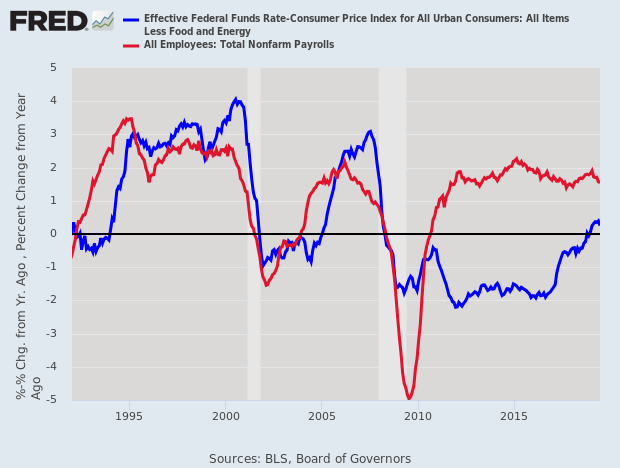
Here’s an interesting chart. The blue line is the real Fed funds rate based on core inflation. The red line is the year-over-year growth in nonfarm payrolls. These two lines had a fairly moderate correlation that was broken apart by the last recession.
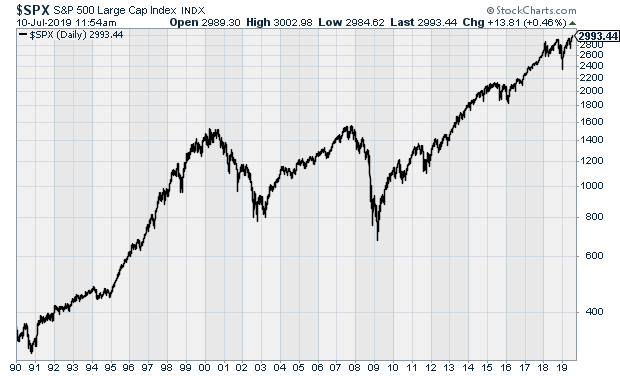
Can the Fed cut rates when the market is near an all-time high? Ryan Detrick ran the numbers and found that since 1980, the Fed has cut rates 17 times when the S&P 500 was within 2% of a new high. One year later, the market was higher all 17 times.
One of the good aspects of our style of investing is that we don’t need to predict Fed policy. While I find the Fed’s plans to be stronger than necessary, they don’t alter our basic approach. The important takeaways are that lower short-term rates are mostly bullish for the stock market. Lower short rates usually allow for higher equity valuations. Indeed, that probably explains why the market jumped to new highs this week.
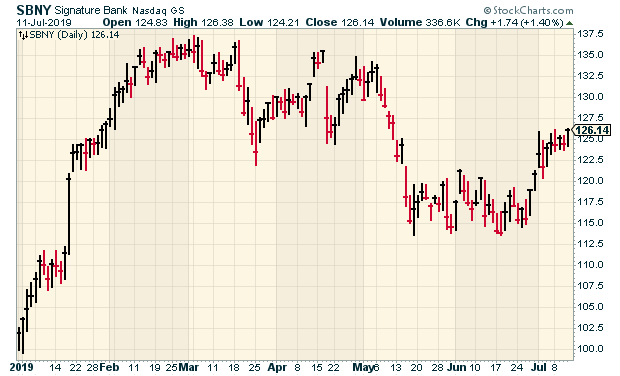
There are also important internal changes to the market. When short-term rates fall, high-dividend stocks are more appealing. We can certainly see that effect in our portfolio. Conversely, financial stocks tend to lag as rates fall. (Please note that I’m speaking in very general terms.)
This week has been a good one for our Buy List. We’re up more than 22% this year. But second-quarter earnings season is about to start. Let’s take a closer look.
Second-Quarter Earnings Preview
There’s hasn’t been a lot of news about our stocks recently. Mostly, it’s been a broad rally, and several of our stocks have made new 52-week highs. On Thursday, both Cerner (CERN) and Moody’s (MCO) made new highs. Both stocks are up over 40% for us this year and have a chance of dethroning FactSet (FDS) as our top performer this year.
Here’s a list of our stocks, the reporting date and Wall Street’s consensus. I have to include my typical warning that these dates and numbers sometimes change. Some companies are, shall we say, not overly forthcoming when it comes to shareholder communication.
 Eddy Elfenbein is a Washington, DC-based speaker, portfolio manager and editor of the blog Crossing Wall Street. His