-
CWS Market Review – June 7, 2019
Posted by Eddy Elfenbein on June 7th, 2019 at 7:08 am“Go for a business that any idiot can run—because sooner or later,
any idiot probably is going to run it.” – Peter LynchMy friend and blogger extraordinaire Josh Brown has a clever way of describing the relationship between the economy and the stock market. He says to think of a woman walking a dog through a park. The woman is walking in a clear path, while the dog lurches all around.
The woman is like the economy. She’s following a steady path. Meanwhile, the dog is like the stock market. It’s erratic and jumping back and forth, but ultimately, the dog arrives at the same destination as the woman.
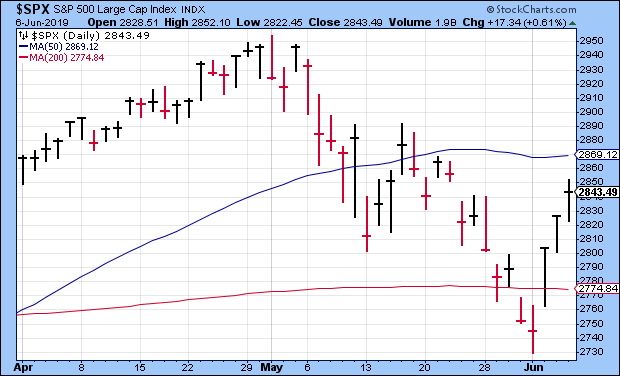
That metaphor has come to mind lately as we’ve experienced a temper tantrum in the financial markets, while the actual economy remains quite stable. The bond market is soaring, and the stock market is dropping. In this week’s CWS Market Review, I’ll explain what it means for us and our investments.
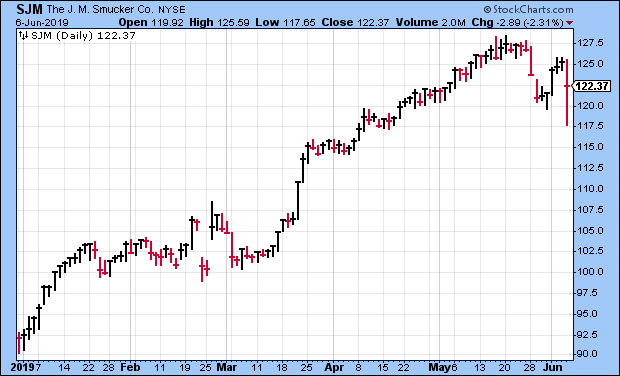
Speaking of which, we just had a very good earnings report from JM Smucker. The jam folks topped Wall Street’s estimates by 13 cents per share. Smucker also had good guidance for the coming year. SJM is now a 30.9% winner for us this year. Before we get to that, let’s take a look at the financial market’s latest freak out.
Will the Fed Come to Wall Street’s Rescue?
Late last year, the stock market threw a hissy fit when the Federal Reserve stuck by its plans to raise interest rates. The central bank was planning to raise rates three times in 2019. Traders didn’t like that at all. Between September and December, the stock market tanked.
The Fed eventually got the message and backed off. The stock market snapped back quickly. It rallied much faster than I had expected. Now we’re in the spring, and the stock market is unhappy again. The major indexes took a bath during May. The selling really got going after a pair of tweets from President Trump escalated the Trade War with China.
Will the Fed come to the rescue again? That’s what the bond market thinks. In anticipation of rate cuts, the yield on the two-year Treasury has fallen off a cliff. The two-year is often a decent proxy for Fed policy. It fell from 2.26% on March 21 to 1.82% this past Monday. That’s a big move for such a short amount of time.
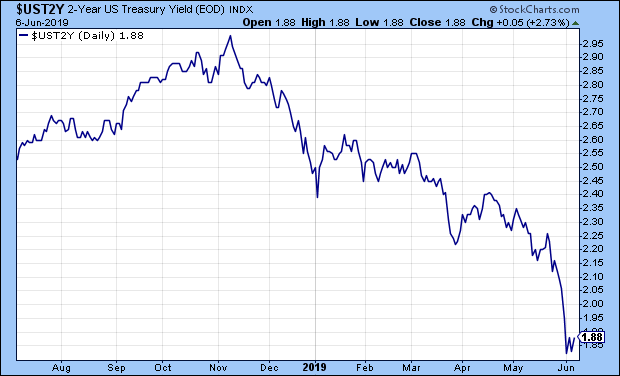
The futures market agrees. The Fed funds futures now thinks the Fed will cut rates at its July meeting, and again at its September meeting. This is a huge about-face from a few months ago. In fact, the futures are split on the odds of a third rate cut in December. This has led to the yield curve becoming partially inverted. Of course, with rates already so low, the Fed doesn’t have much room to cut rates.
Will the Fed take the bait? I’m a skeptic. Central bankers don’t like big dramatic moves, and Chairman Jay Powell is a cautious guy. Without much data indicating that a rate cut is needed, I don’t see the Fed making a move. Just because the market is getting the shakes doesn’t mean the Fed’s going to change course. In the Fed’s mind, they already placated Wall Street by calling off the rate hikes. But now Wall Street wants rate cuts? I doubt it.
I’m in the minority here, but Wall Street is getting way ahead of itself. I’ll give you an example. Recently, Chairman Powell made some perfectly anodyne remarks about the Fed being ready to “act as appropriate to sustain the expansion.” Big deal. All Fed officials say stuff like that. But Wall Street completely overreacted and interpreted the remark as meaning the Fed is ready to pivot. That was enough to spark a relief rally this week.
That leads me back to our original metaphor. The financial markets (the dog on the leash) are frightened that we’re headed to recession meaning that the actual economy (the lady walking the dog) has shown very few signs of trouble.
Sure, this week’s ISM Manufacturing report came in a little light, but it wasn’t that bad. Some other data have been soft, but consumer confidence remains high. The jobless claims reports have been pretty good. Also, mortgage rates are down, so that will help the housing sector. But listening to the financial markets, you’d think the economy is plunging into the abyss.
Not only that, but it’s the kinds of stocks that have taken a beating that’s interesting. The pain has mostly been felt among more aggressive, cyclical stocks. For example, tech stocks have been down. Also, energy stocks are lagging badly. The small-cap Russell 2000 has fallen way behind.
This rotation has been great news for our Buy List stocks. On Thursday, our Buy List closed at a high for this year. This is especially impressive since the S&P 500 is still 3.5% below its high from a few weeks ago. We’re now up 18.4% so far in 2019. That’s 5% better than the S&P 500 (not including dividends).
On Thursday, seven of our stocks hit new 52-week highs: AFLAC (AFL), Cerner (CERN), Church & Dwight (CHD), Danaher (DHR), FactSet (FDS), Hershey (HSY) and Intercontinental Exchange (ICE).
The past few weeks have been excellent for our investing style. The reason is that Wall Street has gotten nervous that a trade war will sink the economy. For the most part, that doesn’t impact our stocks that much. Over the last five weeks, the high-volatility sector has been toast, and we’ve been fine. Apple and Facebook are both down more than 20%, and Google is down 19%. Now let’s look at a surprising winner for us this year.
Smucker Is a Buy up to $130 per Share
On Thursday, JM Smucker (SJM) reported fiscal Q4 earnings of $2.08 per share. Smucker ends its fiscal year on April 30. That’s why we get the earnings report at an odd time.
Overall, this was a solid quarter for SJM. First, some math. Previously, Smucker had given us full-year guidance of $8.00 to $8.20 per share. For the first nine months of the fiscal year, the company had made $6.20 per share. That implies an estimate for Q4 of $1.80 to $2.00 per share. Wall Street had been expecting $1.95 per share.
Whichever number you take, Smucker did much better than estimates. The company also provided guidance for the current fiscal year which is fiscal 2020. Smucker expects sales growth of 1% to 2%. The company expects earnings to range between $8.45 and $8.65 per share. That’s a bold forecast. Wall Street had been expecting $8.33 per share.
Sales growth was a bit weaker than expected. For the quarter, net sales rose 6.8% to $1.90 billion. Wall Street had been expecting $1.93 billion. Like other consumer companies, Smucker has been cutting prices. For the quarter, gross margins fell 2.4% to 36.4%. On the plus side, the pet-food business is doing well. (Yes, Smucker is a lot more than jelly.)
CEO Mark Smucker said:
“We are pleased with the progress that we made during the year towards executing against our strategic plan, which supported fourth-quarter adjusted-earnings growth of 8 percent and full-year adjusted-earnings growth of 4 percent. We successfully integrated Ainsworth, extending our leadership in pet foods, while our key growth brands delivered double-digit sales growth, demonstrating the power of our brands when supported by ongoing product innovation, including 1850® coffee and Jif Power Ups®. We continued to focus on productivity, allowing us to deliver on our cost reduction targets for the year, providing fuel for investment in future growth.”
“As we transition to fiscal year 2020, our organization is committed to delivering on its growth imperatives to lead in the best categories, build brands consumers love, and be everywhere our consumers want us to be. Disciplined investment in our brands across pet food, coffee, and snacking leaves us well-positioned to drive sustainable financial growth and enhance shareholder value for the long term.”
The stock initially dropped 6.1% after the earnings report, but it eventually closed down 2.3%. We have little reason to complain. SJM has been a big winner for us this year. This week, I’m lifting my Buy Below on Smucker to $130 per share.
Buy List Updates
Cerner (CERN) said it’s paying a dividend of 18 cents per share. This is important because it will be Cerner’s first-ever dividend. Impressively, the dividend is 20% higher than the estimate Cerner gave in February.
The new dividend is being paid after Cerner reached a deal with Starboard Value, an activist investor. The dividend will be paid on July 26 to shareholders of record of June 18. It’s not a lot, but it’s good to see. I’m raising my Buy Below on Cerner to $76 per share.
Last month, Church & Dwight (CHD) released a pretty good earnings report. The consumer-products company beat estimates by four cents per share. I was pleased to see gross margins increase by 20 basis points to 45.1%. Operating margins rose 120 basis points to 23.1%.
The company reiterated its full-year EPS guidance of $2.43 to $2.47. That’s an increase of 7% to 9% over last year. For Q2, CHD expects earnings of 52 cents per share, which matches the Street. After the earnings report, I thought of raising my Buy Below price, but I decided against doing so. The shares have performed well recently and touched a new 52-week high on Thursday. I’m raising my Buy Below on Church & Dwight to $82 per share.
That’s all for now. The May jobs report will be out later this morning. Next week, we’ll be getting some important economic reports. On Monday, we’ll get the job-openings report (JOLTS). The CPI report comes out on Wednesday. I’ll be curious to see if there are any price pressures building in the U.S. economy. Then on Friday, we’ll get the retail-sales report and the report on industrial production. Be sure to keep checking the blog for daily updates. I’ll have more market analysis for you in the next issue of CWS Market Review!
– Eddy
-
Morning News: June 7, 2019
Posted by Eddy Elfenbein on June 7th, 2019 at 7:06 amAs Mexico-U.S. Talks Progress, Markets Rise on Hopes a Deal Could Be Close
Trump Says Fed’s Rate Increases Restrained Stock Market Growth
Fed Begins Debate on Whether to Cut Rate as Soon as June
CEOs Are Being Forced to Hedge Against the Chaos of a Full-On Trade War
Europe’s 5G to Cost $62 Billion More if Chinese Vendors Banned
Huawei, Shunned by U.S. Government, Is Welcomed in Russia
How France’s Intrusive Demands Quashed the Fiat-Renault Deal
The Car Industry Is Under Siege
Germany’s Opel Town Shows Struggle for Europe to Plug In Electric Cars
Google to Buy Data Analytics Company Despite New Antitrust Scrutiny
Walmart Wants to Put Groceries Into Your Fridge
Barnes & Noble Nearing Deal to Be Acquired by Elliott Management
Joshua Brown: The New Way To Invest In Emerging Markets
Cullen Roche: Three Things I Think I Think – Don’t Piss in My House
Howard Lindzon: Joe Rogan and Naval Ravikant
Be sure to follow me on Twitter.
-
Smucker Earns $2.08 per Share
Posted by Eddy Elfenbein on June 6th, 2019 at 8:11 amThe J. M. Smucker Company today announced results for the fourth quarter ended April 30, 2019, of its 2019 fiscal year. Financial results for the fourth quarter and fiscal year include the contribution from Ainsworth Pet Nutrition, LLC (“Ainsworth”), which was acquired on May 14, 2018, and reflect the divestiture of the Company’s U.S. baking business on August 31, 2018. All comparisons are to the fourth quarter of the prior fiscal year, unless otherwise noted.
EXECUTIVE SUMMARY
Net sales increased $120.8 million, or 7 percent, driven by the addition of Ainsworth and the Company’s growth brands.
Net income per diluted share was $0.63, including a noncash impairment charge related to the Natural Foods business within the U.S. Retail Consumer Foods segment.
Adjusted earnings per share was $2.08, an increase of 8 percent.
For the full year, net income per diluted share was $4.52. Adjusted earnings per share was $8.29, an increase of 4 percent.
Cash provided by operating activities was $274.2 million, compared to $314.4 million in the prior year.
Free cash flow was $181.6 million in the quarter and $781.4 million for the full year.
The Company provided its fiscal 2020 outlook, with expected net sales growth of 1 to 2 percent and adjusted earnings per share to range from $8.45 to $8.65.
CHIEF EXECUTIVE OFFICER REMARKS
“We are pleased with the progress that we made during the year towards executing against our strategic plan, which supported fourth quarter adjusted earnings growth of 8 percent and full-year adjusted earnings growth of 4 percent. We successfully integrated Ainsworth, extending our leadership in pet foods, while our key growth brands delivered double-digit sales growth, demonstrating the power of our brands when supported by ongoing product innovation, including 1850® coffee and Jif Power Ups®. We continued to focus on productivity, allowing us to deliver on our cost reduction targets for the year, providing fuel for investment in future growth.”
“As we transition to fiscal year 2020, our organization is committed to delivering on its growth imperatives to lead in the best categories, build brands consumers love, and be everywhere our consumers want us to be. Disciplined investment in our brands across pet food, coffee, and snacking leaves us well-positioned to drive sustainable financial growth and enhance shareholder value for the long term.”
-
Morning News: June 6, 2019
Posted by Eddy Elfenbein on June 6th, 2019 at 7:00 amPutin Aims to Revive the Economy With a Plan. And Pianos.
Trump Threatens China with Tariffs on Further $300 Billion of Goods
U.S., Mexico Extend Talks After Trump Claims Lack of Progress
Tech Giants Amass a Lobbying Army for an Epic Washington Battle
Huawei Digs In for a Drawn-Out Battle With Trump’s White House
Ohio To Juárez And Back Again: Why Tariffs On Mexico Alarm The Auto Industry
Fiat Walks Away From Renault Talks, Blaming French State
Beyond Meat’s Home in the Meat Aisle Sparks Food Fight
Amazon’s Drone Delivery Service is One Step Closer to Taking Flight
Uber Copter’s $200 Flights Launch in NYC on July 9th
‘Do I Know You?’ And Other Spam Phone Calls We Can’t Get Rid Of
Jeff Miller: Stock Exchange: Lemons, Lemonade Or Rip Van Winkle?
Roger Nusbaum: Smoothing Out Your Portfolio’s Ride
Ben Carlson: The Influencer Bubble
Be sure to follow me on Twitter.
-
Morning News: June 5, 2019
Posted by Eddy Elfenbein on June 5th, 2019 at 7:15 amGlobal Economy Cools Faster Than Expected as Trade Tensions Rise, World Bank Says
Modern Monetary Theory’s Reluctant Poster Child: Japan
Mexican Officials to Meet Pence in Last-Ditch Talks to Avert Tariffs
First FedEx, Now Ford. China Clamps Down on U.S. Companies
Mnuchin’s Deadlocked China Trade Talks Hang Over Pivotal G-20
SEC Poised to Adopt Rules Aimed at Preventing Broker Conflicts, Boosting Disclosure
Stocks Jump as Fed’s Powell Suggests Rates Could Come Down
Confusing Options May Be Coming to Your 401(k). It Could Cost You.
Short-Seller Pain That Began Monday Just Became a Bloodbath
GameStop: The Knife Keeps On Falling
How A Fight Over Beef Jerky Reveals Tensions Over SNAP In The Trump Era
Woodford ‘Extremely Sorry’ About Cash Freeze in Somber YouTube Video
Nick Maggiulli: The Goldilocks Zone of Personal Finance
Cullen Roche: Is the Bond Market Predicting Recession?
Howard Lindzon: This Is NOT A Coddling Accident!
Be sure to follow me on Twitter.
-
Morning News: June 4, 2019
Posted by Eddy Elfenbein on June 4th, 2019 at 7:56 amA Slower Economy. A Trade War. Now, China Faces Rising Food Prices.
China Warns Citizens Against U.S. Travel, Citing ‘Frequent’ Shootings
U.S. Firms Fret as China’s FedEx Probe, Planned Hit-List Heightens Trade Frictions
Uber Under Tax Investigation by IRS, Foreign Authorities
Antitrust Troubles Snowball for Tech Giants as Lawmakers Join In
The Couple Who Feds Say Scammed Berkshire Hathaway for Millions
The Buy-Side Trader Is Latest Job to Be Outsourced as Costs Rise
Walmart Faces Major India Test Over Unit Flipkart’s Legal Spat With Startup
Forget the Trade War. Citi Sees Brent at $78 Within Three Months
SEC Probes Siemens, GE, Philips in Alleged China Medical Equipment Scheme
Michael Batnick: Re-Kindled: Where Are the Customers’ Yachts & The Coddling of the American Investor
Jeff Carter: The Two Tribes & Corporate Fascism
Ben Carlson: Just the Facts About Market Corrections & Business Booms & Depressions: 1775-1943
Be sure to follow me on Twitter.
-
The Buy List YTD
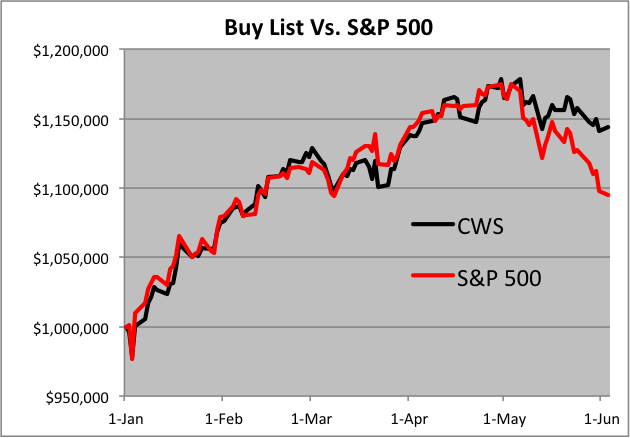
Posted by Eddy Elfenbein on June 3rd, 2019 at 8:08 pmThrough today, our Buy List is up 14.36% while the S&P 500 is up 9.48%. That doesn’t include dividends.
Here’s a chart.
-
Lowest ISM Since October 2016
Posted by Eddy Elfenbein on June 3rd, 2019 at 10:30 amThe ISM report usually comes out on the first business day of the month which is today. The ISM report for May was pretty weak, just 52.1. The expectation was for 53.0. This was the lowest ISM since October 2016.
We’re still not in the danger zone. Historically, recessions line up with ISMs below 44 or 45. But we are closer. Combined with a partially inverted yield curve, this is not good. It’s especially bad with all the heated trade rhetoric.
This morning, the 10-year yield dropped below 2.10%.
-
Morning News: June 3, 2019
Posted by Eddy Elfenbein on June 3rd, 2019 at 7:08 amReeling From Tariff Threat, Mexico Begins Immigration Talks in Washington
Here Are the Most Interesting Items in China’s Trade White Paper
Wall Street Warns of Mounting Recession Risk From Trade War
Google and Amazon Are at the Center of a Storm Brewing Over Big Tech
Blackstone Bets on E-Commerce With $18.7 Billion Logistics Deal
World’s Longest Flight to Be Even Less Comfortable Than Expected
Virgin America Vanishes Along With Branson’s U.S. Dream
Can Tesla Ever Be More Than a Niche Automaker? Wall St. Increasingly Thinks No
AT&T’s Streaming Ambitions Hit a Snag: The Cost of HBO
Warren Buffett Charity Lunch Fetches Record $4.57 Million Winning Bid
For the Chao Family, Deep Ties to the World’s 2 Largest Economies
Roger Nusbaum: Markets Are In Trouble
Joshua Brown: The Land That Time Forgot
Jeff Miller: Is there Any Sense in the Conflicting Market Messages?
Be sure to follow me on Twitter.
-
CWS Market Review – May 31, 2019
Posted by Eddy Elfenbein on May 31st, 2019 at 7:08 am“Intelligent investment is more a matter of mental approach than it is of technique.”
– Ben GrahamThere’s an old Wall Street adage: “sell in May and go away.” Indeed, the historical data shows that the best six-month stretch for investors has been from November to May while the worst has been from May to November.
This year, that advice was exactly right. The S&P 500 had its all-time highest close on the final day of April when the index closed at 2,945.83. The following day, the index reached its intra-day high of 2,954.13.
Since then, the market has gradually drifted lower. On Wednesday, the S&P 500 closed at its lowest level since March 8. The same day, the Dow slipped below 25,000 for the first time in 16 weeks. The S&P 500 is now below its 50-day moving average, and this week it briefly fell below its 200-day moving average.
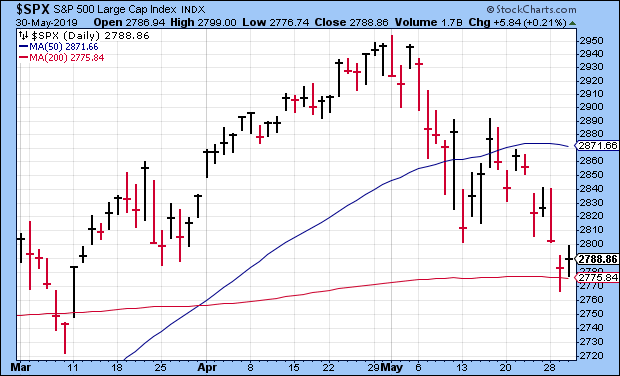
So what has everyone so nervous? The tipping point was President Trump’s tweet from May 5 which escalated the Great Trade War of 2019. What’s interesting about this latest downturn is that it was foreshadowed by the bond market. Not only has the bond market rallied (a lot) but it’s also become inverted, though only partially.
Confused? Fear not. In this week’s CWS Market Review, I’ll explain what it all means. I’ll also take a look at our two recent Buy List earnings reports, Hormel Foods and Ross Stores. Later on, I’ll preview next week’s earnings report from JM Smucker. But first, let’s look at what has Wall Street on edge.
The Yield Curve Gets Inverted…But Only a Little
While the stock market has been weak lately, the bond market has been quite strong. Since November 8, the 10-year yield is down more than 1% (3.24% to 2.22%.) That’s a huge move. We’re in an unusual position right now because the current Treasury yield curve is inverted, but only partially. Treasury yields gradually decrease from one month out until three years out. After that, yields rise again. It almost looks like a check mark.
What explains a check mark curve? Perhaps the market expects one or two therapeutic rates within a broader tightening cycle. The futures market thinks there’s a 65% chance that the Fed will cut by the September meeting. It could happen, but I’m a doubter. Going by the Fed’s statements, they seem to like things as they are. For a rate cut to be on the table, I would expect to see decidedly worse economic news (and worse financial markets). We’re just not seeing it.
The Fed meets again in mid-June. It’s also a meeting where they’ll update their economic forecasts. Personally, I think that meeting will be a big snoozer. The Fed doesn’t like the perception, not unfairly held, that they’re Wall Street’s lackey. It took a pretty big market hissy fit last year just to get the Fed to back off on planned rate hikes. Actual rate cuts are quite another thing.
The Fed also doesn’t want to be seen as bailing out a president in a trade spat they most certainly oppose. The latest is that President Trump is hitting Mexico with a 5% tariff. There is, however, a possible finale to all the trade rhetoric. In June, there’s a big G20 meeting, and it’s possible that President Trump will announce a trade deal with President Xi Jinping of China.
The trade talk and bond-market rally has had an interesting impact on the stock market outside of simply going down. Over the past few weeks, a wide gap has opened between “high beta” stocks and those with low volatility. The more volatile stocks have been dropping the most, while the low volatility sector has been holding steady. Over the last few weeks, the high beta sector is down 10.25% while the low vol sector is higher by 0.75%.
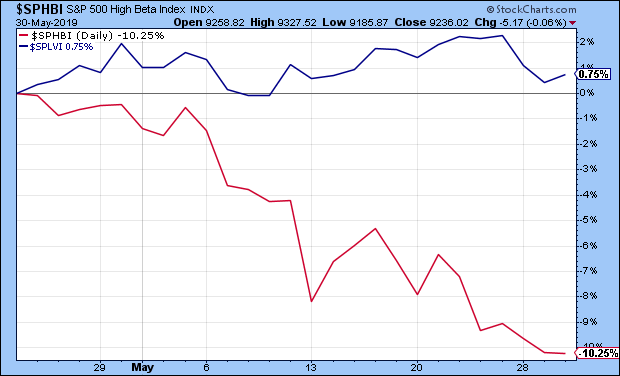
When the stock and bond markets act like this, it means that investors are shunning risk and seeking safety. The 30-year Treasury is now near its lowest point since Election Day in 2016. Within the stock market, sectors like tech, energy and industrials have been lagging. On the other hand, defensive areas have been doing well.
Since our Buy List is concentrated in high-quality stocks, we’ve been doing very well lately, in a relative sense. Or more precisely, we’re flat while everyone else is dropping. For the year so far, our Buy List is up 14.94% to the S&P 500’s 11.25%. But you can really see the divergence in the last month. Since April 22, the S&P 500 is down 4.10% while our Buy List is actually higher by 0.17%. That’s an unusually big gap for such a short time period. This is exactly why we own high-quality stocks. Now let’s take a look at two recent earnings reports from our Buy List.
Earnings from Hormel Foods and Ross Stores
We had two Buy List earnings reports last week. These were for companies that had quarters ending at the end of April. Let’s start with Hormel Foods (HRL). On Thursday, May 23, the Spam company reported fiscal-Q2 earnings of 46 cents per share. That beat expectations by one penny per share.
Despite the earnings beat, Hormel lowered its fiscal 2019 outlook. They now see sales of $9.5 billion to $10 billion. The previous guidance was $9.7 billion to $10.2 billion. They also lowered their EPS guidance to $1.71 to $1.85. The previous range was $1.77 to $1.91 per share.
Jim Snee, Hormel’s CEO, said that despite record sales, Q2 did not meet their expectations: “African swine fever in China started to impact global hog and pork markets this quarter, which led to rapidly increasing input costs. In response, we have announced pricing action across our branded value-added portfolio in the Grocery Products, Refrigerated Foods and International segments.”
Snee said that the lower guidance “is based on the input cost increases experienced in the second quarter and a forecast for volatile domestic pork prices in the second half of fiscal 2019.”
On Thursday, shares of Hormel gapped down at the open. At one point, HRL was off by 6.3%. After that, HRL rallied back, and it closed yesterday not far from where it was before the earnings. It’s as if the market thought it over and changed its mind.
Hormel’s outlook is troubling, but I’m still confident the company can manage its way through short-term issues. As a precaution, this week, I’m lowering my Buy Below on Hormel Foods to $42 per share.
Also on Thursday, Ross Stores (ROST) released its fiscal-Q1 earnings report. For the February/March/April period, Ross made $1.15 per share. Previously, the deep-discounter had given us an earnings range of $1.05 to $1.11 per share. As usual, their guidance was conservative. Comparable-store sales were up 2%.
Barbara Rentler, Chief Executive Officer, commented, “For the first quarter, we delivered sales gains at the high end of our guidance as well as better-than-expected earnings-per-share growth despite continued underperformance in Ladies’ apparel. While operating margin of 14.1% was down from the prior year, it was above plan mainly due to higher merchandise margin. As expected, this improvement was more than offset by increases in freight and wage costs and the timing of packaway-related expenses that benefited the prior-year period.”
For Q2, Ross sees comparable-store sales growth of 1% to 2%. For EPS, the company sees the exact same as Q1, $1.05 to $1.11 per share. Wall Street had been expecting $1.14 per share.
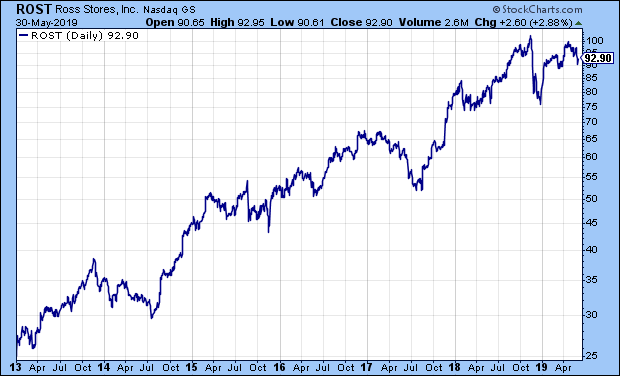
The company also updated its full-year guidance. Ross now sees earnings of $4.38 to $4.52 per share. That includes seven cents per share thanks to a favorable tax benefit. The previous range was $4.30 to $4.52 per share. Adjusting for that, in effect, ROST’s guidance range narrowed thanks to a one-cent increase at the low end and a five-cent decrease at the high end.
The shares pulled back after the earnings report, but it was nothing too serious. At one point on Wednesday, ROST dipped below $90 per share. I’m still a fan. Ross Stores is a buy up to $95 per share.
Earnings from Smucker on June 6
At the start of the year, I would not have guessed that JM Smucker (SJM) would be a 30% winner for us by May, but here we are. Of course, one of the best parts of our strategy is that we don’t have to make such guesses. We buy and we wait. The jelly people are due to report their fiscal-Q4 earnings next Thursday, June 6.
For their fiscal Q3, Smucker earned $2.26 per share, which nicely beat Wall Street’s estimate of $2.02 per share. Sales rose 6% to just over $2 billion. Most importantly, the company stood by its full-year forecast.
For the entire fiscal year, Smucker expects sales of $7.9 billion and earnings of $8.00 to $8.20 per share. They’ve already made $6.20 per share for the first three quarters, so that translates to a Q4 range of $1.80 to $2.00 per share. Wall Street expects $1.95 per share.
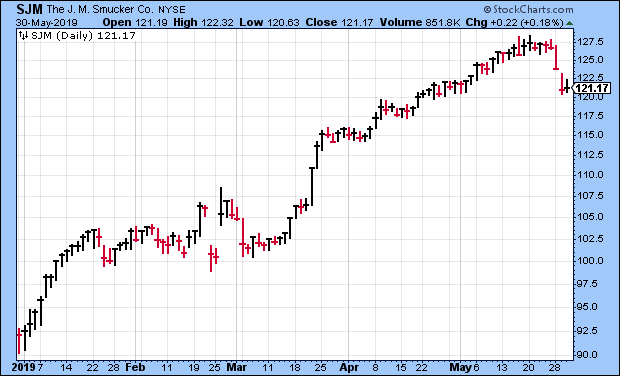
Smucker also said that results for FY 2020, which began on May 1, will be above Wall Street’s expectations. At the time, Wall Street had been expecting 2020 earnings of $8.22 per share. That consensus is now up to $8.33 per share. The current share price is about 14.5 times that, so the stock is reasonably valued.
Remember that Smucker is a lot more than jelly. Their divisions are coffee, retail consumer foods, retail pet foods and international. The stock actually got dinged on Tuesday and Wednesday of this week. Look for a solid earnings report.
After the Smucker report, we enter a dry patch for Buy List earnings. There’s not much until the Q2 earnings season heats up in mid-July. We have two Buy List stocks with quarters that ended in May. FactSet (FDS) will report its earnings on June 25. The other is RPM International (RPM), but they won’t report until mid-to-late July. Companies are allowed extra time with their fiscal Q4 report.
Speaking of FactSet, last week the company raised its dividend by 12.5%. The payout will rise from 64 cents to 72 cents per share. This is the 14th annual dividend increase in a row. The cash dividend will be paid on June 18 to holders of record at the close of business on May 31.
Before I go, I wanted to mention Check Point Software (CHKP). This is a very good company, but the shares have been knocked around lately. In April, CHKP beat earnings by a penny, but traders got spooked by poor guidance. In my opinion, that guidance wasn’t that bad. The day of the earnings report, the shares dropped 7.4%. What’s surprised me is that CHKP has fallen another 6.2% on top of that. Look for a bounce. I’m lowering my Buy Below on Check Point to $120 per share.
That’s all for now. Next week is the first week of June, and with that, we’ll get several of the key turn-of-the-month economic reports. The ISM Manufacturing report comes out on Monday. This is often a good gauge of the factory sector. ADP will release its payroll report on Wednesday. Then on Thursday, the jobless-claims report is due out. This all leads up to the big jobs report next Friday. That last report showed the lowest unemployment rate in five decades. Be sure to keep checking the blog for daily updates. I’ll have more market analysis for you in the next issue of CWS Market Review!
– Eddy
-
Archives
- July 2026
- June 2026
- May 2026
- April 2026
- March 2026
- February 2026
- January 2026
- December 2025
- November 2025
- October 2025
- September 2025
- August 2025
- July 2025
- June 2025
- May 2025
- April 2025
- March 2025
- February 2025
- January 2025
- December 2024
- November 2024
- October 2024
- September 2024
- August 2024
- July 2024
- June 2024
- May 2024
- April 2024
- March 2024
- February 2024
- January 2024
- December 2023
- November 2023
- October 2023
- September 2023
- August 2023
- July 2023
- June 2023
- May 2023
- April 2023
- March 2023
- February 2023
- January 2023
- December 2022
- November 2022
- October 2022
- September 2022
- August 2022
- July 2022
- June 2022
- May 2022
- April 2022
- March 2022
- February 2022
- January 2022
- December 2021
- November 2021
- October 2021
- September 2021
- August 2021
- July 2021
- June 2021
- May 2021
- April 2021
- March 2021
- February 2021
- January 2021
- December 2020
- November 2020
- October 2020
- September 2020
- August 2020
- July 2020
- June 2020
- May 2020
- April 2020
- March 2020
- February 2020
- January 2020
- December 2019
- November 2019
- October 2019
- September 2019
- August 2019
- July 2019
- June 2019
- May 2019
- April 2019
- March 2019
- February 2019
- January 2019
- December 2018
- November 2018
- October 2018
- September 2018
- August 2018
- July 2018
- June 2018
- May 2018
- April 2018
- March 2018
- February 2018
- January 2018
- December 2017
- November 2017
- October 2017
- September 2017
- August 2017
- July 2017
- June 2017
- May 2017
- April 2017
- March 2017
- February 2017
- January 2017
- December 2016
- November 2016
- October 2016
- September 2016
- August 2016
- July 2016
- June 2016
- May 2016
- April 2016
- March 2016
- February 2016
- January 2016
- December 2015
- November 2015
- October 2015
- September 2015
- August 2015
- July 2015
- June 2015
- May 2015
- April 2015
- March 2015
- February 2015
- January 2015
- December 2014
- November 2014
- October 2014
- September 2014
- August 2014
- July 2014
- June 2014
- May 2014
- April 2014
- March 2014
- February 2014
- January 2014
- December 2013
- November 2013
- October 2013
- September 2013
- August 2013
- July 2013
- June 2013
- May 2013
- April 2013
- March 2013
- February 2013
- January 2013
- December 2012
- November 2012
- October 2012
- September 2012
- August 2012
- July 2012
- June 2012
- May 2012
- April 2012
- March 2012
- February 2012
- January 2012
- December 2011
- November 2011
- October 2011
- September 2011
- August 2011
- July 2011
- June 2011
- May 2011
- April 2011
- March 2011
- February 2011
- January 2011
- December 2010
- November 2010
- October 2010
- September 2010
- August 2010
- July 2010
- June 2010
- May 2010
- April 2010
- March 2010
- February 2010
- January 2010
- December 2009
- November 2009
- October 2009
- September 2009
- August 2009
- July 2009
- June 2009
- May 2009
- April 2009
- March 2009
- February 2009
- January 2009
- December 2008
- November 2008
- October 2008
- September 2008
- August 2008
- July 2008
- June 2008
- May 2008
- April 2008
- March 2008
- February 2008
- January 2008
- December 2007
- November 2007
- October 2007
- September 2007
- August 2007
- July 2007
- June 2007
- May 2007
- April 2007
- March 2007
- February 2007
- January 2007
- December 2006
- November 2006
- October 2006
- September 2006
- August 2006
- July 2006
- June 2006
- May 2006
- April 2006
- March 2006
- February 2006
- January 2006
- December 2005
- November 2005
- October 2005
- September 2005
- August 2005
- July 2005
 Eddy Elfenbein is a Washington, DC-based speaker, portfolio manager and editor of the blog Crossing Wall Street. His