-
Earnings from Signature Bank and Danaher
Posted by Eddy Elfenbein on July 18th, 2019 at 7:21 amPress release from Signature Bank:
Net Income for the 2019 Second Quarter Was $147.9 Million, or $2.72 Diluted Earnings Per Share, Versus $154.6 Million, or $2.83 Diluted Earnings Per Share, Reported in the 2018 Second Quarter
The Bank Declared a Cash Dividend of $0.56 Per Share, Payable on or After August 15, 2019 to Common Stockholders of Record at the Close of Business on August 1, 2019
During the 2019 Second Quarter, the Bank Repurchased 412,977 Shares of Common Stock For a Total of $50.0 Million. Thus Far, the Bank Has Repurchased $114.7 Million of Common Stock From Its $500 Million Authorization
Total Deposits in the Second Quarter Grew $917.9 Million to $37.54 Billion; Total Deposits Have Grown $2.55 Billion, or 7.3 Percent, Since the End of the 2018 Second Quarter. Average Deposits Increased $456.0 Million in the 2019 Second Quarter
For the 2019 Second Quarter, Loans Increased $466.5 Million, or 1.2 Percent, to $37.93 Billion. Since the End of the 2018 Second Quarter, Loans Have Increased 11.1 Percent, or $3.78 Billion. During the 2019 Second Quarter, the Bank Sold $46.4 Million of Taxi Medallion Loans and Sold a $91.8 Million Portfolio of Signature Financial Equipment Loans. Excluding These Sales, Loans Would Have Increased $604.7 Million
Non-Accrual Loans Were $41.3 Million, or 0.11 Percent of Total Loans, at June 30, 2019, Versus $94.7 Million, or 0.25 Percent, at the End of the 2019 First Quarter and $158.1 Million, or 0.46 Percent, at the End of the 2018 Second Quarter. Excluding Taxi Medallion Loans, Non-Accrual Loans Were $22.5 Million, or Six Basis Points of Total Loans
Net Interest Margin on a Tax-Equivalent Basis was 2.74 Percent, Compared with 2.75 Percent for the 2019 First Quarter and 2.94 Percent for the 2018 Second Quarter. Core Net Interest Margin on a Tax-Equivalent Basis Excluding Loan Prepayment Penalty Income Decreased Two Basis Points to 2.71 Percent, Compared with 2.73 Percent for the 2019 First Quarter
Tier 1 Leverage, Common Equity Tier 1 Risk-Based, Tier 1 Risk-Based, and Total Risk-Based Capital Ratios were 9.70 Percent, 11.59 Percent, 11.59 Percent, and 12.82 Percent, Respectively, at June 30, 2019. Signature Bank Remains Significantly Above FDIC “Well Capitalized” Standards. Tangible Common Equity Ratio was 9.46 Percent
In the 2019 Second Quarter, the Bank Appointed Two Private Client Banking Teams. Thus Far in 2019, Four Teams have Joined the Bank, Including the 28 Person Venture Banking Group and the Eight Person Kanno-Wood Team Which Specializes in Banking to Mortgage Servicing Clients
Signature Bank (SBNY), a New York-based full service commercial bank, today announced results for its second quarter ended June 30, 2019.
Net income for the 2019 second quarter was $147.9 million, or $2.72 diluted earnings per share, versus $154.6 million, or $2.83 diluted earnings per share, for the 2018 second quarter. The decrease in net income for the 2019 second quarter, versus the comparable quarter last year, is due to an increase of $19.3 million in non-interest expenses mostly due to the significant hiring of private client banking teams, including nearly 50 employees added for the Fund Banking Division, Venture Banking Group and the Kanno-Wood Team.
Net interest income for the 2019 second quarter reached $326.3 million, up $5.3 million, or 1.6 percent, when compared with the 2018 second quarter. This increase is primarily due to growth in average interest-earning assets. Total assets reached $48.88 billion at June 30, 2019, an increase of $3.66 billion, or 8.1 percent, from $45.22 billion at June 30, 2018. Average assets for the 2019 second quarter reached $48.78 billion, an increase of $4.20 billion, or 9.4 percent, compared with the 2018 second quarter.
Deposits for the 2019 second quarter rose $917.9 million to $37.54 billion at June 30, 2019. When compared with deposits at June 30, 2018, overall deposit growth for the last twelve months was 7.3 percent, or $2.55 billion. Average deposits for the 2019 second quarter reached $36.93 billion, an increase of $456.0 million.
“During the past several years, and particularly over the last twelve months, Signature Bank has been focused on expanding our franchise and securing a larger presence throughout the national banking landscape. To reflect, we began diversifying our revenue streams with the launch of Signature Financial, our specialty finance subsidiary. We continued the diversification and expansion of the Bank with the addition of the Digital Banking Team and the Fund Banking Division, which have both already made meaningful contributions. Moreover, we recently added the Venture Banking Group as well as the Kanno-Wood team, which will provide treasury management products and services to residential and commercial mortgage servicers. We also launched Signet, our 24/7 payments platform, which today continues to be the only such platform offered by an FDIC-insured institution. All these banking teams, which are national in scope, have raised Signature Bank’s profile and offerings and are contributing to a more diversified credit and asset liability position over the short and long term,” explained Joseph J. DePaolo, President and Chief Executive Officer.
“Signature Bank is establishing a banking presence across the country. We have always grown this institution prudently and methodically, utilizing our strong reputation and solid capital position to attract the best bankers available in their industry and keeping the needs of our clients and their depositor safety at the forefront of all we do,” DePaolo concluded.
“In spite of a challenging deposit environment, we once again delivered solid deposit and loan growth leading to strong earnings. Also, we further reduced our risk in the Taxi Medallion portfolio with the sale of $46.4 million in NYC taxi loans on 375 medallions. Additionally, we have put in place several major new initiatives, which will provide significant benefit to our institution over the coming years. Personally, I have never been more positive on our future growth prospects. Our model of doing business remains robust, and we will continue to build value for our long-term investors,” explained Scott A. Shay, Chairman of the Board.
Danaher Corporation today announced results for the second quarter 2019. For the quarter ended June 28, 2019, net earnings were $731.3 million, or $0.97 per diluted share which represents a 2.0% year-over-year increase from the comparable 2018 period.
Non-GAAP adjusted diluted net earnings per share were $1.19 which represents a 3.5% increase over the comparable 2018 period. For the second quarter 2019, revenues increased 3.5% year-over-year to $5.2 billion, with non-GAAP core revenue growth of 5.5%.
Operating cash flow for the second quarter 2019 was $1.2 billion and non-GAAP free cash flow was $1.0 billion.
For the third quarter 2019, the Company anticipates that diluted net earnings per share will be in the range of $0.86 to $0.89 and non-GAAP adjusted diluted net earnings per share will be in the range of $1.12 to $1.15.
For the full year 2019, the Company now anticipates that diluted net earnings per share will be in the range of $3.38 to $3.43 versus previous guidance of $3.34 to $3.42. The Company is raising its 2019 non-GAAP adjusted diluted net earnings per share guidance to $4.75 to $4.80 versus previous guidance of $4.72 to $4.80.
Thomas P. Joyce, Jr., President and Chief Executive Officer, stated, “We are very pleased by our strong start to 2019, with our team’s execution driving another quarter of 5.5% core revenue growth. We believe that recent investments in innovation and commercial initiatives contributed to share gains in many of our businesses. Combined with solid operating margin expansion and cash flow generation, the strength of our results is a testament to our team and the power of the Danaher Business System.”
Joyce added, “We continue to make progress on our anticipated acquisition of GE Biopharma and the planned initial public offering of our Dental business, which will be called Envista. Both transactions remain on track relative to our previously indicated expectations. We are excited about the opportunities ahead, and we believe the combination of our differentiated portfolio and our team’s DBS-driven execution positions us well to continue our strong performance through 2019 and beyond.”
-
Morning News: July 18, 2019
Posted by Eddy Elfenbein on July 18th, 2019 at 7:05 amSanctions on Russia and North Korea Put Tiny Latvia in U.S. Cross Hairs
U.S. Targeting of Chinese Scientists Fuels a Brain Drain
Big Banks Are Earning Billions of Dollars. Trump’s Tax Cuts Are a Big Reason.
Bond Markets Once Felled Governments. Now Negative Yields Rule
Netflix Plunges After Biggest Stumble in Streaming Era
Verizon Resurrects Media Business as Safe Haven on the Internet
Trump’s Tariffs Trip Up the All-American RV Industry
Amazon’s Most Ambitious Research Project Is a Convenience Store
The S.U.V.s That Conquered Suburbia
Amazon Prime Day was Bigger than its Black Friday and Cyber Monday — Combined
Mellody Hobson of Ariel Investments: ‘Capitalism Needs to Work for Everyone’
Roger Nusbaum: Avoiding Dogma Part Gajillion
Jeff Carter: You Can’t Have All the Answers
Michael Batnick: Opposite of Conventional Wisdom & Animal Spirits: Shielded Alpha
Be sure to follow me on Twitter.
-
Eagle Bancorp Earned $1.08 per Share for Q2
Posted by Eddy Elfenbein on July 17th, 2019 at 4:20 pmEagle Bancorp (EGBN), the parent company of EagleBank, today announced quarterly net income of $37.2 million for the three months ended June 30, 2019, as compared to $37.3 million net income for the three months ended June 30, 2018.
Net income per basic common share for the three months ended June 30, 2019 was $1.08 compared to $1.09 for the same period in 2018. Net income per diluted common share was $1.08 for both the three months ended June 30, 2019 and June 30, 2018.
For the six months ended June 30, 2019, the Company’s net income was $71.0 million, a 3% decrease from the $73.0 million of net income for the same period in 2018.
Net income per basic common share for the six months ended June 30, 2019 was $2.06 compared to $2.13 for the same period in 2018, a 3% decrease.
Net income per diluted common share for the six months ended June 30, 2019 was $2.05 compared to $2.12 for the same period in 2018, a 3% decrease.
“While we experienced a challenging interest rate environment in the second quarter of 2019, we are pleased to report another quarter of overall favorable earnings, supported by continued loan and balance sheet growth, solid asset quality and favorable operating leverage,” noted Susan G. Riel, President and Chief Executive Officer of Eagle Bancorp, Inc. Ms. Riel continued, “The Company’s assets ended the quarter at $8.7 billion, representing 10% growth over the second quarter of 2018. Second quarter 2019 earnings resulted in a return on average assets (“ROAA”) of 1.74%, return on average common equity (“ROACE”) of 12.81%, and a return on average tangible common equity (“ROATCE”) of 14.08%.”
The Company’s performance in the second quarter of 2019 as compared to the second quarter of 2018 was highlighted by growth in average total loans of 11%, growth in average total deposits of 10%, a net interest margin of 3.91%, 5% growth in total revenue to $87.7 million, and a 3% increase in noninterest expenses, further improving our operating leverage and resulting in an improved efficiency ratio of 38.04% versus 38.55% for the second quarter of 2018. Additionally, annualized net charge-offs to average loans was 0.08%.
Ms. Riel noted, “The Company continues to focus more on growth of average balances year over year and quarter over quarter since that measure more directly impacts income statement results.”
Comparing average balances in the second quarter of 2019 versus the first quarter of 2019, average loan growth was 3% while average deposits declined by 1%. As average U.S. Treasury rates in the two to five year area declined by about 35 basis points in the second quarter 2019 and the average yield curve remained fairly flat, we experienced 11 basis points of net interest margin compression as compared to the first quarter of 2019, as our cost of funds increased 11 basis points while the yield on earning assets was unchanged. The yield on our substantial level of variable rate assets was negatively impacted by the lower interest rate environment in the second quarter of 2019, including a decline in the average one month LIBOR rate, while our cost of funds was impacted by our goal of funding solid new loan opportunities. In spite of the margin compression, we continue to believe that our net interest margin remains superior to other banking companies.
Ms. Riel added, “In the second quarter of 2019, period end total loan growth was 3.1% over March 31, 2019, while total deposits increased 4.0% over March 31, 2019. New loans settled in the second quarter of 2019 were substantially greater than those closed in the first quarter of 2019, which had a 2.6% growth rate. The total of unfunded loan commitments has remained stable over the last six quarters at approximately $2.4 billion. The Company continues to emphasize achieving core deposit growth. The mix of noninterest deposits to total deposits averaged 31% in the second quarter of 2019 as compared to 33% in both the second quarter of 2018 and the first quarter of 2019.
The net interest margin was 3.91% for the second quarter of 2019, down 24 basis points from the second quarter of 2018. Ms. Riel noted, “There has been a lesser focus on higher risk and higher yielding construction lending and more attention towards strong commercial real estate credits secured by stabilized income producing properties. The yield on the loan portfolio was 5.61% for the second quarter of 2019 as compared to 5.53% for the second quarter of 2018 and 5.62% for the first quarter of 2019. The cost of funds was 1.30% for the second quarter of 2019 as compared to 0.96% for the second quarter of 2018 and 1.19% for the first quarter of 2019. We continue to see well structured new loan opportunities and are having to pay higher rates to fund that growth. Even considering the decline in the net interest margin, the Company’s net interest income increased 4% in the second quarter of 2019 over 2018 as the Company has continued its emphasis on disciplined pricing for both new loans and funding sources in the face of competitive pressures.”
-
Transports on a Roller-Coaster
Posted by Eddy Elfenbein on July 17th, 2019 at 10:45 amI like to watch the relative strength of transportation stocks. Yesterday, the transports had one of their best days versus the broader market in years. Today, they’re giving back all that gain.
Here’s the chart:
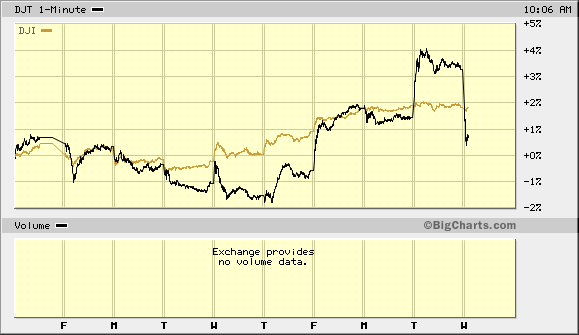
Transports are a classic cyclical play. If the sector is strong, that’s probably a good sign for the economy. I would be concerned if we saw the transports start to lag the market significantly.
-
Morning News: July 17, 2019
Posted by Eddy Elfenbein on July 17th, 2019 at 7:21 amEU Says It Will Investigate Amazon Over Possible Anti-Competitive Business Practices
How Lithium-Rich Chile Botched a Plan to Attract Battery Makers
U.S. Justice Department Asks Appeals Court to Pause Antitrust Ruling Against Qualcomm
A $51 Billion Manager Says Markets Are Wrong to Cheer Fed Cuts
Technology Supplier to U.S. Police Agencies Bans Chinese Drones
‘I Don’t Trust You Guys’: Lawmakers Unite to Take Aim at Big Tech
Making Sense of Chaos? Algos Scour Social Media for Clues to Crypto Moves
Despite High Hopes, Self-Driving Cars Are ‘Way in the Future’
Elon Musk’s Neuralink Says It’s Ready for Brain Surgery
Amazon in EU Antitrust Spotlight Over Use of Merchant Data
Bitcoin Loses Almost a Third of Its Value as Libra Hype Fades
Bill Gates Loses His Spot as World’s Second-Richest Man
Nick Maggiulli: Losing Dollars vs. Losing Percentages
Ben Carlson: A Lesson in Portfolio Correlations
Joshua Brown: How I Invest My Own Money
Be sure to follow me on Twitter.
-
FactSet Downgraded By Morgan Stanley
Posted by Eddy Elfenbein on July 16th, 2019 at 2:17 pmFrom Benzinga:
The Analyst
Morgan Stanley’s Toni Kaplan downgraded FactSet Research Systems from Equal-Weight to Underweight, while reducing the price target from $264 to $263.
The Thesis
FactSet Research Systems’ stock has appreciated around 47% year to date, outperforming Morgan Stanley’s Analytics coverage average and the S&P 500, Kaplan said in the downgrade note.
Most of the share price rally has been driven by multiple expansion, with investors seeking high quality stocks, the analyst mentioned. He expressed concern, however, regarding the company’s earnings growth prospects.
Kaplan mentioned that FactSet’s EPS growth in 2020 may fall to the lowest that the company has generated in the last four years. This is expected due to moderating annual subscription value (ASV), along with lower margin expansion.
While ASV growth at Research, which accounted for 46% of 2018 ASV, could turn negative, pricing pressure is expected to intensify with growing competition, the analyst said.
Following the share price rally, FactSet’s stock now trades at a premium to many Analytics stocks that have better growth prospects.
The stock has been down as much as 4.9% today.

-
Retail Sales and Industrial Production
Posted by Eddy Elfenbein on July 16th, 2019 at 11:51 amThis morning, we got two economic reports. The retail sales report for June was quite good. The Commerce Department said retail sales rose 0.4% last month. The numbers for May were revised down to 0.4% from 0.5% growth. Excluding automobiles, gasoline, building materials and food services, retail sales jumped 0.7% last month.
June’s strong gain in core retail sales, coming on the heels of solid increases in April and May, suggested a sharp acceleration in consumer spending in the second quarter.
Consumer spending grew at its slowest pace in a year in the first quarter. Spending is being supported by a tight labor market, even as the broader economy is slowing as weaker business investment, an inventory overhang, a trade war between the United States and China, and softening global growth pressure the manufacturing sector.
The data probably will have little impact on market expectations that the Federal Reserve will cut interest rates this month for the first time in a decade. But signs of strong consumer spending and rising core inflation suggest the U.S. central bank is unlikely to cut rates by 50 basis points at its July 30-31 policy meeting as markets had initially anticipated.
The industrial production report for June was flat. Economists were expecting an increase of 0.2%. Production for manufacturing and mining increased but that was erased by the decline in utilities.
Capacity utilization, which reflects how much industries are producing compared with what they could potentially produce, slipped by 0.2 percentage point to 77.9% in June. Economists had expected 78.1%.
Industrial production has struggled this year, due in part to trade-related headwinds. For the second quarter as a whole, industrial production declined at a 1.2% annual rate, dropping for the second quarter in a row.
Broader economic growth was strong in the first quarter and the labor market has continued to add jobs.
-
Morning News: July 16, 2019
Posted by Eddy Elfenbein on July 16th, 2019 at 7:07 amChristine Lagarde Faces a New Challenge in Europe
China Says Trump ‘Misleading’ People Linking Trade Deal, Slowing Economy
Tariffs on China Don’t Cover the Costs of Trump’s Trade War
Powell Concession on Too-Tight Fed Underlines Shift Toward Cuts
Wall Street Finds Blockchain Hard to Tame After Early Euphoria
Why (Almost) Everybody Hates Facebook’s Cryptocurrency Libra
Citigroup and Other Banks Are Buying Back Their Stocks and That’s Good for Earnings
Amazon Prime Day Brings Sales, and Risks, for Retailers
Tesla Drops Cheapest Model X, S Variants, Cuts Prices to Simplify Lineup
Boeing Max Crisis Hits 2020 Airline Growth as Ryanair Pares Plan
Nestle Creates New Chocolate—With No Added Sugar
Arby’s Has an Answer to Plant-Based Meat: A Meat-Based Carrot
Cullen Roche: My View On: ESG Investing
Michael Batnick: Animal Spirits, Talk Your Book: Agricultural Commodities
Joshua Brown: Everyone Deserves Good Financial Advice. Everyone.
Be sure to follow me on Twitter.
-
Morning News: July 15, 2019
Posted by Eddy Elfenbein on July 15th, 2019 at 7:06 amJapan, Taking a Page From Trump, Uses Trade Against South Korea
China’s Economic Growth Hits 27-Year Low as Trade War Stings
U.S. Firms May Get Nod to Restart Huawei Sales In Two-Four Weeks
Philippine Stocks Propelled Into Bull Market
Peter Thiel Urges U.S. Probe of Google’s ‘Seemingly Treasonous’ Acts
S&P 3,300 – The Bull Vs. Bear Case
‘The Town Hall of Hollywood.’ Welcome to the Netflix Lobby.
Why Budweiser and Bankers Failed to Sell the King of IPOs
More to Come: FTC Fine Doesn’t Spell Closure for Facebook
Gilead to Boost Stake in Belgian Biotech Galapagos as Part of $5.1 Billion Deal
America’s Youth Think They Can Save the World and Get Rich
The Wealthiest 1% Can Be Good for Everybody
Jeff Miller: Weighing the Week Ahead: How Much Has Economic Weakness Hurt Corporate Earnings?
Jeff Carter: The Creative Class
Ben Carlson: Lessons From the 10 Best Years in Stock Market History & What’s in the box!? (The 7 Deadly Sins of Investing)
Be sure to follow me on Twitter.
-
CWS Market Review – July 12, 2019
Posted by Eddy Elfenbein on July 12th, 2019 at 7:08 am“We don’t have any basis, or any evidence, for calling this a hot labor market.”
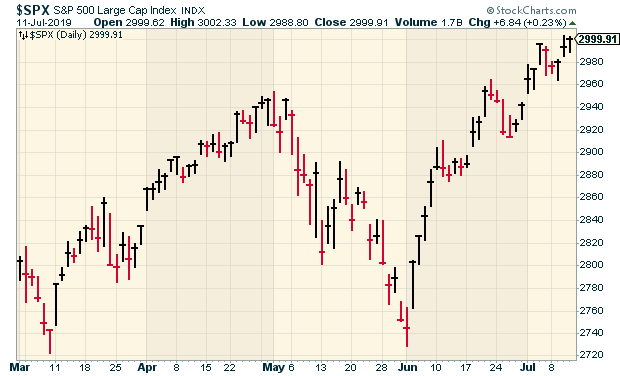
– Jerome PowellFuture historians will note that on Wednesday, July 10 at 9:50 a.m. ET, the S&P 500, for the first time ever, broke through 3,000.
Sure, it fell back again, but it really did happen. Then on Thursday, the Dow broke above 27,000.
What was the cause of this latest rally? That came in the form of Fed Chairman Jay Powell. The Fed head spoke before Congress this week and strongly hinted that the Fed was ready to lower interest rates. How many times is still not known, but Wall Street is pleased with the news. Since June 3, the S&P 500 is up over 9%.
In this week’s CWS Market Review, I’ll go over the latest from the Fed. Also, earnings season is upon us. We have our first Buy List earnings reports coming next week. I’ll preview what’s in store.
The Fed Signals It’s Ready to Cut Rates
Last Friday, shortly after I sent you last week’s issue, the government reported that the U.S. economy created 224,000 net new jobs in June. That was an impressive figure, and it was higher than Wall Street had been expecting. The unemployment rate rose a tick to 3.7%.
On Thursday, we got a CPI report that was a bit higher than expected. The government said that inflation rose 0.1% last month, while the “core rate,” which ignores food and energy, rose by 0.3%. That was the highest jump for core inflation since early 2018.
Also on Thursday, the jobless-claims report fell to 209,000. That’s the lowest in three months.
Taking these three news items together, it appears that the labor market is doing well, and there may be cost pressures building in the economy.
This seems to have had zero effect on the Federal Reserve and its plans for interest rates. This week was the Humphrey-Hawkins testimony. This is the law that requires that the Chairman of the Federal Reserve to go to Capitol Hill twice a year to testify before the House and Senate Committees.
(Years ago, I used to go to these. Once I got the coveted the seat directly behind Bernanke.)
The chairman was asked directly if he thought the labor market was running hot. He said, “We don’t have any basis, or any evidence, for calling this a hot labor market.” That’s unusually frank language for a Fed chair. They’re trained to speak in Obfuscation.
Also this week, we got the minutes from the Fed’s June meeting. They seemed to indicate a growing consensus at the Fed for an interest-rate cut.
Consequently, on Thursday, the Dow, Nasdaq and S&P 500 all closed at record highs. The unemployment rate is near a 50-year low, and the Fed is ready to rescue us. I have to admit that I don’t see the need for a rate cut right now. I thought the December hike was a mistake, so I suppose I can see one rate cut. Wall Street, however, sees a string of rate cuts coming our way. According to the futures markets, there’s a 100% chance of a cut at the end of this month. It’s hard to get more certain than that.
That’s not all. Traders think there’s a 70% chance of another cut in September, plus a third rate cut in December. That could be right. Chairman Powell said, “we hear lots of reports of companies having a hard time finding qualified labor; nonetheless, we don’t really see wages responding.”
One concern is that if the Fed doesn’t cut, then it would be out of alignment with monetary policy in Europe. The European Central Bank may start a new round of bond buying. In fact, the ECB may soon cut interest rates again, which are already negative. Inflation expectations have plunged in Europe.
Here’s an interesting chart. The blue line is the real Fed funds rate based on core inflation. The red line is the year-over-year growth in nonfarm payrolls. These two lines had a fairly moderate correlation that was broken apart by the last recession.
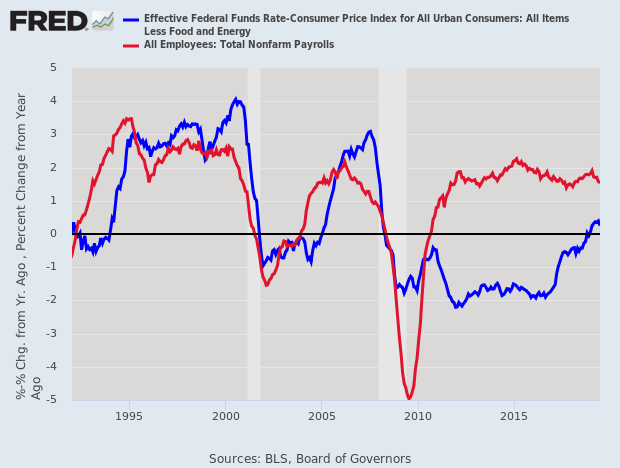
Can the Fed cut rates when the market is near an all-time high? Ryan Detrick ran the numbers and found that since 1980, the Fed has cut rates 17 times when the S&P 500 was within 2% of a new high. One year later, the market was higher all 17 times.
One of the good aspects of our style of investing is that we don’t need to predict Fed policy. While I find the Fed’s plans to be stronger than necessary, they don’t alter our basic approach. The important takeaways are that lower short-term rates are mostly bullish for the stock market. Lower short rates usually allow for higher equity valuations. Indeed, that probably explains why the market jumped to new highs this week.
There are also important internal changes to the market. When short-term rates fall, high-dividend stocks are more appealing. We can certainly see that effect in our portfolio. Conversely, financial stocks tend to lag as rates fall. (Please note that I’m speaking in very general terms.)
This week has been a good one for our Buy List. We’re up more than 22% this year. But second-quarter earnings season is about to start. Let’s take a closer look.
Second-Quarter Earnings Preview
There’s hasn’t been a lot of news about our stocks recently. Mostly, it’s been a broad rally, and several of our stocks have made new 52-week highs. On Thursday, both Cerner (CERN) and Moody’s (MCO) made new highs. Both stocks are up over 40% for us this year and have a chance of dethroning FactSet (FDS) as our top performer this year.
Here’s a list of our stocks, the reporting date and Wall Street’s consensus. I have to include my typical warning that these dates and numbers sometimes change. Some companies are, shall we say, not overly forthcoming when it comes to shareholder communication.
Company Ticker Date Estimate Eagle Bancorp EGBN 17-Jul $1.12 Danaher DHR 18-Jul $1.16 RPM International RPM 22-Jul $1.14 Sherwin-Williams SHW 23-Jul $6.40 Torchmark TMK 24-Jul $1.65 Check Point Software CHKP 24-Jul $1.37 Cerner CERN 24-Jul $0.64 Stryker SYK 25-Jul $1.94 AFLAC AFL 25-Jul $1.07 Hershey HSY 25-Jul $1.17 Raytheon RTN 25-Jul $2.64 Moody’s MCO 31-Jul $2.00 Church & Dwight CHD 31-Jul $0.52 Cognizant Technology Solutions CTSH 31-Jul $0.92 Intercontinental Exchange ICE 1-Aug $0.93 Disney DIS 6-Aug $1.76 Becton, Dickinson BDX 6-Aug $3.07 Signature Bank SBNY TBA $2.71 Fiserv FISV TBA $0.81 Continental Building Products CBPX TBA $0.52 Broadridge Financial BR TBA $1.71 I want to cover two earnings reports scheduled for next week.
Eagle Bancorp (EGBN) is due to report on Wednesday, July 17. Three months ago, the bank missed earnings by one penny per share. I’m not too concerned by that.
Eagle is currently going through a transition after the former CEO, Ron Paul, announced his retirement. Susan G. Riel had been the interim President and CEO, and now she’s taken those positions permanently.
About the Q1 results, Riel said, “The Company’s assets ended the quarter at $8.39 billion, representing 9% growth over the first quarter of 2018. First-quarter 2019 earnings resulted in a return on average assets of 1.62% (1.85% excluding nonrecurring costs as defined above) and a return-on-average tangible common equity of 13.38% (15.26% excluding nonrecurring costs as defined above).”
For Q2, Wall Street expects earnings of $1.12 per share. EGBN is currently going for just over 11 times next year’s earnings estimate.
Danaher (DHR) is scheduled to report its earnings the following day, on July 18. Three months ago, Danaher reported Q1 earnings of $1.07 per share. That was three cents more than estimates.
Danaher has been quite busy this year. The company is buying GE’s biopharma business for $21.4 billion. Danaher said it expects Q2 earnings to range between $1.13 and $1.16 per share. The company lowered its full-year guidance. The previous range was $4.75 to $4.85 per share. The new range is $4.72 to $4.80 per share. This reflects the share dilution to buy GE Biopharma. The deal should close sometime in Q4.
Sometime in the second half of this year, Danaher will IPO Envista Holdings, which is their dental business. The ticker symbol will be NVST. Shares of DHR hit a new 52-week high last week.
I’m also going to include Signature Bank (SBNY). The bank hasn’t said yet when it will report earnings, but going by previous years, July 18 is a good candidate.
Signature may be one of our most frustrating stocks to own. The stock seems to move in big streaks. SBNY was a 30% winner for us this year by February 11. After that, it started to lag. Fortunately, SBNY is on the rise again.
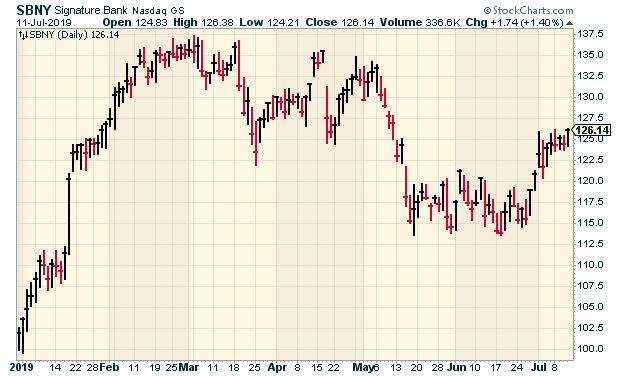
Three months ago, the shares got dinged after the bank missed estimates by 12 cents per share. For Q2, Wall Street expects earnings of $2.71 per share. The stock is currently going for about ten times next year’s earnings. With the earnings report, the bank may increase its dividend as well.
That’s all for now. In addition to earnings reports, there are some key economic reports next week. On Tuesday, we’ll get the latest report on retail sales and industrial production. Then on Wednesday, the report on housing starts is released. Thursday is jobless claims, and Friday is consumer confidence. We’ll also get an update on the budget for this year. Be sure to keep checking the blog for daily updates. I’ll have more market analysis for you in the next issue of CWS Market Review!
– Eddy
P.S. Next Friday, July 19, I’ll be on Bloomberg TV’s market wrap segment at 4 p.m. Tune in!
-
Archives
- November 2026
- October 2026
- September 2026
- August 2026
- July 2026
- June 2026
- May 2026
- April 2026
- March 2026
- February 2026
- January 2026
- December 2025
- November 2025
- October 2025
- September 2025
- August 2025
- July 2025
- June 2025
- May 2025
- April 2025
- March 2025
- February 2025
- January 2025
- December 2024
- November 2024
- October 2024
- September 2024
- August 2024
- July 2024
- June 2024
- May 2024
- April 2024
- March 2024
- February 2024
- January 2024
- December 2023
- November 2023
- October 2023
- September 2023
- August 2023
- July 2023
- June 2023
- May 2023
- April 2023
- March 2023
- February 2023
- January 2023
- December 2022
- November 2022
- October 2022
- September 2022
- August 2022
- July 2022
- June 2022
- May 2022
- April 2022
- March 2022
- February 2022
- January 2022
- December 2021
- November 2021
- October 2021
- September 2021
- August 2021
- July 2021
- June 2021
- May 2021
- April 2021
- March 2021
- February 2021
- January 2021
- December 2020
- November 2020
- October 2020
- September 2020
- August 2020
- July 2020
- June 2020
- May 2020
- April 2020
- March 2020
- February 2020
- January 2020
- December 2019
- November 2019
- October 2019
- September 2019
- August 2019
- July 2019
- June 2019
- May 2019
- April 2019
- March 2019
- February 2019
- January 2019
- December 2018
- November 2018
- October 2018
- September 2018
- August 2018
- July 2018
- June 2018
- May 2018
- April 2018
- March 2018
- February 2018
- January 2018
- December 2017
- November 2017
- October 2017
- September 2017
- August 2017
- July 2017
- June 2017
- May 2017
- April 2017
- March 2017
- February 2017
- January 2017
- December 2016
- November 2016
- October 2016
- September 2016
- August 2016
- July 2016
- June 2016
- May 2016
- April 2016
- March 2016
- February 2016
- January 2016
- December 2015
- November 2015
- October 2015
- September 2015
- August 2015
- July 2015
- June 2015
- May 2015
- April 2015
- March 2015
- February 2015
- January 2015
- December 2014
- November 2014
- October 2014
- September 2014
- August 2014
- July 2014
- June 2014
- May 2014
- April 2014
- March 2014
- February 2014
- January 2014
- December 2013
- November 2013
- October 2013
- September 2013
- August 2013
- July 2013
- June 2013
- May 2013
- April 2013
- March 2013
- February 2013
- January 2013
- December 2012
- November 2012
- October 2012
- September 2012
- August 2012
- July 2012
- June 2012
- May 2012
- April 2012
- March 2012
- February 2012
- January 2012
- December 2011
- November 2011
- October 2011
- September 2011
- August 2011
- July 2011
- June 2011
- May 2011
- April 2011
- March 2011
- February 2011
- January 2011
- December 2010
- November 2010
- October 2010
- September 2010
- August 2010
- July 2010
- June 2010
- May 2010
- April 2010
- March 2010
- February 2010
- January 2010
- December 2009
- November 2009
- October 2009
- September 2009
- August 2009
- July 2009
- June 2009
- May 2009
- April 2009
- March 2009
- February 2009
- January 2009
- December 2008
- November 2008
- October 2008
- September 2008
- August 2008
- July 2008
- June 2008
- May 2008
- April 2008
- March 2008
- February 2008
- January 2008
- December 2007
- November 2007
- October 2007
- September 2007
- August 2007
- July 2007
- June 2007
- May 2007
- April 2007
- March 2007
- February 2007
- January 2007
- December 2006
- November 2006
- October 2006
- September 2006
- August 2006
- July 2006
- June 2006
- May 2006
- April 2006
- March 2006
- February 2006
- January 2006
- December 2005
- November 2005
- October 2005
- September 2005
- August 2005
- July 2005
 Eddy Elfenbein is a Washington, DC-based speaker, portfolio manager and editor of the blog Crossing Wall Street. His