-
March Industrial Production +0.5%
Posted by Eddy Elfenbein on April 18th, 2017 at 10:33 amWe got some good news on industrial production this morning. For March, IP rose by 0.5%. Industrial production bottomed out a year ago. Prior to that, it had been in an unpleasant downtrend.
Looking below the surface, however, shows that factory output was down in March. Utilities saw a jump of 8.6%.
-
The Doolittle Raid 75 Years On
Posted by Eddy Elfenbein on April 18th, 2017 at 10:15 amSeventy-five years ago today marked the daring Doolittle Raid over Tokyo. (This is also the 242nd anniversary of Paul Revere’s ride; “On the 18th of April in ‘75, hardly a man is now alive, who remembers that famous day and year.”)
The stock market was in rough shape at the time of the raid. Since Pearl Harbor, stocks had been drifting lower, but the ultimate low came on April 28, 1942 when the Dow hit 92.92.
Within two years, the Dow was up 50%, and it doubled by 1945. By 1955, the Dow was up fivefold, and it doubled again ten years later. The market really didn’t see any pause until 1966 when inflation started to have a major impact. Twenty four years after FDR’s speech, the Dow had advanced close to 1,000% and that’s not counting dividends.
-
The Skewed Market
Posted by Eddy Elfenbein on April 18th, 2017 at 9:35 am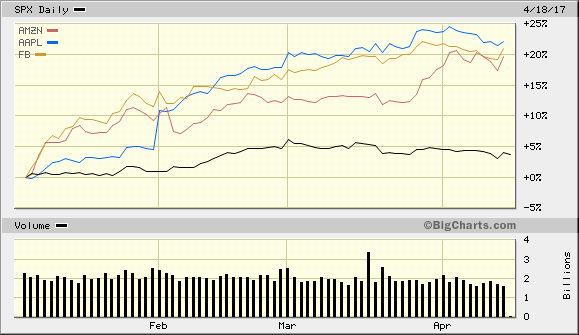
The stock market this year has been unusually skewed, meaning that a small number of stocks are making up a large part of the gains. More than half the gain in the S&P 500 this year comes from just 10 stocks. Further, just three stocks — Apple, Facebook and Amazon — make up nearly one-third of the index’s gain YTD.
The recent strength in tech and internet companies marks a reversal from late last year, when investors piled into banks, industrials and small-cap stocks in the weeks following November’s U.S. elections. They bet that Republican control of Congress and the White House would lead to pro-growth policies.
But as investors began to lose confidence that the policies would be enacted quickly, these sectors have trailed the S&P 500 in recent months. Instead of focusing on companies that could outperform during faster economic growth, many investors returned to large-cap favorites with a track record for boosting revenue during slower growth periods.
On our Buy List, four stocks (CERN, AXTA, MCO, SHW) make up 57% of our YTD gain.
-
Morning News: April 18, 2017
Posted by Eddy Elfenbein on April 18th, 2017 at 7:11 amChina’s Economy Grows 6.9%, but Warning Signs Persist
Saudi Oil Exports Drop to 21-Month Low as Kingdom Sticks to Cuts
Dollar Off Five-Month Low vs. Yen, Trade Issues Weigh
Trump’s Unreleased Taxes Threaten Yet Another Campaign Promise
Don’t Appoint Clones to the Fed
GOP Targets Trillion-Dollar Tax Breaks for Democratic States
Netflix Touts U.S. Growth—and the Market Believes It
Bank of America’s Quarterly Profit Rises 44%
An American Company Is Buying Britain’s Beloved Weetabix in a $1.8 Billion Deal
Arconic C.E.O. Ousted After Sending Unauthorized Letter to Hedge Fund
Cabela’s Sells Banking Assets to Synovus, Clearing Path For Bass Pro Deal
Silver Lake Raises $15 Billion Fund for New Tech Deals
Jeff Carter: If You Are An “Older” Person How Do You Find Your Way Into Startups?
Josh Brown: Cognitive Clownshow
Cullen Roche: The Evidence Based Investing Conference
Be sure to follow me on Twitter.
-
Best Day in Seven Weeks
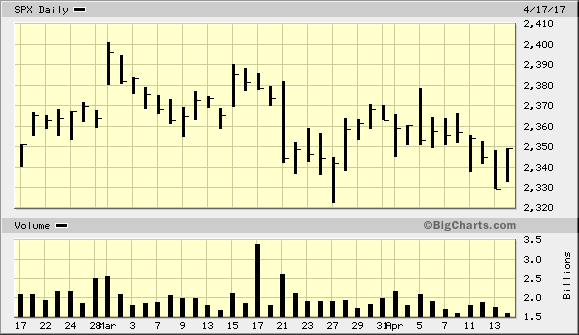
Posted by Eddy Elfenbein on April 17th, 2017 at 4:31 pmToday was a good day for stocks. It was the best day for the S&P 500 since March.
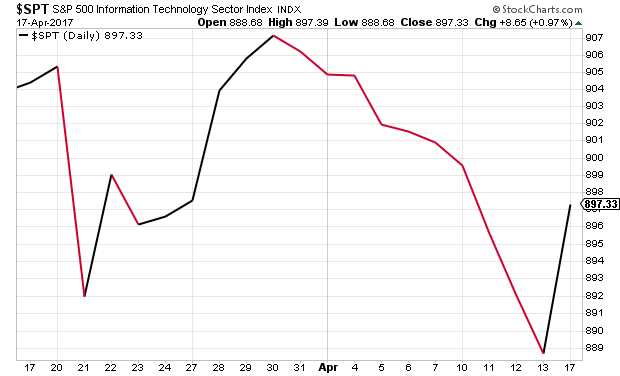
The S&P 500 Tech sector snapped a 10-day losing streak.
-
Retail Sales and Inflation
Posted by Eddy Elfenbein on April 17th, 2017 at 10:52 amThe stock market was closed on Friday for Good Friday but there were two important economic reports I want to highlight.
The first is that the Commerce Department said that retail sales fell by 0.2% last month. That comes on the heels of a 0.3% drop in February. Economists had been expecting a drop of 0.1%.
We also want to look at “core” retail sales which ignores cars and gasoline. That’s usually the best measure of consumer spending. Last month, core retail sales rose by 0.5%. The Atlanta Fed now sees Q1 GDP growth of 0.9%.
But the big surprise was the CPI report. The Labor Department said that consumer prices dropped by 0.3% last month. That was the biggest drop in more than two years.
The core rate, which excludes food and energy, fell by 0.1%. That’s the biggest monthly fall since 1982.
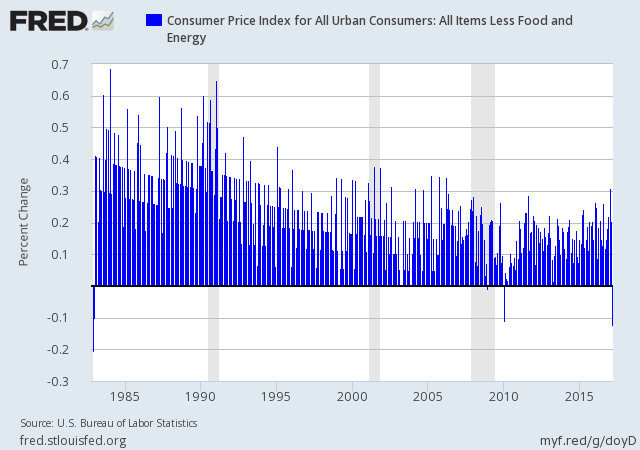
I said in last week’s newsletter that it would be a big mistake for the Fed to raise interest rates in June. I specifically said that inflation is not a problem. That was just prior to these reports, and it confirms that I was more accurate than I suspected.
The futures market is currently about 50-50 on a June hike.
-
Morning News: April 17, 2017
Posted by Eddy Elfenbein on April 17th, 2017 at 7:08 amOil Slides as U.S. Pumps More, But OPEC and North Korea Loom
China Roars Back to Lift Global Outlook as U.S. Consumer Weakens
Saudi to Shelve, Reform Billions of Dollars of Unfinished Projects
Odd Lots: What Happens When Markets As We Know Them Cease to Exist
China’s Ant Hikes MoneyGram Bid By More Than a Third, Beats Rival U.S. Offer
Anbang’s Fidelity & Guaranty Acquisition Set to Fall Through
BP Struggles to Control Damaged Well in Alaskan Arctic
Slack, an Upstart in Messaging, Now Faces Giant Tech Rivals
Inside the Hotel Industry’s Plan to Combat Airbnb
Car Chases, Cute Newcomers and Familiar Faces: Plotting a Turnaround at Sony Pictures
From ‘Zombie Malls’ to Bonobos, America’s Retail Transformation
Uber Wants to Rule the World. First It Must Conquer India.
Survey Reveals the Majority of Americans Are Saving for Retirement All Wrong
Jeff Miller: How Should Investors Cope With Geopolitical Risk?
Howard Lindzon: Voice…The Final Frontier
Be sure to follow me on Twitter.
-
Barron’s on Wabtec
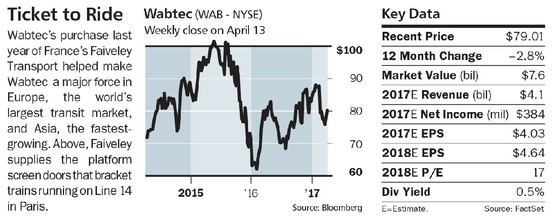
Posted by Eddy Elfenbein on April 16th, 2017 at 6:35 pmOur very own Wabtec (WAB) got some love in this weekend’s Barron’s. They said the stock could jump 20% in a year.
Wabtec, as it is more commonly known, completed some 50 acquisitions in the past decade, growing overseas and expanding into the steadier transit market, which is less cyclical than freight. The $1.7 billion purchase last year of France-based Faiveley Transport, its largest deal to date, makes it a formidable rival in Europe, the world’s largest transit market, and Asia, the fastest-growing. About 65% of this year’s sales will come from abroad, up from 50% five years ago.
The deal’s timing is good. The outlook for global transit is the brightest in 20 years, says veteran industrials analyst Nicholas Heymann, of William Blair, who has an Outperform rating on the stock. The global mass-transit market’s growth has tripled recently to 4% to 5% a year as emerging nations like India look to ease urban congestion and a push for energy efficiency sparks investment in mass transit in Europe.
This is a long-term opportunity. For Wabtec, getting its brakes and safety technology into the new systems means gaining an edge in providing service and maintenance for the life of the vehicle, often 30 to 50 years. About 60% of sales will come from mass transit this year, up from some 40% five years ago.
(…)
At 17 times 2018 earnings estimates, the shares trade slightly below the market multiple—and their historical price/earnings ratio of 22. Stephens analyst Justin Long says any skepticism is misplaced, given Wabtec’s record of exceeding expectations for acquisitions. He expects benefits from Faiveley to kick in during the second half. That, combined with a rail rebound, he says, could lift the stock to $95.
Wabtech’s improved positioning abroad will help drive growth. Instead of being a distant No. 3 to privately held Knorr-Bremse and Faiveley in European mass transit, Wabtec is now a formidable No. 2, with a 25% market share, up from 5%. Andrew Davis, transportation analyst at T. Rowe Price, says the combination “should boost the company’s revenue growth from a low-single-digit pace to mid-single digits.”
Wabtec’s freight business is also poised to grow. Sidelined locomotives are coming back into service, coal traffic appears to have bottomed, and intermodal traffic is picking up. “We will see the benefits, first in the aftermarket area, in the third and fourth quarters,” Chief Executive Raymond Betler tells Barron’s.
Broader industry trends could also lift Wabtec’s growth prospects. While the company expects new railcar orders to slow in the near term, increased usage of railcars means more maintenance that could spur demand for replacement parts. Aftermarket sales produce 60% of revenue and generate hefty profit margins.
-
CWS Market Review – April 14, 2017
Posted by Eddy Elfenbein on April 14th, 2017 at 7:08 am“A good decision is based on knowledge and not on numbers.” – Plato
On Wednesday, the S&P 500 closed below its 50-day moving average for the first time since Election Day. We had a pretty good run. This was the third-longest streak of trading above the 50-DMA in the last 20 years.
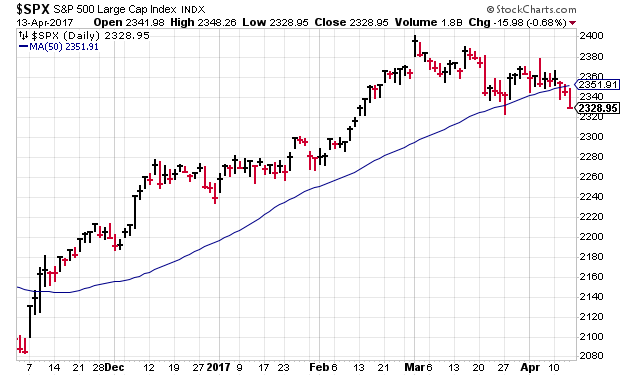
What does it mean? Falling below your 50-DMA is a nice shortcut way of saying that the stock market is losing momentum. That’s not exactly a newsflash because we’ve seen this coming for a few weeks, but breaking below a 50-DMA is often a key technical indicator.
The bears were clearly paying attention because on Thursday, the S&P 500 dropped to a two-month low. We’re in this weird pattern of fading momentum combined with extremely low volatility. Consider that the market just snapped a 10-day streak of closing up or down by less than 0.35%. That’s a market with barely a pulse! We haven’t done that since 1968. Overall, the market is still just 2.8% below its all-time high set at the beginning of March.
We may see some action soon. Next week, we’ll get our first five Buy List earnings reports. Another nine come the week after that. In this week’s CWS Market Review, I’ll preview next week’s reports. I’ll also bring you up-to-speed on the latest on our Buy List stocks. But first, let’s get ready for next week’s earnings parade.
Earnings Season Is About to Start
In last week’s issue, I mentioned how this earnings season may be one of the best in the last few years. For one, the U.S. dollar won’t be such a negative presence on income statements. Also, the energy sector will show some signs of life. Additionally, we’ll probably see decent revenue growth from companies. Lastly, earnings estimates haven’t fallen as much as they have in previous quarters.
Bank stocks did poorly on Thursday in the wake of results from JPMorgan Chase and Wells Fargo. The big banks are usually the first major companies to report. Next week, 68 stocks in the S&P 500 are due to report earnings. As of now, Wall Street expects earnings growth for the quarter of 10.4% which would be the best since 2011.
Over the next few weeks, 20 of our 25 Buy List names will report earnings. Here’s an earnings calendar I made. I’ve included each stock’s ticker symbol, reporting date and Wall Street’s consensus estimate.
Company Ticker Date Estimate Signature Bank SBNY 19-Apr $2.10 Alliance Data Systems ADS 20-Apr $3.89 Danaher DHR 20-Apr $0.84 Sherwin-Williams SHW 20-Apr $2.05 Snap-On SNA 20-Apr $2.36 Express Scripts ESRX 24-Apr $1.32 Stryker SYK 25-Apr $1.42 Wabtec WAB 25-Apr $0.82 Axalta Coating Systems AXTA 26-Apr $0.25 CR Bard BCR 26-Apr $2.65 Fiserv FISV 26-Apr $1.19 AFLAC AFL 27-Apr $1.62 Cerner CERN 27-Apr $0.57 Microsoft MSFT 27-Apr $0.70 Intercontinental Exchange ICE 3-May $0.73 Cognizant Technology CTSH 5-May $0.83 Moody’s MCO 5-May $1.17 Cinemark CNK TBA $0.52 Continental Building Products CBPX TBA $0.26 Ingredion INGR TBA $1.76 Please note that these dates and numbers are subject to change. I did the best I could but some companies are, shall we say, less than forthcoming with their financial info.
Our Five Buy List Earnings Reports Next Week
We have five Buy List earnings reports next week. On Wednesday, April 19, Signature Bank (SBNY) is scheduled to report Q1 earnings. The stock jumped immediately after the election but has slowly lost ground over the last several weeks. Despite the pullback, the bank’s business has been basically sound. The consensus on Wall Street is for earnings of $2.10 per share. My numbers say Signature should be able to beat that.
Next Thursday will be an especially busy day for us. We have four earnings reports. Three months ago, Alliance Data Systems (ADS) beat earnings by a penny per share but the stock got knocked back due to poor top-line numbers. For the whole year, ADS expects earnings of $18.50 per share. For Q1, Wall Street’s consensus is for $3.89 per share. That seems doable. This week, Oppenheimer initiated coverage on ADS with an “underperform” rating. That helped ding the stock for a 3.8% loss on Tuesday. Don’t let that alarm you.
Danaher (DHR) gave us a good earnings report in January. For Q1, the company sees earnings ranging between 82 and 85 cents per share. For all of 2017, they forecast earnings of $3.85 to $3.95 per share. Wall Street is playing it safe. Their Q1 consensus is for 84 cents per share. I like Danaher a lot.
Sherwin-Williams (SHW) was the big star from last earnings season. The company earned $2.34 per share, which was 13 cents more than estimates. The stock jumped 7.6% the next day. For Q1, SHW sees earnings ranging between $2.03 and $2.13 per share and sales rising by mid-to-high single digits.
Sherwin has said that its merger with Valspar will take longer than expected. The company conceded that it will have to jettison some units in order to placate regulators. That’s often the case. This week, in fact, SHW announced they’re going to sell their wood coatings business for $420 million. And who’s the buyer? None other than our very own Axalta Coating Systems (AXTA). Our Buy List stocks are doing deals with each other! Wall Street is expecting Q1 earnings of $2.05 per share from Sherwin.
Snap-on (SNA) has been a fairly sluggish performer for us this year, but I still like this one a lot. The company had a good earnings report in January. They beat on both the top and bottom line. The results from the tool group, however, could have been better. For Q1, Wall Street expects earnings of $2.36 per share. Earlier this week, Oppenheimer initiated coverage on SNA with an outperform rating. (Is Oppenheimer secretly following us?)
Before I get to our Buy List updates, I wanted to add a brief word about Federal Reserve policy. The futures market currently thinks there’s a 57.3% chance the Fed will raise rates in June. If so, this will mark the first time I’ve broken sharply with what the Fed has done. In past instances, I may have leaned one way or another, but now I can say that I’m flatly opposed to another rate increase. It would be a big mistake.
Of course, just because it’s wrong is certainly not a reason why the Fed won’t do it. As I see it, the economy is far from its potential. Wage growth has been modest, and inflation is still well-behaved. On Thursday, we learned that wholesale prices actually fell last month.
We’re still two months away from the Fed’s June meeting, and I hope cooler heads prevail. I’ll have more on this in upcoming issues, but for now, I’m concerned that the Fed may make a big policy blunder.
Buy List Updates
On Tuesday, HEICO (HEI) will split 5-for-4. This means that shareholders will get 25% more shares, and the price will drop about 20%. Once the split takes effect, our Buy Below price will drop 20%, from $90 to $72 per share.
For track record purposes, I assume the Buy List starts the year as a $1 million portfolio that’s equally divided among the 25 stocks. For HEICO, that meant a position of 518.4705 shares at a starting price of $77.15 per share. After the split, that will become 648.0881 shares starting at $61.72 per share.
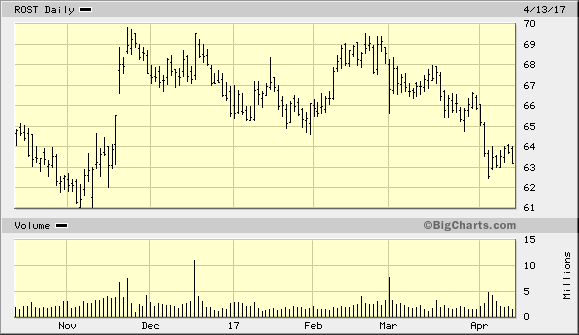
The retail sector has performed very poorly in recent months. A major Retail ETF (XRT) has badly lagged the overall market. This has also dragged Ross Stores (ROST) down below $64 per share. I think the shares look particularly attractive at the moment. Ross is one of the best retailers out there. The next earnings report will be due out around mid-May.
This week, Morgan Stanley downgraded JM Smucker (SJM). They also lowered their price target to $132 per share. The stock has pulled back about 10% in the last seven weeks. If SJM drops below $120, then it’s an exceptional value. This is one to key an eye on.
That’s all for now. The stock market is closed for Good Friday. Next week will mostly be about earnings but there will be some important economic reports. On Tuesday, the industrial production report for March is due out. On Wednesday, the Fed’s Beige Book comes out. This report is usually a good distillation of the economy. Be sure to keep checking the blog for daily updates. I’ll have more market analysis for you in the next issue of CWS Market Review!
– Eddy
Morning News: April 14, 2017
Posted by Eddy Elfenbein on April 14th, 2017 at 7:04 amCrude Caps Third Weekly Gain as IEA Sees Market Nearing Balance
As New Zealand Courts Tech Talent, Isolation Becomes a Draw
Trump’s Flip-Flops On Economics Move Policies Toward The Status Quo
Bank Lending Stalls on Doubts About Trump’s Pro-Growth Agenda
Can The IRS Commissioner Peek At Trump’s Tax Return – Or Yours?
Why Airlines Sell Too Many Seats and Why It Makes Sense
Apple May Be Coming To Toshiba’s Rescue
How Walmart and Target Can Top Amazon on Drone Delivery
Yext Joins $1B Club With Successful IPO, Continuing Software’s Hot Market Run
Billionaire Bets on Old-School Energy in $3 Billion Conoco Deal
Elon Musk Says Tesla Will Unveil an Electric Semi Truck In September
Credit Suisse Cuts Bonuses For Top Execs by 40% Amid Shareholder Protest
With Mark Bittman Aboard, Jana Shows It’s Serious About Revamping Whole Foods
Roger Nusbaum: Don’t Let Performance Haunt You Forever
Be sure to follow me on Twitter.
-
Archives
- September 2026
- August 2026
- July 2026
- June 2026
- May 2026
- April 2026
- March 2026
- February 2026
- January 2026
- December 2025
- November 2025
- October 2025
- September 2025
- August 2025
- July 2025
- June 2025
- May 2025
- April 2025
- March 2025
- February 2025
- January 2025
- December 2024
- November 2024
- October 2024
- September 2024
- August 2024
- July 2024
- June 2024
- May 2024
- April 2024
- March 2024
- February 2024
- January 2024
- December 2023
- November 2023
- October 2023
- September 2023
- August 2023
- July 2023
- June 2023
- May 2023
- April 2023
- March 2023
- February 2023
- January 2023
- December 2022
- November 2022
- October 2022
- September 2022
- August 2022
- July 2022
- June 2022
- May 2022
- April 2022
- March 2022
- February 2022
- January 2022
- December 2021
- November 2021
- October 2021
- September 2021
- August 2021
- July 2021
- June 2021
- May 2021
- April 2021
- March 2021
- February 2021
- January 2021
- December 2020
- November 2020
- October 2020
- September 2020
- August 2020
- July 2020
- June 2020
- May 2020
- April 2020
- March 2020
- February 2020
- January 2020
- December 2019
- November 2019
- October 2019
- September 2019
- August 2019
- July 2019
- June 2019
- May 2019
- April 2019
- March 2019
- February 2019
- January 2019
- December 2018
- November 2018
- October 2018
- September 2018
- August 2018
- July 2018
- June 2018
- May 2018
- April 2018
- March 2018
- February 2018
- January 2018
- December 2017
- November 2017
- October 2017
- September 2017
- August 2017
- July 2017
- June 2017
- May 2017
- April 2017
- March 2017
- February 2017
- January 2017
- December 2016
- November 2016
- October 2016
- September 2016
- August 2016
- July 2016
- June 2016
- May 2016
- April 2016
- March 2016
- February 2016
- January 2016
- December 2015
- November 2015
- October 2015
- September 2015
- August 2015
- July 2015
- June 2015
- May 2015
- April 2015
- March 2015
- February 2015
- January 2015
- December 2014
- November 2014
- October 2014
- September 2014
- August 2014
- July 2014
- June 2014
- May 2014
- April 2014
- March 2014
- February 2014
- January 2014
- December 2013
- November 2013
- October 2013
- September 2013
- August 2013
- July 2013
- June 2013
- May 2013
- April 2013
- March 2013
- February 2013
- January 2013
- December 2012
- November 2012
- October 2012
- September 2012
- August 2012
- July 2012
- June 2012
- May 2012
- April 2012
- March 2012
- February 2012
- January 2012
- December 2011
- November 2011
- October 2011
- September 2011
- August 2011
- July 2011
- June 2011
- May 2011
- April 2011
- March 2011
- February 2011
- January 2011
- December 2010
- November 2010
- October 2010
- September 2010
- August 2010
- July 2010
- June 2010
- May 2010
- April 2010
- March 2010
- February 2010
- January 2010
- December 2009
- November 2009
- October 2009
- September 2009
- August 2009
- July 2009
- June 2009
- May 2009
- April 2009
- March 2009
- February 2009
- January 2009
- December 2008
- November 2008
- October 2008
- September 2008
- August 2008
- July 2008
- June 2008
- May 2008
- April 2008
- March 2008
- February 2008
- January 2008
- December 2007
- November 2007
- October 2007
- September 2007
- August 2007
- July 2007
- June 2007
- May 2007
- April 2007
- March 2007
- February 2007
- January 2007
- December 2006
- November 2006
- October 2006
- September 2006
- August 2006
- July 2006
- June 2006
- May 2006
- April 2006
- March 2006
- February 2006
- January 2006
- December 2005
- November 2005
- October 2005
- September 2005
- August 2005
- July 2005
 Eddy Elfenbein is a Washington, DC-based speaker, portfolio manager and editor of the blog Crossing Wall Street. His