-
Morning News: July 18, 2016
Posted by Eddy Elfenbein on July 18th, 2016 at 7:01 amThe Coup Failed, But Erdogan’s Wrath Keeps Investors on Edge
Ireland Hits Brexit Alarm in Biggest Foreign Crisis in 50 Years
EU Said to Eye ‘Nuclear Option’ to Force May’s Hand on Exit
My Venezuela Nightmare: A 30-Day Hunt for Food in a Starving Land
Rate-Starved U.S. Banks Happily Gobble Mortgage Business
Bank of America’s Profit Slides But Tops Estimates
SoftBank to Buy ARM, a Mobile Chip Designer, for $32 Billion
Alibaba Buying Yahoo Would Make The Most Sense For Everyone
Artificial Intelligence Swarms Silicon Valley on Wings and Wheels
3 Things That Can Go Wrong for Netflix on Monday Afternoon
Even the Losers May Win as Exxon Outbids Partner for PNG Gas
How Coca-Cola Can Make Soda A Growth Market Again
With Pokémon Go, Nintendo Seeks to Salvage Lost Opportunity
Rate-Starved U.S. Banks Happily Gobble Mortgage Business
Jeff Carter: Scaling Your Portfolio
Jeff Miller: What Might Derail the Stock Market Rally?
Be sure to follow me on Twitter.
-
Three Economic Reports Today
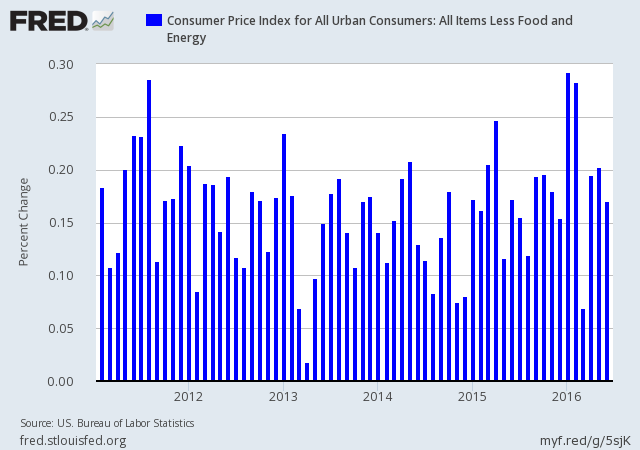
Posted by Eddy Elfenbein on July 15th, 2016 at 12:45 pmWe had a few important economic reports today. The government said that the CPI rose by 0.2% last month. That was below expectations of 0.3%. The core rate also rose by 0.2%.
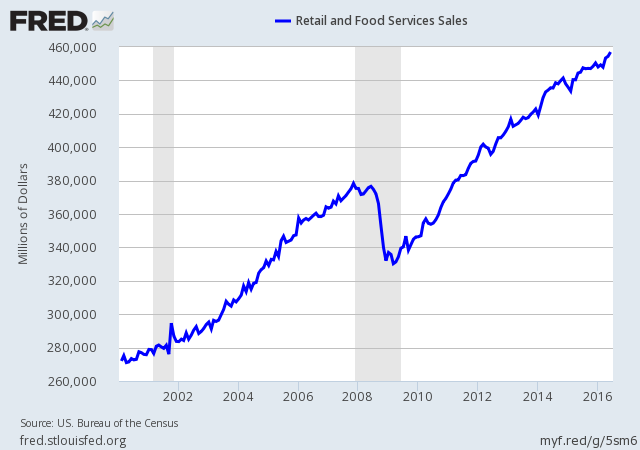
The government also reported that retail sales rose 0.6% last month. The rise for May was pared back to 0.2% from the original 0.5%. Excluding autos, retail sales were up 0.7% in June.
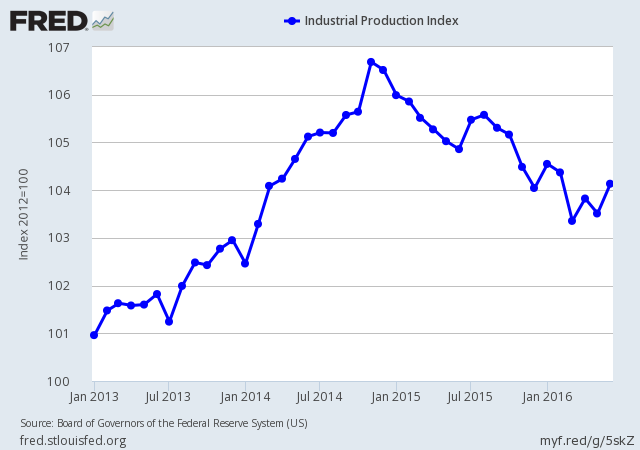
Finally, the Fed said that industrial production rose by 0.6% in June. Expectations were for an increase of 0.4%.
Now for some charts. Here’s the monthly change in seasonally adjusted core inflation:
Here’s retail sales:
Here’s industrial production. IP trended down since late 2014, but it may have turned a corner.
-
Wells Fargo Earns $1.01 per Share
Posted by Eddy Elfenbein on July 15th, 2016 at 9:25 amWells Fargo (WFC) just reported Q2 earnings of $1.01 per share which matched Wall Street’s expectations.
Wells Fargo & Co., the world’s most valuable bank, said second-quarter profit fell 2.8 percent as more energy loans soured, expenses rose and revenue from mortgage lending declined.
Net income slid to $5.6 billion, or $1.01 a share, from $5.72 billion, or $1.03, a year earlier, the San Francisco-based company said Friday in a statement. That matched the average estimate of 30 analysts surveyed by Bloomberg. Mortgage banking revenue declined 17 percent from a year earlier to $1.41 billion, falling short of the $1.8 billion estimate of Oppenheimer & Co.’s Chris Kotowski.
Revenue rose 4 percent to $22.2 billion, in line with analysts’ estimates, while expenses climbed 3.2 percent to $12.9 billion on higher employee compensation and benefits. Provisions for credit losses more than tripled to $1.07 billion from a year earlier on expanded losses in the oil and gas portfolio, the bank said.
Chief Executive Officer John Stumpf has sought to keep costs in check while amassing more deposits and expanding the bank’s loan portfolio with by purchasing assets from firms including General Electric Co. The bank has used derivatives to lock in higher income by converting floating rates into fixed payments as the Federal Reserve delays raising interest rates.
-
CWS Market Review – July 15, 2016
Posted by Eddy Elfenbein on July 15th, 2016 at 7:08 am“Don’t confuse brains with a bull market.” – Humphrey B. Neill
After 14 months of not making any new highs, the S&P 500 finally burst through to record territory on Monday. In fact, the index continued to make new records on Tuesday, Wednesday and Thursday. So much for all those predictions of gloom and doom!
It’s hard to believe that three weeks ago, the financial world got rocked to its core by the stunning Brexit vote in Britain. The experts didn’t see that coming. Not only that, but they were also wrong on the effects of their own incorrect forecasts. Stocks and bonds are up and volatility is way down. In the last twelve days, the stock market has closed higher ten times!

I’m always reminded of the story Jack Bogle tells of being a young broker. An old-timer took him aside and told him, “nobody knows nothing!” I have to think that guy was onto something.
In this week’s CWS Market Review, I’ll take you through the latest drama on Wall Street. I’ll also preview a slew of Buy List earnings report for next week. Here’s a fun fact that shows you just how strange Wall Street can be. Thanks to something called Pokémon Go, Nintendo’s market cap rose by $9 billion in two days. That’s about half the market value of Deutsche Bank, which is a 146-year-old company. Trading in Nintendo was so heavy that it accounted for 17% of all the volume on the Tokyo Exchange.
Yep. Nobody knows nothing!
The S&P 500 Soars to an All-Time High
Last Friday, the U.S. government reported that the economy created 287,000 net new jobs last month. That crushed expectations by over 120,000 jobs. That was the biggest “jobs beat” in seven years!
The jobs report was especially good considering that it came after a lousy report for May. Truthfully, the long-term trend of roughly 220,000 jobs per month is still largely intact. The monthly volatility masks how persistent the underlying trend has been.
Last week’s jobs report will have minimal impact on the Fed. The central bank gets together in two weeks, and it’s very doubtful they’ll touch interest rates. In fact, it’s doubtful they’ll touch interest rates for the rest of the year. The futures market doesn’t expect a rate hike until next June, and even then, the odds are far from overwhelming. We have to get used to the fact that we’re living in a low-rate world.
I want to elaborate on an important point that I think confuses too many investors: the importance of the Federal Reserve. This may surprise a lot of folks, but the Fed isn’t nearly as powerful as is sometimes presented. I notice a lot of undue hostility towards the Fed. While I’m hardly one to jump to their defense, especially on policy grounds, I think much of the criticism goes towards areas outside the Fed’s control.
I think it’s better to see the Fed as another player on the field chasing after the ball. While they currently have interest rates very low, it’s difficult for me to believe that they have rates very far from equilibrium. If they did, we should see far greater distortions like inflation or a recession.
No matter what the Fed does, it will have some financial market consequences. That’s why I’m baffled by so much commentary that says the stock market is merely a Fed-induced bubble that’s about to burst. We’ve been hearing this for several years now, and nothing’s burst so far.
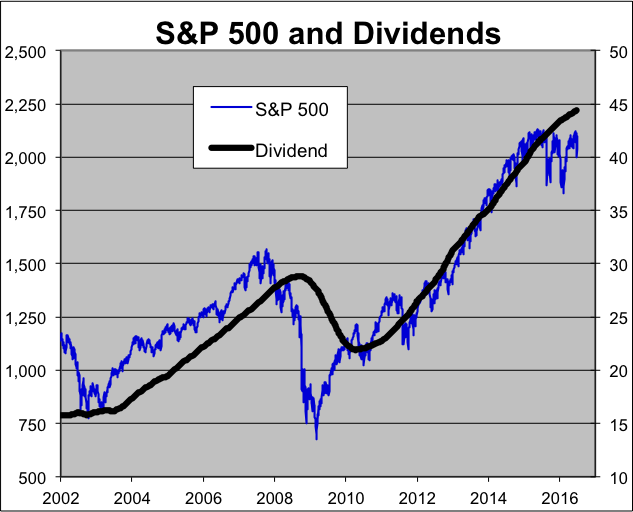
Going by most valuation measures, the stock market is about where you’d expect. Except for the worst parts of the Financial Crisis, the dividend yield for the S&P 500 hasn’t strayed very far from 2% for over a decade. Through Thursday, the S&P 500 is up 5.9% for the year, while dividends were up 5% for the first half. That’s hardly a bubble.
Simply put, the Fed isn’t forcing interest rates this low. Instead, they’re following interest rates this low. I think there have been some important changes in the structure of the world economy that makes low rates the new normal. For example, population growth has slowed down in much of the developed world, and that’s going to be an important part of nominal GDP growth. I think it’s interesting that Japan was the first country to deal with ultra-low and negative rates, and they’re experiencing a declining population.
The economist Scott Sumner has pointed out that the tech economy isn’t as capital-dependent as the old economy. Unlike, say, a steel plant, Google and Facebook don’t need enormous amounts of money to keep their operations running. As such, there’s less demand to rent capital, and that means lower rates. I’m not sure if that’s right but it highlights an important fact that the world has changed. This wasn’t all the Fed’s doing.
I’m guilty of getting caught up in overemphasizing the importance of the Fed. In reality, the stock market is responding to underlying strength in the economy and productivity. The stock market celebrated the strong June jobs report by rallying 1.5% to just below its all-time high. Interestingly, the market’s gain last Friday matched the 10-year Treasury’s annualized yield.
Second-quarter earnings season began on Monday, and we’ve had enough momentum to carry us to a few more new highs. Since the stock market’s low in March 2009, the S&P 500 is up 225%. While other people have waited for it all to crash, we’ve been riding the trend. Now let’s take a look at some earnings reports coming our way next week.
Seven Buy List Earnings Reports Due Next Week
Wells Fargo (WFC) is due to report earnings later today. The consensus is for $1.01 per share. That sounds about right. The bank recently passed the Fed’s latest stress test with flying colors.
We have seven more Buy List earnings reports coming next week; five of them are due on Thursday. Here’s our Earnings Calendar for the second quarter:
 Eddy Elfenbein is a Washington, DC-based speaker, portfolio manager and editor of the blog Crossing Wall Street. His