-
Morning News: August 14, 2015
Posted by Eddy Elfenbein on August 14th, 2015 at 6:44 amAs Greek Bailout Deal Passes, Alexis Tsipras Faces Rebellion
China’s Renminbi Devaluation May Initiate New Phase in Global Currency War
Jobless Claims in U.S. Holding Just Above a Four-Decade Low
In Good Times or Bad, Brazil Banks Profit
In a Show of Confidence, Americans Boost Spending
Solar is Having a Great Year, Except on Wall Street
General Electric Sells GE Capital Bank’s Online Platform to Goldman Sachs
King Digital Entertainment’s Profit Down
Maersk Adjusts To Weakness in Shipping and Oil Markets
Cisco’s Money Can’t Buy It Love
Apple Said to Delay Live TV Service to 2016 as Negotiations Stall
VW Has Spent Two Years Trying to Hide a Big Security Flaw
Cullen Roche: The China Slowdown in Perspective
Jeff Carter: Flexible Work and Flexible Employees
Be sure to follow me on Twitter.
-
Morning News: August 13, 2015
Posted by Eddy Elfenbein on August 13th, 2015 at 5:23 amChina Central Bank Tries to Soothe Global Markets, Says No Reason For Yuan To Fall Further
Deutsche Bank Employees Charged in Emissions Trading Case
India Court Overturns Nestlé Maggi Noodles Ban
The Fed Is on Thinner Ice Than It Realizes, and It May Be Setting Us Up for Recession
Alibaba Revenue Misses Expectations; $4 Billion Stock Buyback Is Planned
Cisco Rises in Germany as Sales Top Estimates on Americas Growth
Lenovo Faces Motorola Hangover, Cuts 3,200 Jobs as Sales Slide, Profit Tumbles
Maersk Soars as Earnings Show Company Defying Market Headwinds
Drinks Bottler Coke HBC Sales Up Slightly
News Corp Posts Loss on Education Write-Down
NBCUniversal Invests $200 Million in Vox Media
Data-Storage Startup Pure Storage Files for IPO
Roche Buys ‘Superbug’ Diagnostics Firm For Up to $425 Million
Cullen Roche: Is More Information Making Us Worse Investors?
Joshua Brown: A New “Headwind” is Born
Be sure to follow me on Twitter.
-
How the Market Behaves at All-Time Highs
Posted by Eddy Elfenbein on August 12th, 2015 at 3:31 pmFinance people tend to be numbers people. I’d certainly include myself in that group. You can mention any financial topic and there are dozens of studies, charts and regressions on it. Name it and the numbers have been crunched.
This obscures an important point. All these numbers do is explain a few basic truths about the market. What can be told with numbers only reinforces what can be said with words, and usually only a few words.
The important truths about the market aren’t many and they aren’t complicated. Investors need to understand them. On Monday, for example, I highlighted the recent behavior of Royal Caribbean (RCL). The stock dove in October due to fears of Ebola. It’s recovered and gone on to soar to new heights.
With our RCL example, the important truth is that stocks oscillate between large, quick downdrafts and long, slow up trends. The downs are fast and dramatic, the recoveries are slow and boring. Yet, it’s the boring part that makes all the difference. People spend too much time worrying about the painful declines and not enough time on riding out the long rallies.
Earlier this year, I looked at all the daily closes for the S&P 500 going back to the 1930s. I found that all the days where the market went up or down by more than 1.17% canceled each other out. The entire gain came from the low volume days. You hear a lot about tail risk, but the important part of the distribution is the tall heads.
(Incidentally, the market’s returns aren’t merely fat-tailed, they’re tall-headed as well. That’s “leptokurtic” if you’re looking to impress people.)
Most of the market’s big one-day gains have come right after big one-day losses. I asked Ryan Detrick, a must-follow on Twitter, to look at how the S&P 500 has behaved when it’s at a new all-time high. As I suspected, the market is far calmer than it normally is, and the return has been better as well.
Since 1950, there have been 1,026 trading days following a new high. (Technically, we could say the study goes back to 1929 because it took until 1954 for the index to make a new high.) That’s about 6.2% of the time, or one new high in every 16.1 days.
Of those 1,026 new highs, the market rose the following day nearly 56% of the time. That compares with 53% for all days.
To me the arresting fact is the standard deviation. For all market days, the standard deviation is 0.965%. But when the market’s at a new high, it’s only 0.611%. That’s more than 36% less volatility.
In the last 60 years, the S&P 500 has risen by more than 2% following a new high just three times. The normal market sees 2% up days more than four times more frequently. It’s probably more appropriate to say that volatility rises when the market is off its high than to say that volatility is lower at the top.
In the last 60 years, the biggest rally off a new high came on January 6, 1999 when the S&P 500 gained 2.21%. Of all days, that’s only the 265th best day.
If you had invested solely in those 1,026 days (with no transaction costs), you would have made 95.6%. Those 1,026 days are equal to about four years. The annualized return works out to 18%.
Let’s consider this hypothetical. Let’s say the entire stock market only offered two rewards. For 95% of the time, the market gained 1.2% a month. For 5% of the time, it lost 10% a month. Those are your only two outcomes.
That’s a good way to think about market behavior. The annualized outcome of our hypothetical is about 7.5%, but there are pronounced dips along the way. If you invest for several years, you’ll likely experience more than a few down months bunched together. The long-term trend, however, is unmistakable.
You’ll notice that market commentators spend far too much time talking about the inevitable declines than they do on what drives the vol gains. As a successful investor, view downturns as both necessary and fleeting.
-
Morning News: August 12, 2015
Posted by Eddy Elfenbein on August 12th, 2015 at 7:18 amGreek Bank Bailout Funds Depend on Business Plan, Stress Test
Gold Recovers as Yuan-Struck Investors Seek Safe Haven
IEA Sees Oil Glut Through 2016 After Reaching 17-Year High
Google CEO Sundar Pichai Symbolizes the New India
Fidelity National Agrees to Buy SunGard for $9.1 Billion
GE to Sell Health-Care Lending Operations to Capital One for $9 Billion
Ford Moves Commercial Truck Production to Ohio From Mexico
Alibaba Growth Slowest in Three Years
Pearson Sells 50% Stake in the Economist Group
On-Demand Startup Zirtual Will Be Back in Business Thanks to Startups.co
Indian Government Seeks Almost $100 Million in Damages From Nestlé
Who’s Behind the 96 Million ‘Shade Balls’ That Just Rolled Into L.A.’s Reservoirs?
American Apparel Warns It Needs to Raise Money
Cullen Roche: The Dunning Kruger Effect in Finance
Jeff Carter: Competitive Devaluation; Not the Way To Run an Economy
Be sure to follow me on Twitter.
-
Moog Adds Four Million Shares to Buyback Plan
Posted by Eddy Elfenbein on August 11th, 2015 at 8:48 pmAfter the bell, Moog (MOG-A) said they’re adding four million shares to their existing share buyback program.
The original plan was to buy back nine million shares. So far, they’ve bought back 8.3 million.
After giving effect to the increase in authority, the Company will be able to acquire an aggregate of 4.7 million shares of its Class A and Class B common stock at management’s discretion. The timing of repurchases will depend upon several factors, including various debt covenants, market and business conditions. The Company does not expect the pace of purchases to match that of the previous 18 months, in part due to compliance requirements with financial covenants included in its debt agreements. The program may be discontinued at any time.
“Our cash flow has been strong over the last few years,” said John Scannell, Chairman and CEO. “This has afforded us the opportunity to return nearly $600 million of value to our shareholders in the form of a share repurchase program that we initiated in early 2014. We are pleased to have the flexibility to continue this program.”
On Friday, the stock got down to $64.28 per share. That’s the lowest price since April 25, 2014.
-
Morning News: August 11, 2015
Posted by Eddy Elfenbein on August 11th, 2015 at 6:58 amGreece, Lenders Clinch Bailout Deal After Marathon Talks
German Economic Sentiment Unexpectedly Deteriorates in August
Yuan Devaluation Worsens Debt Woes for Local Governments and Companies
Japan Restarts Nuclear Reactor, 4 Years After Fukushima. What’s At Stake?
U.S. Government Bonds Post Big Selloff
Small Business Owners’ Optimism Bumping Along
Officials Downstream From Colorado Mine Spill Demand Answers
Pichai Tapped to Run Restructured Google Within Alphabet
Shake Shack Reports Higher Quarterly Sales and Profits
U.S. Postal Service Narrows Its Loss
Symantec Agrees to Sell Data Storage Unit to Carlyle
Tax Scam Losses Exceed $20 Million
Roger Nusbaum: Investors Don’t Want Their MTV
Howard Lindzon: The Race to $1 Trillion…Google and Financial Engineering
Be sure to follow me on Twitter.
-
Buffett Buys Precision Castparts
Posted by Eddy Elfenbein on August 10th, 2015 at 2:39 pmThe big news is that Warren Buffett is buying Precision Castparts (PCP) for $37.2 billion. This is his biggest deal ever.
Berkshire Hathaway, his $354 billion industrial empire, said on Monday that it would buy Precision Castparts for $32 billion. The move will help move Mr. Buffett’s company — which includes earlier acquisitions ranging from the Burlington Northern Santa Fe railroad to Fruit of the Loom underwear — further into the industrial sector. Including debt, the transaction is worth $37.2 billion.
Not only is the acquisition Mr. Buffett’s most ambitious — just weeks from his 85th birthday, but it is also a standout in what has been a banner year for mergers, with more than $2.7 trillion in deals already announced.
Deal watchers and fans of Berkshire Hathaway have long expected the conglomerate to strike huge deals with regularity. The company generates an enormous amount of cash from its various operations, sitting on nearly $67 billion as of June 30.
And Mr. Buffett has long spoken about his “elephant gun,” the huge pile of cash that Berkshire Hathaway has reserved for big deals, and his itchy trigger finger.
Berkshire is paying $235 per share for Precision Castparts. That’s a 21% premium. PCP’s fiscal year ends in March. Wall Street expects earnings of $13.94 for the calendar year of 2016. That means Buffett is paying 16.86 times next year’s earnings for PCP. That seems like a good price but not a screaming bargain.
What’s interesting is that Buffett is buying this stock after it’s had several great years. Since 1978, PCP is up over 158,000% to the S&P 500’s 2,100%.
From December 31, 1999 to December 31, 2013, PCP gained 4,003%. The S&P 500, in contrast, gained 25.8%. PCP has lagged the market since then, but Buffett clearly doesn’t have a problem with buying a stock that’s run up so much.
-
The Aftermath of Ebola
Posted by Eddy Elfenbein on August 10th, 2015 at 2:09 pmLast October, the stock market got freaked by the spreading Ebola Virus. The entire stock market was hit, and travel stocks were attacked especially hard.
In just 11 days, shares of Royal Caribbean Cruises (RCL) fell 18.4%. Since then, RCL is up close to 70%.
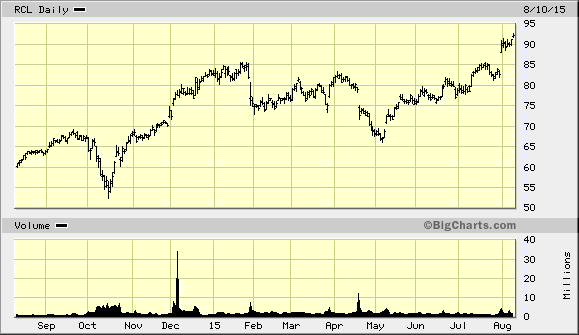
It’s almost like there’s a lesson for investors in this.
-
Morning News: August 10, 2015
Posted by Eddy Elfenbein on August 10th, 2015 at 7:11 amGreece, Lenders in Final Push to Seal New Bailout
Japan Poised for Nuclear Restart
China Stocks Bolt Higher on SOE Reform Speculation
UBS Wary as China Seeks Global Help to Clean Up Local Debt Mess
Oil Trades Near Five-Month Low as U.S. Drillers Deploy More Rigs
Tension Runs High in VIX as Stock Insurance Costs Most Since ’06
U.S. Index Futures Signal Stocks to Rebound; Berkshire Declines
Berkshire Hathaway to Buy Precision Castparts for About $37 Billion
Make in India Push: Apple iPhone Maker Foxconn to Start Maharashtra Manufacturing by 2018
Xiaomi Ties Up With Taiwan’s Foxconn to Assemble Smartphones in India
Alibaba to Invest $4.6 Billion in China Electronics Retailer Suning
Zynga Revenue Rises Despite Fewer Gamers
Here’s Why TV Got Hammered This Week – There’s a Tectonic Shift Underway
Jeff Carter: The Problem With Twitter
Joshua Brown: The Positive Feedback Loop is Broken
Be sure to follow me on Twitter.
-
OPEC is Effectively Dissolved
Posted by Eddy Elfenbein on August 7th, 2015 at 11:15 pmFascinating article by Ambrose Evans-Pritchard on the decline and fall of OPEC. Here’s a sample:
If the oil futures market is correct, Saudi Arabia will start running into trouble within two years. It will be in existential crisis by the end of the decade.
The contract price of US crude oil for delivery in December 2020 is currently $62.05, implying a drastic change in the economic landscape for the Middle East and the petro-rentier states.
The Saudis took a huge gamble last November when they stopped supporting prices and opted instead to flood the market and drive out rivals, boosting their own output to 10.6m barrels a day (b/d) into the teeth of the downturn.
Bank of America says OPEC is now “effectively dissolved”. The cartel might as well shut down its offices in Vienna to save money.
Read the whole thing.
-
Archives
- June 2026
- May 2026
- April 2026
- March 2026
- February 2026
- January 2026
- December 2025
- November 2025
- October 2025
- September 2025
- August 2025
- July 2025
- June 2025
- May 2025
- April 2025
- March 2025
- February 2025
- January 2025
- December 2024
- November 2024
- October 2024
- September 2024
- August 2024
- July 2024
- June 2024
- May 2024
- April 2024
- March 2024
- February 2024
- January 2024
- December 2023
- November 2023
- October 2023
- September 2023
- August 2023
- July 2023
- June 2023
- May 2023
- April 2023
- March 2023
- February 2023
- January 2023
- December 2022
- November 2022
- October 2022
- September 2022
- August 2022
- July 2022
- June 2022
- May 2022
- April 2022
- March 2022
- February 2022
- January 2022
- December 2021
- November 2021
- October 2021
- September 2021
- August 2021
- July 2021
- June 2021
- May 2021
- April 2021
- March 2021
- February 2021
- January 2021
- December 2020
- November 2020
- October 2020
- September 2020
- August 2020
- July 2020
- June 2020
- May 2020
- April 2020
- March 2020
- February 2020
- January 2020
- December 2019
- November 2019
- October 2019
- September 2019
- August 2019
- July 2019
- June 2019
- May 2019
- April 2019
- March 2019
- February 2019
- January 2019
- December 2018
- November 2018
- October 2018
- September 2018
- August 2018
- July 2018
- June 2018
- May 2018
- April 2018
- March 2018
- February 2018
- January 2018
- December 2017
- November 2017
- October 2017
- September 2017
- August 2017
- July 2017
- June 2017
- May 2017
- April 2017
- March 2017
- February 2017
- January 2017
- December 2016
- November 2016
- October 2016
- September 2016
- August 2016
- July 2016
- June 2016
- May 2016
- April 2016
- March 2016
- February 2016
- January 2016
- December 2015
- November 2015
- October 2015
- September 2015
- August 2015
- July 2015
- June 2015
- May 2015
- April 2015
- March 2015
- February 2015
- January 2015
- December 2014
- November 2014
- October 2014
- September 2014
- August 2014
- July 2014
- June 2014
- May 2014
- April 2014
- March 2014
- February 2014
- January 2014
- December 2013
- November 2013
- October 2013
- September 2013
- August 2013
- July 2013
- June 2013
- May 2013
- April 2013
- March 2013
- February 2013
- January 2013
- December 2012
- November 2012
- October 2012
- September 2012
- August 2012
- July 2012
- June 2012
- May 2012
- April 2012
- March 2012
- February 2012
- January 2012
- December 2011
- November 2011
- October 2011
- September 2011
- August 2011
- July 2011
- June 2011
- May 2011
- April 2011
- March 2011
- February 2011
- January 2011
- December 2010
- November 2010
- October 2010
- September 2010
- August 2010
- July 2010
- June 2010
- May 2010
- April 2010
- March 2010
- February 2010
- January 2010
- December 2009
- November 2009
- October 2009
- September 2009
- August 2009
- July 2009
- June 2009
- May 2009
- April 2009
- March 2009
- February 2009
- January 2009
- December 2008
- November 2008
- October 2008
- September 2008
- August 2008
- July 2008
- June 2008
- May 2008
- April 2008
- March 2008
- February 2008
- January 2008
- December 2007
- November 2007
- October 2007
- September 2007
- August 2007
- July 2007
- June 2007
- May 2007
- April 2007
- March 2007
- February 2007
- January 2007
- December 2006
- November 2006
- October 2006
- September 2006
- August 2006
- July 2006
- June 2006
- May 2006
- April 2006
- March 2006
- February 2006
- January 2006
- December 2005
- November 2005
- October 2005
- September 2005
- August 2005
- July 2005
 Eddy Elfenbein is a Washington, DC-based speaker, portfolio manager and editor of the blog Crossing Wall Street. His