-
Q1 GDP Revised Higher to -0.2%
Posted by Eddy Elfenbein on June 24th, 2015 at 12:58 pmThe first quarter was bad for the economy but not quite as bad as previously thought. This morning, the government revised Q1 GDP up to -0.2%. That matches what the Street had been expecting.
The harsh winter weather and port delays that damped growth at the start of the year have given way to increases in consumer spending and housing, bolstering Federal Reserve projections that the setback was temporary. Still, pockets of weakness remain as lower oil prices continue to hinder investment in the energy industry and a firm dollar restrains global sales.
“What we are seeing here does validate the story that the first-quarter weakness was transitory,” said Michael Feroli, chief U.S. economist at JPMorgan Chase & Co. in New York, who correctly forecast GDP. “The consumer is coming back to overall decent growth.”
-
Ford Rallies on Goldman Upgrade
Posted by Eddy Elfenbein on June 24th, 2015 at 12:06 pmShares of Ford Motor (F) are finally getting some love. The stock is up today thanks to an upgrade from Goldman Sachs. They raised the stock from a buy to a hold. The shares, which had been as low as $14.86 one week ago, have been as high as $15.66 today.
The firm increased its price target to $19 from $18, citing Ford’s “superior” growth outlook and its improving positioning in China.
Goldman expects earnings momentum to accelerate through 2016 driven by production of the new F-150 pick up truck.
Analysts noted that Ford is seeing strong truck pricing and has limited exposure to China.
Bed Bath & Beyond (BBBY) reports after the closing bell. Spencer Jakab looked at the stock in today’s WSJ:
So Bed Bath is looking a bit rumpled. But management’s strong track record and the company’s proven ability to throw off cash should make it interesting at its current price to both public and private investors.
Last July, the company issued debt and launched a big share buyback. The moves were perhaps opportunistic, due to Bed Bath’s depressed share price. There is also the possibility they were meant to make it a less attractive leveraged-buyout candidate.
Bed Bath’s debt-adjusted market value is currently just 7.1 times earnings before interest, taxes, depreciation and amortization. That is a 7% discount to its 10-year average.
Meanwhile, its price and pristine balance sheet could still make the company interesting to private-equity firms.
-
Morning News: June 24, 2015
Posted by Eddy Elfenbein on June 24th, 2015 at 7:03 amGreece Handed New Terms as Tsipras Approaches Decision Time
Italy Says Greece Must Act To Get Deal
Hedge Fund ‘War Games’ in Monaco Predict No Greek Euro Exit
German Business Confidence Hits Four-Month Low in June
Spain Says Economy Growing At Fastest Rate Since 2008
Korea Fund Has $18 Billion at Stake Backing Samsung on C&T
Australia Commits to China-Led Bank
U.S. Firms Fear Financing Drought as Deadline Looms For Trade Bank
As U.S. Probes $12.7 Trillion Treasury Market, Trader Talk Is a Good Place to Start
Ford Embraces Car-Sharing and Electric Bikes on a Crowded Planet
Monsanto CEO Calls Syngenta Approach ‘A Long Game’
IBM and Box Forge Global Partnership to Transform Work in the Cloud
Wal-Mart to Impose Charges on Suppliers As Its Costs Mount
Howard Lindzon: Congratulations Facebook ….Time to Buy Slack
Cullen Roche: Did Schwab Just Kill the Non-Human Robo Advisor Services?
Be sure to follow me on Twitter.
-
The Disaster Of Confederate Monetary Policy
Posted by Eddy Elfenbein on June 23rd, 2015 at 10:37 pm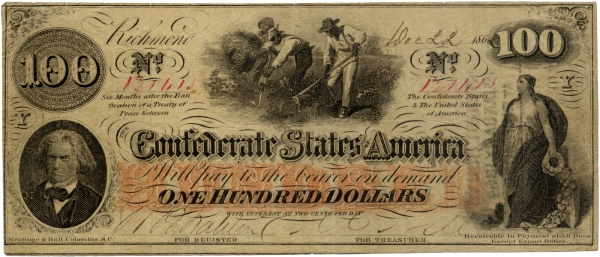
I won’t weigh in on the controversy surrounding the Confederate flag. But if you’re not persuaded by insurrection or slavery, at least consider the disaster that was Confederate monetary policy.
Wars are expensive things and the Confederacy had trouble raising revenue with taxes; nor could they borrow effectively in the international bond market. So CSA Treasury Secretary Christopher Memminger turned to an old stand-by — the printing press.
With no other avenue open, Secretary Memminger reluctantly turned to the printing press to meet the Confederacy’s financing needs. Memminger was aware that such a move would likely cause a rise in the price level and warned the government repeatedly about this danger, to no avail. The Treasury bills issued during the war had a peculiar feature: They were redeemable for gold two years after the war ended, which meant that the value of the bills was partially tied to expectations of victory for the Confederacy. So rapid was the expansion of the Confederate money supply that at one point during the war, the orders for new currency exceeded the printing capacity of the Treasury’s presses. To fill the order, the Treasury began to accept counterfeit currency as valid to further expand the supply of money.
The enormous increase in the quantity of currency precipitated an era of hyperinflation in the Confederacy as more dollars chased fewer goods. The price level in the South rose by roughly 10 percent per month during the conflict and by the end of the war, the price level had increased in the Confederacy by a factor of 92, though imports tended to inflate more quickly and exports more slowly. At the same time, the blockade, military destruction, and the loss of workers to the war caused real wages and output to fall dramatically, with per-capita consumption falling by 50 percent in real terms. Indeed, if banks had not sharply increased their reserve ratios for fear of bank runs, the inflation created by excess money in the South would likely have been even more severe.
Hyperinflation had a number of negative effects on the Southern wartime economy. As currency became useless as a store of value, the rate at which people spent their cash reserves — the velocity of money — increased, driving prices still higher. In many areas of the South, Confederate dollars became worthless unless accompanied by some valuable underlying commodity such as cotton or leather, impeding the smooth economic exchanges on which healthy economies depend. In border areas, the Union greenback currency became the preferred medium for exchange due to its superior stability. Faced with the danger of imminent invasion and the burden of supporting and hosting the military, the border areas tended to be particularly harmed by the war.
The Confederate government passed the Currency Reform Act of 1864 in an effort to stem the rampant inflation ravaging the South. The Act effectively removed one third of all currency in the South from circulation by mandating that all large denomination bills be converted to 4 percent Treasury bonds before April 1, 1864, and imposing a 3-to-2 redemption ratio for small bills after the deadline. As people tried to get rid of their large notes, velocity spiked and in the months prior to the deadline, inflation rose to 23 percent a month. In the summer of 1864, though, price levels in the Confederacy finally stabilized and even declined slightly, just as monetary theory would predict following a contraction in the money supply. However, in the face of continuing pressure to meet war obligations, Congress authorized the printing of an additional $275 million in August of 1864, mostly reversing the effects of the Currency Reform Act.
In contrast with the South, the Union successfully raised the $2.3 billion necessary to fund its war effort without causing hyperinflation. Though inflation was high in the North during the war — prices doubled in most Northern cities — it paled in comparison to the hyperinflation that plagued the Confederacy. The North drastically changed its tax collection system and financial infrastructure to accommodate the burdens of a long, expensive war. These wartime changes ultimately helped reshape the economic face of America.
Whereas the South was mostly unable to raise funds through loans, the North financed roughly 65 percent of its war effort through borrowing. Wealthy Philadelphia financier Jay Cooke successfully orchestrated the sale of huge numbers of war bonds. In order to sell these issues, Cooke launched a massive advertising campaign aimed at middle- and working-class families who traditionally were not seen as a major source of funds. His campaign was a success, with almost 1 million working families purchasing war bonds. This advertising effort presaged the modern era in which bond issues to the general public were used to help pay for wars.
During the war, the Union also managed to expand its tax base and revamp its collection system. After some initial tax measures in 1861, including the first federal income tax in U.S. history, the Union passed the Internal Revenue Act of 1862 which raised the income tax, enacted luxury and consumption taxes, and created the Bureau of Internal Revenue. In contrast to the Confederate bureaucracy where central control was weak and administrative capability lacking, the Bureau of Internal Revenue streamlined federal tax collection, a process so effective that the North raised 20 percent of its wartime revenue through taxation.
The Union Congress also passed several important pieces of financial legislation during the Civil War. In 1861, the financial demands of the war began to deplete the gold reserves of both the banking sector and the Treasury. In response, private banks ceased redeeming currency for gold, and soon the Treasury followed suit. The government passed the Legal Tender Act of 1862, which allowed the issuance of legal tender currency not backed by gold. This marked the first time in U.S. history that a fiat currency, or a currency not backed by some underlying commodity, was used as legal tender. A year later the Union government passed the National Banking Act of 1863 which created a system of nationally chartered and regulated banks to ensure a market for Union war bonds. Preexisting banks were given very strong incentives to become nationally chartered. Once chartered they were subject to federal reserve requirements, had to accept all other national banks’ currencies at face value, and had to hold federal bonds as collateral against note issue.
Both the Legal Tender Act and the National Banking Act were intended to be temporary measures to meet the exigencies of war. However, both sets of reforms lasted long after the conflict ended. More broadly, these acts, coupled with the expansion of taxation and the creation of the Bureau of Internal Revenue, marked an important shift in the power of the U.S. government. After the Civil War, the federal government had much more control over banking regulation and monetary policy, and much more power over the states generally.
-
Buy List Closes at YTD High
Posted by Eddy Elfenbein on June 23rd, 2015 at 4:32 pmThe Nasdaq Composite closed today at an all-time high, and the S&P 500 closed at its highest level since May 22.
Our Buy List closed at its YTD high, now up 5.93% for the year (dividends not included). The S&P 500 is up 3.17% on the year. Our current lead over the S&P 500 is 276 basis points which is the second-widest this year. On March 31, we were leading by 282 basis points.
I haven’t included dividends in this post because I didn’t have the time, but please know that dividends are part of my final calculations. I’m not trying to hide anything. The S&P 500 does yield a bit more than our Buy List, but it’s not that big of a factor.
-
No 2% Days this Year
Posted by Eddy Elfenbein on June 23rd, 2015 at 9:43 amAs a sign of falling volatility, the S&P 500 hasn’t had a single 2% daily move all year.
-
Durable Goods Fall in May
Posted by Eddy Elfenbein on June 23rd, 2015 at 9:25 amThe government reported that orders for durable goods fell by 1.8% last month.
New orders for durable goods—products such as computers and trucks designed to last at least three years—decreased a seasonally adjusted 1.8% in May from a month earlier, the Commerce Department said
Tuesday. April durable goods orders fell a revised 1.5%, compared with the previously reported 1% decrease.
Economists surveyed by The Wall Street Journal had expected overall orders to fall 1% in May.
Details of the report were mixed, with underlying figures showing gains in some key categories but nothing in the way of a breakout.
“The bottom line is that equipment investment is one of the few expenditure components that isn’t showing signs of a marked rebound in the second quarter,” Paul Ashworth, chief U.S. economist at Capital Economics, said in a note to clients.
Through the first five months of the year, overall orders are down 2.2% compared to the same period in 2014.
-
Morning News: June 23, 2015
Posted by Eddy Elfenbein on June 23rd, 2015 at 7:18 amTsipras Aims to Stave Off Defections in Greece Over Aid Plan
German Private Sector Grows, Points to 0.3% Growth in Second-Quarter
Putting Woman on $10 Note Spurs Backlash Over Hamilton Demotion
Good News On The Grapevine From The Supreme Court About Raisins
Alibaba And Ant Financial to Invest $1 Billion in Local Services
24M: A Breakthrough In Lithium-Ion Battery Technology?
With A Tap of Taylor Swift’s Fingers, Apple Retreated
Syngenta Chairman Sets Criteria For ‘Serious’ Takeover Offer
Takata Is Said to Have Stopped Safety Audits as Cost-Saving Move
Dow Chemical Weedkiller May Cause Cancer, WHO Agency Says
Why The Uber Ruling Shows the ‘Sharing Economy’ Is Bunk
Uber’s Promises of Privacy Ring Hollow, Says Group
Wall Street Diverges as Gorman and Blankfein Take Opposite Paths
Joshua Brown: How are Active Managers Beating the Market? By Taking More Risk.
Jeff Carter: Success Is A Lousy Teacher
Be sure to follow me on Twitter.
-
Let’s Try this Market Metaphor
Posted by Eddy Elfenbein on June 22nd, 2015 at 12:06 pmImagine that instead of a stock market, all stock prices are decided by a committee of ten men. Inside a big room, ten guys who all look somewhat look like the Monopoly Man convene once a day. They judge each stock and the average of their decisions is the stock’s price.
Let’s say that for one particular stock, the committee rules as follows. Two members say it’s worth $23 per share. Two more say it’s worth $24. Four members say $25. One says it’s $26.
That leaves one more member. He says stock is worthless. $0 per share.
Thanks to the ultrabear, the average of the ten comes to $22 per share.
It’s this one bearish outlier that’s our very good friend. Because of this spread, the prices underlying the stock’s price aren’t normally distributed. There’s a small fear of disaster. Even though the fear is small, it weighs heavily on the share price.
Although this is just a thought exercise, I like it because it elucidates a broader truth about the market. Every stock has a fear premium built into its price. Most of the market’s gains come from the slow, incremental advance in the judgment of the vast majority of the market. The sudden downshifts are when the lone dissenter is able to get a few more people into his camp. And very rarely, everyone joins his camp.
This is why changes in stock prices don’t follow the normal bell curve. As a very general rule of thumb, stock prices go up slowly and fall rapidly. In fact, bear markets are often largely done right at the point the public realizes they’re in one.
What value investing does, in essence, is constantly short the fear premium—that one $0 guy. It’s not the nine people paring back their view that creates opportunity. If the market is efficient, it’s those nine guys who are. The inefficiency happens when the fear premium jumps.
-
EU Meeting Agrees to Hold More Meetings
Posted by Eddy Elfenbein on June 22nd, 2015 at 9:29 amTime is running out on the Greek saga, and the two sides still aren’t close to a deal. There was a surge of optimism this weekend which has carried over into the markets on Monday. But the Europe finance ministers were quick to temper any enthusiasm. The Greek government has offered a new plan, but the EU hasn’t had a chance to look at the details just yet. There probably won’t be a breakthrough today.
The Greeks are demanding to meet with the big prime ministers of Europe, not just the bureaucrats within the EU. The meetings on Monday seem to be largely a waste of time. The only outcome is the promise of more meetings. Assuming a deal is reached soon, it still needs to pass the Greek parliament.
The Greek two-year is at 23%.6. Actually, I should say that it’s down to 23.6%. It had been much higher.
I have to believe that some deal at some point will be reached somehow. There’s more to lose than to gain. Still, I’m not willing to make a bet on that. Watch shares in the National Bank of Greece (NBG). They may shoot up or down by 15% over the next week.
-
Archives
- June 2026
- May 2026
- April 2026
- March 2026
- February 2026
- January 2026
- December 2025
- November 2025
- October 2025
- September 2025
- August 2025
- July 2025
- June 2025
- May 2025
- April 2025
- March 2025
- February 2025
- January 2025
- December 2024
- November 2024
- October 2024
- September 2024
- August 2024
- July 2024
- June 2024
- May 2024
- April 2024
- March 2024
- February 2024
- January 2024
- December 2023
- November 2023
- October 2023
- September 2023
- August 2023
- July 2023
- June 2023
- May 2023
- April 2023
- March 2023
- February 2023
- January 2023
- December 2022
- November 2022
- October 2022
- September 2022
- August 2022
- July 2022
- June 2022
- May 2022
- April 2022
- March 2022
- February 2022
- January 2022
- December 2021
- November 2021
- October 2021
- September 2021
- August 2021
- July 2021
- June 2021
- May 2021
- April 2021
- March 2021
- February 2021
- January 2021
- December 2020
- November 2020
- October 2020
- September 2020
- August 2020
- July 2020
- June 2020
- May 2020
- April 2020
- March 2020
- February 2020
- January 2020
- December 2019
- November 2019
- October 2019
- September 2019
- August 2019
- July 2019
- June 2019
- May 2019
- April 2019
- March 2019
- February 2019
- January 2019
- December 2018
- November 2018
- October 2018
- September 2018
- August 2018
- July 2018
- June 2018
- May 2018
- April 2018
- March 2018
- February 2018
- January 2018
- December 2017
- November 2017
- October 2017
- September 2017
- August 2017
- July 2017
- June 2017
- May 2017
- April 2017
- March 2017
- February 2017
- January 2017
- December 2016
- November 2016
- October 2016
- September 2016
- August 2016
- July 2016
- June 2016
- May 2016
- April 2016
- March 2016
- February 2016
- January 2016
- December 2015
- November 2015
- October 2015
- September 2015
- August 2015
- July 2015
- June 2015
- May 2015
- April 2015
- March 2015
- February 2015
- January 2015
- December 2014
- November 2014
- October 2014
- September 2014
- August 2014
- July 2014
- June 2014
- May 2014
- April 2014
- March 2014
- February 2014
- January 2014
- December 2013
- November 2013
- October 2013
- September 2013
- August 2013
- July 2013
- June 2013
- May 2013
- April 2013
- March 2013
- February 2013
- January 2013
- December 2012
- November 2012
- October 2012
- September 2012
- August 2012
- July 2012
- June 2012
- May 2012
- April 2012
- March 2012
- February 2012
- January 2012
- December 2011
- November 2011
- October 2011
- September 2011
- August 2011
- July 2011
- June 2011
- May 2011
- April 2011
- March 2011
- February 2011
- January 2011
- December 2010
- November 2010
- October 2010
- September 2010
- August 2010
- July 2010
- June 2010
- May 2010
- April 2010
- March 2010
- February 2010
- January 2010
- December 2009
- November 2009
- October 2009
- September 2009
- August 2009
- July 2009
- June 2009
- May 2009
- April 2009
- March 2009
- February 2009
- January 2009
- December 2008
- November 2008
- October 2008
- September 2008
- August 2008
- July 2008
- June 2008
- May 2008
- April 2008
- March 2008
- February 2008
- January 2008
- December 2007
- November 2007
- October 2007
- September 2007
- August 2007
- July 2007
- June 2007
- May 2007
- April 2007
- March 2007
- February 2007
- January 2007
- December 2006
- November 2006
- October 2006
- September 2006
- August 2006
- July 2006
- June 2006
- May 2006
- April 2006
- March 2006
- February 2006
- January 2006
- December 2005
- November 2005
- October 2005
- September 2005
- August 2005
- July 2005
 Eddy Elfenbein is a Washington, DC-based speaker, portfolio manager and editor of the blog Crossing Wall Street. His