-
Morning News: June 22, 2015
Posted by Eddy Elfenbein on June 22nd, 2015 at 7:21 amECB Approves Additional Emergency Liquidity for Greek Banks
Greek Optimism Tempered by Finance Chiefs as Plan Sows Confusion
What Do Greek Bonds Tell Us About the Crisis?
Gold Eases From Near-Four-Week High on Greek Debt Talks
Effect of Saudi Arabia Decisions on Global Crude Oil Supply and Demand
iPhones as Hard to Find as Dollars in Venezuela During Oil Slump
Health Insurers Brace for Supreme Court Ruling
California Ruling Seen Unlikely to Dent Value of Uber, Other Start-Ups
Altice Arm Offers €10 Billion for Bouygues Telecom
’Emotional’ Robot Sells Out In A Minute
Cigna Rebuffs Anthem’s ‘Deeply Disappointing’ Proposal
Taylor Swift Criticism Spurs Apple to Change Royalties Policy
Roger Nusbaum: Alternative Retirement: Working or Not Retiring
Jeff Miller: Weighing the Week Ahead: What Does the Greek Crisis Mean for Financial Markets?
Be sure to follow me on Twitter.
-
Bursting the China Bubble
Posted by Eddy Elfenbein on June 19th, 2015 at 11:09 amJosh Brown wonders if the Chinese stock bubble just burst.
Shanghai’s A shares market has just corrected by 13% over the last week, one of the biggest pullbacks for Chinese stocks on record. Is this a buyable pullback in a longer-term uptrend or the beginning of the end.
I don’t know the answers to these questions, nor will anyone until after the fact.
Check out the Shanghai Composite over the last two weeks:
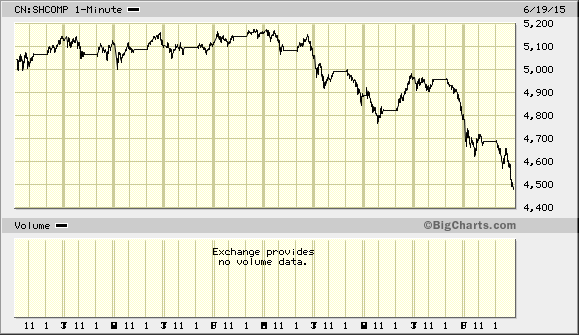
One year ago, the index was a little over 2,000.
-
CWS Market Review – June 19, 2015
Posted by Eddy Elfenbein on June 19th, 2015 at 7:08 am“I can calculate the motion of heavenly bodies, but not the madness of people.”
– Isaac NewtonOn Thursday, the Nasdaq Composite touched its highest point ever. Yesterday, the index hit an intra-day peak of 5,143.32. That finally eclipsed the high of 5,132.52 reached on March 10, 2000, more than 15 years ago. The Nasdaq had already broken its record for closing highs, but the intra-day peak held out until yesterday.
It’s not just the Nasdaq. On Thursday, the small-cap Russell 2000 closed at an all-time high. The S&P 500, which is a broader index than both the Russell or Nasdaq, closed at 2,121.24, which is less than 0.5% from its all-time closing high reached four weeks ago.

What’s the reason for the rally’s latest surge? For that, we can thank Janet Yellen and her friends at the Federal Reserve. This week, the Fed decided against raising interests, at least for now. The Fed made it clear that interest rates will be going higher soon, and probably before the end of the year. But now Wall Street is starting to think the Fed may raise rates once or twice, and then stop.
Our Buy List continues do well (+5.39% YTD) but we had a weak earnings report from Oracle (ORCL). The culprit was, again, the strong U.S. dollar. Shares of Oracle lost nearly 5% on Thursday. I’ll have full details in a bit. Later on, I’ll discuss the latest act of the ongoing Greek drama. It seems that both sides are incapable of serious negotiations unless it’s the final minute. I’ll also bring us up to speed on the latest news from our Buy List. But first, let’s look at what the Federal Reserve had to say this week.
Will the Fed Do a One-and-Done?
On Wednesday, the Federal Reserve wrapped up its two-day meeting in Washington. For now, the Fed decided against raising interest rates but strongly hinted that a rate hike isn’t far off. As part of this meeting, Fed members updated their economic projections. These are the famous “blue dots” from the graphs in this report.
The key detail from these forecasts is that 15 of the 17 FOMC members said they see a rate increase coming before the end of this year. Since the year is nearly half over, that’s not too far away.
The Fed’s policy statement said that the economy is growing moderately and that job growth is picking up. They also noted that the housing market is getting better, while household spending is “moderate.”
The crucial point for the Fed is that inflation is still low, but they said they expect inflation to rise towards their 2% target. The Fed hasn’t done a very good job of hitting that target. The central bank’s preferred measure of inflation is the personal-consumption expenditures price index, and that’s come in below 2% for 36 straight-months.
On Thursday, the government released the Consumer Price Index report for May. That showed the highest monthly inflation rate in more than two years. Don’t worry, inflation’s still low, but it may be trending upward. Don’t forget that a few months ago, we had three months of deflation, which was largely due to plunging oil prices. That episode has passed.
Personally, I like to look at the “core rate” of inflation, which excludes food and energy prices. So far this year, core inflation is growing at 2.37% annualized. It’s still early to say that inflation is definitely in an uptrend, but the early evidence suggests that the Fed may finally reach its 2% target. Naturally, that would boost the argument for raising interest rates sooner rather than later.
The Fed has four meetings left this year. Here’s what the futures market currently thinks. For the July meeting, the futures say “no way”—there’s a 0% chance of a rate hike. I have to agree. For September, that rises to 16.8%. For the October meeting, the chances rise to 34.4%. So, possible, but not probable. But for December, the chances rise to 57.1%. The futures market actually thinks there’s a 20% chance there could be two rate hikes by December.
But here’s something to consider: What if the Fed raises rates only once and pauses? Or maybe once, pauses, then again, and another pause? The last rate-hike cycle consisted of 17 rate hikes at 17 consecutive meetings. Just because they did it that way before doesn’t mean they’ll do it again.
To my mind, what really bolsters the case for the one-and-done scenario is what Janet Yellen said during her post-meeting press conference. The Fed Chairwoman said, “Let me emphasize that the importance of the initial increase should not be overstated. The stance of monetary policy will likely remain highly accommodative for quite some time after the initial increase in the federal funds rate in order to support continued progress towards our objectives of maximum employment and 2% inflation.”
I think that’s what’s causing the market’s latest rally. This means that real interest rates, meaning inflation-adjusted rates, will probably remain negative for 18 more months. Maybe even longer. That’s good news for stocks. I’m still in the bullish camp until interest rates provide significant competition for stocks. On our Buy List, some of the best bargains include Qualcomm (QCOM), Hormel Foods (HRL), Wells Fargo (WFC) and Stryker (SYK).
The Consequences of Greece Exiting the Euro
I haven’t written much about Greece and its ruinous finances lately since I don’t believe it has a major impact on our portfolios. The issue, however, has dominated a lot of the financial media, so I wanted to say a few words (and calm some nerves).
The short version is that Greece has a major debt payment coming due to the IMF. Greece’s creditors, the IMF and other euro countries, have demanded that Greece make some reforms to its public finances. The Greek government is screaming that this is blackmail, and they’ve resisted every step of the way. The EU has hinted that this time they’ve been pushed too far and that they’re willing to let Greece default and exit the euro.
Negotiations fell though this week, and leaders are planning a summit for Monday to give it another shot. But time is running out. The loans are due at the end of the month. There’s been a lot of finger-pointing as both sides blame each other for the impasse. Alexis Tsipras, Greece’s prime minister, won the election by his vocal opposition to the terms of the bailout. His recent chumminess with Vladimir Putin hasn’t helped.
Would it be such a disaster if Greece leaves the euro? The IMF said that a default would be manageable for Europe, but the impact on the U.S. economy would be minimal. Greece simply isn’t a major trading partner for the United States. A Greek default would barely register on our markets and in our economy. Greek savers are already pulling their money out of banks. The authorities may have to step in and limit withdrawals. The ECB said they’re not sure if Greek banks can open on Monday. Shares in the National Bank of Greece (NBG) have fallen to $1 per share. In 2007, they were going for $700.
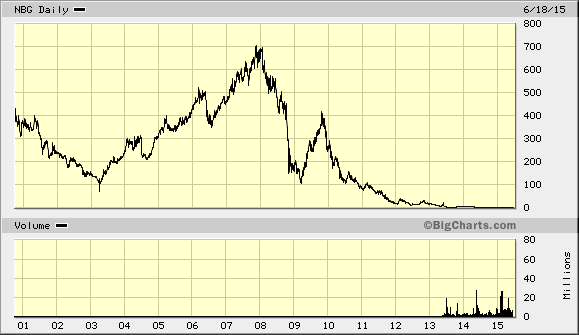
But the real fear isn’t Greece—it’s who comes next. If Greece leaves the euro, then it establishes a precedent. Soon, countries like Spain, Italy or Portugal could follow. The fear before was that an exit from the euro would disrupt the intertwined banking system. That’s not the case now. Rather, it’s a political fear that an anti-establishment party in one of the euro countries would lead a revolt against its creditors.
I think any fears of this happening are very premature. Greece is a very different case from the rest of Europe. (If you have time, I’d recommend Michael Lewis’s devastating look at the Greek economy.) As bad as Greece is, the rest of Europe wants to keep them in. A deal will probably be reached at the last possible moment. There’s little chance of any contagion spreading across the continent.
Oracle Drops on Earnings Disappointment
After the closing bell on Wednesday, Oracle (ORCL) reported fiscal Q4 earnings of 78 cents per share. That’s not good. It was nine cents below Wall Street’s estimate. The results were even below the company’s own guidance. Oracle had told us to expect earnings to range between 90 and 96 cents per share. Quarterly revenues came in at $10.71 billion, which was below the Street’s forecast of $10.92 billion.
So what was the problem? Oracle said that their business was “significantly impacted” by the strong U.S. dollar. They said the same thing three months ago. Revenues fell 5% compared with last year, but Oracle said that adjusted for forex, revenues would have risen by 3%.
Looking at the numbers, I agree that currency was a factor, but that’s not all. Oracle is facing real headwinds with their business. In fact, it’s impacting all tech. For Q4, software sales fell 6% to $8.4 billion. I was expecting more. One bright spot is that Oracle’s cloud revenue rose 28%, but that’s still a small part of their overall business.
I’m disappointed with this earnings report, but I’m not about to bail on Oracle. The company still has lots of strength. For the fiscal year, Oracle earned $2.77 per share. Their free cash flow was an astounding $12.9 billion. Net of debt, the company is sitting on $12 billion in cash.
For fiscal Q1, Oracle sees earnings coming in between 56 and 59 cents per share. Wall Street had been expecting 61 cents per share. The share dropped sharply on Thursday. At one point, Oracle got as low at $40.97 per share, but it rallied back to close at $42.74. Oracle is not a pricey stock, but they need to give investors something to cheer about. This week, I’m lowering my Buy Below on Oracle to $45 per share.
Buy List Updates
On Thursday, three of our stocks hit new 52-week highs; Fiserv (FISV), Snap-on (SNA) and Wells Fargo (WFC). Also, Stryker (SYK) is closing in on its 52-week high. Here’s some more news on our Buy List stocks.
Bed Bath & Beyond (BBBY) is due to report fiscal Q1 earnings on Wednesday, June 24. I previewed the earnings report in last week’s CWS Market Review. I said that I’ve gotten a little frustrated with BBBY. I don’t like to see them spend so much on share buybacks. It’s a solid company, but I want to see better numbers. They gave us an earnings range of 90 to 95 cents per share. I’m also curious to see what their guidance is for the current quarter.
Ross Stores (ROST) split 2-for-1 last Friday, so I hope you didn’t panic about the lower share price. The deep discounter continues to perform well. Ross got dinged after the last earnings report, even though it looked fine to me. Traders were expecting better guidance. On Thursday, Ross closed above $50 for the first time since the earnings report. Ross Stores is a good buy up to $52 per share.
Signature Bank (SBNY) announced this week that former Congressman Barney Frank is joining their board of directors. I got a few emails telling me that this move spells certain doom for the bank. (Even the Wall Street Journal got in the act “Barney Frank—Yes, THAT Barney Frank—Joins a Bank Board.”)
Sorry, but I’m not going to bite. For one, Congressman Frank has lots of experience that can serve Signature well. Don’t forget that the financial-reform law is called Dodd-Frank. Congressman Frank also chaired the House Banking Committee. It’s nice to have someone like that on your team. I’ve seen too many investors get hurt when they use their politics as the basis for their portfolios. Signature is a buy up to $150 per share.
That’s all for now. Next week is the final full week of Q2. We’re also going to get some key economic reports. The durable-goods report comes out on Tuesday. On Wednesday, the government will release its second revision to Q1 GDP. The last report said that the economy contracted by 0.7% during Q1. Then on Thursday, the government reports on personal income and spending for May. Be sure to keep checking the blog for daily updates. I’ll have more market analysis for you in the next issue of CWS Market Review!
– Eddy
-
Morning News: June 19, 2015
Posted by Eddy Elfenbein on June 19th, 2015 at 7:05 amE.C.B. Holds Emergency Meeting on Extending Lifeline to Greece
Greek PM Optimistic on Debt Deal As Banks Bleed
BOJ’s Kuroda Backpedals on Yen Warning, Says Weakness Not So Harmful
Who Says China Markets Are Rallying More Than India?
After Doubts, Economists Find China Kills U.S. Factory Jobs
House Sends Trade Bill Back to Senate in Bid to Outflank Foes
Proposed Rule For Big Trucks Aims at Cutting Fuel Emissions
Two Macroeconomic Puzzles Answered By California’s Uber
Exxon Mobil, Petróleos de Venezuela to Sell Jointly Owned Refinery
The Shale Industry Could Be Swallowed By Its Own Debt
Nucor Forecasts Dip in Profit as Imports Hit Steel Prices
Google Told to Expect Large Fines in EU Antitrust Probe
Toyota in Damage Control Mode After American Exec Arrested
Marc Chandler: This is the Framework of a Potential Greek Compromise Taking Shape
Joshua Brown: What You Need to Know About the FOMC’s Dot Plot
Be sure to follow me on Twitter.
-
The Nasdaq Hits All-Time Intra-Day High
Posted by Eddy Elfenbein on June 18th, 2015 at 12:49 pmAfter 15 years, the Nasdaq Composite finally broke its all-time intraday high from 15 years ago. On March 10, 2000, the index got as high as 5,132.52 during the day before closing at 5,048.62.
The Nasdaq finally topped the all-time high close on April 23 of this year, but it hadn’t broken the intra-day mark until today. The Nasdaq has been as high as 5,143.32 today.
-
Inflation May Be Creeping Higher
Posted by Eddy Elfenbein on June 18th, 2015 at 10:43 amThe government reported that inflation rose 0.44% last month. That’s the biggest increase in more than two years.
For some context, let’s remember that we recently had three straight months of deflation (November, December and January). Those decreases were fairly sizable. In fact, year-over-year CPI is still negative. CPI dropped 0.11% in the last 12 months. Past of that is because the trailing 12 months is carrying those big drops we had this winter.
But slowly, it appears that inflation is creeping up on the Fed’s 2% target. I don’t want to overstate the case. There still isn’t much evidence, but we can say that our recent bout of deflation has passed.Since the recent deflation was largely driven by falling energy prices, let’s look at the core rate of inflation, which doesn’t include food or energy prices. Core prices rose by 0.15% in May. That comes after a 0.26% jump in April which was the largest increase since August 2011. Core prices are up 1.73% in the last 12 months. Interestingly, that hasn’t changed much in the last two years.
Here’s a stat the surprised me when I calculated it: Core CPI is tracking 2.37% so far this year. (That’s the annualized increase of the last five months.)
-
Morning News: June 18, 2015
Posted by Eddy Elfenbein on June 18th, 2015 at 7:14 amThe Latest on Greece: Officials Pessimistic Ahead of Meeting
Germany Presses Greece to Deliver as Bailout Tension Mounts
Swiss Banks’ Profit Rises; Staff Count Down
Nicaragua Canal Project Cloaked in Secrecy – Apparently at Government’s Behest/a>
Banks’ Civil Forex Settlements Near $2 Billion
Fed Holds Off On Interest Rate Hike, Downgrades Economic Forecast
F.C.C. to Fine AT&T For Slowing Data Speeds of Some Customers
SoftBank, Alibaba Team Up on Robot
Apple Mines Big Profits From Watch Band
Alibaba’s Ant Financial Valued at $45 Billion After New Funding
Rite Aid Same-Store Sales Miss Estimates
This ‘Barbarian’ Banker Has Turned Into a Friendly Activist
Brian Williams to Stay at NBC, but Not as News Anchor
Cullen Roche: Leveraged Bubbles and the Importance of Endogenous Money
Jeff Carter: Does The Sharing Economy Create Employees?
Be sure to follow me on Twitter.
-
Oracle Earns 78 Cents per Share
Posted by Eddy Elfenbein on June 17th, 2015 at 4:04 pmOracle (ORCL) just reported fiscal Q4 earnings of 78 cents per share. That’s nine cents below estimates. The trouble was the strong dollar. For the year, Oracle earned $2.77 per share compared with $2.87 per share last year.
Oracle Corporation today announced fiscal 2015 Q4 results. The results were significantly impacted by the strengthening of the U.S. dollar compared to foreign currencies. Total Q4 Revenues were $10.7 billion, down 5% but would have been up 3% without the strengthening of the U.S. dollar. Software and Cloud Revenues were $8.4 billion, down 6%, but up 2% in constant currency. Cloud software as a service (SaaS) and platform as a service (PaaS) revenues were $416 million, growing 29%, and up 35% in constant currency. Cloud infrastructure as a service (IaaS) revenues were $160 million, growing 25%, and up 31% in constant currency. Hardware Systems Revenues were $1.4 billion, down 4%, but up 5% in constant currency.
Q4 Operating Income was $4.0 billion, and the Operating Margin was 37%. Non-GAAP Operating Income was $5.0 billion, and the non-GAAP Operating Margin was 46%. Net Income was $2.8 billion while non-GAAP Net Income was $3.5 billion. Earnings Per Share was $0.62, down 23%, and down 12% in constant currency, while non-GAAP Earnings Per Share was $0.78, down 14%, and down 5% in constant currency.
Short-term Deferred revenues were $7.2 billion, slightly down, but up 9% in constant currency compared with a year ago. Operating Cash Flow on a trailing twelve-month basis was $14.3 billion.
For fiscal year 2015, Total Revenues were $38.2 billion, essentially unchanged, but up 4% in constant currency. Software and Cloud Revenues were $29.5 billion, up 1%, and up 5% in constant currency. Cloud SaaS and PaaS revenues were $1.5 billion, up 32%, and up 35% in constant currency. Cloud IaaS revenues were $608 million, up 33%, and up 36% in constant currency. Total Hardware System Revenues were $5.2 billion, down 3%, but up 2% in constant currency. Operating Income was $13.9 billion, and the Operating Margin was 36%. Non-GAAP Operating Income was $17.4 billion, and non-GAAP Operating Margin was 45%. Net Income was $9.9 billion, while non-GAAP Net Income was $12.5 billion. Earnings Per Share was $2.21, down 7%, but unchanged in constant currency. Non-GAAP Earnings Per Share was $2.77 down 3%, but up 2% in constant currency.
“We sold an astonishing $426 million of new SaaS and PaaS annually recurring cloud subscription revenue in Q4,” said Oracle CEO, Safra Catz. “We expect our rapidly increasing cloud sales to quickly translate into significantly more revenue and profits for Oracle Corporation. For example, SaaS and PaaS revenues grew at a 34% constant currency rate in our just completed Q4, but we expect that revenue growth rate to jump to around 60% in constant currency this new fiscal year.”
“Coming into Q4, we forecast selling $300 million of new SaaS and PaaS annual recurring revenue,” said Oracle CEO, Mark Hurd. “We dramatically beat that forecast by selling a cloud industry all-time-record amount of $426 million of new SaaS and PaaS business. That is a year-over-year bookings growth rate of over 200%. As our multi-billion dollar cloud business gets bigger, our SaaS and PaaS revenue growth rates are on their way up to 60% in constant currency. Compare this to our primary cloud competitors’ whose own revenue growth forecasts are on their way down to 44% and 22%.”
“We expect to book between $1.5 and $2.0 billion of new SaaS and PaaS business this fiscal year,” said Oracle Executive Chairman and CTO Larry Ellison. “That means Oracle would sell more new SaaS and PaaS business than salesforce.com plans to sell in their current fiscal year — the only remaining question is how much more. Oracle’s planned SaaS and PaaS revenue growth rate is around 60% in constant currency; salesforce.com has a planned growth rate of around 20%. When you contrast those growth rates it becomes clear that Oracle is on its way to becoming the world’s largest enterprise cloud company.”
-
Barney Frank Joins Signature’s Board
Posted by Eddy Elfenbein on June 17th, 2015 at 2:23 pmSignature Bank, a New York-based full-service commercial bank, announced today the election of former U.S. Congressman Barney Frank to its Board of Directors, effective today. Frank fills the seat left vacant by the recent passing of Alfred B. DelBello, who had served on Signature Bank’s board since January 2003, and also was Lead Independent Director since December 2011.
Frank served as a U.S. Congressman representing the 4th District of Massachusetts from 1981-2013 and also was Chairman of the House Financial Services Committee from 2007-2011. While in Congress, Frank worked to address America’s spending priorities to reduce the deficit and protect funding for important quality-of-life needs at home. He championed the interests of the poor, underprivileged and vulnerable. Frank won reelection 16 times by double-digit margins. As chair of the House Financial Services Committee, he was instrumental in crafting the short-term $550 billion rescue plan in response to the nation’s financial crisis. Later, Frank co-sponsored the Dodd-Frank Wall Street Reform and Consumer Protection Act, an extensive set of financial regulations aimed at preventing recurrence of the crisis that was signed into law in July 2010. From 2003 until his retirement, Frank was the leading Democrat on the House Financial Services Committee. Prior to serving in Congress, Frank spent eight years as a state Representative in Massachusetts and earlier, served as Chief of Staff to Congressman Michael Harrington and Chief Assistant to Mayor Kevin White of Boston.
-
Today’s Fed Statement
Posted by Eddy Elfenbein on June 17th, 2015 at 2:18 pmAs expected, no rate hike. Here’s the latest:
Information received since the Federal Open Market Committee met in April suggests that economic activity has been expanding moderately after having changed little during the first quarter. The pace of job gains picked up while the unemployment rate remained steady. On balance, a range of labor market indicators suggests that underutilization of labor resources diminished somewhat. Growth in household spending has been moderate and the housing sector has shown some improvement; however, business fixed investment and net exports stayed soft. Inflation continued to run below the Committee’s longer-run objective, partly reflecting earlier declines in energy prices and decreasing prices of non-energy imports; energy prices appear to have stabilized. Market-based measures of inflation compensation remain low; survey-based measures of longer-term inflation expectations have remained stable.
Consistent with its statutory mandate, the Committee seeks to foster maximum employment and price stability. The Committee expects that, with appropriate policy accommodation, economic activity will expand at a moderate pace, with labor market indicators continuing to move toward levels the Committee judges consistent with its dual mandate. The Committee continues to see the risks to the outlook for economic activity and the labor market as nearly balanced. Inflation is anticipated to remain near its recent low level in the near term, but the Committee expects inflation to rise gradually toward 2 percent over the medium term as the labor market improves further and the transitory effects of earlier declines in energy and import prices dissipate. The Committee continues to monitor inflation developments closely.
To support continued progress toward maximum employment and price stability, the Committee today reaffirmed its view that the current 0 to 1/4 percent target range for the federal funds rate remains appropriate. In determining how long to maintain this target range, the Committee will assess progress–both realized and expected–toward its objectives of maximum employment and 2 percent inflation. This assessment will take into account a wide range of information, including measures of labor market conditions, indicators of inflation pressures and inflation expectations, and readings on financial and international developments. The Committee anticipates that it will be appropriate to raise the target range for the federal funds rate when it has seen further improvement in the labor market and is reasonably confident that inflation will move back to its 2 percent objective over the medium term.
The Committee is maintaining its existing policy of reinvesting principal payments from its holdings of agency debt and agency mortgage-backed securities in agency mortgage-backed securities and of rolling over maturing Treasury securities at auction. This policy, by keeping the Committee’s holdings of longer-term securities at sizable levels, should help maintain accommodative financial conditions.
When the Committee decides to begin to remove policy accommodation, it will take a balanced approach consistent with its longer-run goals of maximum employment and inflation of 2 percent. The Committee currently anticipates that, even after employment and inflation are near mandate-consistent levels, economic conditions may, for some time, warrant keeping the target federal funds rate below levels the Committee views as normal in the longer run.
Voting for the FOMC monetary policy action were: Janet L. Yellen, Chair; William C. Dudley, Vice Chairman; Lael Brainard; Charles L. Evans; Stanley Fischer; Jeffrey M. Lacker; Dennis P. Lockhart; Jerome H. Powell; Daniel K. Tarullo; and John C. Williams.
-
Archives
- June 2026
- May 2026
- April 2026
- March 2026
- February 2026
- January 2026
- December 2025
- November 2025
- October 2025
- September 2025
- August 2025
- July 2025
- June 2025
- May 2025
- April 2025
- March 2025
- February 2025
- January 2025
- December 2024
- November 2024
- October 2024
- September 2024
- August 2024
- July 2024
- June 2024
- May 2024
- April 2024
- March 2024
- February 2024
- January 2024
- December 2023
- November 2023
- October 2023
- September 2023
- August 2023
- July 2023
- June 2023
- May 2023
- April 2023
- March 2023
- February 2023
- January 2023
- December 2022
- November 2022
- October 2022
- September 2022
- August 2022
- July 2022
- June 2022
- May 2022
- April 2022
- March 2022
- February 2022
- January 2022
- December 2021
- November 2021
- October 2021
- September 2021
- August 2021
- July 2021
- June 2021
- May 2021
- April 2021
- March 2021
- February 2021
- January 2021
- December 2020
- November 2020
- October 2020
- September 2020
- August 2020
- July 2020
- June 2020
- May 2020
- April 2020
- March 2020
- February 2020
- January 2020
- December 2019
- November 2019
- October 2019
- September 2019
- August 2019
- July 2019
- June 2019
- May 2019
- April 2019
- March 2019
- February 2019
- January 2019
- December 2018
- November 2018
- October 2018
- September 2018
- August 2018
- July 2018
- June 2018
- May 2018
- April 2018
- March 2018
- February 2018
- January 2018
- December 2017
- November 2017
- October 2017
- September 2017
- August 2017
- July 2017
- June 2017
- May 2017
- April 2017
- March 2017
- February 2017
- January 2017
- December 2016
- November 2016
- October 2016
- September 2016
- August 2016
- July 2016
- June 2016
- May 2016
- April 2016
- March 2016
- February 2016
- January 2016
- December 2015
- November 2015
- October 2015
- September 2015
- August 2015
- July 2015
- June 2015
- May 2015
- April 2015
- March 2015
- February 2015
- January 2015
- December 2014
- November 2014
- October 2014
- September 2014
- August 2014
- July 2014
- June 2014
- May 2014
- April 2014
- March 2014
- February 2014
- January 2014
- December 2013
- November 2013
- October 2013
- September 2013
- August 2013
- July 2013
- June 2013
- May 2013
- April 2013
- March 2013
- February 2013
- January 2013
- December 2012
- November 2012
- October 2012
- September 2012
- August 2012
- July 2012
- June 2012
- May 2012
- April 2012
- March 2012
- February 2012
- January 2012
- December 2011
- November 2011
- October 2011
- September 2011
- August 2011
- July 2011
- June 2011
- May 2011
- April 2011
- March 2011
- February 2011
- January 2011
- December 2010
- November 2010
- October 2010
- September 2010
- August 2010
- July 2010
- June 2010
- May 2010
- April 2010
- March 2010
- February 2010
- January 2010
- December 2009
- November 2009
- October 2009
- September 2009
- August 2009
- July 2009
- June 2009
- May 2009
- April 2009
- March 2009
- February 2009
- January 2009
- December 2008
- November 2008
- October 2008
- September 2008
- August 2008
- July 2008
- June 2008
- May 2008
- April 2008
- March 2008
- February 2008
- January 2008
- December 2007
- November 2007
- October 2007
- September 2007
- August 2007
- July 2007
- June 2007
- May 2007
- April 2007
- March 2007
- February 2007
- January 2007
- December 2006
- November 2006
- October 2006
- September 2006
- August 2006
- July 2006
- June 2006
- May 2006
- April 2006
- March 2006
- February 2006
- January 2006
- December 2005
- November 2005
- October 2005
- September 2005
- August 2005
- July 2005
 Eddy Elfenbein is a Washington, DC-based speaker, portfolio manager and editor of the blog Crossing Wall Street. His