-
Morning News: March 31, 2015
Posted by Eddy Elfenbein on March 31st, 2015 at 7:08 amGreece, EU/IMF Lenders End Round of Technical Talks Without Deal
Greece Looks to Russia As Deal With Europe Stumbles
It’s Normal That UK GDP Is Still Below Pre-Crisis Levels
Japan Says Not Bound By Deadline to Join AIIB, And Not Yet Decided
China to Introduce Bank Deposit Insurance From May
China Appears to Attack GitHub by Diverting Web Traffic
Iran Nuclear Envoys Near Outline Agreement, Buy More Time
Oil Heads for Third Quarterly Drop as Iran Deal Deadline Looms
Here Comes a New Wave of Billion-Dollar Hedge Funds
Prosecutors Scrutinize Minority Borrowers’ Auto Loans
Philips Sells 80.1% of Lighting Components Unit For $2.8 Billion
Tesla to Unveil New Product-Likely a Battery-Next Month
The Geek of Chic Aims High As Yoox Merges With Net-A-Porter
Jeff Carter: The Great Unbundling
Roger Nusbaum: First Quarter Closing On A Deceptively Volatile Note
Be sure to follow me on Twitter.
-
Morning News: March 30, 2015
Posted by Eddy Elfenbein on March 30th, 2015 at 7:19 amForecasters Shrug Off Winter Economic Blues
China Stocks Surge to 7-year Highs on Silk Road Building Project, Easing Hopes
Amid Yemen Chaos, China Keeps Oil Shipments Flowing
Japan Clips Thailand’s Wings With Airline Ban
Consumer Spending in U.S. Rose Less Than Forecast in February
Bernanke Will Blog on Economics, Finance and Sometimes Baseball
UnitedHealth Buys Catamaran for $12.8 Billion for Drug Benefits
Teva to Buy Auspex to Bolster Central-Nervous-System Business
Horizon Pharma Offers to Acquire Hyperion Therapeutics for $1.1 Billion
Dufry to Undertake Bid For All of Its Rival, World Duty Free
News Companies See Movies as Opportunity for Growth
Fidelity Moves to End DuPont Proxy Battle
Big Oil Pressured Scientists Over Fracking Wastewater’s Link to Quakes
Joshua Brown: Confusing Today’s Liquidity With Tomorrow’s
Jeff Miller: Weighing the Week Ahead: Time For an Economic Spring Thaw?
Be sure to follow me on Twitter.
-
No Back-to-Back Gains
Posted by Eddy Elfenbein on March 27th, 2015 at 9:55 amHere’s a closer look at a stat I mentioned in today’s newsletter. The S&P 500 hasn’t had back-to-back up days since February 13-17. That’s a run of 27 days which is the longest such streak in more than 20 years.
Update: Our friends over at Bespoke ran the numbers: “After taking into account the fact that the S&P 500 won’t make back-to-back gains today (we didn’t have an up day yesterday) we’re now at a 28-day streak without gains on consecutive trading days. It turns out that this is incredibly rare: it has only happened twice since World War 2!”
-
Q4 GDP Revision Still at 2.2% Growth
Posted by Eddy Elfenbein on March 27th, 2015 at 8:56 amThe government revised its Q4 GDP number. In real terms, the economy grew by 2.2% for the final three months of 2014. That’s the same as the previous report. Actually, looking at the decimals, real GDP was revised a tiny bit higher, from 2.193% to 2.218%. For all of 2014, real GDP grew by 2.389%.
Here’s the million dollar real GDP chart going back a few years:
-
CWS Market Review – March 27, 2015
Posted by Eddy Elfenbein on March 27th, 2015 at 7:08 am“We wander for distraction, but we travel for fulfillment.” – Hilaire Belloc
Greetings from Manila! I’m writing to you from the Philippines, where I’m on vacation. It’s interesting that back home in Washington, I live a few blocks from the Federal Reserve, yet after having traveled 8,600 miles from home, one of the things that most strikes me is the purchasing power of the strong U.S. dollar. Even on vacation, you can’t escape economics.
While the pronounced rally for the greenback has been tough on domestic manufacturers, it’s a boon for Americans going overseas. The Philippine peso has held up better than many other currencies. I should also point out that while I’m here, the Philippine Stock Exchange Index just hit another all-time high. To be fair, I can’t take full credit for this. I will, however, note the fortuitous correlation.
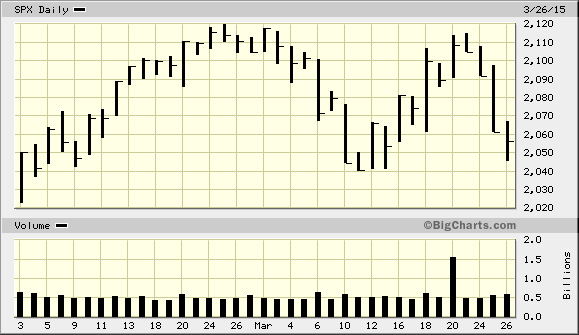
The first quarter of 2015 ends next week, and soon we’ll get a look at Q1 earnings reports. I have to say that I’m not expecting very strong numbers. Once again, analysts have been slashing their forecasts, and we can largely blame the strong dollar. This doesn’t appear to be the start of a downturn for the economy, but merely a pause in corporate earnings growth. I’ll have more on this in a bit. I’ll also discuss this week’s stock split announcement from Ross Stores (ROST) and what it means for our Buy List. But first, let’s take a look ahead at what to expect for the Q1 earnings season.
Q1 Earnings Preview
Analysts now expect Q1 earnings for the S&P 500 of $26.75 per share. (That’s the index-adjusted number. Each point on the S&P 500 is about $8.9 billion.) At the start of the year, they had been expecting Q1 earnings of $30.57 per share. So that’s a big cut in just a few months. If they’re right, Q1 will have the smallest profit since Q2 of 2013. It will be just slightly below the profits from Q4 of 2014.
Let me be clear that this is merely a pause in earnings growth, not a broad-based decline like we would see in a recession. In fact, there was a similar pause in 2012-13. Looking at this upcoming earnings season is what has led me to stress the Strong Dollar Trade so frequently. The reason is that some sectors are being greatly impacted, while others barely feel the difference. For example, the Energy Sector is expected to see its earnings fall more than 62% for Q1. But healthcare is expected to show a 21% increase. As we often learn, stock prices and earnings may ignore each other in the short term, but they’re joined at the hip in the long term. The Energy Sector ETF (XLE) is currently more than 24% off its 52-week high, while the similar figure for Healthcare (XLV) is less than 5%.
There’s a point at which a strong dollar is no longer a good thing, and the harm it does to the domestic economy is real. This week, Bloomberg cited a study that showed that since 1972, whenever the dollar rallies by more than 25%, the S&P 500 falls by an average of 6.4% in six months.
The important Tech Sector is expected to show earnings growth of 18%. Lately, however, many large-cap tech stocks have been underperforming. On Wednesday, the Nasdaq Composite had its best one-day drop since April. My Buy Below for Microsoft (MSFT) is currently $45 per share, but if you can get it below $41.33, that’s a very good deal. That’s exactly where the stock would be for the dividend to yield 3%. Meanwhile, the 10-year Treasury yield currently stands at 2.01%.
Last week, I talked about the dividend increase at Oracle (ORCL). The stock initially reacted well, but has since given back its entire gain. Remember that the earnings report showed us that business is basically going well, and would be even better if not for that meddling dollar. At 14 times next year’s earnings, I think Oracle is a good deal.
The S&P 500 has fallen every day this week (please note, this has happened when I’m not around). But if the earnings slowdown is temporary, and I suspect it will be, the S&P 500 is still going for a reasonable valuation. Analysts currently expect earnings next year of $135 per share. I should add that I’m always a bit leery of analyst estimates, especially that far out. In this case, I’m using these figures to represent reasonable scenarios. That would mean the S&P 500 is going for 15.2 times next year’s earnings. That’s hardly a bubble. For now, we should expect soggy earnings for the next three quarters, but the profit outlook should improve before the end of the year.
Our Recent Bout of Deflation Is Over
Earlier this week, the government reported that consumer prices rose for the first time since October. Consumer prices rose by 0.2% last month. The “core rate,” which excludes food and energy prices, also rose by 0.2%. Of course, that’s small, but it’s a break from the recent trend.
The uptick in inflation is important for us because it gives the Fed more reasons to raise interest rates, and a rate increase may come soon. It’s hard to justify raised interest rates while prices are falling. Charles Evans, the head of the Chicago Fed, said he doesn’t expect a rate hike in June. I hope he’s right, but I’m afraid he’s not. The futures market currently thinks there’s a 65% chance that rates will rise before the end of the year. (By the way, a fund manager at Morgan Stanley thinks the Fed’s next move could be a rate cut.)
The recent tensions in Yemen have given a temporary boost to the oil market, but I doubt this will last. All the important signs point to lower prices for oil, but it won’t happen in a straight line.
Here’s a remarkable stat: The S&P 500 has now gone 27 days without posting back-to-back daily gains. That’s the longest streak in more than 20 years. The four-day selloff in the S&P 500 is the longest since January, but the index came very close to another all-time high last Friday. The highest close came on March 2, when the S&P 500 finished the day at 2,117.39. Last Friday, it got to 2,108.06.
Ross Stores to Split 2 for 1
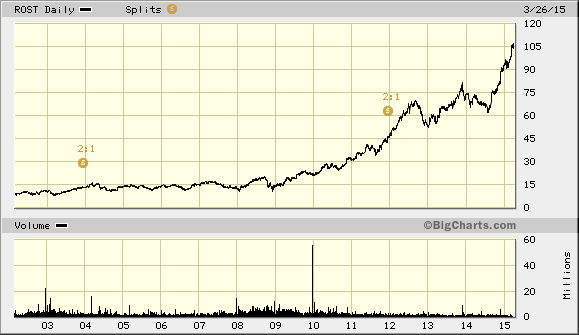
On Tuesday, Ross Stores (ROST) announced that it split its stock 2 for 1. This means that shareholders will get twice as many shares, while the share price will drop in half. Ross closed the day on Thursday at $103.82.
This will be the fifth time in the last eighteen years that Ross has split 2 for 1. One share of ROST bought 20 years ago for $11.50 is now 16 shares at $103.77. Let me be clear that a stock split by itself doesn’t add any value. But it’s generally seen as good news, since profitable, growing enterprises split their shares every few years, and that’s what Ross has done.
Ideally, I think a company shouldn’t pay much attention to its share price. In my view, management should have more important things to do, like make a profit. As long as a company does well, the stock price should follow. Warren Buffett famously has never split Berkshire Hathaway (BRKA), and the “A” shares are currently worth $216,240.
You’ll often hear that stock splits “increase the liquidity” of a stock. That could be true, but I would be leery of any investment in which lack of liquidity is an issue. I’m sometimes amused by companies that are overeager to split their shares just so they can say they split their shares. For example, I don’t see why anyone would want to declare a 3-for-2 stock split. JetBlue (JBLU) once split its stock 3 for 2 three times in three years, yet their stock didn’t appreciate much at all.
If I had my way, only splits greater than 2 for 1 would be allowed. No 5 for 4s or 3 for 2s. Also, only stocks with share prices greater than $100 would be allowed. This would stop much pointless meddling by management.
The important news for us is that Ross continues to do well. Despite the stock’s poor showing during the first half of 2014, earnings are still quite good. Last month’s earnings report beat consensus by nine cents per share. Ross remains a good buy up to $107 per share. The split will take effect on June 11. One final note: As the stock splits 20 for 1, so, too, will our Buy Below Price.
That’s all for now. This Tuesday will be the final day of the first quarter. After that, we will get the important turn-of-the-month economic reports. On Wednesday, the ISM Index comes out. Manufacturing is still expanding, but the ISM has slowly declined for the last four months in a row. I want to see a turnaround here. The big jobs report comes out next Friday. The key isn’t the number of new jobs; I want to see if there’s been a marked increase in wages. That’s what will drive the direction of interest rates. The stock market will be closed next Friday for Good Friday. Be sure to keep checking the blog for daily updates. I’ll have more market analysis for you in the next issue of CWS Market Review!
-Eddy
-
Morning News: March 27, 015
Posted by Eddy Elfenbein on March 27th, 2015 at 7:06 amJapan’s Zero Inflation Is No Worry
Economy in U.S. Grew 2.2% in Fourth Quarter on Consumer Spending
Futures Tick Lower as Dollar Gains Ahead of Yellen
Fed Market Gurus Prep Rate Hike Amid Last-Minute Anxieties
Payday Lenders Warn That Proposed New Rules Could Hurt Consumers
Senate Adopts Budget That Won’t Privatize Medicare
BlackBerry Reports Surprise Profit as Sales Fall Short
Google CFO Gets $70 Million Pay Package
Chevron Exits Australia in Record $461 Billion Block Trade
Gamestop Outlines Acquisition Plans in Push to Diversify Stores
Amazon in Talks to Buy Online Luxury Retailer Net-a-Porter
Contact Lens Makers and Discounters Tussle Over Price Setting
Cullen Roche: The USA is Addicted to California Agriculture (and its low Water Prices)
Jeff Carter: The Smallest Possible Leads to Biggest Possible
Be sure to follow me on Twitter.
-
Morning News: March 26, 2015
Posted by Eddy Elfenbein on March 26th, 2015 at 5:10 amAsian Stocks Are Getting Smoked
Why Bombing This Tiny Oil Producer Is Roiling the Energy Market
Oil, Gold and Yen Up on Yemen Tensions
The Central Banker Who Saved the Russian Economy From the Abyss
Trans-Pacific Partnership Seen as Door for Foreign Suits Against U.S.
SEC Proposes Rule Aimed at Monitoring High Freq. Trading More Closely
Payday Lenders to Face New Regulations
Kraft-Heinz Deal Shows Brazilian Buyout Firm’s Cost-Cutting Recipe
Comcast Pushes Back Closing for Time Warner Cable Merger to Middle of 2015
Adidas Targets Turnaround With New Strategy
Modular Mojo: Toyota Re-engineers Its Appeal
Lumber Liquidators Under Investigation by Consumer Agency
Dark Clouds Loom Over Yingli Green Energy
Joshua Brown: Turning Bonds Into Stocks
Cullen Roche: A Bond “Bubble” Is Very Different From a Stock “Bubble”
Be sure to follow me on Twitter.
-
Morning News: March 25, 2015
Posted by Eddy Elfenbein on March 25th, 2015 at 7:17 amGerman Business Confidence Rises Again in March
Capital Flees Europe And Fed Warns – Time To Trim Stocks
Fed’s Evans Says Low Inflation Makes Rate Rise Too Risky in 2015
Oil Prices Steady, But Inventory Build Drags
A New Rule Could End Up Punishing the Wrong Banks
3G Capital, Berkshire to Buy Kraft, Merge It With Heinz
Freeport-McMoRan Cuts Dividend as Commodity Slump Bites
Amazon Blasts U.S. Agency for Slowness on Drone Regulation
Fitch: Lexmark International’s ‘BBB-‘ IDR Unaffected by Kofax Acquisition
No Deal for Shale Driller Whiting as Stock Sale Announced
Netflix, Amazon and Hulu No Longer Find Themselves Upstarts in Online Streaming
Delhi Requests Block on Uber, Ola Apps
Silicon Valley’s Blockbuster Growth Draws Valuable New Talent From Wall Street
Joshua Brown: Inbox: Leverage Your Luxuries for Instant Liquidity
Credit Writedowns: AIIB Prelude to SDR Decision
Be sure to follow me on Twitter.
-
Ross Stores to Split 2-for-1
Posted by Eddy Elfenbein on March 24th, 2015 at 8:56 amRoss Stores (ROST) just announced that it will be splitting its stock 2-for-1. This means that shareholders will have twice as many shares, and the share price will fall in half.
A stock split doesn’t add any value by itself but a stock that splits every few years is seen as a healthy, growing enterprise. The split at Ross will happen on June 11.
In commenting on this action, Barbara Rentler, Chief Executive Officer, said, “We have delivered solid and consistent financial performance over the past few years which has contributed to significant stock price appreciation over this period. Our decision to split the stock reflects both the Board of Directors’ and management’s ongoing confidence in the Company’s future growth prospects and our continued commitment to enhancing stockholder value.”
To be clear, our Buy Below price will split 2-for-1 as well.
Ross has had four previous 2-for-1 splits; 1997, 1999, 2003 and 2011. One share bought 20 years ago for $11.50 is now 16 shares at $106.
-
Morning News: March 24, 2015
Posted by Eddy Elfenbein on March 24th, 2015 at 7:11 amGrowth in Eurozone Business Activity Near Four-Year High
Wave of Investor Cash Exits Eurozone
U.K. Inflation Rate Drops to Zero in February
Asian Stocks Mixed Over China Growth Fears
Oil Below $56 as Saudi Output Near Record, China Activity Slows
There’s a Big Fed Speech Coming Up on Monday – Here’s Why Traders Are Paying Attention
Fed’s Bullard: Zero Rates No Longer Appropriate for U.S. Economy
Comcast Tries Yet Again To Fix Its Customer Service (This Time, Online)
Are You Willing to Pay to Watch Video Clips Online?
H&M Profit Tops Estimates as Retailer Extends Offering
Eli Lilly (LLY) Stock Gains Today After FDA Lifts Ban on Pain Treatment Drug Trials
Li Ka-shing’s Hutchison Nears $15 Billion Deal for O2
Louisville Slugger, Iconic U.S. Baseball Brand, Sold to Wilson
Roger Nusbaum: The Fed Loses Its Patience
Cullen Roche: Is It Impossible to Predict the Future?
Be sure to follow me on Twitter.
-
Archives
- September 2026
- August 2026
- July 2026
- June 2026
- May 2026
- April 2026
- March 2026
- February 2026
- January 2026
- December 2025
- November 2025
- October 2025
- September 2025
- August 2025
- July 2025
- June 2025
- May 2025
- April 2025
- March 2025
- February 2025
- January 2025
- December 2024
- November 2024
- October 2024
- September 2024
- August 2024
- July 2024
- June 2024
- May 2024
- April 2024
- March 2024
- February 2024
- January 2024
- December 2023
- November 2023
- October 2023
- September 2023
- August 2023
- July 2023
- June 2023
- May 2023
- April 2023
- March 2023
- February 2023
- January 2023
- December 2022
- November 2022
- October 2022
- September 2022
- August 2022
- July 2022
- June 2022
- May 2022
- April 2022
- March 2022
- February 2022
- January 2022
- December 2021
- November 2021
- October 2021
- September 2021
- August 2021
- July 2021
- June 2021
- May 2021
- April 2021
- March 2021
- February 2021
- January 2021
- December 2020
- November 2020
- October 2020
- September 2020
- August 2020
- July 2020
- June 2020
- May 2020
- April 2020
- March 2020
- February 2020
- January 2020
- December 2019
- November 2019
- October 2019
- September 2019
- August 2019
- July 2019
- June 2019
- May 2019
- April 2019
- March 2019
- February 2019
- January 2019
- December 2018
- November 2018
- October 2018
- September 2018
- August 2018
- July 2018
- June 2018
- May 2018
- April 2018
- March 2018
- February 2018
- January 2018
- December 2017
- November 2017
- October 2017
- September 2017
- August 2017
- July 2017
- June 2017
- May 2017
- April 2017
- March 2017
- February 2017
- January 2017
- December 2016
- November 2016
- October 2016
- September 2016
- August 2016
- July 2016
- June 2016
- May 2016
- April 2016
- March 2016
- February 2016
- January 2016
- December 2015
- November 2015
- October 2015
- September 2015
- August 2015
- July 2015
- June 2015
- May 2015
- April 2015
- March 2015
- February 2015
- January 2015
- December 2014
- November 2014
- October 2014
- September 2014
- August 2014
- July 2014
- June 2014
- May 2014
- April 2014
- March 2014
- February 2014
- January 2014
- December 2013
- November 2013
- October 2013
- September 2013
- August 2013
- July 2013
- June 2013
- May 2013
- April 2013
- March 2013
- February 2013
- January 2013
- December 2012
- November 2012
- October 2012
- September 2012
- August 2012
- July 2012
- June 2012
- May 2012
- April 2012
- March 2012
- February 2012
- January 2012
- December 2011
- November 2011
- October 2011
- September 2011
- August 2011
- July 2011
- June 2011
- May 2011
- April 2011
- March 2011
- February 2011
- January 2011
- December 2010
- November 2010
- October 2010
- September 2010
- August 2010
- July 2010
- June 2010
- May 2010
- April 2010
- March 2010
- February 2010
- January 2010
- December 2009
- November 2009
- October 2009
- September 2009
- August 2009
- July 2009
- June 2009
- May 2009
- April 2009
- March 2009
- February 2009
- January 2009
- December 2008
- November 2008
- October 2008
- September 2008
- August 2008
- July 2008
- June 2008
- May 2008
- April 2008
- March 2008
- February 2008
- January 2008
- December 2007
- November 2007
- October 2007
- September 2007
- August 2007
- July 2007
- June 2007
- May 2007
- April 2007
- March 2007
- February 2007
- January 2007
- December 2006
- November 2006
- October 2006
- September 2006
- August 2006
- July 2006
- June 2006
- May 2006
- April 2006
- March 2006
- February 2006
- January 2006
- December 2005
- November 2005
- October 2005
- September 2005
- August 2005
- July 2005
 Eddy Elfenbein is a Washington, DC-based speaker, portfolio manager and editor of the blog Crossing Wall Street. His