-
Morning News: February 19, 2015
Posted by Eddy Elfenbein on February 19th, 2015 at 7:03 amECB Profit Declines as Interest Rates Drop, Staff Costs Surge
Greece Asks Eurozone for Loan Extension
Oil Prices Fall as U.S. Crude Stockpiles Grow
Port Dispute is Felt All Along the West Coast
Could Apple Compete With Tesla?
Ball Corp. Rolls Up Rexam With Sweetened $6.7 Billion Offer
Barrick Gold Reveals Asset Sale and Debt Reduction Plan
Nestle Forecasts Improvement in 2015
TurboTax, Phishing, E-Filing, And IRS Security
Strike Creates Turbulence for Air France-KLM
Is Snapchat Really Worth What Silicon Valley Thinks It Is?
T-Mobile US Swings to Profit As Revenue Surges
BAE Systems Posts More Than Fourfold Rise in 2014 Net Profits
Joshua Brown: Where Does the Fed See Systemic Risk?
Jeff Carter: Go Big or Go Home
Be sure to follow me on Twitter.
-
PPI Drops 0.8% in January
Posted by Eddy Elfenbein on February 18th, 2015 at 10:04 amHere’s a look at the seasonally-adjusted PPI. That’s the index of wholesale prices. This means that the Fed is in no hurry to raise rates.
-
Wabtec Earns 95 Cents per Share
Posted by Eddy Elfenbein on February 18th, 2015 at 8:47 amWabtec ($WAB) earned 95 cents per share for Q4. That was a penny above consensus. For the year, WAB earned $3.62 per share. They also issued guidance of $4.05 per share for all of this year.
CEO Raymond T. Betler said: “We finished the year with a strong performance in the fourth quarter, and we are anticipating record results again in 2015. While we expect to face challenges this year, including global economic uncertainty and foreign currency exchange headwinds, we will benefit from ongoing investment in freight rail and passenger transit projects around the world. Our long-term growth prospects remain solid, thanks to our diversified business model, balanced strategies and rigorous application of the Wabtec Performance System.”
-
Morning News: February 18, 2015
Posted by Eddy Elfenbein on February 18th, 2015 at 6:59 amGreece to Seek Extension on Loan Agreement
Swiss Prosecutors Search Offices of HSBC Unit
Kuroda Sees Inflation on Track as BOJ Keeps Record Stimulus
As Rivals Falter, India’s Economy Is Surging Ahead
U.S. Household Debt Rises Slightly
Mortgage Applications Plunge as Rates Hit Highest Level of the Year
Warren Buffett Buys a Stake in Rupert Murdoch’s 21st Century Fox
Soros Shifts to Europe, Asia as Investors Cut U.S. Equities
Snapchat Said to Seek Up to $19 Billion Value in Funding
Telecoms Tycoon Seeks to Buy Out Vivendi from Numericable
Sony Outlines 3-Year Recovery Plan, Targets $4.2 Billion Earnings
Why Tesla Continues To Flop In China
Why Candy Bars May Never Be The Same Again
Cullen Roche: Negative Volatility in Long Bonds Surges
Joshua Brown: Why Active Management Fell Off a Cliff – Perhaps Permanently
Be sure to follow me on Twitter.
-
The Impact of Higher Yields
Posted by Eddy Elfenbein on February 17th, 2015 at 1:58 pmI spotted this at Bloomberg:
Following the biggest one-week jump in 10-year Treasury yields in more than a year, investors are selling the highest-yielding companies in the Standard & Poor’s 500 Index. The top quarter of dividend-yielding stocks in the S&P 500 have lost an average 0.4 percent since an employment report on Feb. 6 showed the U.S. is adding jobs at a faster rate than estimated. That compares with a gain of 2.6 percent for stocks with the smallest dividends, and a 1.7 percent climb in the benchmark gauge.
Stocks including utility companies and real-estate investment trusts have weighed on the benchmark gauge since Treasury yields climbed 32 basis points the week of the report, signaling caution to investors who piled into dividend stocks through the bull market, according to Sam Stovall, chief equity strategist at S&P Capital IQ.
Simple math: When bonds go down, those higher-yielding stocks lose some of their luster.
-
It’s Actually Happening
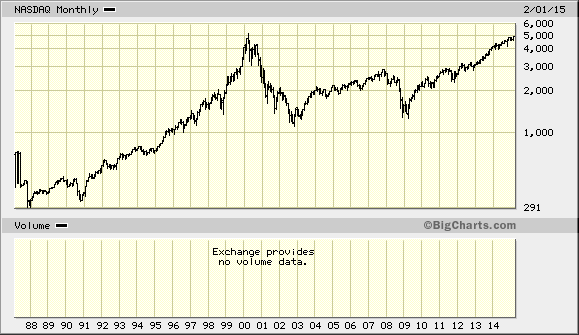
Posted by Eddy Elfenbein on February 17th, 2015 at 1:44 pmThe Nasdaq Composite is over 4,900, and it’s within sight of its all-time high reached 15 years ago. The index peaked at 5,048.62 on March 10, 2000. That’s 15 long years without making a new high.
That sounds bad but it’s been worse. The Dow didn’t break its September 3, 1929 high until November 23, 1954.
-
The Market Closed at Another High
Posted by Eddy Elfenbein on February 17th, 2015 at 9:37 amI hope everyone had a nice three-day weekend. The stock market closed Friday at a new all-time high. The S&P 500 finished the week at 2,096.99 and the Dow is back over 18,000. This was almost certainly a new inflation-adjusted high. Our Buy List continues to outpace the climbing market as well. I try not to get worked up about short-term moves, but this is nice to see. This month, our Buy List is up 7.88% to the S&P 500’s 5.11%.
Things may get jittery this week as investors turn their attention to the soap opera between Greece and the rest of Europe. The debt talks have broken down but still, investors seem optimistic that some sort of deal will be reached. I think both sides are working hard to position themselves as not “caving in” in the eyes of their respective voters. Once this is achieved, they can hammer out a deal. Consider that consumer prices in Greece have fallen for 23 months in a row. This is a problem that the important people in suits cannot allow to go on much further.
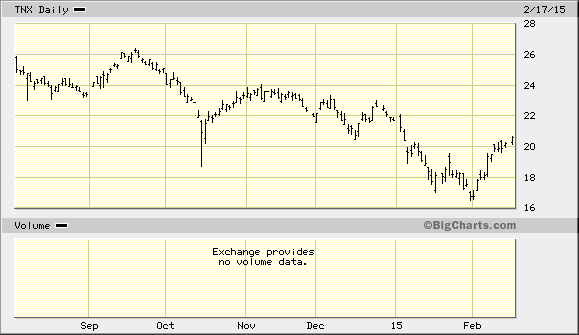
The bond market has quietly retreated over the past few days, bearing in mind that this comes after a spectacular run. The yield on the 10-year Treasury fell as low as 1.65% on January 30 and February 2. Since then, the yield has drifted higher as it’s up to 2.06 this morning. That’s still very low, but it’s interesting to see the bond market finally move downward.
-
Morning News: February 17, 2015
Posted by Eddy Elfenbein on February 17th, 2015 at 7:06 amGreek Euro Exit Risk Increases as EU Delivers Ultimatum
EU Hangs Tough, Waiting for Greece to Bend as Euro Wilts
German Investor Confidence Rises to One-Year High Before QE
U.K. Inflation Slows More Than Forecast to Record-Low
Putin’s Paradise Becomes Economic No-Go Zone
U.S. Companies Can Avoid Slow Torture of Venezuela Devaluations by Taking One Big Hit
U.S. Embedded Spyware Overseas, Report Claims
The Price of Getting Apple’s Attention: $12 Billion
Spain’s Caixabank Offers 1 Billion Euros for Whole of Portugal’s BPI
Canada’s Fairfax Snaps Up Lloyd’s Insurer Brit for $1.88 Billion
Liberty Global, Becoming a Big Fish, Risks Attracting the Eye of a Shark
Ford Guns for China’s App Addicts, Seeks WeChat Tie-Up
Dutch Startup WeTransfer Just Raised $25 Million to Expand into the US
Jeff Carter: Are You The Right Investor?
Credit Writedowns: Tax Anticipation Notes: A Timely Alternative Financing Instrument for Greece
Be sure to follow me on Twitter.
-
Jesse Livermore: The Greatest Trader Who Ever Lived
Posted by Eddy Elfenbein on February 16th, 2015 at 2:03 pmWhen Jesse Livermore made his first stock trade at the tender age of 15, he didn’t hedge his bets. He consulted the charts he’d compiled working as a chalkboard runner in a Boston brokerage firm, and when the figures for the company in question, Burlington, checked out, he went all in, investing everything he had—all $5—in the railroad. Two days later, he cashed in his shares, for a profit of $3.12.
It was 1892.
Exhilarating, that first taste. The pendulum had begun to swing.
Livermore began to roam the streets of Beantown, frequenting its bucket shops, gambling counters that took bets on stocks without executing actual trades. His ability to recognize patterns in the ticker tape stood him in good stead. In six months, he’d accumulated $1,000. Five years later, it was $10,000—enough to make him persona non grata to every pseudo-broker in the city.
So he moved to New York and graduated to trading with real Wall Street firms. Something, however, was wrong. His system wasn’t delivering as expected. He watched his stake drop, first to $2,500, then to zero. At an age when most contemporary youth were still preoccupied with fraternity smokers and petting, the “Boy Plunger” (turn-of-the-century slang for “reckless gambler”) had already gone through a full cycle of boom and bust.
Livermore decided the problem lay in the lag time between the stock order and the execution of the purchase itself. So he borrowed $500 against future gains. The pendulum began to swing wider. Quickly making back what he’d lost, he increased his stash further, to $50,000. Then, on May 9, 1901, he lost it all, every penny, largely due to the frenzied pace of the day’s trading.
Again he hit the bucket shops, again accumulating a stake that allowed him to get back into the game. He returned to New York with what he termed a “fair-sized roll.” Then, on April 16, 1906, he was hit by a premonition. With no warning, he yielded to a strange urge to sell short a thousand shares of Union Pacific railroad—an urge even he admitted he didn’t understand. Two days later, the San Francisco Earthquake hit. Union Pacific was decimated; he’d made $250,000 literally overnight. Inexplicable, the sudden intuition, but just as inexplicable was what happened next: again trading in shares of Union Pacific, he violated two of his most cherished principles—never heed insider information, and always keep your own counsel—and sold short when a friend tipped him off that the stock was about to tank. It didn’t. His net loss: more than $40,000.
The arcs described by the pendulum continued to widen, the swings to grow ever more vertiginous. During the Panic of 1907, Livermore again shorted the market, earning $1 million in the course of a few days. He then proceeded to lose everything in an attempt to corner the cotton sector, declaring bankruptcy and running up debts of over $1 million by 1916. Once again, he amassed sufficient capital to recover, making first $3 million (in assorted commodities), then $10 million (in wheat). Then came his greatest moment: sensing the impending 1929 crash, he again shorted the market, emerging from the rubble of October 29 with a net profit of $100 million—well over a billion dollars in today’s money.
Five years later, he was bankrupt, his vast fortune completely wiped out, for reasons that remain mysterious even today.
Livermore rallied from his subsequent depression in the late 30s, pooling sufficient energy to write a book detailing his trading principles. But on November 20, 1940, the pendulum swung finally, irrevocably against him. In the cloakroom of the Sherry Netherland Hotel in Midtown Manhattan, he shot himself in the head with a .32 Colt automatic. A suicide note was found scribbled in his notebook: “I am a failure,” it said.
Who was Jesse Livermore? How could the world’s greatest trader, the author of one of the most staggering fortunes America had ever seen, end up hitting the wall in just five years? What drove him to take ever more manic risks with his trades, to the point where the harmonic oscillator of his own speculations ended by ripping him apart?
Livermore himself gives us a clue to his own mystery in Reminiscences of a Stock Operator, the book of interviews he wrote with the journalist Edwin Lefèvre:
The speculator’s chief enemies are always boring from within. It is inseparable from human nature to hope and to fear….The successful trader has to fight these two deep-seated instincts. He has to reverse what you might call his natural impulses. Instead of hoping he must fear; instead of fearing he must hope….It is absolutely wrong to gamble in stocks the way the average man does.
The great trader liked to style himself as a dispassionate analyst. Repeatedly in Reminiscences, we find him stepping back from the welter of the trading floor to admonish himself with conclusions drawn from his market smash-ups—conclusions that read like oracular utterances brought down from the sacred mount of traders: “I learned you must give up trying to catch the last eighth, or the first: these two are the most expensive eighths in the world,” and the like. But the excerpt above intimates that perhaps cold-blooded calculation wasn’t the whole story. That beneath the rational exterior lay something that was not rational, that had to do instead with dreams and forebodings and hidden compulsions. That this aloof, seemingly imperturbable man was in fact deeply attuned to the obscure rumblings of chaos.
For chaotic his life was, in spades. His broker, reflecting on his penchant for cruising the Manhattan streets at night in his canary-yellow Rolls Royce in search of young girls, quipped, “When Livermore is speculating, he is thinking of screwing, and when he is screwing he is thinking of speculating.” His first wife, Nettie Jordan, separated from him one year after their wedding, following a tearful scene in which he begged her to pawn her jewels to finance one of his bankruptcies. His second wife, Dorothy Wendt, was an 18-year-old Ziegfield Follies showgirl who responded to Livermore’s philandering by taking up with a Prohibition agent; after separating from both men, she went on to shoot her 16-year-old son, Jesse, Jr., through the chest with a .22-caliber rifle. Both Livermore’s son and his grandson were manic-depressive and suffered from alcoholism. Both committed suicide.
Nor was chaos a mere by-product of Livermore’s personal eccentricities—it was his stock in trade. The Great Bear of Wall Street made his greatest profits when he sold short, that is to say, when he capitalized on other traders’ helplessness in the face of their own hopes and fears. In an age when Wall Street optimism was almost an American religion, he learned to read, and profit by, the dark anxieties that flowed just beneath the surface of the zeitgeist and that were liable to break out at any moment. He was an expert at sensing the nature and scope of mass hysteria, the thresholds at which men begin to panic. It’s no accident, then, that his favorite book was Extraordinary Popular Delusions and the Madness of Crowds, the Scottish philosopher Charles Mackay’s dark treatise on the power of the irrational in history. Nor is it an accident that, in seeking to harness the forces of unreason that he knew so intimately, he ended up betrayed by them—betrayed and, ultimately, destroyed.
The man who all his life sought to codify the workings of the market into a foolproof set of rules was the same man who consistently violated those rules, helpless to resist his own compulsions. The man who proclaimed clear-sighted analysis as the key to the charts was also a man haunted by irrational dreams and forebodings, who depended upon an uncanny sixth sense to tell him which way the market was moving, and who ultimately succumbed to the same delusions he fought so hard to keep at bay.
Traders are not the same as investors. Investors, however aggressive, are devotees of the long term. Personality-wise they tend to be more sober, more thoughtful and restrained, a la Warren Buffett or Peter Lynch. Volatility is, if not their enemy, then at best an unpredictable confederate, to be regarded with suspicion. Traders, by contrast, live in the moment. They operate by learning to feel the market, sensing when to cut their losses, when to double down, when to follow the trend and when to go against everyone. Far from being adverse to volatility, they secretly hope to get inside it, to understand it and so ride it to victory.
Like all traders, Livermore dreamed of beating the market, pinning his hopes to the forces of order: reason, logic, calculation, monetary self-discipline. Yet like all traders, he ultimately came face to face with that which cannot be rationalized, not just in the great hurly-burly of Wall Street but inside himself, in the shadowy realm where desire becomes compulsion and ambition self-destructive obsession. So that in the end, his battle with the market was a stand-in for his larger battle with himself.
Livermore was well aware of the chaos inside him. That’s why, early in his career, he invested in $800,000 worth of annuities for his wife and children that he himself would be unable to touch: “I knew a trading man will spend anything he can lay his hands on. By doing what I did my wife and child are safe from me.”
In the end, Livermore’s dream was the great, illusory dream of gamblers everywhere: to impose form and coherence on chance itself. But he failed to treat chance with the proper respect: he got too close. His story reads like a dark pendant to that other great 1920s story of lives lost to the pursuit of wealth, The Great Gatsby. Like Fitzgerald’s hero, Livermore sought to define himself against the huge forces that were shaping an America on the verge of empire. His failure, no less than Gatsby’s, is a grim parable of the fate of the individual in the age of money.
(You can sign up for my free investing newsletter here.)
-
Morning News: February 16, 2015
Posted by Eddy Elfenbein on February 16th, 2015 at 7:16 amGreek Markets Hold Steady as Crucial Debt Talks Approach
Euro Zone December Trade Surplus Higher Than Expected
Japan’s Out of Recession – But Not With Any Great Conviction
Oil Steadies Around $61, Kuwait Sees Prices Supported
Hackers Steal Up to $1 Billion From Banks, Security Co. Says
HSBC Says Sorry Over Past Standards at Swiss Bank
Currency Battle is Tethered to Obama Trade Agenda
With Port Talks Gridlocked, White House Move Ramps Up Pressure For a Deal
AIG Profit Drops 67% And Misses Street Estimates
Amazon Drone Plans Shot Down By Authorities
Infosys Buys Automation Tech Company Panaya Valued at $200 Million
Putin Lets Consumers Feel Pain as Russian Slump Deepens
Pinterest is Reportedly Trying to Launch a “Buy” Button This Year
Jeff Miller: Weighing the Week Ahead: Will Energy Stocks Support the Market Breakout?
Epicurean Dealmaker: Goldman Sachs Doesn’t Care What You Think
Be sure to follow me on Twitter.
-
Archives
- July 2026
- June 2026
- May 2026
- April 2026
- March 2026
- February 2026
- January 2026
- December 2025
- November 2025
- October 2025
- September 2025
- August 2025
- July 2025
- June 2025
- May 2025
- April 2025
- March 2025
- February 2025
- January 2025
- December 2024
- November 2024
- October 2024
- September 2024
- August 2024
- July 2024
- June 2024
- May 2024
- April 2024
- March 2024
- February 2024
- January 2024
- December 2023
- November 2023
- October 2023
- September 2023
- August 2023
- July 2023
- June 2023
- May 2023
- April 2023
- March 2023
- February 2023
- January 2023
- December 2022
- November 2022
- October 2022
- September 2022
- August 2022
- July 2022
- June 2022
- May 2022
- April 2022
- March 2022
- February 2022
- January 2022
- December 2021
- November 2021
- October 2021
- September 2021
- August 2021
- July 2021
- June 2021
- May 2021
- April 2021
- March 2021
- February 2021
- January 2021
- December 2020
- November 2020
- October 2020
- September 2020
- August 2020
- July 2020
- June 2020
- May 2020
- April 2020
- March 2020
- February 2020
- January 2020
- December 2019
- November 2019
- October 2019
- September 2019
- August 2019
- July 2019
- June 2019
- May 2019
- April 2019
- March 2019
- February 2019
- January 2019
- December 2018
- November 2018
- October 2018
- September 2018
- August 2018
- July 2018
- June 2018
- May 2018
- April 2018
- March 2018
- February 2018
- January 2018
- December 2017
- November 2017
- October 2017
- September 2017
- August 2017
- July 2017
- June 2017
- May 2017
- April 2017
- March 2017
- February 2017
- January 2017
- December 2016
- November 2016
- October 2016
- September 2016
- August 2016
- July 2016
- June 2016
- May 2016
- April 2016
- March 2016
- February 2016
- January 2016
- December 2015
- November 2015
- October 2015
- September 2015
- August 2015
- July 2015
- June 2015
- May 2015
- April 2015
- March 2015
- February 2015
- January 2015
- December 2014
- November 2014
- October 2014
- September 2014
- August 2014
- July 2014
- June 2014
- May 2014
- April 2014
- March 2014
- February 2014
- January 2014
- December 2013
- November 2013
- October 2013
- September 2013
- August 2013
- July 2013
- June 2013
- May 2013
- April 2013
- March 2013
- February 2013
- January 2013
- December 2012
- November 2012
- October 2012
- September 2012
- August 2012
- July 2012
- June 2012
- May 2012
- April 2012
- March 2012
- February 2012
- January 2012
- December 2011
- November 2011
- October 2011
- September 2011
- August 2011
- July 2011
- June 2011
- May 2011
- April 2011
- March 2011
- February 2011
- January 2011
- December 2010
- November 2010
- October 2010
- September 2010
- August 2010
- July 2010
- June 2010
- May 2010
- April 2010
- March 2010
- February 2010
- January 2010
- December 2009
- November 2009
- October 2009
- September 2009
- August 2009
- July 2009
- June 2009
- May 2009
- April 2009
- March 2009
- February 2009
- January 2009
- December 2008
- November 2008
- October 2008
- September 2008
- August 2008
- July 2008
- June 2008
- May 2008
- April 2008
- March 2008
- February 2008
- January 2008
- December 2007
- November 2007
- October 2007
- September 2007
- August 2007
- July 2007
- June 2007
- May 2007
- April 2007
- March 2007
- February 2007
- January 2007
- December 2006
- November 2006
- October 2006
- September 2006
- August 2006
- July 2006
- June 2006
- May 2006
- April 2006
- March 2006
- February 2006
- January 2006
- December 2005
- November 2005
- October 2005
- September 2005
- August 2005
- July 2005
 Eddy Elfenbein is a Washington, DC-based speaker, portfolio manager and editor of the blog Crossing Wall Street. His