-
Dividend Champions
Posted by Eddy Elfenbein on February 13th, 2015 at 11:43 amDividend Growth Investor tells me that the S&P 500 Dividend Aristocrats is an incomplete list. For example, the steel company Nucor paid a special dividend on top of its regular dividend. When they ended their special dividend, S&P considered that to be a dividend cut even though they continued to raise their regular dividend. That doesn’t seem fair.
Instead of the Dividend Aristocrats, Dividend Growth Investor recommends the Dividend Champions list complied by David Fish. That list has over 100 names. Fish also includes stocks that have raised their dividends at least 10 years in a row, and at least five years in a row. You can see the Dividend Champions here.
-
CWS Market Review – February 13, 2015
Posted by Eddy Elfenbein on February 13th, 2015 at 7:08 am“Reversion to the mean is the iron rule of financial markets.” – Jack Bogle
Jack’s right. Not only do markets revert to the mean, but sometimes that reversion can be quite mean. By now, you’ve probably gathered that I’m not much of a fan of market forecasts. People often ask me where I think the market will be in six or twelve months. My answer: “beats me!”
The past few days are a great example of why it’s so hard to predict the market. Not only is it impossible, but it’s unnecessary as well. Just a few days ago, everyone seemed so down on the S&P 500. On February 2, the S&P 500 reached an intra-day low of 1,980.90; that’s 5.4% below the all-time intra-day high reached five weeks before. But since then, the market has rebounded impressively. On Thursday, the S&P 500 reached its highest close this year. (Maybe the market was rooting for the Patriots?)
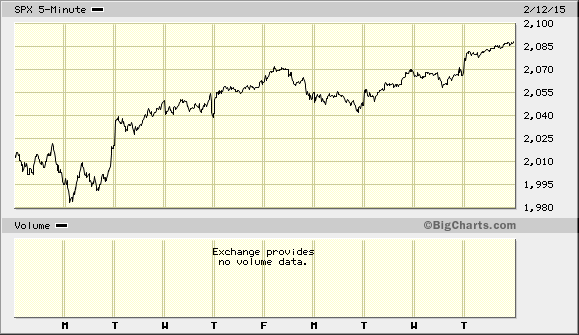
In this week’s CWS Market Review, we’ll take a closer look at the market’s recent uptick. Our Buy List stocks continue to do well. Qualcomm ($QCOM) finally reached a deal with the Chinese government. It’s not every day you agree to fork over $1 billion and your stock shoots up. I suppose investors expect the worst when dealing with the PRC. I’ll also preview two more Buy List earnings reports coming next week, Wabtec ($WAB) and Hormel Foods ($HRL). But first, let’s take a look at the market’s recent rally.
The S&P 500 May Be at an All-Time Inflation-Adjusted High
On Thursday, the S&P 500 ended at 2,088.48 for its highest close this year. The index may have closed at an all-time inflation-adjusted high. That hasn’t happened in nearly 15 years. The only problem is, we can’t say for sure until the CPI for February comes out in about five weeks.
Here’s how it works. The S&P 500 made its all-time inflation-adjusted high on March 23, 2000. The index closed that day at 1,527.35. That’s actually one day before the market peaked, but the one-day gain was less than the rate of inflation. Going by the recent CPI data, which is for December, the close from March 23, 2000 works out to 2,099.30 in today’s dollars.
Here’s the catch: The CPI has been falling lately thanks to lower oil. As a result, the all-time inflation-adjusted high has been falling as well. The S&P 500 closed 0.52% below its inflation-adjusted high. So the question is, have prices deflated that much this year? I don’t know. But the lesson for investors is that the market can go a long time without making any real gains. Another lesson is the importance of dividends. Once we include dividends, the S&P 500 is well above its 2000 peak, with or without inflation.
I’m also happy to say that our Buy List has been doing very well lately. Our Buy List beat the S&P 500 for eight days in a row, and it came close to making nine days on Thursday. Thanks to some strong earnings reports, our Buy List is up 6.99% so far this month compared with 4.69% for the S&P 500. That’s a pretty big gap for such a short time period.
I should point out how conservative our Buy List truly is. Last year, the daily changes of our Buy List correlated more than 93% with the daily changes of the S&P 500. It will probably be about the same this year. Many active managers would try very hard to avoid such a high correlation with the overall market. After all, they want to show how they stand apart from everyone else. For me, I don’t mind following the market so closely. I know that over time, the superior characteristics of our strategy will come forward, and that’s happened many times over the last ten years.
Qualcomm Settles With the PRC
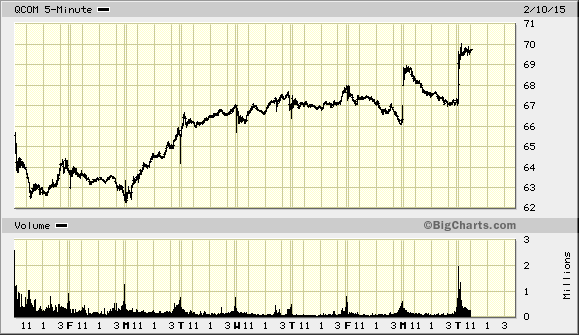
Qualcomm ($QCOM) has been our leading candidate for Dud of the Earnings Season. Even in top-notch portfolios, there’s always going to be one. Actually, Qualcomm’s earnings were quite good. The company pulled in $1.34 per share for Q4. That beat estimates by nine cents per share.
The problem was Qualcomm’s guidance. Before, the company said to expect full-year earnings of $5.35 per share. In the earnings report, they said they’ll range between $4.75 and $5.05 per share. As you might imagine, Wall Street was not pleased. The stock dropped 10% in one day.
This week, Qualcomm announced that they’d reached a deal with the Chinese government. The company will pay a fine of $975 million due to their “anti-competitive practices.” If I were the cynical type, I’d mention the irony of this charge coming from a one-party state. Since I’m not, I won’t. The fine works out to about 60 cents per share. The deal also calls for Qualcomm to lower the royalty rate they get on their patents.
The good news from this deal is that it doesn’t alter Qualcomm’s business model. A lot of people were expecting much worse. The company gets about half of its revenue from China. Qualcomm actually raised the lower end of its guidance by ten cents per share. Excluding the fine, Qualcomm now expects earnings to range between $4.85 and $5.05 per share.
This is very good news for Qualcomm. They really dodged a bullet. I think some other countries may try to pile on like South Korea, but China is the biggie. From the low on February 2 to the high on February 11, Qualcomm rallied 14%. After the earnings report, I cut my Buy Below to $66 per share. As is often the case with investing, doing nothing probably would have been a better move. In any event, I’m going to raise our Buy Below on Qualcomm to $72 per share.
I faced a similar situation with Ford Motor ($F). Since October, I’ve had my Buy Below for Ford at $17 per share, and I resisted lowering it for as long as I could. The stock reacted poorly in January to what I thought was a fine earnings report so I relented and lowered my Buy Below to $16 per share.
Sure enough, a strong sales report sparked a rally. I don’t know if that’s reversion to the mean, or if it was simply people realizing that this stock recently raised its dividend by 20% and now yields 3.7%. Ford is also sticking by its forecast of $8.5 billion to $9.5 billion in pretax profit this year. This week, I’m raising my Buy Below on Ford to $17 per share.
By the way, if you’re looking to add new money to the market, some of our tech stocks are looking very attractive right now. Our four worst-performing stocks so far this year are all tech stocks; Microsoft, eBay, Oracle and Qualcomm. The weakness in overseas economies is taking a toll on these stocks. I’ve already discussed Qualcomm, but I think the other three are going for very good prices at the moment.
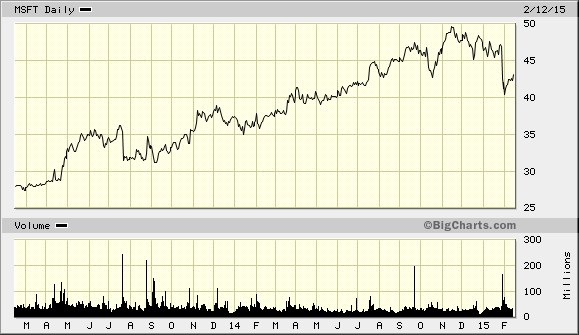
For example, Microsoft ($MSFT) is trading at 14.7 times next fiscal year’s earnings. Let’s remember that this is one of very few AAA-rated stocks. A lot of companies can’t say that. Actually, a lot of countries can’t say that. Microsoft just floated a huge bond deal this week, which included 40-year paper. That coupon is just 4%. Microsoft is also sitting on $90 billion in cash, and over 90% of that is outside the United States. It looks like Congress is getting serious about a deal that would allow companies to bring that money home at a reduced rate. The stock has recently dropped which broke a long uptrend (see below). Microsoft is a good buy up to $45 per share.
The situation at Oracle ($ORCL) isn’t quite as rosy. The company had missed earnings for four straight quarters. They finally delivered an earnings beat in December, and the stock shot up, but it’s been pretty lackluster ever since. The good news for Oracle is that they’ve been catching up with their cloud business. The company reports earnings again next month, and I want to see more confirmation of their progress before I say it’s a very attractive buy. For now, Oracle remains a decent buy up to $48 per share.
Upcoming Buy List Earnings Reports
We still have a few more earnings reports to go for Q4 earnings season. I have to explain that companies sometimes take a little longer to report their Q4 earnings. The SEC grants a little extra time for companies to report their fiscal Q4 than with the other three quarters. As a result, some of the later Q4 earnings reports tend to overlap with the earnings reports of companies who end their quarters in January. Next week, two of our new Buy List stocks report earnings, Hormel Foods and Wabtec. But Wabtec’s quarter ended in December, while Hormel’s ended in January. The same thing will happen the week after when Express Scripts (December) and Ross Stores (January) are due to report.
Wabtec ($WAB) is due to report on Wednesday, February 18. This is a very strong company. Wabtec is the only stock on any U.S. exchange that’s risen in each of the last 13 years. If you’re not familiar with WAB, they make locomotives, brakes and other parts for the freight- and passenger-rail industries. In October, Wabtec raised its Q4 guidance to 91 to 95 cents per share. Look for good more good results. I rate Wabtec a buy up to $90 per share.
Hormel Foods ($HRL), the Spam company, is due to report earnings on Thursday, February 19. It was just reported that Hormel is close to a deal to buy Applegate Farms, a privately held firm that makes organic products. The deal could be between $600 million and $1 billion.
For Q4 earnings, Wall Street expects earnings of 64 cents per share. In December, Hormel said to expect full-year earnings to range between $2.45 and $2.55 per share (their fiscal year ends in October). Also in December, Hormel raised their dividend by 25%. It was their 49th consecutive annual dividend increase. Not bad for lunch meat. Hormel is a buy up to $56 per share.
That’s all for now. The stock market will be closed on Monday for George Washington’s Birthday. The NYSE makes it very clear that officially, the holiday is not President’s Day but Washington’s Birthday. Next Wednesday will be an important day. We’ll get key reports on industrial production and capacity utilization. The Federal Reserve will also release the minutes of their last meeting. It will be interesting to hear more details on the Fed’s thinking. Be sure to keep checking the blog for daily updates. I’ll have more market analysis for you in the next issue of CWS Market Review!
– Eddy
-
Morning News: February 13, 2015
Posted by Eddy Elfenbein on February 13th, 2015 at 7:03 amPutin’s High Tolerance for Pain and Europe’s Reluctance to Inflict It
Time For Germany To Leave The Euro; German GDP Growth Unexpectedly Strong
Greece, Germany Said to Offer Compromises on Aid Terms
Banks’ Ability to Delay Currency Trades May Not Be Fair
Orbitz Meets Estimates, Shares Up on Expedia Merger News
AmEx-Costco Divorce Shakes Up Card Industry
Groupon Beats on Revenue But Misses Expectations on 1Q Forecast
Kellogg Posts Loss, Cautions on Outlook
Lyft Said to Talk With Investors on $250 Million in Funds
Rolls-Royce Warns on Impact of Oil Price Fall
ArcelorMittal Reports Fourth Quarter 2014 and Full Year 2014 Results
The Big Lesson From a Bet With Warren Buffett
Joshua Brown: This Is The Big One
Be sure to follow me on Twitter.
-
A New Inflation-Adjusted High?
Posted by Eddy Elfenbein on February 12th, 2015 at 4:14 pmThe S&P 500 may have closed at an all-time inflation-adjusted high today. The problem is we can’t say for sure until the CPI data for February comes out in about five weeks.
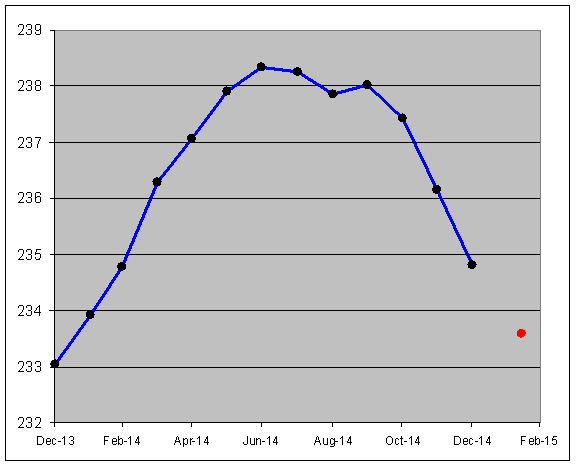
Here’s how it works. The S&P 500 made its all-time inflation-adjusted high on March 23, 2000 at 2,099.30 (1,527.35 nominal). That’s actually one day before the nominal high. That figure is as of the last CPI data point which is for December 31, 2014.
The CPI for December was 234.812. Here’s the catch: The CPI has been falling lately thanks to lower oil. As a result, the all-time inflation-adjusted high has been falling as well.
Today’s close was 2,088.48. That’s 0.52% below the inflation-adjusted high. So the question is, have prices deflated that much so far this year? I don’t know. The January CPI comes out in two weeks.
The blue line is the CPI (not seasonally adjusted). I added the red dot as the tipping point. If the blue line has trended down BELOW the red dot, then today’s close is an all-time inflation-adjusted high. If the blue line has trended above the red dot, then we’re still short of it.
-
Updated S&P 500 Dividend Aristocrats
Posted by Eddy Elfenbein on February 12th, 2015 at 2:42 pmHere’s an updated list of the S&P 500 Dividend Aristocrats. These are companies that have raised their dividend for 25 years in a row. This list is a great place to find high-quality stocks and you’ll notice a few current Buy List stocks along with some former members. I’ve included each stock, the ticker symbol, when the dividend streak started and the current yield.
That’s quite impressive that a company can increase its dividend every year for a quarter of a century. There’s an ETF which follows this: ProShares S&P 500 Dividend Aristocrats ($NOBL).
The S&P 500 Dividend Aristocrats had a big change this year as Diebold ($DBD) is no longer a member. After 60 straight dividend increases, they weren’t able to do it again. Energen ($EGN) also got booted when they ended their streak last year. Bemis ($BMS) and Family Dollar ($FDO) left due to acquisitions. Sigma-Aldrich ($SIAL) is in the process of being bought out as well, but they’re still on the list for now.
 Eddy Elfenbein is a Washington, DC-based speaker, portfolio manager and editor of the blog Crossing Wall Street. His