-
Value Vs. Growth Since 1979
Posted by Eddy Elfenbein on February 9th, 2015 at 2:51 pmI’m glad to see that FRED, the St. Louis Fed’s Data Library, has added the Russell indexes to their database. Here’s a look at the Russell 3000 Value Total Return Index divided by its Growth counterpart:
Value has indeed beaten Growth over the long run but the premium hasn’t been terribly impressive, about 1.3% per year. Since 1988, it’s run about 0.6%. (That’s Value over Growth, not over the entire market.) Perhaps more surprising is how volatile the Value premium has been. In fact, there have been 20-year stretches where Growth has outperformed. We’re currently in a 12-year winning streak for Growth.
Value does work, but it takes a lot of time.
-
Qualcomm to Pay Massive Fine
Posted by Eddy Elfenbein on February 9th, 2015 at 9:08 amThis has been building for a long time but it appears that Qualcomm ($QCOM) is about to pay the government of China of a massive fine for “anti-competitive practices.”
There’s not much Qualcomm can do except pay the fine. The stock may rally simply on the news that this matter may finally be resolved. Reuters reports:
Qualcomm Inc is likely to pay China a record fine of around $1 billion, ending a 14-month government investigation into anti-competitive practices, after the U.S. chipmaker and the regulator made significant progress during talks last week.
The deal, which may also see Qualcomm lower its royalty rates by around a third on patents used in China, could be announced as soon as Monday, a source said.
Discussions in Beijing over one of the most contentious cases under China’s 2008 anti-monopoly law have intensified in recent weeks, culminating in meetings between Qualcomm senior executives and National Development and Reform Commission (NDRC) officials on Friday.
Qualcomm’s fine would be the largest paid by any company in China. The company would also agree to make changes to its licensing practices, though those are not expected to alter its business model.
-
RT Must Be Ostracized
Posted by Eddy Elfenbein on February 9th, 2015 at 8:57 amI was recently invited to appear on the RT television network to discuss financial markets and the economy. I declined, and I wanted to explain why. RT is not an ordinary news network, as you might think of one. Instead, it’s a propaganda arm of the Russian government, and they peddle the most absurd programming. RT regularly features Holocaust deniers, 9/11 Truthers and tinfoilers of all stripes, and it’s slickly packaged as regular news. I won’t even mention the oleaginous crank Max Keiser.
But my favorite is Karen Hudes, whom RT has interviewed a few times. RT calls Hudes a World Bank whistleblower, but they neglect to discuss some of her more colorful beliefs. For example, Ms. Hudes believes the world is secretly controlled from the Vatican by Homo Capensis, a large-brained, non-human species. The bishops’ miters hide their elongated skulls.
To be clear, I have no interest in censoring Hudes, or RT or anyone else. In fact, I share their goal of making their views far better known than they are. One of the neglected arguments for Free Speech is that allows you to shine a light on dumb ideas.
I recently tweeted this about some of Ms. Hudes’s views. I was glad to see that Edward Lucas, a senior editor at The Economist, obliquely referred to Ms. Hudes at the recent security conference in Munich.
We need to get back the ability to rebut and to criticize. If RT puts on people – and it does put on people who are Holocaust deniers, who think that 9/11 was an inside job, who believe that [the] Pope is a lizard – I’m not joking, this is true – we should be able to humiliate those channels and those people and the people who put them on, and the producers who put them on and push them out into the media fringes so they are no longer treated as real journalists and real programs but as cranks and propagandists.
I think we could do a bit more of ostracism. I’m quite happy to say that if anyone puts a CV on my desk, and on that CV I see they worked at RT or Sputnik or one of these things, that CV is going into the bin and not into the intro. We would not have accepted it during the Cold War that people could move from working for Pravda, or Izvestia, or TASS, and then into jobs in Western media. Far too many people see a job at RT as the first stage on a career ladder. It’s not. It’s the last stage on a career ladder. It’s like working as a PR person for a tobacco company, but even worse. And only then would I start looking at regulatory things — and there are things we can do on a regulatory side. We have a regulated media space. In my own country, Ofcom is complaining to RT about its lack of balance. So, there are things we can do but I think those things are the last resort, not the first resort.
He’s right. We should ostracize RT’s journalists. This should include Alyona Minkovski, a former RT-er who currently hosts HuffPost Live for the Huffington Post.
-
Morning News: February 9, 2015
Posted by Eddy Elfenbein on February 9th, 2015 at 7:08 amCan the G-20 Deliver on Its Lofty Growth Pledges?
Greek Markets Plunge After Defiant PM Tsipras Speech
Alan Greenspan Says Greek Euro Exit Is Inevitable
Crude Oil Prices Rise on Signs of Cut in US Crude Production
Will The Recovery Finally Translate Into Better Wages?
HSBC Shares Decline Amid Swiss Tax Avoidance Claims
Comcast-Time Warner Cable Deal Still Up in the Air a Year Later
Why Alibaba Jumped Into the Smartphone Fray
Nissan Raises Full-year Profit Forecast to $3.5 Billion
Motorola Solutions Poised to Woo Private Equity, Contractor Bids
Hasbro’s Holiday Quarter Profit Rises About 31%
RadioShack Is Closing Stores, but Few Signs of Big Discounts
Howard Lindzon: The Death of Banks…and Wells Fargo Can’t Prove They are a Bank.
Jeff Miller: Weighing the Week Ahead: Time for “Risk On?”t
Be sure to follow me on Twitter.
-
Just the Facts
Posted by Eddy Elfenbein on February 8th, 2015 at 10:10 pmMy pal, Josh Brown, goes all Joe Friday and lists some key economic facts. Not hopes, but facts:
The US economy has now added more than a million net new jobs over the last three months. This was the best 90 days’ worth of hiring since 1997.
More jobs were created in 2014 than during any year since 1999.
759,000 people just joined the labor force and there was no post-holiday seasonal decline – it may be that temporary workers are sticking.
Average hourly wages rose .5% in January.
The cost of living has only risen .8% over the last year while wage growth has outstripped it, rising by 2.2%.
21 of 50 states put through minimum wage hikes, including populous ones like NY, FL and NJ.
US energy consumers have received a cumulative $14 billion tax cut (and counting) as a result of the oil price decline since June.
Consumer confidence just smashed through the highest level since August 2007. Consumers are saying their “present condition” is the best it’s been since January 2008.
Auto sales rose 14% in January 2015 versus 2014, with 1.15 million vehicles sold in the US. Auto sales are now on an annualized pace of 16.6 million vehicles, the highest rate since 2006.
In December, commercial loan demand grew for the first time since June. Consumer loan applications and approvals are also expanding with dirt-cheap borrowing costs at levels that were previously unimaginable.
Single-family housing starts jumped 7.2% in December to an annual pace of 728,000. This is the best level for new home groundbreaking since March 2008. There’s more on the way – single-family home building permits rose 4.5% to their highest level since January 2008.
20% of consumers report that “jobs are plentiful” versus just 25% who say that jobs are hard to find. The differential between the two was cut in half between December and January, from -10 to -5, and shrinking.
96% of Americans with 401(k) accounts are actively participating and the average savings rate is 12% of salary (Fidelity). Among employees contributing to a 401(k) for ten years or more, the average balance is $248,000, up 11% from the end of 2013. The average balance across all 401(k) accounts is now over $100,000 and it has doubled since the end of 2008 (Vanguard).
US household net worth hit $81.5 trillion. This includes all stocks, bonds, properties and business values, minus any debts or liabilities. This is a new all-time record.
I’ve always been amazed at how much good economic news upsets people.
-
Morgan’s Reading List
Posted by Eddy Elfenbein on February 6th, 2015 at 9:57 amMorgan Housel is one of my favorite financial writers. He just compiled a list of some of the people he reads and why. I was fortunate enough to make the list.
There are several great finance writers on the list and it’s an honor to be among them. Check it out.
-
January NFP +257,000
Posted by Eddy Elfenbein on February 6th, 2015 at 8:33 amThe jobs numbers are out. The U.S. economy created 257,000 net new jobs last month. The private sector created 267,000 jobs. The revisions for November and December added 147,000 jobs. That’s huge.
The unemployment rate rose to 5.7%. Average hourly earnings rose 0.5% which is the biggest increase since November 2008.
Here’s a chart of NFP over the last 20 years:
-
CWS Market Review – February 6, 2015
Posted by Eddy Elfenbein on February 6th, 2015 at 7:08 am“When it comes to investing, my suggestion is to first understand your strengths and weaknesses, and then devise a simple strategy so that you can sleep at night.”
– Walter SchlossOur Buy List is starting to respond well to earnings. On Wednesday, shares of Cognizant Technology Solutions ($CTSH) gapped up more than 5% after the company’s earnings report. Then on Thursday, Snap-on ($SNA) and Ball Corp. ($BLL) both surged higher. At one point, Ball was up more than 11% on the day.
Earlier in the week, AFLAC ($AFL) gained strength after its earnings report came out, as did Fiserv ($FISV) which broke out to a new 52-week high. For the first four days of this week, our Buy List gained 5.03%, outpacing the 3.38% from the S&P 500. We have a modest profit on the year, and we’re beating the market as well. As always, we don’t want to get too excited about short-term victories. Instead, we’re focused on the long-term.
In this week’s CWS Market Review, I want to run down our recent earnings reports. It’s been a busy week. But first, I want to discuss an important shift that’s happening in the economy.
Expect Flat Earnings Growth This Year
What’s happened lately with the economy is that consumers and businesses have basically switched places. From 2010 through 2013, corporate profits were very strong, but consumers were struggling. There seemed to be a big disconnect between Main Street and Wall Street as the stock market zoomed ahead while wages and job growth stagnated. I think that may have played a part in the emergence of the Occupy Wall Street movement.
Lately, however, consumers have woken up. The unemployment rate is below 6%, and last year was the best year for payroll employment growth since 1999. Mind you, I’m not saying all is well for the economy, but I am saying that some lines have finally started moving in the right direction.
For businesses, it’s been a different story. The last two reports on durable goods were negative. Industrial production and factory orders are down as well. The recent ISM was decent, but nothing great. But the biggest change has been the dramatic lowering of earnings expectations. Just a few weeks ago, Wall Street had been very optimistic for Q4 earnings. It’s like having a first and goal on the five-yard line with 1:06 to play. What’s the worst that could happen?
Well, the dollar—that’s what. The surging U.S. dollar and collapsing oil prices have dramatically changed the outlook for corporate earnings growth. Guidance from companies hasn’t been this poor since the depths of the Financial Crisis. At the end of the Q3, Wall Street had been expecting Q4 earnings of $32.24 (that’s the index-adjusted number). Now it looks like it will be about $27.64. That’s a big cut. At the end of Q3, the Street was expecting full-year earnings for 2015 of $136.07. That’s now down to $119.76. That’s a 12% cut in four months. Stock prices haven’t responded nearly as much.
The lion’s share of that cutting has been in energy stocks. Three months ago, Wall Street had been expecting ExxonMobil ($XOM) to earn $7.50 per share for 2015. That’s now down to $5.41 per share. People don’t exactly sympathize when Big Oil is struggling, but remember that Exxon’s woes will translate into lower capex spending which will eventually be felt across the broader economy.
The question now is, how much will corporate earnings suffer? I suspect that the benefits of lower oil will largely cancel out the costs of the rising greenback. For the next few quarters, I think overall corporate profit growth will be low but positive. Think 2% to 5%. Of course, some companies will manage themselves better than others during a flat environment. In fact, we’re starting to notice that with the results of our Buy List stocks. Having said that, let’s take a closer look at our recent earnings news.
Our Recent Buy List Earnings Reports
Last Friday, Moog ($MOG-A) reported fiscal Q1 earnings of 86 cents per share. It’s interesting how this earnings report was a microcosm of so much that’s been going on. Sales for the quarter dropped 2% compared with a year ago, but that was largely due to the dollar. Net earnings rose 10%, but earnings per share was up 23%. Why? Because Moog has been gobbling back its own shares at a rapid clip.
Last quarter’s earnings were basically fine. Moog missed consensus by a penny per share. It’s basically good execution, but in a poor environment. The bad news was their guidance. In October, Moog projected full-year earnings of $4.25 per share. Now they’re saying it will be $3.85 per share—$3.95 if you include buybacks. They earned $3.52 per share last year.
CEO John Scannell said, “On a positive note, earnings came in slightly ahead of our forecast, and cash was very strong. However, during the quarter we started to feel the impact of three macroeconomic headwinds, the strengthening of the U.S. dollar, the industrial malaise outside the U.S. and the sharp and sustained drop in the price of oil. As a result, we are introducing some caution in our forecast and revising our outlook for the remainder of fiscal ’15 downward. Despite these challenges, we are still forecasting fiscal ’15 to be another year of strong cash flow and record earnings per share.”
The stock got tripped up after the earnings report, but it’s since stabilized in the low $70’s. There’s nothing at all wrong with Moog, but I’m going to lower my Buy Below price to $76 per share. This is a good, conservative stock.
On Tuesday, Fiserv ($FISV) reported Q4 earnings of 89 cents per share, which hit expectations on the nose. I like this company a lot. For all of 2014, they earned $3.37 per share, to notch their 29th year in a row of double-digit adjusted EPS growth. That’s amazing.
In last week’s CWS Market Review, I said I was curious to hear any guidance for this year. This week, Fiserv said they expect internal revenue growth of 5% to 6% for 2015. They also expect earnings per share to range between $3.73 and $3.83. That represents a growth rate of 11% to 14%, so the earnings streak should continue. The shares gapped up more than 4% this week, and on Thursday, Fiserv hit a new all-time high. This week, I’m raising our Buy Below on Fiserv to $80 per share. This is a solid stock.
Also on Tuesday, AFLAC ($AFL) reported more of the same. On a nuts-and-bolts basis, the duck stock is doing just fine; the problem is the weak yen. For Q4, AFLAC reported operating earnings of $1.29 per share. For insurance companies, it’s better to look at operating earnings rather than net earnings. That result also matched Wall Street’s estimate. AFLAC said that the weak yen cost them eight cents per share quarter. That’s actually lower than I thought.
For all of 2014, AFLAC had operating earnings of $6.16 per share. The weak yen knocked off 26 cents per share. If we ignore currency, which is admittedly hard to do, AFLAC’s earnings were up 3.9% last year. Dan Amos, AFLAC’s CEO, said that their goal is to grow earnings by 2% to 7% on a currency-neutral basis. The problem, of course, is that currency will have an impact. Fortunately, AFLAC broke down their expectations. Here’s a chart of AFLAC’s expected operating earnings per share based on different yen/dollar exchange ratios.
Yen/Dollar Ratio EPS Range Yen Impact 100 $6.46 to $6.77 $0.18 100.46 $6.29 to $6.59 — 115 $6.01 to $6.31 ($0.28) 125 $5.77 to $6.07 ($0.52) 135 $5.56 to $5.86 ($0.73) The stock rallied after the earnings report and closed at its highest level in a month. AFLAC remains a good buy up to $63 per share.
Going into earnings season, investors appeared to be a little skittish on Cognizant Technology Solutions ($CTSH), but the IT outsourcer delivered yet again. For Q4, Cognizant earned 67 cents per share which was two cents better than estimates. Quarterly revenues jumped 16.4% to $2.74 billion. The company has been helped by its aggressive expansion into healthcare.
Now for guidance. Cognizant said they see Q1 earnings of at least 69 cents per share. That was a penny below consensus (note they said “at least”). They also see Q1 revenues of at least $2.88 billion, which was just above consensus of $2.86 billion.
For all of 2014, Cognizant projects earnings of at least $2.91 per share. That’s five cents below consensus. They see revenues of at least $12.21 billion, which was higher than the consensus of $12.16 billion. The shares jumped 5% on Wednesday. This is already our top-performing stock this year, with a 9.45% YTD gain (Fiserv is #2). I’m raising my Buy Below on Cognizant to $60 per share.
Now for two of our newbies, Ball Corp. ($BLL) and Snap-on ($SNA). Both companies reported before the opening bell on Thursday. Ball had Q4 earnings of 84 cents per share, which was one penny below expectations. Revenues rose 1.8% to $2.03 billion, which was $50 million more than consensus. Even though Ball missed earnings, they wrapped up a very strong year. For all of 2014, the can maker earned $3.88 per share, which compares with $3.28 per share they made in 2013. The earnings growth was so good that Ball said they’ll have a tough time hitting their 10% to 15% long-term growth target for 2015.
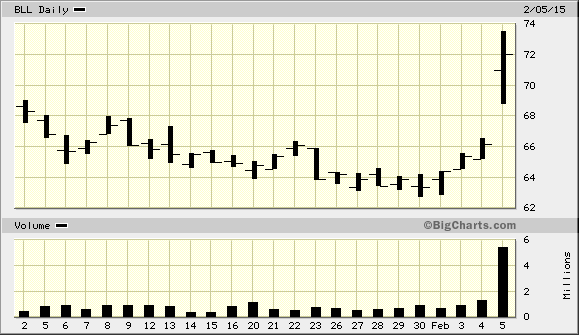
But the really big news is that Ball confirmed they’re in talks to buy Rexam, an aluminum can-maker in Britain. The potential deal could be worth $6.5 billion. The deal would be two-thirds in cash and one-third in stock, and it would combine two of the largest beverage can makers in the world. I like to see deals done in cash as much as possible. Shares of Rexam soared 23% in London. In the U.S., the market loved the news. Shares of Ball rallied nearly 9% on the day. I’m raising my Buy Below on Ball by $3. Ball is a buy any time the shares are below $75.
Snap-On reported very good earnings for Q4. The diversified manufacturer made $1.97 per share last quarter. That topped expectations by 16 cents per share. For the year, Snap-on made $7.14 per share, which is a very nice increase over the $5.93 per share they made in 2014. On Thursday, shares of SNA rallied for a 6.3% gain. I’m raising my Buy Below on Snap-on to $145 per share.
Before I go, I wanted to give you an update on Ford Motor ($F). I’ve been telling investors not to worry too much about last quarter’s earnings and that the earnings from now on will be very important. What’s interesting is that the automaker shrugged off last week’s earnings report, which was mostly good. But the stock really responded to the monthly sales report which came out on Tuesday. Ford’s sales rose 15.3% in January. From the low last Thursday to yesterday’s high, Ford rallied more than 12%. It’s good to see some strength in Ford. Let’s not chase it. I’m keeping our Buy Below at $16 per share.
That’s all for now. Outside of more Q4 earnings reports, next week should be fairly quiet on Wall Street. None of our Buy List stocks are due to report. On Tuesday, we’ll get another update on crude inventories. Then on Thursday, the Census Bureau will release its report on retail sales for January. It will be interesting to see how busy shoppers have been. Be sure to keep checking the blog for daily updates. I’ll have more market analysis for you in the next issue of CWS Market Review!
– Eddy
Morning News: February 6, 2015
Posted by Eddy Elfenbein on February 6th, 2015 at 7:03 amUK Trade Deficit Hits Four-Year High
Oil Prices Rise Again in Volatile Week
IRS Rehires Hundreds Of Problem Former Employees
RadioShack Files for Bankruptcy Protection, To Sell Stores
Twitter Revenue Rises 97% in 4th Quarter
Verizon to Sell $15 Billion in Assets, Launches $5 Billion Buyback
Why Pfizer’s $17 Billion Buyout of Hospira is a Super-Smart Move
Alcatel-Lucent Improves Q4 Profit Margins
Statoil Steps Up Cost-Cuts After Loss
Yelp Posts Strong Revenue Increase
LinkedIn Stock Rockets Almost 8% on Big Earnings Beat
Why Call of Duty and Destiny’s Gaming Dominance Is Coming to an Untimely End
Michael Pettis: Syriza and the French Indemnity of 1871-1873
Jeff Carter: The End of the Pits
Cullen Roche: Yes, the Economy Matters to the Markets
Be sure to follow me on Twitter.
Earnings from Ball Corp. and Snap-on
Posted by Eddy Elfenbein on February 5th, 2015 at 2:01 pmMore good Buy List news today. We had one very strong earnings report and an OK earnings report, but that was coupled with very encouraging acquisition news. Ball Corp. ($BLL) reported Q4 earnings of 84 cents per share. That was a penny below Wall Street’s consensus. Revenues rose 1.8% to $2.03 billion which was $50 million more than consensus. For the year, Ball earned $3.88 per share which is a nice increase over $3.28 per share they made in 2013.
Even though Ball missed by a penny per share, they finished up a very good year for 2014. As such, the company said it’s unlikely they’ll hit their long-term goal for growing earnings by 10% to 15% this year.
But the really big news is that Ball confirmed they’re in talks to buy Rexam, an aluminum can maker in Britain. The potential deal would be worth $6.5 billion. The market apparently likes this news a lot. Ball has been up as much as 11% today.
The other earnings news came from Snap-on ($SNA). The company reported Q4 earnings of $1.97 per share. That creamed estimates by 16 cents per share. For all of 2014, Snap-on made $7.14 per share. That’s a huge jump over $5.93 per share they earned a year ago. Business is going very well for them; the shares have been up as much as 7% today.
-
Archives
- July 2026
- June 2026
- May 2026
- April 2026
- March 2026
- February 2026
- January 2026
- December 2025
- November 2025
- October 2025
- September 2025
- August 2025
- July 2025
- June 2025
- May 2025
- April 2025
- March 2025
- February 2025
- January 2025
- December 2024
- November 2024
- October 2024
- September 2024
- August 2024
- July 2024
- June 2024
- May 2024
- April 2024
- March 2024
- February 2024
- January 2024
- December 2023
- November 2023
- October 2023
- September 2023
- August 2023
- July 2023
- June 2023
- May 2023
- April 2023
- March 2023
- February 2023
- January 2023
- December 2022
- November 2022
- October 2022
- September 2022
- August 2022
- July 2022
- June 2022
- May 2022
- April 2022
- March 2022
- February 2022
- January 2022
- December 2021
- November 2021
- October 2021
- September 2021
- August 2021
- July 2021
- June 2021
- May 2021
- April 2021
- March 2021
- February 2021
- January 2021
- December 2020
- November 2020
- October 2020
- September 2020
- August 2020
- July 2020
- June 2020
- May 2020
- April 2020
- March 2020
- February 2020
- January 2020
- December 2019
- November 2019
- October 2019
- September 2019
- August 2019
- July 2019
- June 2019
- May 2019
- April 2019
- March 2019
- February 2019
- January 2019
- December 2018
- November 2018
- October 2018
- September 2018
- August 2018
- July 2018
- June 2018
- May 2018
- April 2018
- March 2018
- February 2018
- January 2018
- December 2017
- November 2017
- October 2017
- September 2017
- August 2017
- July 2017
- June 2017
- May 2017
- April 2017
- March 2017
- February 2017
- January 2017
- December 2016
- November 2016
- October 2016
- September 2016
- August 2016
- July 2016
- June 2016
- May 2016
- April 2016
- March 2016
- February 2016
- January 2016
- December 2015
- November 2015
- October 2015
- September 2015
- August 2015
- July 2015
- June 2015
- May 2015
- April 2015
- March 2015
- February 2015
- January 2015
- December 2014
- November 2014
- October 2014
- September 2014
- August 2014
- July 2014
- June 2014
- May 2014
- April 2014
- March 2014
- February 2014
- January 2014
- December 2013
- November 2013
- October 2013
- September 2013
- August 2013
- July 2013
- June 2013
- May 2013
- April 2013
- March 2013
- February 2013
- January 2013
- December 2012
- November 2012
- October 2012
- September 2012
- August 2012
- July 2012
- June 2012
- May 2012
- April 2012
- March 2012
- February 2012
- January 2012
- December 2011
- November 2011
- October 2011
- September 2011
- August 2011
- July 2011
- June 2011
- May 2011
- April 2011
- March 2011
- February 2011
- January 2011
- December 2010
- November 2010
- October 2010
- September 2010
- August 2010
- July 2010
- June 2010
- May 2010
- April 2010
- March 2010
- February 2010
- January 2010
- December 2009
- November 2009
- October 2009
- September 2009
- August 2009
- July 2009
- June 2009
- May 2009
- April 2009
- March 2009
- February 2009
- January 2009
- December 2008
- November 2008
- October 2008
- September 2008
- August 2008
- July 2008
- June 2008
- May 2008
- April 2008
- March 2008
- February 2008
- January 2008
- December 2007
- November 2007
- October 2007
- September 2007
- August 2007
- July 2007
- June 2007
- May 2007
- April 2007
- March 2007
- February 2007
- January 2007
- December 2006
- November 2006
- October 2006
- September 2006
- August 2006
- July 2006
- June 2006
- May 2006
- April 2006
- March 2006
- February 2006
- January 2006
- December 2005
- November 2005
- October 2005
- September 2005
- August 2005
- July 2005
 Eddy Elfenbein is a Washington, DC-based speaker, portfolio manager and editor of the blog Crossing Wall Street. His