-
My Watch List
Posted by Eddy Elfenbein on January 27th, 2015 at 1:08 pmBelow is my latest Watch List. This is my unofficial list of high-quality stocks I like to follow. If a stock is on this list, then there’s a very good chance that it’s in the upper 5% of well-run companies on Wall Street. This is the elite.
I’m often asked how I go about selecting the stocks for my Buy List. It’s actually very simple. I have this Watch List of stocks and if one of them falls down to a very attractive price, then it becomes a contender for the new Buy List. I like to think of the Watch List as the minor leagues for the Buy List. Strong prospects earn their way up the ladder.
The Watch List is very informal. Unlike the Buy List, I’m constantly adding and deleting names. In fact, I have a bad habit of letting the Watch List grow too large. I often find myself adding three names for every one I delete. It’s simply not possible to follow 130 stocks.
Every few months I promise myself that this will be the time to trim down the Watch List. Well, I actually did it this time! Over the past several weeks, I trimmed the Watch List down to 76 names.
Symbol Stock ABC AmerisourceBergen ABT Abbott Laboratories ADS Alliance Data Systems AL Air Lease AME Ametek ANSS Ansys ANTM Anthem APH Amphenol AZO AutoZone BCPC Balchem BDX Becton, Dickinson BIIB Biogen Idec CATM Cardtronics CTAS Cintas CERN Cerner CHD Church & Dwight CL Colgate-Palmolive COST Costco CPRT Copart CVS CVS Health DHR Danaher DKS Dick’s Sporting Goods DLX Deluxe EV Eaton Vance FAST Fastenal FDS FactSet Research Systems FL Foot Locker FTI FMC Technologies GGG Graco GPN Global Payments GWW W.W. Grainger HEI HEICO HSIC Henry Schein HSNI HSN Inc HSY Hershey HUB-B Hubbell ICE Intercontinental Exchange IDXX IDEXX Laboratories IEX IDEX IFF International Flavors & Fragrances INTU Intuit IPCM IPC Healthcare IT Gartner JBHT JB Hunt Transport Services JKHY Jack Henry & Associates MDT Medtronic MIDD Middleby MKC McCormick MTD Mettler-Toledo International MWIV MWI Veterinary Supply NKE Nike NTCT NetScout Systems OSIS OSI Systems PB Prosperity Bancshares PSA Public Storage PZZA Papa John’s International RAI Reynolds American RMD ResMed ROL Rollins SBUX Starbucks SEIC SEI Investments SJI South Jersey Industries SLGN Silgan Holdings SRCL Stericycle STJ St. Jude Medical SWI SolarWinds TJX TJX TMO Thermo Fisher Scientific TSCO Tractor Supply TXRH Texas Roadhouse TYL Tyler Technologies V Visa VFC V.F. Corp VSI Vitamin Shoppe WEX WEX ZMH Zimmer Holdings Spies and Finance
Posted by Eddy Elfenbein on January 27th, 2015 at 11:48 amYesterday, the FBI arrested a Russian businessman named Evgeny Buryakov and charged him with being an agent of Russian intelligence.
Buryakov was in the U.S. on “non-official status,” meaning he didn’t have diplomatic immunity, while his two co-conspirators (Igor Sporyshev and Victor Podobnyy) had official status but they had already split back to Mother Russia.
Reading the details of their story, it’s pretty embarrassing. These guys come across more like Boris Badenov rather than international men of mystery. The spies are on the phone complaining about their jobs.
While it’s easy to dismiss these buffoons as merely buffoons, noted strategy analyst John Schindler cautions that there’s something more sinister afoot. Bear in mind that Vladimir Putin is a former KGB officer and that he takes spy warfare seriously. Putin believes Russia is in a Holy War with the west, the U.S. especially, and he intends to win.
Schindler notes that the important part of the story, the part that we ought to be paying attention to, is that the spies were targeting the U.S. financial infrastructure. They were looking for information on topics like high-frequency trading and automated trading algorithms. Basically, anything that could be used to destabilize our financial markets.
As with the Illegals Network in 2010, journalists and commentators who are ignorant of Russian espionage tradecraft are blowing this story off as being of little consequence, even comedic. There is, however, nothing funny about this case. In the first place, it shows that the Kremlin continues to collect economic intelligence in the West, using various covers to steal information of many sorts. This is a big win for the FBI and U.S. counterintelligence, but luck was on our side here, and that cannot be counted on.
Moreover, Illegals have many purposes, including functioning as long-term sources to maintain agent networks in the event of war, when diplomatic facilities close and Legals get pulled home. Given the parlous state of relations between the West and Russia now, this is not a theoretical concern. The Kremlin, unlike most Western intelligence services, tends towards the long-view and worst-case planning with utmost seriousness.
Most individual investors are unaware of how much modern trading is dominated by machines. These are highly sophisticated operations. Whenever you buy a stock, it’s very likely you’re buying it from a machine. Whenever you sell a stock, it’s very likely a machine bought it from you. There’s a vast army of computers that do nothing all day but trade at insanely high speeds to eek out a micro-penny’s profit on each trade. The worry is that once one robot starts selling massively, it could trigger all the other robots to sell as well.
Could this really happen? I don’t know, but we’ve had Flash Crashes before. It’s realistic enough that the Russians were looking into it. The trio was especially interested in ETFs (exchange traded funds). On the other hand, rather than them attacking us, they have been interested in finding out if we had been attacking them.
The irony here is that it’s been the Russian system that’s been destabilized. The Russian economy has been clobbered by the recent fall in oil. The ruble has been smashed and the Russian Fed has responded by jacking up interest rates. As I’ve noted before, the Russian ETF ($RSX) is in a severe bear market. Capital outflows ballooned from $60 billion in 2013 to $150 billion last year.
It may soon get worse for Russia. Yesterday, S&P cut Russia’s bond rating to junk (and someone may have known). The U.S. wants to kick Russia out of the SWIFT banking network. This is the standardized network that lets banks conduct international transactions. This is a big deal as it would isolate the Russian economy even more. Dmitry Medvedev said that Russia’s reaction would be “unlimited.” The fear is that with a busted up financial system, the Russian Fed won’t be able to conduct monetary policy.
In 2009, a computer programmer (and Russian immigrant) named Sergey Aleynikov was arrested and accused of improperly copying computer codes that could be used to destabilize the markets. This was the inspiration for Michael Lewis’s “Flash Boys.” After years of legal battles, Aleynikov’s case was ultimately thrown out, although his life was nearly ruined.
This is a secret world of spycraft and high finance. We may never know exactly what’s going on. In the meantime, it’s best to remember those haunting words by T.S. Eliot, himself a Lloyd’s Bank employee:
Between the order
And the confirmation
Between the bid
And the ask
Falls the shadow.Morning News: January 27, 2015
Posted by Eddy Elfenbein on January 27th, 2015 at 7:07 amGreece’s Odd-Couple Only Agrees About Ending Austerity
Russia’s Downgrade Has Important Political Implications
British Economy Brows at Best Annual Rate Since 2007
Doubts Grow About Mid-Year Rate Hike, But Fed Won’t Express Any
Oil Price Recovers as Dollar Weakens Against Euro
Winklevoss Twins: Bitcoin Will Explode Beyond $1 Trillion
Wall Street Left With Skeleton Crews Down as Blizzard Bears Down
Price Caps Leave Blizzard Riders Out in the Cold
IBM Dismisses Forbes Report of Massive Layoffs
Philips Lags Behind Its Profit Targets as Earnings Slide
Ericsson Hurt by North American Slowdown
Novartis Upbeat Despite Weaker Profit
Shake-Up at Mattel as Barbie Loses Her Appeal
Jeff Carter: First Regulated Bitcoin Exchange
Joshua Brown: QOTD: Is Fundamental Indexing Passive or Active?
Be sure to follow me on Twitter.
Microsoft Earns 71 Cents per Share
Posted by Eddy Elfenbein on January 26th, 2015 at 4:59 pmMicrosoft reported fiscal Q2 earnings of 71 cents per share. That matched Wall Street’s consensus.
The company’s bottom line has been hit in recent quarters by expenses related to job cuts started last summer and the Nokia mobile phone business that it acquired in April. The July plans included up to 18,000 jobs cuts, or about 14% of its workforce at the time, largely to clear up overlap with the Nokia businesses.
For the period ended Dec. 31, Microsoft reported a profit of $5.86 billion, or 71 cents a share, down from $6.56 billion, or 78 cents a share, a year earlier. Microsoft said its per-share earnings in the latest quarter were hurt by 2 cents from costs related to integration and restructuring.
Revenue increased to $26.47 billion from $24.52 billion.
Analysts polled by Thomson Reuters expected per-share profit of 71 cents and revenue of $26.29 billion.
The stock is down 3% after hours.
All Hail Starbucks!
Posted by Eddy Elfenbein on January 26th, 2015 at 12:45 pmI have to confess that I’m not a consumer of Starbucks ($SBUX) — I’m just not a coffee drinker — but I’m a fan of the company. As a business, Starbucks has done incredibly well.
I often tell investors that doing a business turnaround is far harder than it looks, and Starbucks pulled one off. The shares fell from $40 down to $7.
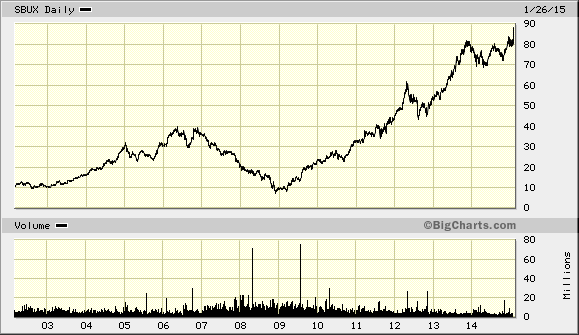
The stock is now at $88 and on Thursday, Starbucks reported another good quarter:
Sales in the quarter, which ended Dec. 28 and was its first quarter for the 2015 fiscal year, rose 13 percent to $4.8 billion, while earnings rose to $983.1 million, from $540.7 million in the same quarter a year earlier, thanks to the Starbucks Japan purchase.
Adjusted for that acquisition, earnings on each share of stock were 80 cents, a 16 percent increase over the same quarter last year. The figures for revenue and earnings per share were records for Starbucks.
The company also announced that Kevin Johnson, the retired chief executive of Juniper Networks and a member of the Starbucks board, would become its new president and chief operating officer. Mr. Johnson replaces Troy Alstead, who starting in March will take a yearlong sabbatical from the company, as previously announced.
Investment analysts were closely watching comparable-store sales performance, after five quarters of relatively lackluster traffic. The company used a mix of new products and promotions, including an increased selection of gift cards and a new latte, Chestnut Praline, to attract consumers during the critical holiday season.
The company has an ambitious goal to nearly double sales and operating income over the next five years, and to that end, has begun acting on several strategies to make its stores more productive in the afternoons and evenings and increase their convenience to consumers.
Last fall, it announced it would begin wine and beer sales, previously tested in the Chicago area, in about a quarter of its 12,000 stores, and more of the food being made through its purchase of La Boulange in 2012 is geared toward light lunch and dinner meals.
Starbucks earns about 16 percent of its revenue from its mobile payment system, which is regarded as a model by others in the food industry, and it has been testing a new mobile ordering and payment system that it hopes will lift sales and shorten the time customers spend waiting in line.
It also is working on a delivery service.
The Markets Post-Greece
Posted by Eddy Elfenbein on January 26th, 2015 at 12:19 pmThe stock market is holding up better today than I thought it would following the elections in Greece. The S&P 500 just turned positive for the day.
Former Buy List stock, IBM ($IBM), is in the news today. The company is planning layoffs but not as large as had been expected. This is tough for me to see because the company is in more trouble than I had realized. The job cuts are difficult but are necessary for IBM to get back on track.
The Federal Reserve meets tomorrow and on Wednesday, plus New York City is being hit with a massive snow storm (we’re getting a little here in DC but not much). We’re also waiting on Microsoft ($MSFT) to report after the close today.
Gold, which had been rallying this year, is down a lot today following Greece. The yellow metal is back below $1,280 per ounce. Gold was recently above $1,300.
Morning News: January 26, 2015
Posted by Eddy Elfenbein on January 26th, 2015 at 7:14 amTsipras Forges Anti-Austerity Coalition in EU Challenge
Tsipras Win Draws French Congratulations, German Threat
German Business Confidence Exceeds Expectations
Obama Fêted in Delhi as US Cements Closer Ties With India
Economic ‘New Normal’ Needs Full Context
First U.S. Bitcoin Exchange Set to Open
MWV and RockTenn Agree to Combination Creating a $16 Billion Global Packaging Leader
AT&T Agrees to Buy Nextel Mexico for $1.875 Billion Minus Debt
Post Holdings to Acquire MOM Brands for $1.15 Billion
Unease for What Microsoft’s HoloLens Will Mean for Our Screen-Obsessed Lives
Lenovo Brings Motorola Back to China as Moto X Phone Released
NY Insider Trading Ruling Tests Prosecutors Beyond Wall Street
Cullen Roche: Initial Thoughts on European QE
Jeff Miller: Weighing the Week Ahead: Time to Focus on Europe?
Be sure to follow me on Twitter.
Syriza Wins in Greece
Posted by Eddy Elfenbein on January 25th, 2015 at 6:47 pmExpect the U.S. stock market to open lower tomorrow morning. The far-Left Syriza has won the elections in Greece. That means austerity is gone, and with it, perhaps EU money. It’s hard to say at this point.
I would like to think that Greece and the EU will reach some sort of deal to restructure Greece’s debt. No one wants to see the euro go down because of Greece.
Syriza leader Alexis Tsipras said that Greece’s era of bowing to international creditors is over, as he celebrated his party’s victory in Greek elections dominated by a public backlash against years of budget cuts.
Tsipras, addressing supporters in central Athens Sunday night after Prime Minister Antonis Samaras conceded defeat, said that Greece is turning a page and putting austerity behind it. The Syriza government’s priority “will be for Greece and its people to regain their lost dignity,” he said.
“There will neither be a catastrophic clash nor will continued kowtowing be accepted,” said Tsipras, 40. “We are fully aware that the Greek people hasn’t given us carte blanche but a mandate for national revival.”
While Syriza’s victory was more decisive than polls had predicted, it remains unclear whether the party will be able to govern alone. Even with a razor-thin majority or in a fragile coalition, the result hands Tsipras a clear mandate to confront Greece’s program of austerity imposed in return for pledges of 240 billion euros ($269 billion) in aid since May 2010. The challenge for him now is to strike a balance between keeping his election pledges including a writedown of Greek debt and avoiding what Samaras repeatedly warned was the risk of an accidental exit from the euro.
I’m reminded of François Mitterrand’s stunning election victory in 1981. At the time, it was seen as a dramatic turn to the left for France. But once the franc started to plunge, the government quickly reversed course. The world that is has a nasty habit of beating the world that ought to be.
Signature Bank: “We don’t even have a line item in our budget for advertising.”
Posted by Eddy Elfenbein on January 23rd, 2015 at 3:44 pmVery nice article on Signature Bank ($SBNY):
With just 0.1 percent of Signature’s loan portfolio listed as “nonperforming,” meaning that the debtor has not made scheduled payments on the loan for 90 or more days, it would be easy to assume there was some secret formula to how the bank finds solid borrowers. But DePaolo chalks the bank’s loan portfolio success up to its niche in the market, targeting privately held businesses valued between $20 million and $100 million.
“For the most part, either we know the client or prospect, or they were referred by an existing client that’s well-known to us,” DePaolo said.
The chief executive said that Signature, nestled in the largest financial market in the country, is well-positioned to siphon off business in that privately held business market from the big banks, a pull that those banks likely have noticed.
“We have a lot of opportunity to take business away from them,” DePaolo said. “I’m not sure that they want to admit it to anyone, but they’re worried about us.”
(…)
With $26 billion in assets and a market capitalization of approximately $6.09 billion, Signature Bank has branches in New Rochelle and White Plains, another branch soon to open in Greenwich, Conn., and about 30 total locations in the New York metropolitan area.
But those locations, DePaolo said, aren’t as visible as those of the big banks, by design. They are often on the upper floors of office buildings, near the action, but somewhat hidden in plain sight.
Each morning, when DePaolo gets off that 5:45 a.m. Metro-North train from New Rochelle, he walks by the brightly lit big bank signs to lead a bank that takes a different approach.
“That’s just not us,” DePaolo said of the flashy advertising. “We don’t even have a line item in our budget for advertising.”
Swiss 50-Year Bonds
Posted by Eddy Elfenbein on January 23rd, 2015 at 9:35 amThe 50-year bonds in Switzerland now yield 22.35%.
That’s not annualized — that’s the whole darn thing.
-
Archives
- June 2026
- May 2026
- April 2026
- March 2026
- February 2026
- January 2026
- December 2025
- November 2025
- October 2025
- September 2025
- August 2025
- July 2025
- June 2025
- May 2025
- April 2025
- March 2025
- February 2025
- January 2025
- December 2024
- November 2024
- October 2024
- September 2024
- August 2024
- July 2024
- June 2024
- May 2024
- April 2024
- March 2024
- February 2024
- January 2024
- December 2023
- November 2023
- October 2023
- September 2023
- August 2023
- July 2023
- June 2023
- May 2023
- April 2023
- March 2023
- February 2023
- January 2023
- December 2022
- November 2022
- October 2022
- September 2022
- August 2022
- July 2022
- June 2022
- May 2022
- April 2022
- March 2022
- February 2022
- January 2022
- December 2021
- November 2021
- October 2021
- September 2021
- August 2021
- July 2021
- June 2021
- May 2021
- April 2021
- March 2021
- February 2021
- January 2021
- December 2020
- November 2020
- October 2020
- September 2020
- August 2020
- July 2020
- June 2020
- May 2020
- April 2020
- March 2020
- February 2020
- January 2020
- December 2019
- November 2019
- October 2019
- September 2019
- August 2019
- July 2019
- June 2019
- May 2019
- April 2019
- March 2019
- February 2019
- January 2019
- December 2018
- November 2018
- October 2018
- September 2018
- August 2018
- July 2018
- June 2018
- May 2018
- April 2018
- March 2018
- February 2018
- January 2018
- December 2017
- November 2017
- October 2017
- September 2017
- August 2017
- July 2017
- June 2017
- May 2017
- April 2017
- March 2017
- February 2017
- January 2017
- December 2016
- November 2016
- October 2016
- September 2016
- August 2016
- July 2016
- June 2016
- May 2016
- April 2016
- March 2016
- February 2016
- January 2016
- December 2015
- November 2015
- October 2015
- September 2015
- August 2015
- July 2015
- June 2015
- May 2015
- April 2015
- March 2015
- February 2015
- January 2015
- December 2014
- November 2014
- October 2014
- September 2014
- August 2014
- July 2014
- June 2014
- May 2014
- April 2014
- March 2014
- February 2014
- January 2014
- December 2013
- November 2013
- October 2013
- September 2013
- August 2013
- July 2013
- June 2013
- May 2013
- April 2013
- March 2013
- February 2013
- January 2013
- December 2012
- November 2012
- October 2012
- September 2012
- August 2012
- July 2012
- June 2012
- May 2012
- April 2012
- March 2012
- February 2012
- January 2012
- December 2011
- November 2011
- October 2011
- September 2011
- August 2011
- July 2011
- June 2011
- May 2011
- April 2011
- March 2011
- February 2011
- January 2011
- December 2010
- November 2010
- October 2010
- September 2010
- August 2010
- July 2010
- June 2010
- May 2010
- April 2010
- March 2010
- February 2010
- January 2010
- December 2009
- November 2009
- October 2009
- September 2009
- August 2009
- July 2009
- June 2009
- May 2009
- April 2009
- March 2009
- February 2009
- January 2009
- December 2008
- November 2008
- October 2008
- September 2008
- August 2008
- July 2008
- June 2008
- May 2008
- April 2008
- March 2008
- February 2008
- January 2008
- December 2007
- November 2007
- October 2007
- September 2007
- August 2007
- July 2007
- June 2007
- May 2007
- April 2007
- March 2007
- February 2007
- January 2007
- December 2006
- November 2006
- October 2006
- September 2006
- August 2006
- July 2006
- June 2006
- May 2006
- April 2006
- March 2006
- February 2006
- January 2006
- December 2005
- November 2005
- October 2005
- September 2005
- August 2005
- July 2005
 Eddy Elfenbein is a Washington, DC-based speaker, portfolio manager and editor of the blog Crossing Wall Street. His