-
Today’s Fed Statement
Posted by Eddy Elfenbein on July 30th, 2014 at 3:16 pmHere’s today’s FOMC statement:
Information received since the Federal Open Market Committee met in June indicates that growth in economic activity rebounded in the second quarter. Labor market conditions improved, with the unemployment rate declining further. However, a range of labor market indicators suggests that there remains significant underutilization of labor resources. Household spending appears to be rising moderately and business fixed investment is advancing, while the recovery in the housing sector remains slow. Fiscal policy is restraining economic growth, although the extent of restraint is diminishing. Inflation has moved somewhat closer to the Committee’s longer-run objective. Longer-term inflation expectations have remained stable.
Consistent with its statutory mandate, the Committee seeks to foster maximum employment and price stability. The Committee expects that, with appropriate policy accommodation, economic activity will expand at a moderate pace, with labor market indicators and inflation moving toward levels the Committee judges consistent with its dual mandate. The Committee sees the risks to the outlook for economic activity and the labor market as nearly balanced and judges that the likelihood of inflation running persistently below 2 percent has diminished somewhat.
The Committee currently judges that there is sufficient underlying strength in the broader economy to support ongoing improvement in labor market conditions. In light of the cumulative progress toward maximum employment and the improvement in the outlook for labor market conditions since the inception of the current asset purchase program, the Committee decided to make a further measured reduction in the pace of its asset purchases. Beginning in August, the Committee will add to its holdings of agency mortgage-backed securities at a pace of $10 billion per month rather than $15 billion per month, and will add to its holdings of longer-term Treasury securities at a pace of $15 billion per month rather than $20 billion per month. The Committee is maintaining its existing policy of reinvesting principal payments from its holdings of agency debt and agency mortgage-backed securities in agency mortgage-backed securities and of rolling over maturing Treasury securities at auction. The Committee’s sizable and still-increasing holdings of longer-term securities should maintain downward pressure on longer-term interest rates, support mortgage markets, and help to make broader financial conditions more accommodative, which in turn should promote a stronger economic recovery and help to ensure that inflation, over time, is at the rate most consistent with the Committee’s dual mandate.
The Committee will closely monitor incoming information on economic and financial developments in coming months and will continue its purchases of Treasury and agency mortgage-backed securities, and employ its other policy tools as appropriate, until the outlook for the labor market has improved substantially in a context of price stability. If incoming information broadly supports the Committee’s expectation of ongoing improvement in labor market conditions and inflation moving back toward its longer-run objective, the Committee will likely reduce the pace of asset purchases in further measured steps at future meetings. However, asset purchases are not on a preset course, and the Committee’s decisions about their pace will remain contingent on the Committee’s outlook for the labor market and inflation as well as its assessment of the likely efficacy and costs of such purchases.
To support continued progress toward maximum employment and price stability, the Committee today reaffirmed its view that a highly accommodative stance of monetary policy remains appropriate. In determining how long to maintain the current 0 to 1/4 percent target range for the federal funds rate, the Committee will assess progress–both realized and expected–toward its objectives of maximum employment and 2 percent inflation. This assessment will take into account a wide range of information, including measures of labor market conditions, indicators of inflation pressures and inflation expectations, and readings on financial developments. The Committee continues to anticipate, based on its assessment of these factors, that it likely will be appropriate to maintain the current target range for the federal funds rate for a considerable time after the asset purchase program ends, especially if projected inflation continues to run below the Committee’s 2 percent longer-run goal, and provided that longer-term inflation expectations remain well anchored.
When the Committee decides to begin to remove policy accommodation, it will take a balanced approach consistent with its longer-run goals of maximum employment and inflation of 2 percent. The Committee currently anticipates that, even after employment and inflation are near mandate-consistent levels, economic conditions may, for some time, warrant keeping the target federal funds rate below levels the Committee views as normal in the longer run.
Voting for the FOMC monetary policy action were: Janet L. Yellen, Chair; William C. Dudley, Vice Chairman; Lael Brainard; Stanley Fischer; Richard W. Fisher; Narayana Kocherlakota; Loretta J. Mester; Jerome H. Powell; and Daniel K. Tarullo. Voting against was Charles I. Plosser who objected to the guidance indicating that it likely will be appropriate to maintain the current target range for the federal funds rate for “a considerable time after the asset purchase program ends,” because such language is time dependent and does not reflect the considerable economic progress that has been made toward the Committee’s goals.
-
Q2 GDP Grew By 4%
Posted by Eddy Elfenbein on July 30th, 2014 at 11:27 amGood news for the economy. The government reported that the economy expanded by 4% during the second three months of the year. The terrible number for Q1 was revised up from -2.9% to 2.1%. Still bad, but not quite as bad.
The GDP figure was aided by inventory rebuilding. The opposite effect caused much of the damage for Q1.
Over the past year, the economy grew 2.4%—slightly ahead of the 2.3% average annual gain from recovery’s start until the end of 2013, before an unusually cold winter socked the economy.
The first-quarter “was an anomaly and growth will be much stronger through the rest of this year,” said PNC Financial Services Group economist Stuart Hoffman. “Consumers are spending thanks to job and income gains, and with borrowing costs still low businesses are investing to meet stronger demand.”
Annual revisions, also released Wednesday, showed the economy expanded at a 4% pace in the second half of 2013, the best six-month stretch in 10 years. But figures over the past five years, including new revisions back to 2011, continue to tell a familiar tale. Unable to string together several quarters of steady growth, the recovery that began in 2009 is still the weakest since World War II.
Wednesday’s report showed household spending advanced at a 2.5% rate last quarter, an increase from the first quarter’s modest 1.2% gain. Spending on total goods accounted for its highest contribution to GDP since late 2010, and spending on long-lasting durable goods was near a five-year high, led by a big jump in auto sales.
Gold and stocks are down, while bonds are up.
-
Morning News: July 30, 2014
Posted by Eddy Elfenbein on July 30th, 2014 at 6:53 amU.N. Agency to Form Airline Safety Task Force After Ukraine Crash
Spain’s Economy Grows Faster Than Expected, But CPI Flags Deflation Threat
Home Prices Rise, But More Slowly
Liberals Love the ‘One Percent’
Barclays Returns to Quarterly Profit as Impairments Fall
Ed Balls Backs Tougher Bank Regulation
UBS and Deutsche Bank Embroiled in Dark Pool Probe
McDonald’s Ruling Sets Ominous Tone for Franchisers
Twitter’s User Growth Picks Up
Topix Gains for Fourth Day Amid Earnings as Honda Jumps
Why Flipkart Looks Set to Fail Against Amazon
Total Leads European Shares Lower on Russia Worries
Amazon Says Lower Ebook Prices Benefit Authors, Publishers
Joshua Brown: The Death of Twitter Had Been Greatly Exaggerated
Be sure to follow me on Twitter.
-
More Buy List Earnings
Posted by Eddy Elfenbein on July 29th, 2014 at 5:18 pmAfter the closing bell, we got three more earnings reports for our Buy List.
Fiserv ($FISV) reported Q2 earnings of 81 cents per share which beat expectations by one penny per share. The company also raised the low-end of its full-year forecast by three cents per share. Fiserv now expects full-year earnings of $3.31 to $3.37 per share.
Express Scripts ($ESRX) reported Q2 earnings of $1.23 per share. That was also a penny higher than expectations. ESRX also slightly narrowed their full-year range. The previous range was $4.82 to $4.94 per share. Now it’s $4.84 to $4.92 per share. The shares were up 2.1% today.
AFLAC ($AFL) had Q2 operating earnings of $1.66 per share. They had been expecting operating earnings to range between $1.54 and $1.68 per share. The yen knocked off three cents per share. Wall Street’s consensus was for $1.59 per share.
As for guidance, CEO Dan Amos said, “If the yen averages 100 to 105 to the dollar for the third quarter, we would expect earnings in the third quarter to be approximately $1.38 to $1.47 per diluted share. Using that same exchange rate assumption for the remainder of 2014, we would expect full-year reported operating earnings to be about $6.16 to $6.30 per diluted share.”
-
Morning News: July 29, 2014
Posted by Eddy Elfenbein on July 29th, 2014 at 6:48 amEU Finalizes Russian Sanctions as BP Warns of Impact on Business
UK Mortgage Approvals Turn Around, Jump 8% in June
Medicare, Social Security Disability Fund Headed in Different Directions
Tech Companies Reel as NSA’s Spying Tarnishes Reputations
Deutsche Bank Revenue From Debt Trading Beats U.S. Peers
Zillow Deal to Buy Trulia Creates Real Estate Digital Ad Juggernaut
FAA Seeks $12 Million Fine Against Southwest
Honda Projects Record Profit on Yen, Emerging Markets
UBS Profit Rises 15% as It Grapples With Legal Matters
Aetna Posts Higher Q2 Profit, Lifts Full-Year Outlook
The Bear Case For Uber (Yes, There Is One)
Orange Accelerates Cost Cuts to Halt Earnings Drop
35% in US Facing Debt Collectors
John Hempton: The Herbalife Miss
Roger Nusbaum: Should You Invest in Farm Land?
Be sure to follow me on Twitter.
-
Light Posting this Week
Posted by Eddy Elfenbein on July 28th, 2014 at 11:18 pmI’m taking a little time off this week to enjoy summer. I’ll still post but it will be lighter than normal.
I thought Lu Wang at Bloomberg had an interesting article on the persistence of buying the dips. Here are some choice nuggets:
Declines in the benchmark gauge for American equity are lasting an average of 1.5 days in 2014, the shortest since at least 2009, according to data compiled by Bloomberg. Starting last year, returns on days after the index fell have averaged 0.13 percent, the highest since they were 0.38 percent in 2009.
(…)
Losing streaks in the U.S. equity market are getting shorter. The S&P 500 has posted no declines that lasted more than three days in 2014, compared with an average of nine a year since March 2009, data compiled by Bloomberg show.
Drops this quarter have lasted 1.2 days, down from 1.5 days in the previous three months and about half the length in 2012. The number of losses has stayed roughly the same as in the past. There have been 59 down days this year, compared with an average of 61 during the same time period since 2011.
(…)
About $190 billion has been added to equity mutual funds and exchange-traded funds since the start of 2013, data compiled by the Investment Company Institute and Bloomberg show. That’s a reversal from the five years through 2012, when $300 billion was withdrawn.
(…)
The S&P 500 has gone without a 10 percent loss for 33 months, the third-longest stretch since 1990. On average, corrections have occurred every 18 months since 1946, according to a study by Sam Stovall, chief equity strategist at S&P Capital IQ.
-
Morning News: July 28, 2014
Posted by Eddy Elfenbein on July 28th, 2014 at 6:43 amReckitt Helps Keep Britain’s FTSE Afloat After Solid Update
Bank of Communications Mulls Plan to Reform Ownership Structure
Court Orders Russia to Pay $50 Billion to Yukos Shareholders
Lew Can Use Tax Rule to Slow Inversions, Ex-Official Says
NYC Pension Funds Report 17.4% Gain as U.S. Stocks Soar
Dollar Tree to Buy Family Dollar for About $8.5 BIllion
Rumored Danone Medical Food Sale To Hospira Would End Ambition
No Burgers at Some China McDonald’s Over Food Scare
Nissan First-quarter Profit Rises, Exceeds Consensus as U.S. Sales Improve
Amazon Faces Threat of Losing Investors’ Trust Amid Low Profits
Tyson Foods to Sell Mexico and Brazilian Poultry Businesses
Ryanair Lifts Forecast as Quarterly Profit Soars
Epicurean Dealmaker: Improve Yourself
Howard Lindzon: Zillow is Hungry and Just Ate Trulia… & The Future of Financial Tech
Be sure to follow me on Twitter.
-
Moog Earns $1.08 per Share
Posted by Eddy Elfenbein on July 25th, 2014 at 10:42 amThis morning, Moog ($MOG-A) reported fiscal Q3 earnings of $1.08 per share. Sales were up 2% to $684 million.
“This was a very good quarter for our company with increased sales, record earnings and very strong cash flow,” said John Scannell, Chairman and CEO. “We are on track for fiscal ’14, which will be a great year for Moog. As we look to fiscal ’15, we should see further improvement. We’re forecasting very modest sales growth but a 16% increase in earnings per share. Company operating margins in fiscal ’15 will expand by 50 basis points, despite some margin challenges in our Aircraft segment. We also expect another year of strong cash flow. Overall, if fiscal ’15 turns out as we expect, it will be another record year for the company.”
Moog raised its 2014 full-year guidance to $3.65 per share. Wall Street had been expecting $3.74 per share. Since they’ve already earned $2.59 per share for the first three quarters, that means they expect $1.06 per share for fiscal Q4. For 2015, Moog expects sales of $2.69 billion and EPS of $4.25. Wall Street had been expecting $4.56 per share.
-
CWS Market Review – July 25, 2014
Posted by Eddy Elfenbein on July 25th, 2014 at 7:05 am“People always call it luck when you’ve acted more sensibly than they have.”
– Anne TylerLike the honey badger, this stock market just doesn’t care. Was it going to be tripped up by Ukraine? Nope. Gaza? Nope. Fed tapering? Not a chance. The stock market keeps chugging higher. On Thursday, the S&P 500 finished the day at 1,987.98 for its 27th record close this year. Not that long ago, 2,000 for the S&P 500 was a distant hope. Now, it looks like we’ll hit it any day now.
This week has been all about earnings, earnings and more earnings. So far, the earnings have been pretty good. According to the latest numbers from Bloomberg, 77% of the S&P 500 companies that have reported so far have topped Wall Street’s expectations. Also, 64% have beaten their sales expectations. The S&P 500 is currently on track to deliver Q2 earnings growth of 6.2% and sales growth of 3.3%.
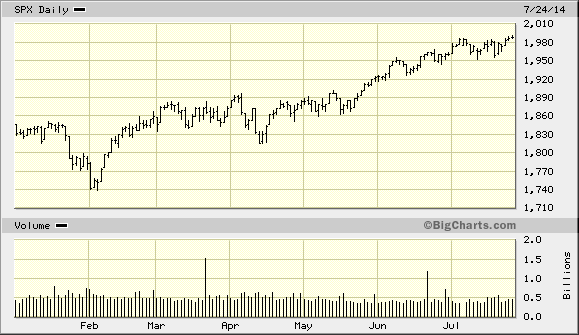
Our Buy List has been very busy this week; we had seven earnings reports. Thanks to good earnings, Ford Motor jumped out to a new 52-week high. Even boring CA Technologies rallied 4.5% after a strong earnings report. I’ll review all of our recent earnings in a just a moment. I’ll also highlight four Buy List earnings reports coming next week. I should mention that weekly jobless claims just dropped to an eight-year low, which bodes well for next week’s jobs report. But first, let’s take a closer look at our mass of earnings reports.
Surveying the Earnings Parade
We have a lot to go through, so let’s start with Tuesday’s earnings report from McDonald’s and Microsoft. Unfortunately, the McDonald’s ($MCD) news wasn’t very good. The fast-food joint earned $1.40 for Q2, which was four cents shy of Wall Street’s consensus. In the U.S., same-store sales dropped by 1.5%.
It’s no secret that MCD has made a lot of missteps. This is particularly painful when we see the outstanding results from Chipotle ($CMG), a company MCD used to own. Simply put, McDonald’s ($MCD) is not in a good way right now. As an investor, I like when companies hit rough patches since there’s a good opportunity to find a bargain. The catch, of course, is that the company has to right itself.
I think the folks at MCD understand the position they’re in, although I think the reforms may take a while to impact the business. For now, MCD is indeed a cheap stock. The shares got hit by a bunch of downgrades after the earnings report. Going by Thursday’s close, MCD yields 3.4%. Not many blue chips pay that well. The restaurant said that it’s planning to reform itself over the next 18 months. They’d better get cracking. I’m lowering my Buy Below on McDonald’s to $101 per share.
Except for Nokia, Microsoft Is Looking Good
Microsoft’s ($MSFT) earnings report was a bit confusing, but after giving it a read, traders decided they like it. After the bell on Tuesday, the software giant reported fiscal Q4 earnings of 55 cents per share. That was five cents below consensus. The shares quickly plunged in the after-hours market.
Then more details came out, and it turned out that the results weren’t that bad at all. Microsoft’s quarterly revenue rose a healthy 18% to $23.4 billion. The company also pleased investors last week when they announced big job cuts. It’s not that the market is happy about folks losing their jobs, but they’re pleased to see that MSFT is working to streamline operations. Most of those jobs are from Nokia.
The big problem for Microsoft is that Nokia’s handset business is a money loser. The division could turn into a winner in the long term, but the outlook is rather iffy at the moment. The good news for Microsoft is that their cloud business is going very well. Microsoft remains a good buy up to $48 per share.
Earnings from CA Technologies and Qualcomm
On Wednesday, two of our tech stocks reported results, CA Technologies and Qualcomm. I have to admit that I’ve become quite frustrated with CA Technologies ($CA). However, the company earned itself a temporary respite from my doghouse by reporting decent results. For their fiscal Q1, CA earned 65 cents per share, which was five cents better than estimates. Quarterly revenue dropped 2% to $1.069 billion. This was the ninth quarter in a row of falling revenue.
But the important news was guidance. For fiscal 2015, which ends next March, CA sees revenues falling by 1% to 2%. They also said they expect to see earnings range between $2.42 and $2.49 per share. Apparently this relieved a lot of investors. The shares jumped 4.5% on Thursday to close at $29.64. Even with that rally, we’re still down nearly 12% on the year with CA. The big positive continues to be the 25-cent quarterly dividend. The stock yield now works out to 3.4%. CA remains a buy up to $31 per share.
Technically, Qualcomm ($QCOM) reported amazing earnings for their fiscal third quarter. The company earned $1.44 per share, which crushed estimates by 22 cents per share. In April, they said they were expecting Q3 earnings to range between $1.15 and $1.25 per share. Well, I guess they beat that!
The good news and bad news for Qualcomm is China. The country continues to be a great customer, but several companies there “are not fully complying with their contractual obligations.” As a result, the company had weak guidance for the current quarter. For fiscal Q4, Qualcomm sees earnings ranging between $1.20 and $1.35, which is below Wall Street’s consensus of $1.39 per share.
Thanks to the blow-out earnings Q3 report, Qualcomm raised their full-year EPS range to $5.21 – $5.36, from the earlier range of $5.05 – $5.25. Note that QCOM’s earnings beat was larger than the lower guidance. Nevertheless, traders didn’t like the China news and the shares fell by more than 6% on Thursday. Qualcomm is a buy up to $83 per share.
Ford Motor Is a Buy up to $19 per Share
On Thursday, Ford Motor ($F) reported another strong quarter. This is their first one under their new CEO, Mark Fields. I really like what I’m seeing at Ford. Alan Mulally and his team deserve a lot of credit. The company made 40 cents per share for Q2, which beat consensus by four cents per share. This was Ford’s 20th profitable quarter in a row.
I was also pleased to see Ford stand by its forecast for this year of $7 billion to $8 billion in pre-tax profit. The really good news is that Ford managed to eke out a teeny tiny profit in Europe of $14 million. Of course, $14 million may sound like a lot, but in ROE terms, to an outfit like Ford, it’s peanuts. Still, no one was expecting they’d be at peanuts in Europe this early. Ford is clearly moving in the right direction.
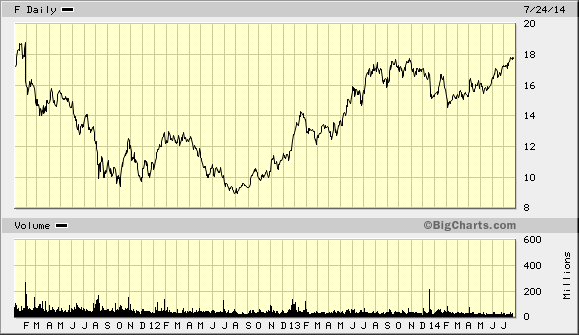
This is a key moment for Ford. They’re introducing a bunch of new vehicles, and that requires a lot of up-front money. Overall, the company is holding the line on costs. One weak spot was South America, where they lost $300 million. Ford earned $2.4 billion in operating profit in North America. That’s a company record. The new Mustang and aluminum F-150 are due later this year, and that could give a nice boost to sales.
On Thursday, the shares jumped as high as $18.12, which is a three-year high (see above). Ford is a solid buy up to $19 per share.
CR Bard Beats Low-Balled Expectations
In April, CR Bard ($BCR) told us to expect Q2 earnings to range between $1.98 and $2.02 per share. Last week, I said I thought they were low-balling us, and sure enough, on Thursday, Bard reported Q2 earnings of $2.06 per share.
I know companies like to lower the bar on earnings and then try to impress us by topping phony expectations. I don’t blame Bard for playing the game, but I’ll let you know it when I see it.
Overall, they had a decent quarter. Quarterly sales rose 9% to $827.1 million. Bard’s chairman and CEO, Timothy M. Ring, said, “Once again we exceeded our expectations for revenue growth this quarter. We continue to believe that executing our investment plan will accelerate the sustainable growth rate of the overall portfolio and put us in a position to provide revenue growth in the mid-to-high single digits with attractive returns for shareholders.”
Now let’s turn to guidance. For Q3, Bard expects earnings to range between $2.07 and $2.11 per share. They shouldn’t have trouble hitting that. Bard also increased their full-year range by five cents at each end. The new range is $8.25 to $8.35 per share.
If you recall, Bard raised their quarterly dividend last month from 21 to 22 cents per share. They’ve raised their dividend every year since 1972. I rate CR Bard as a buy up to $151 per share.
Upcoming Buy List Earnings
We have four earnings reports coming next week. Three of our stocks, AFLAC, Express Scripts and Fiserv, report on Tuesday, July 29. Then DirecTV reports on Thursday, July 31. (Also, earnings from Moog are due out later today. Be sure to check the blog for the latest.)
Shares of AFLAC ($AFL) have improved recently. The supplemental-insurance company has worked to diversify its investment portfolio. The yen/dollar ratio has been fairly stable since February. The company has performed well, but foreign exchange has taken a big chunk out of earnings. Three months ago, AFLAC said to expect Q2 operating earnings between $1.54 and $1.68 per share. Their full-year guidance was $6.06 to $6.40 per share. Both forecasts are based on a yen/dollar exchange rate between 100 and 105. AFLAC is a buy up to $68 per share.
In April, Express Scripts ($ESRX) beat earnings by two cents per share, but they lowered their full-year guidance to $4.82 to $4.94. That was a decrease of six cents per share at each end. Express Scripts remains a buy up to $74 per share. That’s a high Buy Below price. I may lower it after the earnings report.
Fiserv ($FISV) hit another 52-week high this week. This stock has climbed almost non-stop for the last three years. Wall Street expects Q2 earnings of 80 cents per share. Fiserv is a buy up to $64 per share. I may have to raise that soon.
DirecTV ($DTV) is still our big winner on the year, with a 25% gain. There’s not much to say about DTV since the $95 buyout deal with AT&T. DTV’s volatility has nearly evaporated, and the stock is trading like a zero-coupon bond that matures at $95 at some point. The stock is now almost exactly 10% below its merger price.
That’s all for now. More earnings to come next week. Wall Street will also have an intense 48 hours between Wednesday and Friday. On Wednesday morning, the government will release its first estimate of Q2 GDP. The Fed also meets, and later that day, the FOMC will release its latest policy statement. Friday is Jobs Day, and we’ll also get a look at the ISM report for July. Be sure to keep checking the blog for daily updates. I’ll have more market analysis for you in the next issue of CWS Market Review!
– Eddy
-
Morning News: July 25, 2014
Posted by Eddy Elfenbein on July 25th, 2014 at 6:55 amGerman Ifo Business Morale Index Falls in July
UK Economy Back at Pre-Crisis Level
Royal Bank of Scotland Chief Optimistic on Ulster Bank Solution
Will Protest or Persuasion Shape Hong Kong’s Future?
Brent Crude Back in Range Trading
Amazon’s Ambitious Bets Pile Up, and Its Losses Swell
BSkyB $8.3 Billion Deal to Create ‘Sky Europe’
McDonald’s Halts Nuggets Sales in Hong Kong
Ford’s Second-Quarter Surge May Be as Good as 2014 Gets
Vodafone Sees European Recovery After Eight-Quarter Drop
Zillow Seen Dominating U.S. Home Searches With Trulia
Anglo American Profit Sees Strong Rise Despite Setbacks
Banking Ikea Style Puts Billionaire’s Model to Test
Cullen Roche: Does QE Finance Government Spending?
Joshua Brown: Is the Fed Now Underestimating the Labor Market?
Be sure to follow me on Twitter.
-
Archives
- July 2026
- June 2026
- May 2026
- April 2026
- March 2026
- February 2026
- January 2026
- December 2025
- November 2025
- October 2025
- September 2025
- August 2025
- July 2025
- June 2025
- May 2025
- April 2025
- March 2025
- February 2025
- January 2025
- December 2024
- November 2024
- October 2024
- September 2024
- August 2024
- July 2024
- June 2024
- May 2024
- April 2024
- March 2024
- February 2024
- January 2024
- December 2023
- November 2023
- October 2023
- September 2023
- August 2023
- July 2023
- June 2023
- May 2023
- April 2023
- March 2023
- February 2023
- January 2023
- December 2022
- November 2022
- October 2022
- September 2022
- August 2022
- July 2022
- June 2022
- May 2022
- April 2022
- March 2022
- February 2022
- January 2022
- December 2021
- November 2021
- October 2021
- September 2021
- August 2021
- July 2021
- June 2021
- May 2021
- April 2021
- March 2021
- February 2021
- January 2021
- December 2020
- November 2020
- October 2020
- September 2020
- August 2020
- July 2020
- June 2020
- May 2020
- April 2020
- March 2020
- February 2020
- January 2020
- December 2019
- November 2019
- October 2019
- September 2019
- August 2019
- July 2019
- June 2019
- May 2019
- April 2019
- March 2019
- February 2019
- January 2019
- December 2018
- November 2018
- October 2018
- September 2018
- August 2018
- July 2018
- June 2018
- May 2018
- April 2018
- March 2018
- February 2018
- January 2018
- December 2017
- November 2017
- October 2017
- September 2017
- August 2017
- July 2017
- June 2017
- May 2017
- April 2017
- March 2017
- February 2017
- January 2017
- December 2016
- November 2016
- October 2016
- September 2016
- August 2016
- July 2016
- June 2016
- May 2016
- April 2016
- March 2016
- February 2016
- January 2016
- December 2015
- November 2015
- October 2015
- September 2015
- August 2015
- July 2015
- June 2015
- May 2015
- April 2015
- March 2015
- February 2015
- January 2015
- December 2014
- November 2014
- October 2014
- September 2014
- August 2014
- July 2014
- June 2014
- May 2014
- April 2014
- March 2014
- February 2014
- January 2014
- December 2013
- November 2013
- October 2013
- September 2013
- August 2013
- July 2013
- June 2013
- May 2013
- April 2013
- March 2013
- February 2013
- January 2013
- December 2012
- November 2012
- October 2012
- September 2012
- August 2012
- July 2012
- June 2012
- May 2012
- April 2012
- March 2012
- February 2012
- January 2012
- December 2011
- November 2011
- October 2011
- September 2011
- August 2011
- July 2011
- June 2011
- May 2011
- April 2011
- March 2011
- February 2011
- January 2011
- December 2010
- November 2010
- October 2010
- September 2010
- August 2010
- July 2010
- June 2010
- May 2010
- April 2010
- March 2010
- February 2010
- January 2010
- December 2009
- November 2009
- October 2009
- September 2009
- August 2009
- July 2009
- June 2009
- May 2009
- April 2009
- March 2009
- February 2009
- January 2009
- December 2008
- November 2008
- October 2008
- September 2008
- August 2008
- July 2008
- June 2008
- May 2008
- April 2008
- March 2008
- February 2008
- January 2008
- December 2007
- November 2007
- October 2007
- September 2007
- August 2007
- July 2007
- June 2007
- May 2007
- April 2007
- March 2007
- February 2007
- January 2007
- December 2006
- November 2006
- October 2006
- September 2006
- August 2006
- July 2006
- June 2006
- May 2006
- April 2006
- March 2006
- February 2006
- January 2006
- December 2005
- November 2005
- October 2005
- September 2005
- August 2005
- July 2005
 Eddy Elfenbein is a Washington, DC-based speaker, portfolio manager and editor of the blog Crossing Wall Street. His