-
Morning News: March 5, 2014
Posted by Eddy Elfenbein on March 5th, 2014 at 6:01 amEconomic Expansion in Euro Zone Accelerates
ECB May Repeat Japan Mistake That Triggered Lost Decade
From Funds to Gold, How Will Ukraine Affect My Investments?
China Vows Tough Reforms, Stronger Defense
IDC: China Smartphone Growth To Slow
Qatar Stocks Fall Most in Five Months as GCC States Pull Envoys
Market and Rates Helped Private Equity Chiefs Thrive Last Year
Obama Budget Sets Up Election-year Clash With Republicans
Chicago Cut to Three Levels Above Junk by Moody’s Ahead of Sale
Carrefour Boosts 2014 Capex After 2013 Profit Rises
Forget About Windows 8, Insiders Say Microsoft’s Real Money Maker Is Broken
Darden Expects Weak Q3, Re-Affirms Outlook
Will 1,100 Stores Closures Save RadioShack? Probably Not
Roger Nusbaum: Getting in Front of Changing Retirement Dynamics
John Hempton: Letting Qantas Go Bankrupt Would Be Good For Australia
Be sure to follow me on Twitter.
-
S&P 500 Jumps to 1,873
Posted by Eddy Elfenbein on March 4th, 2014 at 5:25 pmGreat day for the market today. The S&P 500 soared 1.53% to close at 1,873.91. That was our best day since December 18.
But the real stars were the small-cap stocks. The Russell 2000 ($RUT) index jumped 2.75% to close at 1,208.65. That’s a huge outperformance for a single day. The VIX plunged back down to 14.10. This was a good day for the optimism trade.
Our Buy List also had a good day. Our portfolio rose 1.62% which edged out the rest of the market. Moog ($MOG-A), which has been a laggard, jumped 5.44%. At one point, it was up as much as 6.79%.
Qualcomm ($QCOM) had a good day with the news of its 20% dividend hike. The company also announced that Steve Mollenkopf will take over as CEO and Paul Jacobs will become the executive chairman.
For the year so far, our Buy List is up 1.73% compared with 1.38% for the S&P 500.
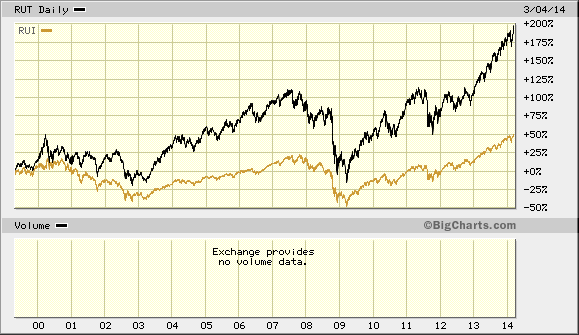
Here’s a remarkable chart. This is the Russell 1000 (in black) compared with the Russell 2000 (gold). The R1000 is the one thousand largest stocks in the R3000 Index, while the R2000 are the smallest two thousand. It’s stunning to see this divergence last for 15 years.
-
225 Years Ago Today
Posted by Eddy Elfenbein on March 4th, 2014 at 2:34 pmToday is the 225th anniversary of the U.S. government. Congress first met in New York on March 4, 1789.
Not much happened. They took roll and not enough people had made it there yet. Just nine of 22 senators and 13 of 59 representatives showed up.
George Washington wasn’t inaugurated until April, but March 4th remained Inauguration Day until 1933 when it was changed to January 20th.
Here’s a look at the Congressional Record from 225 years ago today.
-
Qualcomm Raises Dividend by 20%
Posted by Eddy Elfenbein on March 4th, 2014 at 10:45 amNow that the fears from Europe have subsided somewhat, the S&P 500 is rallying strongly this morning. According to the latest reports, Russian soldiers have concluded their exercises in western Russia. The S&P 500 has been as high as 1,868.94 this morning which is a new all-time intra-day high. The high close is 1,859.45 from last Friday.
The stocks in the small-cap Russell 2000 are especially strong today. Next month, the small-cap cycle turns 15 years old. If the S&P 500 had kept pace with the Russell 2000 since the start of this cycle, the S&P 500 would be over 4,000 today.
Several of our Buy List stocks are also doing well today. Moog ($MOG-A) was crushed in January, but the stock is creeping higher today. The shares are up close to 5% today, and are up more than 12% from last month’s low. DirecTV ($DTV) is up to a new high, and the stock came close to hitting $80 per share this morning. Oracle ($ORCL) is back over $39 per share this morning. The company said that it will release its next earnings report in two weeks, on March 18.
The best news for us this morning is that Qualcomm ($QCOM) announced a 20% increase to its dividend. The quarterly payout will rise from 35 cents to 42 cents per share. The board also approved a $5 billion increase to their buyback authorization. That brings the total authorization to $7.8 billion. Going by the late-morning share price, QCOM now yields 2.2% which is about the average for the market.
-
Morning News: March 4, 2014
Posted by Eddy Elfenbein on March 4th, 2014 at 6:34 amDollar Surges, While Ukraine Crisis Looms
Ukraine: Pressure Is On But No Need to Panic
Germany’s RWE Slides to €2.8 Billion Net Loss for 2013
RBA Reiterates Likely Period of Rate Stability After Holding
Supreme Court to Consider Employee Pay for Security Screenings
SEC Can Explain Why It’s So Good at Selling Stocks
Carmakers Find Working With EPA on Smog Better Than Fight
Deal May Be Near for Men’s Wearhouse and Jos. A. Bank
Reynolds Eyes Lorillard Tobacco Bid
Hopes High for Zinc But Glencore Profits Down
Beiersdorf Sees Margin Improvement Amid Emerging-Market Push
Citigroup Joins JPMorgan in Seeing Trading-Revenue Drop
Buffett Fails to Dispel Investor Angst Over Succession Plan
Joshua Brown: Nonsense Forecasts
Howard Lindzon: 20 Years of Angel Investing
Be sure to follow me on Twitter.
-
The Russian Market Tanks
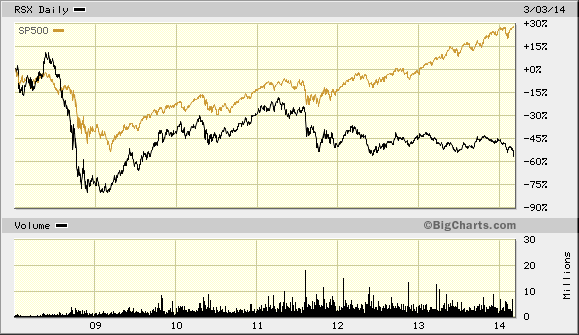
Posted by Eddy Elfenbein on March 3rd, 2014 at 5:12 pmHere’s a look at the S&P 500 compared with the Russian ETF ($RSX) over the past few years.
-
Ford’s February Sales Fell
Posted by Eddy Elfenbein on March 3rd, 2014 at 1:44 pmFrom USA Today:
Ford Motor said it sold 183,947 new cars and trucks in February, down 6.1% from a year ago.
Cars and SUVs were down, but pickup trucks were about flat. The only Ford-brand car that posted a gain was the Mustang, up 6.4%.
Among Ford SUVs, older-design Edge, Flex and Expedition all were up, while Escape and Explorer, the newer models among the SUV lineup, both were off.
F-series, the company’s golden goose and America’s best-selling vehicles of any kind for more than three decades, was up a modest 2.6%. Still, Ford said, it was the line’s best February in eight years.
But the Transit Connect, which had been the talk of tradesmen and small business owners because of its relatively low price, good mileage and cavernous cargo space, tumbled 38%.
Not as bad as it looks, Ford said. “Sales surged in the final week, providing us momentum after a slow start to the month,” said John Felice, Ford vice president in charge of U.S. marketing, sales and service. “Ford Fusion continued its strong retail sales performance in the West, outpacing the mid-size sedan segment. F-Series and Lincoln also continued to perform well.”
The Lincoln brand’s MKZ, an entry-luxury sedan based on the Ford Fusion and one of the new models that Ford hopes will revive Lincoln, was up a hefty 222.1%. The MKX midsize SUV was up 8.4% and overall, the Lincoln brand was up 36.4% for its fifth straight consecutive month of sales gains.
Lincoln has foundered, unable to convince buyers to take it seriously as a luxury alternative to Cadillac, Infiniti or Lexus, but in the past five months, Lincoln sold 34,476 vehicles, representing a 26% increase over the same period one year ago.
Ford Motor fleet sales were off 10% in February, as winter weather again delayed a portion of fleet orders. The volumes are anticipated to be made up in March.
-
Putin Sinks the Market
Posted by Eddy Elfenbein on March 3rd, 2014 at 12:29 pmThe stock market is down today after the terrible news of the Russian invasion of Ukraine. The Russian stock market is getting crushed, and the ruble is down sharply. The Russian Fed had to step in and raise interest rates by 150 basis points. At one point, the MICEX was down by as much as 12.5%. On the U.S. market, shares of Gazprom ($OGZPY) dropped nearly 14%. The yield on six-month Ukrainian paper is close to 50%.
The S&P 500 is currently down 23 points. There’s now talk that Q1 GDP growth will come in around 1.7% or 1.8%, when not too long ago people thought it would top 3%.
The real action today has been in the gold pits. The yellow metal is currently up $32.40 to $1354 per ounce. Most of our Buy List is down today. Shares of DirecTV ($DTV), however, are holding up well. The latest disclosure from Warren Buffett indicates that the investing icon likes DTV. Buffett has increased his DTV substantially. Meanwhile, he’s sold out of DISH.
Qualcomm ($QCOM) is having rough day even though JMP Securities raised its price target to $85 per share, and they have an “outperform” rating.
-
February ISM = 53.2
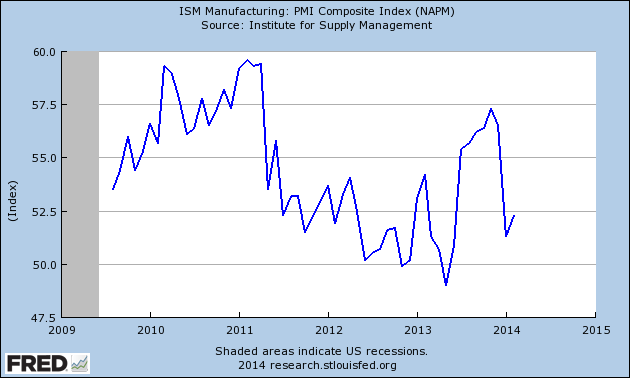
Posted by Eddy Elfenbein on March 3rd, 2014 at 10:51 amWe got a little bit of good news this morning; the ISM for February came in at 53.2. Expectations were for 52.3.
This ISM report is significant because we’re starting to get economic data that’s post “bad weather.” January’s ISM took a big dive and dropped to 51.3.
This shocked a lot of folks but people mostly bought the excuse that poor winter weather held back consumers. We also saw that effect in other data.
Now, however, the bad weather has passed and investors have become curious if the weather excuse was really a smokescreen for poor economic performance. Today’s ISM suggests that the weather excuse was indeed accurate and the economy continues to expand. The ISM report has been 49.0 or better for the last 56 months in a row.
-
S&P 500 Sectors and the Bull Market
Posted by Eddy Elfenbein on March 3rd, 2014 at 9:19 amWe’re coming up on the fifth anniversary of the great Bull Market. Here’s a look at the relative strength of the S&P 500 sectors since the market’s low.
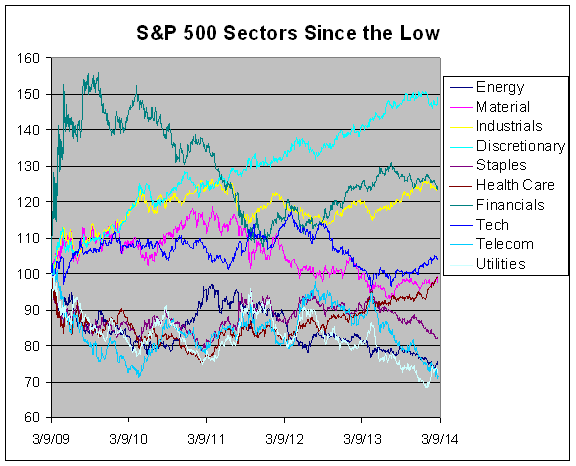
So what is this chart? I took the total return index of each sector and divided it by the S&P 500 total return index, then set each one to start at 100 on March 9, 2009. If the line is rising, then the index is outperforming the market. If not, then it’s trailing. This way, you can see the make-up of the rally.
A few takeaways. The bull market was started by a huge rally in financials (see that early surge in the green line). To put this in perspective, the Financial Sector ETF ($XLF) doubled in two months. Of course, that’s after an epic collapse.
Even though the green line shot up so much so early, I think the bull market has been relatively evenly distributed. Sure, it’s not perfect, but I don’t see any gross imbalances like we saw with the tech bubble.
The consumer discretionary sector has been very strong, and consistently so. The outperformers have been financials, discretionary, industrials and tech. The laggards have been utes, telecom and energy. I’ve been a little surprised that tech (navy blue) has mostly been a so-so performer. Tech got left behind during much of 2012-13 and has only been a market leader during the last six months or so.
-
Archives
- September 2026
- August 2026
- July 2026
- June 2026
- May 2026
- April 2026
- March 2026
- February 2026
- January 2026
- December 2025
- November 2025
- October 2025
- September 2025
- August 2025
- July 2025
- June 2025
- May 2025
- April 2025
- March 2025
- February 2025
- January 2025
- December 2024
- November 2024
- October 2024
- September 2024
- August 2024
- July 2024
- June 2024
- May 2024
- April 2024
- March 2024
- February 2024
- January 2024
- December 2023
- November 2023
- October 2023
- September 2023
- August 2023
- July 2023
- June 2023
- May 2023
- April 2023
- March 2023
- February 2023
- January 2023
- December 2022
- November 2022
- October 2022
- September 2022
- August 2022
- July 2022
- June 2022
- May 2022
- April 2022
- March 2022
- February 2022
- January 2022
- December 2021
- November 2021
- October 2021
- September 2021
- August 2021
- July 2021
- June 2021
- May 2021
- April 2021
- March 2021
- February 2021
- January 2021
- December 2020
- November 2020
- October 2020
- September 2020
- August 2020
- July 2020
- June 2020
- May 2020
- April 2020
- March 2020
- February 2020
- January 2020
- December 2019
- November 2019
- October 2019
- September 2019
- August 2019
- July 2019
- June 2019
- May 2019
- April 2019
- March 2019
- February 2019
- January 2019
- December 2018
- November 2018
- October 2018
- September 2018
- August 2018
- July 2018
- June 2018
- May 2018
- April 2018
- March 2018
- February 2018
- January 2018
- December 2017
- November 2017
- October 2017
- September 2017
- August 2017
- July 2017
- June 2017
- May 2017
- April 2017
- March 2017
- February 2017
- January 2017
- December 2016
- November 2016
- October 2016
- September 2016
- August 2016
- July 2016
- June 2016
- May 2016
- April 2016
- March 2016
- February 2016
- January 2016
- December 2015
- November 2015
- October 2015
- September 2015
- August 2015
- July 2015
- June 2015
- May 2015
- April 2015
- March 2015
- February 2015
- January 2015
- December 2014
- November 2014
- October 2014
- September 2014
- August 2014
- July 2014
- June 2014
- May 2014
- April 2014
- March 2014
- February 2014
- January 2014
- December 2013
- November 2013
- October 2013
- September 2013
- August 2013
- July 2013
- June 2013
- May 2013
- April 2013
- March 2013
- February 2013
- January 2013
- December 2012
- November 2012
- October 2012
- September 2012
- August 2012
- July 2012
- June 2012
- May 2012
- April 2012
- March 2012
- February 2012
- January 2012
- December 2011
- November 2011
- October 2011
- September 2011
- August 2011
- July 2011
- June 2011
- May 2011
- April 2011
- March 2011
- February 2011
- January 2011
- December 2010
- November 2010
- October 2010
- September 2010
- August 2010
- July 2010
- June 2010
- May 2010
- April 2010
- March 2010
- February 2010
- January 2010
- December 2009
- November 2009
- October 2009
- September 2009
- August 2009
- July 2009
- June 2009
- May 2009
- April 2009
- March 2009
- February 2009
- January 2009
- December 2008
- November 2008
- October 2008
- September 2008
- August 2008
- July 2008
- June 2008
- May 2008
- April 2008
- March 2008
- February 2008
- January 2008
- December 2007
- November 2007
- October 2007
- September 2007
- August 2007
- July 2007
- June 2007
- May 2007
- April 2007
- March 2007
- February 2007
- January 2007
- December 2006
- November 2006
- October 2006
- September 2006
- August 2006
- July 2006
- June 2006
- May 2006
- April 2006
- March 2006
- February 2006
- January 2006
- December 2005
- November 2005
- October 2005
- September 2005
- August 2005
- July 2005
 Eddy Elfenbein is a Washington, DC-based speaker, portfolio manager and editor of the blog Crossing Wall Street. His