-
Morning News: October 8, 2013
Posted by Eddy Elfenbein on October 8th, 2013 at 7:03 amGerman Exports Rise Less Than Expected in August
The Ultimate Bitcoin Question: Can the Feds Spend $3.3M in Seized Digital Currency?
Federal Reserve to Unveil a Redesigned $100 Bill
Shutdown Costs at $1.6 Billion With $160 Million Each Day
The Costs of Debt Default Are Sobering
Morgan Stanley Seen Leading Profit Gains at U.S. Banks
Twitter’s Need To Profit Overseas Will Test Its Free Speech Principles
Apollo’s $2.5 Billion Cooper Offer in Jeopardy
Google Lands A Huge Customer For Google Apps: Whirlpool
BlackBerry Security May Be Key to an ‘Agnostic’ Future
To Lift Hong Kong Park, Disney Deploys Iron Man
Ford Comes From Behind In China To Stun Japanese Rivals
Steve Ballmer’s Final Letter To Shareholders As CEO ‘Of The Company I Love’
Jeff Carter: Bitcoin Volatility Solution
Joshua Brown: Preparing for the Twitter IPO – Get Your Mind Right
Be sure to follow me on Twitter.
-
The VIX Hits Three-Mont High
Posted by Eddy Elfenbein on October 7th, 2013 at 2:41 pmThe government is still closed and the stock market is down again today. The market had been down about 1% early on, but now it’s down about half that much.
The politicians are involved in a stand-off and I’m inclined to think it will go on until someone has to make a move. Here’s how it stands: The country will exhaust its borrowing authority on October 17th. We’ll then run out of money sometime between October 22nd and October 31st.
One casualty of the government shutdown is economic stats. We didn’t get the regular jobs report on Friday, and many other reports may be delayed. On Wednesday, the Fed will release the minutes from its September meeting.
What’s interesting is that the stock and bond markets are actually quite calm despite the chaos in Washington. I think the choice of defaulting is so outrageous that Wall Street can’t take it seriously. I think that’s right.
The VIX hit a three-month high today of 18.54, but that’s still well below the levels we saw during the Debt Ceiling Crisis from two years ago. During the summer of 2011, the VIX was regularly over 40.
The market has a defensive posture today as telecom and utilities are up, and financials are down.
-
Morning News: October 7, 2013
Posted by Eddy Elfenbein on October 7th, 2013 at 6:33 amWorld Bank Cuts China, East Asia Growth Forecasts
Japan PM Abe Tells Trade Negotiators of Commitment to Deregulation
Global Financial Services Firms Join New Open Messaging Network
A U.S. Default Seen as Catastrophe Dwarfing Lehman’s Fall
Five Reasons to Fear the Debt Ceiling
Here’s a Fantastic and Disturbing Paragraph on How the Market Views the Debt Ceiling
JAL, Airbus Announce Landmark Order
Apollo, Cooper Disagree Over $2.5 Billion Price in Latest Deal Setback
Twitter’s Data Business Proves Lucrative
Twitter Advertisers Say Service Needs More Users
Swarms of Rivals Seeking Share of Social Media Pie
BlackBerry Accused in Suit of Inflating Shares With False Claims
As DVRs Shift TV Habits, Ratings Calculations Follow
Epicurean Dealmaker: Punished by Fate
Weighing the Week Ahead: Will Markets Look Beyond the Washington Logjam?
Be sure to follow me on Twitter.
-
Twitter Soars 1,000%. Sorry, Make that Tweeter
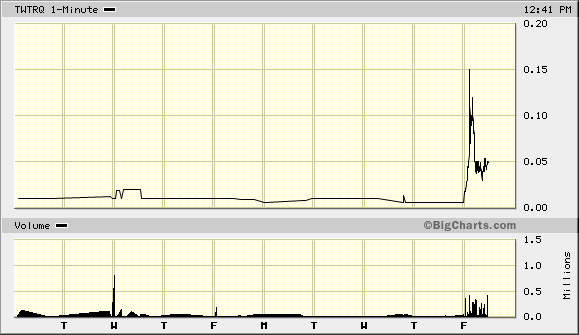
Posted by Eddy Elfenbein on October 4th, 2013 at 1:04 pmExcitement for Twitter’s coming IPO is running pretty high – so much so that some investors on Friday mistook the nearly worthless stock of long-dead electronics retailer Tweeter for the “tweeting” site, sending shares up more than 1,000 percent.
Tweeter Home Entertainment Group, a specialty consumer electronics company that went bankrupt in 2007, saw a its most active day of trading in more than six years even though it has nothing to do with the social media site.
The stock, which trades over the counter, closed Thursday at a price of less than a penny a share, and Friday hit a high of 15 cents a share on Friday, before paring gains to trade at 5 cents, a 669 percent rise. More than 11.7 million shares had traded by midday.
The volume was the most active trading day for the company since May 10, 2007, when 13.05 million shares were traded and the company reported quarterly results and said it may choose to file Chapter 11 bankruptcy.
-
Phillips 66 Raises Dividend By 25%
Posted by Eddy Elfenbein on October 4th, 2013 at 11:41 amOne of the mistakes new investors make is they assume that any stock that’s down is a value stock and is therefore a good buy. Unfortunately, a stock being down doesn’t make it cheap. It only makes it cheaper than it was.
The same thing with a low P/E Ratio. Sometimes a stock’s P/E Ratio is low for a very good reason. A low multiple is a necessary but not sufficient characteristic for a value stock.
How can you tell the difference between a good stock that’s down and a bad one that’s down? That’s a very difficult question, but there is one shortcut I like.
The dividend.
Investors should always take notice whenever a beaten-down stock raises its dividend. That’s often a sign from management that things will get better.
Last year, Phillips 66 (PSX) was spun-off from ConocoPhillips. The stock initially did very well, but it has been a laggard for the last six months. Impressively, the company just raised their dividend by 25%. That’s a hefty increase. The quarterly dividend will rise from 31.25 cents per share to 39 cents per share. At $1.56 for the year, PSX now yields 2.65%.
I can’t say whether PSX is a good buy here. I’d need to do more research. But the higher dividend is a very encouraging sign.
-
CWS Market Review – October 4, 2013
Posted by Eddy Elfenbein on October 4th, 2013 at 7:13 am“A good decision is based on knowledge and not on numbers.” – Plato
The stock market has had a good time recently rallying when things have not happened. No taper, we’re up. No Syria attack, we rally. No Larry Summers, up again.
Now we have no government, and the market is starting to get annoyed. Well, we don’t literally have zero government, but we do have a government shutdown, and it’s looking like it might last a while. The Economist observed, “once a stalwart of good governance, America looks like a rodeo clown.” Traders clearly aren’t happy. On Thursday, the stock market took its biggest tumble in five weeks. More importantly, the S&P 500 closed below its 50-day moving average by a teeny 0.07%. That’s usually a bad omen.

First, the S&P 500 rallied for 11 out of 12 days. Now it’s fallen for 9 of the last 11 days. I’m happy to report that our Buy List continues to do very well. We outperformed the S&P 500 during the trip up, from August 30th to September 18th (6.36% versus 5.67%). And we’re beating the index on the way down, since September 18th (-1.78% versus -2.72%).
In this week’s CWS Market Review, I’ll discuss my outlook for the stock market amid the government shutdown. The good news is that earnings season is finally here. As I like to say, earnings season is Judgment Day for Wall Street. We’ll soon learn whose earnings were good, bad and/or ugly.
I’ll also preview next week’s Buy List earnings reports from JPMorgan Chase (JPM) and Wells Fargo (WFC). JPM has been causing us a lot of headaches recently, but I think we’re in store for a solid report. I’ll also discuss recent developments with some of our stocks. (Is Alan Mulally really considering leaving Ford for Microsoft? Nah!) But first, let’s look at why I’m not so concerned about the latest shenanigans in Washington but I am concerned about earnings.
The Stock Market Has Chilled Out in a Big Way
As I mentioned before, the S&P 500 rallied during the first part of September and has retreated ever since. But what’s particularly interesting is how calm the market has been. Volatility, in fact, is at a seven-year low. Thursday was the worst day in five weeks, but it was only a loss of 0.9%. That’s not that bad. During the third quarter, the average daily swing of the S&P 500 was a measly 0.45%. Compared with recent history, that’s peanuts.
Consider this fact: The S&P 500 has risen by more than 1.5% just once this year. Between 2008 and 2010, that happened 103 times. And that one day this year came on the very first trading day of the year. So we haven’t had a decent one-day jump in nine months. Sure, the market’s been going up, but it’s been an orderly and progressive climb.
Part of the reason is that the big concerns for Wall Street are gradually going away. Two years ago, the big concern was Europe. If you recall, each Friday was a nail-biter because traders didn’t want to hold their positions over the weekend when God-knows-what political bombshell could strike Europe. Two years ago, the stock market was down one day because of the news out of…wait for it…Slovakia. (Yes, I’m serious.)
My apologies to our friends in government agencies and bureaucracies, but our concern as investors should be the business operations of our stocks. We shouldn’t have to worry about who might bail out whom.
The market’s natural tendency is to search around for something to worry over and then blow it out of proportion. We’ve seen that time and time again this year. If the market can’t easily find something to fret over, it will keep on searching till it finds something. Anything.
Here’s my take. I don’t worry about any of these transient stories, but there is one big thing I do worry about: earnings. And to a much lesser extent, interest rates. But if earnings are good and the earnings outlook is good, I’m not panicking. That’s all there is to it. In fact, I would say that I’m not even concerned about a high-quality stock missing the Street’s earnings forecast by a penny or two, as long as the good trend remains intact. Remember Plato’s words: “A good decision is based on knowledge and not on numbers.” That’s the great benefit of owning good stocks.
It’s useless to speculate how long a government shutdown will last or what will happen with the debt ceiling. I’m confident in saying these issues will be resolved simply because they have to be. Members of Congress aren’t about to wreck the economy in an attempt to rescue it. To quote Ecclesiastes, “The king himself is served by the field.”
We also had some good economic news this week. On Tuesday, the ISM Manufacturing Index came in at 56.2. That’s the highest number in 30 months. Any number above 50 means the factory sector of the economy is expanding. Below 50 means it’s shrinking. The ISM report has a very good track record of aligning with recessions. For now, the economy is very much in the safe zone. But we shouldn’t take that to mean the economy will grow rapidly. In fact, I think it’s very likely that we’ll continue our current sluggishly positive growth.
The other big economic news was the ADP jobs report. Thanks to the government shutdown, there won’t be a BLS jobs report this week so we have to rely on ADP, which is a private payroll firm. According to ADP, the economy created 166,000 jobs last month. That was a bit less than expected but it’s basically inline with the current trend of meager job growth. This news will probably put more pressure on Ben Bernanke and his buddies at the Fed to hold off on tapering for awhile more. The recent talk is that tapering may start in December. Until then, the Fed is squarely on the side of investors. Now let’s look at some upcoming earnings.
Earnings Preview for JPMorgan and Wells Fargo
Next Friday, our two big bank stocks, Wells Fargo (WFC) and JPMorgan Chase (JPM), are due to report Q3 earnings. Both banks have been very profitable this year. Interestingly, both banks shifted into mortgages and have ridden the recovery in the housing market. A question for this earnings season is how much the recent rise in mortgage rates has impacted their business.
Wells Fargo made news last month when they announced layoffs in their mortgage unit. In early August, JPM laid off 2,000 people in their mortgage department. While that’s certainly unpleasant to see, I can’t say it’s much of a surprise. The market adjusts to prices, and the rise in rates has been dramatic. However, I suspect that the impact of higher mortgage rates will be less than many observers expect.
As far as banking fundamentals go, both banks continue to be very strong. Wall Street’s consensus is for Wells to earn 97 cents per share. That’s up from 88 cents per share last year. I think Wells can earn as much as $1 per share. The bank has beaten expectations for the last seven quarters in a row. Wells is a good value here. WFC is currently going for just over 10 times next year’s earnings. That’s about 25% less than where the S&P 500 is trading. Wells Fargo remains a solid buy up to $45 per share.
I feel like I’ve written enough about JPM’s tribulations. Jamie Dimon is a walking headline risk. Fortunately, the bank is making money so that will quell some criticism. I’ve said many times that I think it’s time for Dimon to leave. I’d also like to see the bank broken up. The spin-offs would be worth much more than the whole.
The consensus of the analyst community is that JPM will earn $1.29 per share. That’s down from $1.40 for last year’s third quarter. My numbers say JPM will earn $1.50 per share. I think Jamie is very talented at leading analysts to low-ball their estimates. Thanks to all the scandals, the stock is going for a very low valuation.
Let’s compare JPM’s valuation to that of Fiserv (FISV), another Buy List favorite. This isn’t highly scientific but I think you’ll see my point. Wall Street expects both companies to earn nearly the same earnings-per-share figure for next year; $6.66 for Fiserv and $6.05 for JPM. Yet, Fiserve’s share price is roughly double JPM’s. That tells you how skittish investors are. JPMorgan is a deep discount up to $56 per share.
Should Bill Gates Leave Microsoft?
Lately, there’s been a lot of chatter about some personnel shakeups at some of our Buy List stocks. Specifically, some big Microsoft (MSFT) investors said that it’s time for Bill Gates to step down as Chairman of the Board. Technically, shareholders can vote him out, but Bill owns such a big stake in MSFT that it’s nearly impossible to do.
I think the issue is very simple. If Bill Gates is more interested in philanthropy at this stage in his life, he ought to step down and concentrate on giving away his fortune full-time. I wouldn’t blame him at all. In general, I think Microsoft would be better served by some newer folks. I’m also not sure how involved Gates is in the day-to-day running of the firm, even as COB. Microsoft certainly has a lot of challenges ahead of them, but I like the stock on a valuation basis. MSfT is a good buy up to $34 per share.
There were also reports that Ford’s (F) brilliant CEO Alan Mulally might depart to become CEO at Microsoft. (If you recall, Steve Ballmer said he will retire in the next 12 months.) I strongly doubt this would ever happen. Mulally seems happy where he is, and he’s been doing a great job at Ford. Plus, the turnaround still has some time.
Speaking of which, Ford had more good news this week when they announced strong sales gains last month. September was their best sales month in seven years. The F-150 pickup had its fifth month in a row of sales topping 60,000. The Fusion and Fiesta are also doing well. Look for a strong earnings report from Ford later this month. Ford continues to be a very good buy up to $18 per share.
FBR Capital Upgrades AFLAC; $71 Price Target
Earlier this week, AFLAC (AFL) was upgraded by FBR Capital. It’s about time AFLAC got some praise from Wall Street. This is an excellent stock. FBR upgraded AFL to Outperform from Market Perform. The firm especially likes the Japan Post deal (and so do I). FBR raised their price target from $60 to $71 per share. The stock jumped back over $63 and came very close to hitting a new 52-week high.
Q3 earnings are due out on October 29th. The Q2 report was very strong. AFLAC topped the high end of their own range by six cents per share. In July, AFLAC told us to expect Q3 operating earnings to range between $1.41 and $1.51 per share.
AFLAC also said they expect full-year earnings between $5.83 and $6.39 per share. Since they made $3.31 per share for the front half of the year, that means they expect between $2.52 and $3.08 per share on the back half. They should be able to hit that range with little difficulty. Importantly, the yen/dollar exchange rate seems to have stabilized. The plunging yen took a big bite out of last quarter’s earnings. AFLAC remains a very good buy up to $64 per share.
Before I go, I wanted to add few more items. Bloomberg had a very good article discussing the issues facing DirecTV (DTV) and the satellite-TV industry. The Wall Street Journal had a good interview with the CEO of Stryker (SYK). I also want to raise my Buy Below price on Ross Stores (ROST) to $75 per share. The August earnings report was very good, and the stock is a solid value here.
That’s all for now. Earnings season officially starts next week, but it doesn’t really get going until the following week. Next Friday, we’ll have earnings reports from our big banks, Wells Fargo and JPMorgan. Also next week, we get the trade report on Tuesday. Then on Thursday, the government reports on the budget deficit for September, which was the final month of the fiscal year. Be sure to keep checking the blog for daily updates. I’ll have more market analysis for you in the next issue of CWS Market Review!
– Eddy
-
Morning News: October 4, 2013
Posted by Eddy Elfenbein on October 4th, 2013 at 6:39 amBOJ Refrains From More Stimulus as Business Confidence Up
Swiss Regulator Probes Banks Over Currency Manipulation
Obama’s No-Show in Asia Is a Win For China’s Xi
Boehner Pledges to Avoid Default, Republicans Say
Jack Lew’s Dilemma: Which Bills to Pay and When
Twitter Opens Up With I.P.O. Filing
JPMorgan’s Dimon Said to Relinquish Chairman Title at Bank Unit
SAC’s Forceful Ways Shown in Massachusetts Citi Case
Samsung Predicts Record Operating Profit
Drug Firm Ikaria On The Block For More Than $2 Billion
Barclays Says Investors Bought 94.6% of Rights Issue Stock
Some Economic Consequences of the Shutdown
Don’t Believe The Debt Ceiling Hype: The Federal Government Can Survive Without An Increase
-
Twitter’s S-1
Posted by Eddy Elfenbein on October 3rd, 2013 at 7:28 pmThe S-1 is out. Fair warning: it’s long.
Under business risks Twitter lists: “our users start living healthy, normal, socially productive lives.” That comes after meteor attack.
-
Healthcare and Staples Part Ways
Posted by Eddy Elfenbein on October 3rd, 2013 at 12:33 pmHere’s something interesting I’ve noticed, but I’m not yet sure of its significance. The healthcare sector and consumer staples sector usually follow each other closely. This makes sense since both are defensive sectors that tend to weather recessions better than other groups do.
Recently, however, the Healthcare ETF (XLV) has climbed higher while the Staples ETF (XLP) has been rather sluggish. On the chart below, the gap doesn’t appear to be that wide, but relative to how they usually behave, it’s quite a jolt — and it’s getting wider nearly every week.
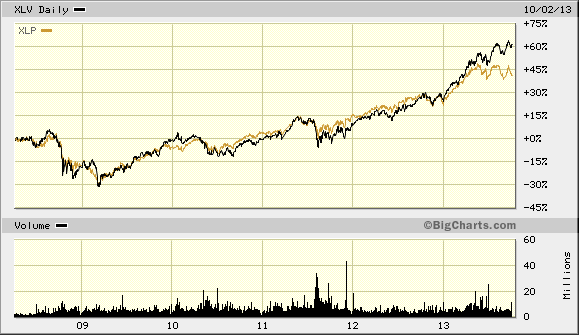
What could be going on? Perhaps the market is responding to Obamacare. Or maybe something’s wrong with the staples. Or maybe the two groups are just out of whack and will come back momentarily. I honestly don’t know, but I try to pay attention whenever the market sends out an anomaly.
-
Morning News: October 3, 2013
Posted by Eddy Elfenbein on October 3rd, 2013 at 7:06 amGerman Private Sector Expansion Signals Solid Growth in Q3
BlackRock Buying Bonds Shows Draghi Directs Markets
Wall St. Fears Go Beyond Shutdown
Here’s Why We’re Better Off Without the Jobs Report
U.S. Government Shutdown Threatening Housing Recovery
U.S. Holiday Retail Sales May Climb by 3.9%, NRF Says
Intellectual Ventures Curbs Patent Buying Amid Fund-Raising Effort
BP Wins Review of Challenged Payouts to Gulf Spill Victims
Wells Fargo Sued by New York Over Mortgage-Servicing Accord
Monsanto Buys, Almost Literally, The Greatest Thing Since Sliced Bread
BlackBerry Not Ripe for Higher Bid
Bitcoin Bets Feed Twitter Dreams as Regulators Circle
Billionaire Dan Loeb Blasts Sotheby’s CEO For Spending ‘Hundreds Of Thousands’ On Luxury Lunches
Cullen Roche: Inflation is NOT Necessarily a “Different Form of Default”
Be sure to follow me on Twitter.
-
Archives
- August 2026
- July 2026
- June 2026
- May 2026
- April 2026
- March 2026
- February 2026
- January 2026
- December 2025
- November 2025
- October 2025
- September 2025
- August 2025
- July 2025
- June 2025
- May 2025
- April 2025
- March 2025
- February 2025
- January 2025
- December 2024
- November 2024
- October 2024
- September 2024
- August 2024
- July 2024
- June 2024
- May 2024
- April 2024
- March 2024
- February 2024
- January 2024
- December 2023
- November 2023
- October 2023
- September 2023
- August 2023
- July 2023
- June 2023
- May 2023
- April 2023
- March 2023
- February 2023
- January 2023
- December 2022
- November 2022
- October 2022
- September 2022
- August 2022
- July 2022
- June 2022
- May 2022
- April 2022
- March 2022
- February 2022
- January 2022
- December 2021
- November 2021
- October 2021
- September 2021
- August 2021
- July 2021
- June 2021
- May 2021
- April 2021
- March 2021
- February 2021
- January 2021
- December 2020
- November 2020
- October 2020
- September 2020
- August 2020
- July 2020
- June 2020
- May 2020
- April 2020
- March 2020
- February 2020
- January 2020
- December 2019
- November 2019
- October 2019
- September 2019
- August 2019
- July 2019
- June 2019
- May 2019
- April 2019
- March 2019
- February 2019
- January 2019
- December 2018
- November 2018
- October 2018
- September 2018
- August 2018
- July 2018
- June 2018
- May 2018
- April 2018
- March 2018
- February 2018
- January 2018
- December 2017
- November 2017
- October 2017
- September 2017
- August 2017
- July 2017
- June 2017
- May 2017
- April 2017
- March 2017
- February 2017
- January 2017
- December 2016
- November 2016
- October 2016
- September 2016
- August 2016
- July 2016
- June 2016
- May 2016
- April 2016
- March 2016
- February 2016
- January 2016
- December 2015
- November 2015
- October 2015
- September 2015
- August 2015
- July 2015
- June 2015
- May 2015
- April 2015
- March 2015
- February 2015
- January 2015
- December 2014
- November 2014
- October 2014
- September 2014
- August 2014
- July 2014
- June 2014
- May 2014
- April 2014
- March 2014
- February 2014
- January 2014
- December 2013
- November 2013
- October 2013
- September 2013
- August 2013
- July 2013
- June 2013
- May 2013
- April 2013
- March 2013
- February 2013
- January 2013
- December 2012
- November 2012
- October 2012
- September 2012
- August 2012
- July 2012
- June 2012
- May 2012
- April 2012
- March 2012
- February 2012
- January 2012
- December 2011
- November 2011
- October 2011
- September 2011
- August 2011
- July 2011
- June 2011
- May 2011
- April 2011
- March 2011
- February 2011
- January 2011
- December 2010
- November 2010
- October 2010
- September 2010
- August 2010
- July 2010
- June 2010
- May 2010
- April 2010
- March 2010
- February 2010
- January 2010
- December 2009
- November 2009
- October 2009
- September 2009
- August 2009
- July 2009
- June 2009
- May 2009
- April 2009
- March 2009
- February 2009
- January 2009
- December 2008
- November 2008
- October 2008
- September 2008
- August 2008
- July 2008
- June 2008
- May 2008
- April 2008
- March 2008
- February 2008
- January 2008
- December 2007
- November 2007
- October 2007
- September 2007
- August 2007
- July 2007
- June 2007
- May 2007
- April 2007
- March 2007
- February 2007
- January 2007
- December 2006
- November 2006
- October 2006
- September 2006
- August 2006
- July 2006
- June 2006
- May 2006
- April 2006
- March 2006
- February 2006
- January 2006
- December 2005
- November 2005
- October 2005
- September 2005
- August 2005
- July 2005
 Eddy Elfenbein is a Washington, DC-based speaker, portfolio manager and editor of the blog Crossing Wall Street. His