-
Warren Buffett on “Owner’s Earnings”
Posted by Eddy Elfenbein on June 7th, 2012 at 11:35 amI think this is one of the most important investing concepts Warren Buffett has ever made. He outlines what he calls “Owner’s Earnings,” which is reported earnings plus depreciation, depletion, amortization, and certain other non-cash charges minus the average annual amount of capitalized expenditures for plant and equipment. Buffett says that Owner’s Earnings is a much better indicator of corporate health than Cash Flow.
This is from his 1986 Chairman’s Letter:
If we think through these questions, we can gain some insights about what may be called “owner earnings.” These represent (a) reported earnings plus (b) depreciation, depletion, amortization, and certain other non-cash charges such as Company N’s items (1) and (4) less (c) the average annual amount of capitalized expenditures for plant and equipment, etc. that the business requires to fully maintain its long-term competitive position and its unit volume. (If the business requires additional working capital to maintain its competitive position and unit volume, the increment also should be included in (c). However, businesses following the LIFO inventory method usually do not require additional working capital if unit volume does not change.)
Our owner-earnings equation does not yield the deceptively precise figures provided by GAAP, since(c) must be a guess – and one sometimes very difficult to make. Despite this problem, we consider the owner earnings figure, not the GAAP figure, to be the relevant item for valuation purposes – both for investors in buying stocks and for managers in buying entire businesses. We agree with Keynes’s observation: “I would rather be vaguely right than precisely wrong.”
The approach we have outlined produces “owner earnings” for Company O and Company N that are identical, which means valuations are also identical, just as common sense would tell you should be the case. This result is reached because the sum of (a) and (b) is the same in both columns O and N, and because (c) is necessarily the same in both cases.
And what do Charlie and I, as owners and managers, believe is the correct figure for the owner earnings of Scott Fetzer? Under current circumstances, we believe (c) is very close to the “old” company’s (b) number of $8.3 million and much below the “new” company’s (b) number of $19.9 million. Therefore, we believe that owner earnings are far better depicted by the reported earnings in the O column than by those in the N column. In other words, we feel owner earnings of Scott Fetzer are considerably larger than the GAAP figures that we report.
That is obviously a happy state of affairs. But calculations of this sort usually do not provide such pleasant news. Most managers probably will acknowledge that they need to spend something more than (b) on their businesses over the longer term just to hold their ground in terms of both unit volume and competitive position. When this imperative exists – that is, when (c) exceeds (b) – GAAP earnings overstate owner earnings. Frequently this overstatement is substantial. The oil industry has in recent years provided a conspicuous example of this phenomenon. Had most major oil companies spent only (b) each year, they would have guaranteed their shrinkage in real terms.
All of this points up the absurdity of the “cash flow” numbers that are often set forth in Wall Street reports. These numbers routinely include (a) plus (b) – but do not subtract (c). Most sales brochures of investment bankers also feature deceptive presentations of this kind. These imply that the business being offered is the commercial counterpart of the Pyramids – forever state-of-the-art, never needing to be replaced, improved or refurbished. Indeed, if all U.S. corporations were to be offered simultaneously for sale through our leading investment bankers – and if the sales brochures describing them were to be believed – governmental projections of national plant and equipment spending would have to be slashed by 90%.
“Cash Flow”, true, may serve as a shorthand of some utility in descriptions of certain real estate businesses or other enterprises that make huge initial outlays and only tiny outlays thereafter. A company whose only holding is a bridge or an extremely long-lived gas field would be an example. But “cash flow” is meaningless in such businesses as manufacturing, retailing, extractive companies, and utilities because, for them, (c) is always significant. To be sure, businesses of this kind may in a given year be able to defer capital spending. But over a five- or ten-year period, they must make the investment – or the business decays.
Why, then, are “cash flow” numbers so popular today? In answer, we confess our cynicism: we believe these numbers are frequently used by marketers of businesses and securities in attempts to justify the unjustifiable (and thereby to sell what should be the unsalable). When (a) – that is, GAAP earnings – looks by itself inadequate to service debt of a junk bond or justify a foolish stock price, how convenient it becomes for salesmen to focus on (a) + (b). But you shouldn’t add (b) without subtracting (c): though dentists correctly claim that if you ignore your teeth they’ll go away, the same is not true for (c) . The company or investor believing that the debt-servicing ability or the equity valuation of an enterprise can be measured by totaling (a) and (b) while ignoring (c) is headed for certain trouble.
To sum up: in the case of both Scott Fetzer and our other businesses, we feel that (b) on an historical-cost basis – i.e., with both amortization of intangibles and other purchase-price adjustments excluded – is quite close in amount to (c) . (The two items are not identical, of course. For example, at See’s we annually make capitalized expenditures that exceed depreciation by $500,000 to $1 million, simply to hold our ground competitively.) Our conviction about this point is the reason we show our amortization and other purchase-price adjustment items separately in the table on page 8 and is also our reason for viewing the earnings of the individual businesses as reported there as much more closely approximating owner earnings than the GAAP figures.
Questioning GAAP figures may seem impious to some. After all, what are we paying the accountants for if it is not to deliver us the “truth” about our business. But the accountants’ job is to record, not to evaluate. The evaluation job falls to investors and managers.
Accounting numbers, of course, are the language of business and as such are of enormous help to anyone evaluating the worth of a business and tracking its progress. Charlie and I would be lost without these numbers: they invariably are the starting point for us in evaluating our own businesses and those of others. Managers and owners need to remember, however, that accounting is but an aid to business thinking, never a substitute for it.
-
Bernanke’s Testimony
Posted by Eddy Elfenbein on June 7th, 2012 at 10:06 amHere are Ben Barnanke’s remarks that he’ll deliver before the Joint Economic Committee. As I’ve said before, the Fed has not given us any hints that more quantitative easing is coming or is needed. By reading this testimony, it’s clear that Bernanke’s doesn’t think more QE is needed:
Chairman Casey, Vice Chairman Brady, and other members of the Committee, I appreciate this opportunity to discuss the economic outlook and economic policy.
Economic growth has continued at a moderate rate so far this year. Real gross domestic product (GDP) rose at an annual rate of about 2 percent in the first quarter after increasing at a 3 percent pace in the fourth quarter of 2011. Growth last quarter was supported by further gains in private domestic demand, which more than offset a drag from a decline in government spending.
Labor market conditions improved in the latter part of 2011 and earlier this year. The unemployment rate has fallen about 1 percentage point since last August; and payroll employment increased 225,000 per month, on average, during the first three months of this year, up from about 150,000 jobs added per month in 2011. In April and May, however, the reported pace of job gains slowed to an average of 75,000 per month, and the unemployment rate ticked up to 8.2 percent. This apparent slowing in the labor market may have been exaggerated by issues related to seasonal adjustment and the unusually warm weather this past winter. But it may also be the case that the larger gains seen late last year and early this year were associated with some catch-up in hiring on the part of employers who had pared their workforces aggressively during and just after the recession.2 If so, the deceleration in employment in recent months may indicate that this catch-up has largely been completed, and, consequently, that more-rapid gains in economic activity will be required to achieve significant further improvement in labor market conditions.
Economic growth appears poised to continue at a moderate pace over coming quarters, supported in part by accommodative monetary policy. In particular, increases in household spending have been relatively well sustained. Income growth has remained quite modest, but the recent declines in energy prices should provide some offsetting lift to real purchasing power. While the most recent readings have been mixed, consumer sentiment is nonetheless up noticeably from its levels late last year. And, despite economic difficulties in Europe, the demand for U.S. exports has held up well. The U.S. business sector is profitable and has become more competitive in international markets.
However, some of the factors that have restrained the recovery persist. Notably, households and businesses still appear quite cautious about the economy. For example, according to surveys, households continue to rate their income prospects as relatively poor and do not expect economic conditions to improve significantly. Similarly, concerns about developments in Europe, U.S. fiscal policy, and the strength and sustainability of the recovery have left some firms hesitant to expand capacity.
The depressed housing market has also been an important drag on the recovery. Despite historically low mortgage rates and high levels of affordability, many prospective homebuyers cannot obtain mortgages, as lending standards have tightened and the creditworthiness of many potential borrowers has been impaired. At the same time, a large stock of vacant houses continues to limit incentives for the construction of new homes, and a substantial backlog of foreclosures will likely add further to the supply of vacant homes. However, a few encouraging signs in housing have appeared recently, including some pickup in sales and construction, improvements in homebuilder sentiment, and the apparent stabilization of home prices in some areas.
Banking and financial conditions in the United States have improved significantly since the depths of the crisis. Notably, recent stress tests conducted by the Federal Reserve of the balance sheets of the 19 largest U.S. bank holding companies showed that those firms have added about $300 billion to their capital since 2009; the tests also showed that, even in an extremely adverse hypothetical economic scenario, most of those firms would remain able to provide credit to U.S. households and businesses. Lending terms and standards have generally become less restrictive in recent quarters, although some borrowers, such as small businesses and (as already noted) potential homebuyers with less-than-perfect credit, still report difficulties in obtaining loans.
Concerns about sovereign debt and the health of banks in a number of euro-area countries continue to create strains in global financial markets. The crisis in Europe has affected the U.S. economy by acting as a drag on our exports, weighing on business and consumer confidence, and pressuring U.S. financial markets and institutions. European policymakers have taken a number of actions to address the crisis, but more will likely be needed to stabilize euro-area banks, calm market fears about sovereign finances, achieve a workable fiscal framework for the euro area, and lay the foundations for long-term economic growth. U.S. banks have greatly improved their financial strength in recent years, as I noted earlier. Nevertheless, the situation in Europe poses significant risks to the U.S. financial system and economy and must be monitored closely. As always, the Federal Reserve remains prepared to take action as needed to protect the U.S. financial system and economy in the event that financial stresses escalate.
Another factor likely to weigh on the U.S. recovery is the drag being exerted by fiscal policy. Reflecting ongoing budgetary pressures, real spending by state and local governments has continued to decline. Real federal government spending has also declined, on net, since the third quarter of last year, and the future course of federal fiscal policies remains quite uncertain, as I will discuss shortly.
With regard to inflation, large increases in energy prices earlier this year caused the price index for personal consumption expenditures to rise at an annual rate of about 3 percent over the first three months of this year. However, oil prices and retail gasoline prices have since retraced those earlier increases. In any case, increases in the prices of oil or other commodities are unlikely to result in persistent increases in overall inflation so long as household and business expectations of future price changes remain stable. Longer-term inflation expectations have, indeed, been quite well anchored, according to surveys of households and economic forecasters and as derived from financial market information. For example, the five-year-forward measure of inflation compensation derived from yields on nominal and inflation-protected Treasury securities suggests that inflation expectations among investors have changed little, on net, since last fall and are lower than a year ago. Meanwhile, the substantial resource slack in U.S. labor and product markets should continue to restrain inflationary pressures. Given these conditions, inflation is expected to remain at or slightly below the 2 percent rate that the Federal Open Market Committee (FOMC) judges consistent with our statutory mandate to foster maximum employment and stable prices.
With unemployment still quite high and the outlook for inflation subdued, and in the presence of significant downside risks to the outlook posed by strains in global financial markets, the FOMC has continued to maintain a highly accommodative stance of monetary policy. The target range for the federal funds rate remains at 0 to 1/4 percent, and the Committee has indicated in its recent statements that it anticipates that economic conditions are likely to warrant exceptionally low levels of the federal funds rate at least through late 2014. In addition, the Federal Reserve has been conducting a program, announced last September, to lengthen the average maturity of its securities holdings by purchasing $400 billion of longer-term Treasury securities and selling an equal amount of shorter-term Treasury securities. The Committee also continues to reinvest principal received from its holdings of agency debt and agency mortgage-backed securities (MBS) in agency MBS and to roll over its maturing Treasury holdings at auction. These policies have supported the economic recovery by putting downward pressure on longer-term interest rates, including mortgage rates, and by making broader financial conditions more accommodative. The Committee reviews the size and composition of its securities holdings regularly and is prepared to adjust those holdings as appropriate to promote a stronger economic recovery in a context of price stability.
The economy’s performance over the medium and longer term also will depend importantly on the course of fiscal policy. Fiscal policymakers confront daunting challenges. As they do so, they should keep three objectives in mind. First, to promote economic growth and stability, the federal budget must be put on a sustainable long-run path. The federal budget deficit, which averaged about 9 percent of GDP during the past three fiscal years, is likely to narrow in coming years as the economic recovery leads to higher tax revenues and lower income support payments. Nevertheless, the Congressional Budget Office (CBO) projects that, if current policies continue, the budget deficit would be close to 5 percent of GDP in 2017 when the economy is expected to be near full employment.3 Moreover, under current policies and reasonable economic assumptions, the CBO projects that the structural budget gap and the ratio of federal debt to GDP will trend upward thereafter, in large part reflecting rapidly escalating health expenditures and the aging of the population. This dynamic is clearly unsustainable. At best, rapidly rising levels of debt will lead to reduced rates of capital formation, slower economic growth, and increased foreign indebtedness. At worst, they will provoke a fiscal crisis that could have severe consequences for the economy. To avoid such outcomes, fiscal policy must be placed on a sustainable path that eventually results in a stable or declining ratio of federal debt to GDP.
Even as fiscal policymakers address the urgent issue of fiscal sustainability, a second objective should be to avoid unnecessarily impeding the current economic recovery. Indeed, a severe tightening of fiscal policy at the beginning of next year that is built into current law–the so-called fiscal cliff–would, if allowed to occur, pose a significant threat to the recovery. Moreover, uncertainty about the resolution of these fiscal issues could itself undermine business and household confidence. Fortunately, avoiding the fiscal cliff and achieving long-term fiscal sustainability are fully compatible and mutually reinforcing objectives. Preventing a sudden and severe contraction in fiscal policy will support the transition back to full employment, which should aid long-term fiscal sustainability. At the same time, a credible fiscal plan to put the federal budget on a longer-run sustainable path could help keep longer-term interest rates low and improve household and business confidence, thereby supporting improved economic performance today.
A third objective for fiscal policy is to promote a stronger economy in the medium and long term through the careful design of tax policies and spending programs. To the fullest extent possible, federal tax and spending policies should increase incentives to work and save, encourage investments in workforce skills, stimulate private capital formation, promote research and development, and provide necessary public infrastructure. Although we cannot expect our economy to grow its way out of federal budget imbalances without significant adjustment in fiscal policies, a more productive economy will ease the tradeoffs faced by fiscal policymakers.
Thank you. I would be glad to take your questions.
-
The Stock Market Builds on Yesterday’s Rally
Posted by Eddy Elfenbein on June 7th, 2012 at 9:56 amThe stock market is building on its impressive jump from yesterday. The S&P 500 rose 2.3% yesterday, and so far, we’re up another 1% today. After the stock market rose 110% in a little over three years, one of the greatest rallies in history, a two-month fall of 7% was taken somehow by bears as vindication for their views.
One of the major concerns in Europe is in Spain. The bond market had effectively shut them out of raising more money. Fortunately, they had a successful bond auction this week. That’s probably one of the reasons why AFLAC ($AFL) has responded so well. Shares of AFL rose from a low of $38.18 on Monday to as high as $41.55 today.
Sysco ($SYY) went to the bond market and borrowed money for three years with a coupon of 0.55%. The other part of their borrowing was at ten years, and that carried a coupon of 2.6%. Bear in mind that Sysco’s stock currently yields 3.8%.
This quest for high-quality bonds has gained pace in the last couple of weeks as supply has receded amid rising eurozone contagion worries.
Although Sysco’s business is not the most glamorous, delivering food is viewed by investors as an essential business that generates guaranteed cash flow in good and bad economic times.
Sysco is regarded as a quality, powerful franchise with a diverse selection of food products that gives it significant pricing power.
Sysco’s deal is expected to encourage other issuers who have been sitting on the sidelines waiting for overall market nervousness to subside.
The other positive news today is that China cut its interest rates for the first time since 2008. Also, unemployment claims fell to 377,000.
-
Morning News: June 7, 2012
Posted by Eddy Elfenbein on June 7th, 2012 at 6:46 amMerkel Backs Two-Speed Europe With Core Euro in Poke at Cameron
Spain Holds a Trump Card in Bank Bailout Negotiations
IIF Criticizes ECB For Claiming Seniority In Greek Debt Swap
China Spends US $21.4 Billion On Foreign Assets In First Quarter
China Vows To Speed Up Tax Reform in 2012
King Confronts Stimulus Revival Case as U.K. Slump Persists
Global Food Prices Fell Most in 2 Years in May on Grains
U.S. Productivity Fell 0.9% in First Quarter as Growth Cooled
Bill Pushes for Increase in Wages
Halliburton Q2 Hit By Costly Indian Bean Shortage
Nasdaq Sets Aside $40 Million to Settle Facebook Trading Claims
IPO “Whisper” Estimates May Be Heard After Facebook
Linkedin, Eharmony Suffer Data Breaches
Can Occupy Wall Street Survive?
Credit Writedowns: First Mover Advantage
Jeff Carter: Sub Penny Trading
Be sure to follow me on Twitter.
-
Warren Buffett Discusses the Economy
Posted by Eddy Elfenbein on June 6th, 2012 at 6:49 amI can’t embed this video but at this link you can hear Warren Buffett talk about the economy.
-
Morning News: June 6, 2012
Posted by Eddy Elfenbein on June 6th, 2012 at 6:34 amEuro-Area Investment Drop Offsets Export Gains
E.C.B. Meets Amid Gathering Signs of Bank Stress
EU Eyes New Regime To Cope With Stricken Banks
Draghi May Move Toward Rate Cut as Debt Crisis Worsens
Commerzbank Cut as Moody’s Downgrades German, Austrian Banks
Greece Warns of Going Broke as Tax Proceeds Dry Up
Two Fed Officials Cool To More Easing
Buffett Sees No U.S. Recession Unless Europe Causes It
Fannie Mae Names Its Top Lawyer as Chief
Thomas H. Lee Partners Buys Party City for $2.69 Billion
YPF to Invests $1.2 Billion on Argentine Shale Oil
Flagging US Sales Drag Down Ahold Income
Debating Facebook IPO Fallout for Start-Ups
The Social CRM Arms Race Heats Up
Epicurean Dealmaker: Tumbling Dice
Roger Nusbaum: Defensive Action Started
Be sure to follow me on Twitter.
-
The Market and Inflation Expectations
Posted by Eddy Elfenbein on June 5th, 2012 at 3:34 pmThe stock market and inflation expectations have been highly correlated lately. Are inflation expectations driving the stock market? Well, I can’t say for sure. Correlation, of course, doesn’t mean causation. But still, correlation can be very important.
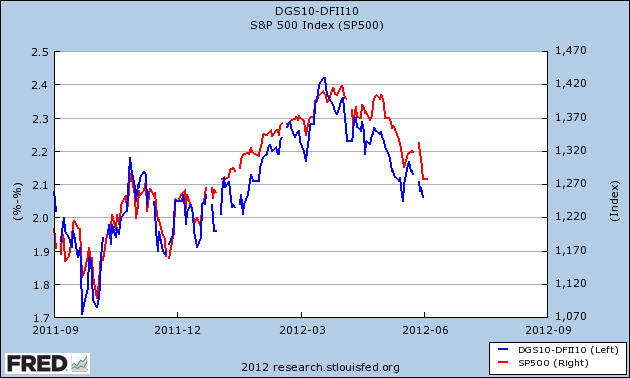
Over the last nine months, every 0.1% move in ten-year inflation expectations has correlated with a 50-point move in the S&P 500.
I suspect that Ben Bernanke and his buddies at the Fed are familiar with the chart above. The issue is that the Fed is nearly out of bullets, but there are still some tricks they haven’t used. One move could be to have the market believe that inflation expectations will rise. The best part is that it won’t cost a dime if (and this is a big if) the market believes what the Fed says.
Matthew O’Brien explains in The Atlantic:
The true nature of central banking isn’t about interest rates. It’s about making and keeping promises. And that brings me to a confession. I lied earlier. Central banks don’t really buy or sell short-term bonds when they lower or raise short-term interest rates. They don’t need to. The market takes care of it. If the Fed announces a target and markets believe the Fed is serious about hitting that target, the Fed doesn’t need to do much else. Markets don’t want to bet against someone who can conjure up an infinite amount of money — so they go along with the Fed.
Don’t underestimate the power of expectations. It might sound a like a hokey religion, but it’s not. Consider Switzerland. Thanks to the euro’s endless flirtation with financial oblivion, investors have piled into the Swiss franc as a safe haven. That sounds good, but a massively overvalued currency is not good. It pushes inflation down to dangerously low levels, and makes exports uncompetitive. So the Swiss National Bank (SNB) has responded by devaluing its currency — setting a ceiling on its value at 1.2 Swiss francs to 1 euro. In other words, the SNB has promised to print money until its money is worth what it wants it to be worth. It’s quantitative easing with a target. And, as Evan Soltas pointed out, the beauty of this target is that the SNB hasn’t even had to print money lately, because markets believe it now. Markets have moved the exchange rate to where the SNB wants it.
-
The Magic Line Everyone’s Watching is 1,277.14
Posted by Eddy Elfenbein on June 5th, 2012 at 10:16 amOn April 2nd, the S&P 500 closed at its recent peak of 1,419.04. Traders traditionally mark a correction as a 10% decline, so a 10% fall from 1,419.04 comes to 1,277.14. That’s the number everyone’s been watching.
On Friday, we held above it. The intra-day low was 1,277.25. Yesterday, the S&P 500 got as low as 1,266.74 but thanks to a late-day rally, we closed at 1,278.18.
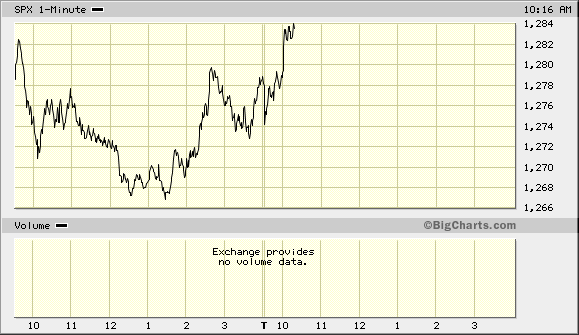
Today looks more encouraging. We’re currently over 1,284. There’s probably some optimism that the “correction line” held. For now.
-
Morning News: June 5, 2012
Posted by Eddy Elfenbein on June 5th, 2012 at 6:34 amEuropean Financial Markets Shaky After PMI Disappointment
Spain Warns on Borrowing as G-7 Prepares to Discuss Crisis
E.C.B. Under Pressure to Ride to the Euro’s Rescue
Drugmakers Afflicted by Greek Pain With or Without Euro
Germany Opens to Banking Coordination in Drive for Fiscal Union
UAE’s Etihad Buys Stake In Virgin Australia
Market’s Echo of Tiananmen Date Sets Off Censors
Solar Panel Payments Set Off a Fairness Debate
Starbucks to Expand Food Offering With La Boulange Bakery Acquisition
Salesforce To Buy Social-Media Marketer Buddy Media
Wynn’s Macau Resort To Cost $4 Billion; Shrugs Off VIP Slowdown Fears
HP Says Oracle Violated Contract, Seeks Billions
Promoting Nutrition, Disney to Restrict Junk-Food Ads
Wall Street CEO Pay Rises 20% With KKR’s Kravis No. 1
Goldman Sachs Said to Cut Jobs as Earnings Outlook Dims
Phi Pearlman: My Fave Vid of the Year from Lazerow…
Joshua Brown: State of the ETP Business
Be sure to follow me on Twitter.
-
“The Best Investments Are Often the Ones that Few People Have Heard Of”
Posted by Eddy Elfenbein on June 4th, 2012 at 12:49 pmRon Lieber at the New York Times writes an article dear to my heart. He notes that the best investments to own are often not very well known. Lieber asked the folks at Wilshire Associates to list the top-performing stocks of the last 30 years.
Here’s what they came up with:
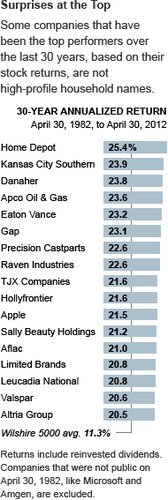
There are a few famous names like Home Depot ($HD), but many are well below Wall Street’s radar. Regular readers of Crossing Wall Street, however, will recognize some of the top stocks like Danaher ($DHR), Raven Industries ($RAVN), Leucadia National ($LUK) and Eaton Vance ($EV).
The top-performing stock on the Wilshire list is Home Depot. Was anyone pointing at that company back in the early 1980s and insisting that it was going to the moon?
“Oh no,” said Arthur Blank, one of Home Depot’s founders, when I asked him this week. “We had no idea that was going to happen. When we went public in 1981, we only had eight stores.”
Indeed, the best investments are often the ones that few people have heard of, and sometimes the companies like it that way.
Take Danaher, which makes a variety of testing and dental equipment, among other things. Its founders are two brothers, Steven and Mitchell Rales, who named the company after a Montana fishing area and rarely talk to the media. Danaher executives did not return several calls for comment, and a former group president, George Koenigsaecker, said its silence had long been strategic. He helped oversee a transition to what became known as the Danaher Business System, a rigorous operating philosophy that survives to this day and wrings excess out of every part of every company it owns.
The company shunned most visitors. “There was little value to sharing this knowledge and your people with companies you might acquire and improve, as opposed to them acquiring your people and improving themselves,” said Mr. Koenigsaecker, who is the author of “Leading the Lean Enterprise Transformation” and is still a shareholder. “I should have bought more.”
As a true believer with intimate knowledge of the company even after his departure in 1992, Mr. Koenigsaecker had the willpower to hold on to the stock. But this is a hard thing to do for most individual investors.
There are thousands of companies that are listed in the stock exchange, and hundreds of them aren’t followed by a single Wall Street analyst. Lieber makes the point that some of these companies like it this way.
If you sit down and read the financial reports, it doesn’t take you long to know as much about a stock as anyone. That’s what happened when I first learned of Nicholas Financial ($NICK). The stock is up more than fivefold in three years and still no one follows it.
-
Archives
- October 2026
- September 2026
- August 2026
- July 2026
- June 2026
- May 2026
- April 2026
- March 2026
- February 2026
- January 2026
- December 2025
- November 2025
- October 2025
- September 2025
- August 2025
- July 2025
- June 2025
- May 2025
- April 2025
- March 2025
- February 2025
- January 2025
- December 2024
- November 2024
- October 2024
- September 2024
- August 2024
- July 2024
- June 2024
- May 2024
- April 2024
- March 2024
- February 2024
- January 2024
- December 2023
- November 2023
- October 2023
- September 2023
- August 2023
- July 2023
- June 2023
- May 2023
- April 2023
- March 2023
- February 2023
- January 2023
- December 2022
- November 2022
- October 2022
- September 2022
- August 2022
- July 2022
- June 2022
- May 2022
- April 2022
- March 2022
- February 2022
- January 2022
- December 2021
- November 2021
- October 2021
- September 2021
- August 2021
- July 2021
- June 2021
- May 2021
- April 2021
- March 2021
- February 2021
- January 2021
- December 2020
- November 2020
- October 2020
- September 2020
- August 2020
- July 2020
- June 2020
- May 2020
- April 2020
- March 2020
- February 2020
- January 2020
- December 2019
- November 2019
- October 2019
- September 2019
- August 2019
- July 2019
- June 2019
- May 2019
- April 2019
- March 2019
- February 2019
- January 2019
- December 2018
- November 2018
- October 2018
- September 2018
- August 2018
- July 2018
- June 2018
- May 2018
- April 2018
- March 2018
- February 2018
- January 2018
- December 2017
- November 2017
- October 2017
- September 2017
- August 2017
- July 2017
- June 2017
- May 2017
- April 2017
- March 2017
- February 2017
- January 2017
- December 2016
- November 2016
- October 2016
- September 2016
- August 2016
- July 2016
- June 2016
- May 2016
- April 2016
- March 2016
- February 2016
- January 2016
- December 2015
- November 2015
- October 2015
- September 2015
- August 2015
- July 2015
- June 2015
- May 2015
- April 2015
- March 2015
- February 2015
- January 2015
- December 2014
- November 2014
- October 2014
- September 2014
- August 2014
- July 2014
- June 2014
- May 2014
- April 2014
- March 2014
- February 2014
- January 2014
- December 2013
- November 2013
- October 2013
- September 2013
- August 2013
- July 2013
- June 2013
- May 2013
- April 2013
- March 2013
- February 2013
- January 2013
- December 2012
- November 2012
- October 2012
- September 2012
- August 2012
- July 2012
- June 2012
- May 2012
- April 2012
- March 2012
- February 2012
- January 2012
- December 2011
- November 2011
- October 2011
- September 2011
- August 2011
- July 2011
- June 2011
- May 2011
- April 2011
- March 2011
- February 2011
- January 2011
- December 2010
- November 2010
- October 2010
- September 2010
- August 2010
- July 2010
- June 2010
- May 2010
- April 2010
- March 2010
- February 2010
- January 2010
- December 2009
- November 2009
- October 2009
- September 2009
- August 2009
- July 2009
- June 2009
- May 2009
- April 2009
- March 2009
- February 2009
- January 2009
- December 2008
- November 2008
- October 2008
- September 2008
- August 2008
- July 2008
- June 2008
- May 2008
- April 2008
- March 2008
- February 2008
- January 2008
- December 2007
- November 2007
- October 2007
- September 2007
- August 2007
- July 2007
- June 2007
- May 2007
- April 2007
- March 2007
- February 2007
- January 2007
- December 2006
- November 2006
- October 2006
- September 2006
- August 2006
- July 2006
- June 2006
- May 2006
- April 2006
- March 2006
- February 2006
- January 2006
- December 2005
- November 2005
- October 2005
- September 2005
- August 2005
- July 2005
 Eddy Elfenbein is a Washington, DC-based speaker, portfolio manager and editor of the blog Crossing Wall Street. His