-
The WSJ Misleads on AFLAC’s Earnings
Posted by Eddy Elfenbein on February 1st, 2012 at 12:44 pmThe WSJ reports:
Aflac lost 1.2% after the insurance provider reported fourth-quarter earnings that fell short of expectations, even as revenue beat, and provided a downbeat outlook for 2012 earnings.
Downbeat? AFLAC gave the exact same forecast for 2012, and they increased it for 2013. This is what AFLAC wrote yesterday:
Looking ahead, I want to reiterate that our objective for 2012 is to increase operating earnings per diluted share 2% to 5% on a currency neutral basis. This range reflects the impact of portfolio derisking and investing significant cash flows at low interest rates. We expect the rate of earnings growth in 2013 to improve over 2012.
-
Q4 Earnings Season By the Numbers
Posted by Eddy Elfenbein on February 1st, 2012 at 11:02 amWendy Soong of Bloomberg has updated the earnings numbers for this season:
Of the 500 companies in the S&P 500, 236 have reported so far. Of that, 143 have beaten expectations, 71 have missed and 22 have matched. That’s a “beat rate” of 60.6%.
Earnings growth is tracking at 2.7%. For financials, it’s -21.6%. When we exclude financials, earnings are growing at 8.0%.
-
January ISM – 54.1
Posted by Eddy Elfenbein on February 1st, 2012 at 10:07 amThe ISM report for January came out at 54.1 today. That makes for 30 straight months that it’s been above 50 which signifies an expanding economy.
Are we in a recession? Put it this way: The ISM has fallen between 53.0 and 55.0 a total of 101 times. Just two of those times have come during recessions.
-
Morning News: February 1, 2012
Posted by Eddy Elfenbein on February 1st, 2012 at 5:38 amWorst Earnings Since 2006 Fail to Dent European Stock Rally
In Talks on Greek Bailout, Eyes Turn to Central Bank
Greek Bondholders May Get GDP Sweetener in Deal
EU Vetoes Deutsche Boerse-NYSE Euronext Merger
U.K. Manufacturing Expanded in January
China PMI Tops Forecast, Hard Landing Fears Ease
Malaysian Rare Earth Metal Refinery Nears Approval
Stocks Best Start Since ’94 Tops Commodities
Freddie Mac Halts Use of Derivatives Tied to High Interest Rates
Personal Data’s Value? Facebook Is Set to Find Out
UPS Profit Forecast for Year Tops Estimates as Shipping Demand Increases
Roche Sees High Single-Digit 2012 Profit Growth on New Drugs
After a Delay, MF Global’s Missing Money Is Traced
Jeff Miller: Investors: De-mystifying the Central Bank Balance Sheets
James Altucher: Self-Publishing Your Own Book is the New Business Card
Be sure to follow me on Twitter.
-
After the Close: CR Bard Beats Earnings, AFLAC Misses But Guides Higher for 2013
Posted by Eddy Elfenbein on January 31st, 2012 at 6:09 pmThe S&P 500 just closed out its best January in 15 years. The 55-point gain was the largest for January on record.
After the bell today, we had two more earnings reports. CR Bard ($BCR) reported fourth-quarter earnings of $1.70 per share which was two cents better than expectations.
Revenues rose 4.9% to $751.9 million. For the year, Bard earned $6.40 per share. That’s a 14% increase over the $5.60 Bard earned in 2010. Based on today’s close, Bard is going for 14.45 times trailing earnings.
Timothy M. Ring, chairman and chief executive officer, commented, “Fourth quarter constant currency net sales growth of 5% was at the top end of our guidance and allowed us to exceed adjusted EPS guidance for the quarter and for the year. Our revenue growth is being driven by a combination of geographic investments, external acquisitions and internal research and development. By combining top-line growth with disciplined expense management and share-repurchase programs, we have been able to meet our short-term commitments to shareholders while positioning the company for healthy long-term growth.”
AFLAC ($AFL) reported fourth-quarter operating earnings of $1.48 per share which was four cents below expectations. Three months ago, AFLAC said it expected to earn $1.45 to $1.52 per share for the fourth quarter. This is a slight disappointment to me because I had been expecting AFLAC to beat expectations by a few pennies per share.
AFLAC reiterated their earnings forecast for this year of growth of 2% to 5%. For the year, AFLAC had operating earnings of $6.33 per share. That means the company sees earnings for 2012 ranging between $6.46 per share and $6.65 per share.
The best news, however, is that AFLAC said it expects the rate of earnings growth in 2013 to exceed that of 2012. That’s excellent news. If we take the mid-point of AFLAC’s range for this year’s growth (3.5%) and assume 4% growth for 2013, that translates to earnings of $6.81 per share.
Daniel P. Amos stated: “Aflac had another strong year. Growth of operating earnings per diluted share was in line with our goal of an 8% increase before the impact of foreign currency. That result was also consistent with guidance we provided when we released third quarter results. We had conveyed in the third quarter that following nine months of restrained expenditures, we planned to increase spending on IT and marketing initiatives in the fourth quarter to strengthen our business, and that’s exactly what we did. I am pleased that 2011 marked the 22nd consecutive year in which we achieved our earnings objective.
“Aflac Japan gets high marks for another great quarter and year. The tremendous sales momentum they generated this quarter, largely propelled by success in selling through banks, significantly exceeded our expectations for the year and especially for the quarter. In fact, Aflac Japan’s fourth quarter production set an all-time quarterly record, which is especially remarkable considering 2011 was the year Japan was hit with the most devastating natural disaster in its history.
“We are also pleased with Aflac U.S. results for the quarter and year. It has been, and continues to be, the longstanding goal and vision of Aflac U.S. to be the leading provider of voluntary insurance in the United States, and our sales results in 2011 build on that vision. Through our efforts, we continue to expand Aflac’s potential to connect with employees at more companies, large and small, across the United States.
The 2009 addition of group products to our existing portfolio has allowed us to leverage our strong brand and provide more options for customers of both our traditional and broker distribution channels. In 2011, product marketing efforts geared toward existing accounts contributed to strong sales for our veteran agents. Additionally, you’ll recall that we have been establishing and developing relationships with brokers that handle the larger-case market. While this broker initiative is still in its infancy, we are excited about the opportunity this channel presents for future growth.
“The strength of our capital ratios demonstrates our commitment to maintain financial strength on behalf of our policyholders and bondholders. As we have communicated over the past several years, sustaining a strong risk-based capital, or RBC ratio, remains a priority for us. We had conveyed that our goal was to end 2011 with an RBC ratio in the range of 400% to 500% with a target of 450%. Although we have not yet finalized our statutory financial statements, we estimate our 2011 RBC ratio will be between 480% and 520%. Additionally, we are comfortable with our solvency margin ratio and continue to apply rigorous stress testing under extreme scenarios.
“As we look ahead to 2012 sales opportunities in the United States, we expect Aflac U.S. sales to increase 3% to 8%. Following Aflac Japan’s outstanding sales growth of 18.6% last year, I think it’s reasonable to expect Aflac Japan sales will decrease within the range of down 2% to down 5% for the year.
“Looking ahead, I want to reiterate that our objective for 2012 is to increase operating earnings per diluted share 2% to 5% on a currency neutral basis. This range reflects the impact of portfolio derisking and investing significant cash flows at low interest rates. We expect the rate of earnings growth in 2013 to improve over 2012.”
-
The Golden Cross
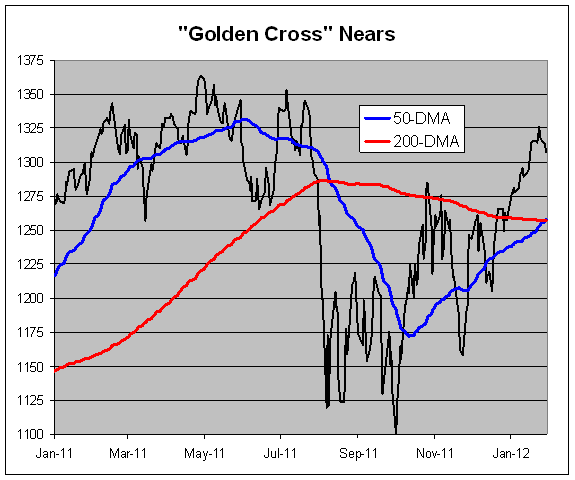
Posted by Eddy Elfenbein on January 31st, 2012 at 11:25 amTechnical analysts are atwitter this week as the S&P 500 just passed a “Golden Cross.” This is when the 50-day moving average breaks above the 200-day moving average.
This is supposed to be good for the market. Personally, I’m rather skeptical of these technical milestones. After all, the S&P 500 has already soared a good deal off its October low. It seems strange to say after a very solid rally that now is the time when things looks good.
I do pay a little attention to where the market is versus its 50- and 200-DMA. This is not for any trading guidelines but because historically the market is a trend-sensitive data set. Momentum does exist and it’s a powerful anomaly to current theory.
-
The Onion Was First
Posted by Eddy Elfenbein on January 31st, 2012 at 10:54 amEven CEO Can’t Figure Out How RadioShack Still In Business
FORT WORTH, TX—Despite having been on the job for nine months, RadioShack CEO Julian Day said Monday that he still has “no idea” how the home electronics store manages to stay open.
“There must be some sort of business model that enables this company to make money, but I’ll be damned if I know what it is,” Day said. “You wouldn’t think that people still buy enough strobe lights and extension cords to support an entire nationwide chain, but I guess they must, or I wouldn’t have this desk to sit behind all day.”
The retail outlet boasts more than 6,000 locations in the United States, and is known best for its wall-sized displays of obscure-looking analog electronics components and its notoriously desperate, high-pressure sales staff. Nevertheless, it ranks as a Fortune 500 company, with gross revenues of over $4.5 billion and fiscal quarter earnings averaging tens of millions of dollars.
“Have you even been inside of a RadioShack recently?” Day asked. “Just walking into the place makes you feel vaguely depressed and alienated. Maybe our customers are at the mall anyway and don’t feel like driving to Best Buy? I suppose that’s possible, but still, it’s just…weird.”
RadioShack shares drop 30% after forecast
NEW YORK (MarketWatch) – Shares of RadioShack Corp RSH -29.13% plunged 30%, or $3.03, to $7.20 on Tuesday, a day after the electronics retailer said its fourth-quarter quarter earnings per share would be 11 cents to 13 cents, versus the expected 36 cents by analysts surveyed by FactSet. Janney Capital Markets downgraded the shares to neutral from buy and gave a fair value estimate at $7. Analysts at Janney said it was unclear when gross margin will bottom out and cited concerns over the firm’s weak performance around post-paid business with Sprint S -1.16%, its biggest carrier partner. In the fourth quarter, RadioShack’s gross margin narrowed to 35% from 41% a year ago.
-
Harris Beats By Three Cents
Posted by Eddy Elfenbein on January 31st, 2012 at 10:47 amToday is a big earnings day for us. AFLAC ($AFL) and CR Bard ($BCR) report after the close. This morning, Harris Corp ($HRS) reported earnings of $1.22 per share which was three cents better than estimates. The December quarter is the second quarter of Harris’ fiscal year.
“Harris posted solid second quarter results with earnings per share in line with the prior year, despite orders and revenue being dampened by the constrained government spending environment,” said William M. Brown, president and chief executive officer. “The sequential increase in operating income for the company, driven by operating margin improvement in all of our segments, was encouraging. Cash flow from operations increased significantly compared to the previous quarter and the prior year, supporting expectations for strong cash flow again this year.”
This is a good earnings report from Harris. The only sour note, and it’s not a biggie, was the company’s revenue guidance for the entire year. Harris now sees revenues ranging between $6 billion and $6.2 billion. Wall Street had been expecting slightly more, $6.15 billion to $6.3 billion.
On the plus side, Harris sees full-year EPS ranging between $5.10 and $5.30. That’s not bad at all. The Street had been expecting $5.07 per share. The stock is up nicely today. It’s currently over $40 per share which is still less than eight times this year’s earnings.
-
Morning News: January 31, 2012
Posted by Eddy Elfenbein on January 31st, 2012 at 5:40 amEU Nears Confrontation Over Greek Rescue
European Leaders Agree to New Budget Discipline Measures
Profit Plummets at Spain’s Biggest Bank
Trade Protest Is Planned on Eve of a Chinese Leader’s Visit
Oil Rises From One-Week Low as Japanese Industrial Output Climbs
F.T.C. Fines a Collector of Debt $2.5 Million
Treasury Investigates Freddie Mac Investment
Honda Profit Slumps on Thai Floods, Strong Yen
J&J Shakes Up McNeil Unit Again
Apple Names Browett to Lead Retail Business Amid Global Push
Pep Boys to Be Sold in $791 Million Buyout
New Fund Hopes to Prove Thesis of Outspoken Analyst
After a Year of Delays, the First Starbucks Is to Open in Tea-Loving India This Fall
RIM Committee Stresses Importance of Independent Chair
Cullen Roche: The Most Destructive Monetary Myth in the USA…
Roger Nusbaum: More on “Just Don’t Lose It”
Be sure to follow me on Twitter.
-
5-Year Treasury Yield Drops to 0.73%
Posted by Eddy Elfenbein on January 30th, 2012 at 1:34 pmThe yield on the five-year Treasury has plunged to another all-time low. The yield is currently 0.73%.
Here’s some perspective. Despite being 20 times longer, the total cash flow on the 5-year bond is less than the total cash flow from a 3-month T-bill at its peak rate in 1981 when it yielded 17%.
-
Archives
- August 2026
- July 2026
- June 2026
- May 2026
- April 2026
- March 2026
- February 2026
- January 2026
- December 2025
- November 2025
- October 2025
- September 2025
- August 2025
- July 2025
- June 2025
- May 2025
- April 2025
- March 2025
- February 2025
- January 2025
- December 2024
- November 2024
- October 2024
- September 2024
- August 2024
- July 2024
- June 2024
- May 2024
- April 2024
- March 2024
- February 2024
- January 2024
- December 2023
- November 2023
- October 2023
- September 2023
- August 2023
- July 2023
- June 2023
- May 2023
- April 2023
- March 2023
- February 2023
- January 2023
- December 2022
- November 2022
- October 2022
- September 2022
- August 2022
- July 2022
- June 2022
- May 2022
- April 2022
- March 2022
- February 2022
- January 2022
- December 2021
- November 2021
- October 2021
- September 2021
- August 2021
- July 2021
- June 2021
- May 2021
- April 2021
- March 2021
- February 2021
- January 2021
- December 2020
- November 2020
- October 2020
- September 2020
- August 2020
- July 2020
- June 2020
- May 2020
- April 2020
- March 2020
- February 2020
- January 2020
- December 2019
- November 2019
- October 2019
- September 2019
- August 2019
- July 2019
- June 2019
- May 2019
- April 2019
- March 2019
- February 2019
- January 2019
- December 2018
- November 2018
- October 2018
- September 2018
- August 2018
- July 2018
- June 2018
- May 2018
- April 2018
- March 2018
- February 2018
- January 2018
- December 2017
- November 2017
- October 2017
- September 2017
- August 2017
- July 2017
- June 2017
- May 2017
- April 2017
- March 2017
- February 2017
- January 2017
- December 2016
- November 2016
- October 2016
- September 2016
- August 2016
- July 2016
- June 2016
- May 2016
- April 2016
- March 2016
- February 2016
- January 2016
- December 2015
- November 2015
- October 2015
- September 2015
- August 2015
- July 2015
- June 2015
- May 2015
- April 2015
- March 2015
- February 2015
- January 2015
- December 2014
- November 2014
- October 2014
- September 2014
- August 2014
- July 2014
- June 2014
- May 2014
- April 2014
- March 2014
- February 2014
- January 2014
- December 2013
- November 2013
- October 2013
- September 2013
- August 2013
- July 2013
- June 2013
- May 2013
- April 2013
- March 2013
- February 2013
- January 2013
- December 2012
- November 2012
- October 2012
- September 2012
- August 2012
- July 2012
- June 2012
- May 2012
- April 2012
- March 2012
- February 2012
- January 2012
- December 2011
- November 2011
- October 2011
- September 2011
- August 2011
- July 2011
- June 2011
- May 2011
- April 2011
- March 2011
- February 2011
- January 2011
- December 2010
- November 2010
- October 2010
- September 2010
- August 2010
- July 2010
- June 2010
- May 2010
- April 2010
- March 2010
- February 2010
- January 2010
- December 2009
- November 2009
- October 2009
- September 2009
- August 2009
- July 2009
- June 2009
- May 2009
- April 2009
- March 2009
- February 2009
- January 2009
- December 2008
- November 2008
- October 2008
- September 2008
- August 2008
- July 2008
- June 2008
- May 2008
- April 2008
- March 2008
- February 2008
- January 2008
- December 2007
- November 2007
- October 2007
- September 2007
- August 2007
- July 2007
- June 2007
- May 2007
- April 2007
- March 2007
- February 2007
- January 2007
- December 2006
- November 2006
- October 2006
- September 2006
- August 2006
- July 2006
- June 2006
- May 2006
- April 2006
- March 2006
- February 2006
- January 2006
- December 2005
- November 2005
- October 2005
- September 2005
- August 2005
- July 2005
 Eddy Elfenbein is a Washington, DC-based speaker, portfolio manager and editor of the blog Crossing Wall Street. His